

1.4 - Reference Frames and Relative Motion
Reference Frames
The choice of reference frame sets the direction and magnitude of the motion an observer measures in that frame. Measurements from one reference frame can be converted into measurements from another.
Example: Train Perspective
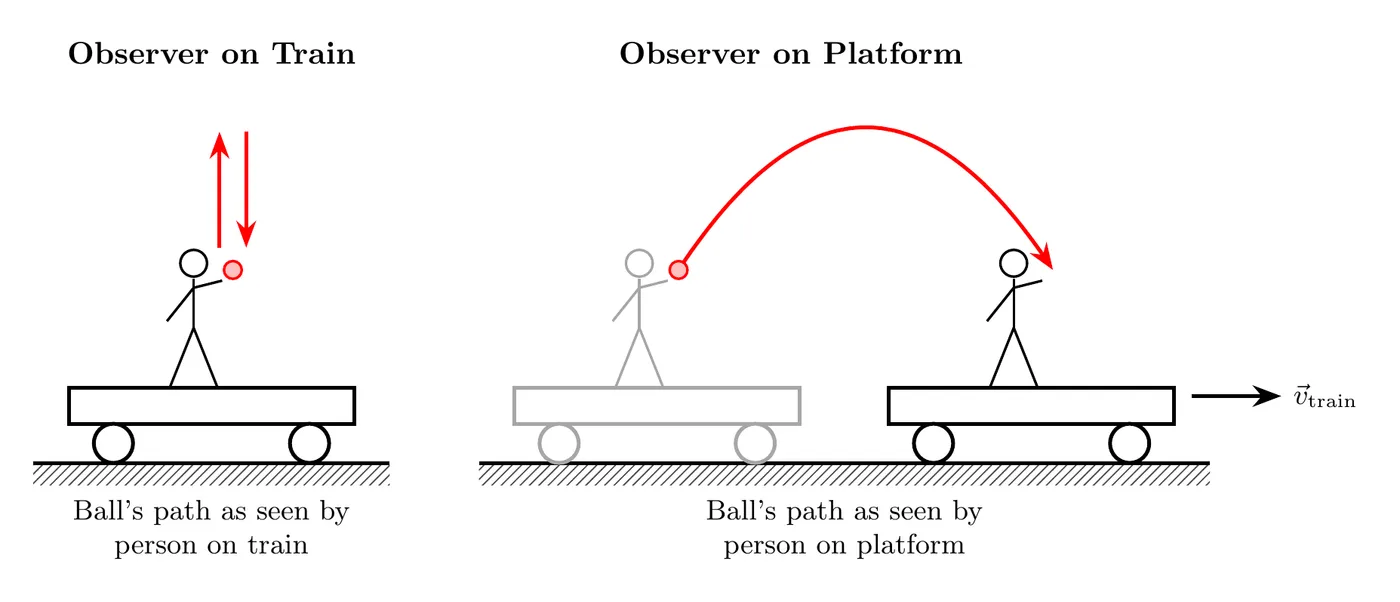
An observer on a train who throws a ball upward sees it go straight up and straight down. But an observer on the platform sees it follow a parabolic path, because they see both the vertical motion of the ball and the horizontal motion of the train.
Key Principles of Relative Motion
- The velocity an observer measures for an object is the combination of:
- The object’s velocity.
- The velocity of the observer’s reference frame.
- Combining those motions means vector addition or subtraction.
- Acceleration is invariant. The acceleration of any object is the same as measured from all inertial reference frames.
Note: this section focuses on velocity, but these ideas apply to position and acceleration too.
Inertial Reference Frames
An inertial reference frame is one that isn’t accelerating: it’s at rest or moving at a constant velocity. The ground, a train cruising at a steady speed on straight track, and a plane in smooth, level flight at constant speed all count. A car that’s braking or turning does not.
Unless a problem says otherwise, assume every reference frame is inertial. This is one of the exam conventions printed on the AP Physics C equation sheet.
Why acceleration is the same in every inertial frame: if frame B moves at , then . Take the derivative of both sides:
If B is inertial, , so . The two observers measure different velocities but the same acceleration.
Quick check: a car speeds up from 10 m/s to 20 m/s in 5.0 s, while a train beside it moves at a constant 25 m/s in the same direction. From the ground, m/s². From the train, the car’s velocity goes from m/s to m/s, so m/s². Same answer.
Simple Linear Example: Two Trains
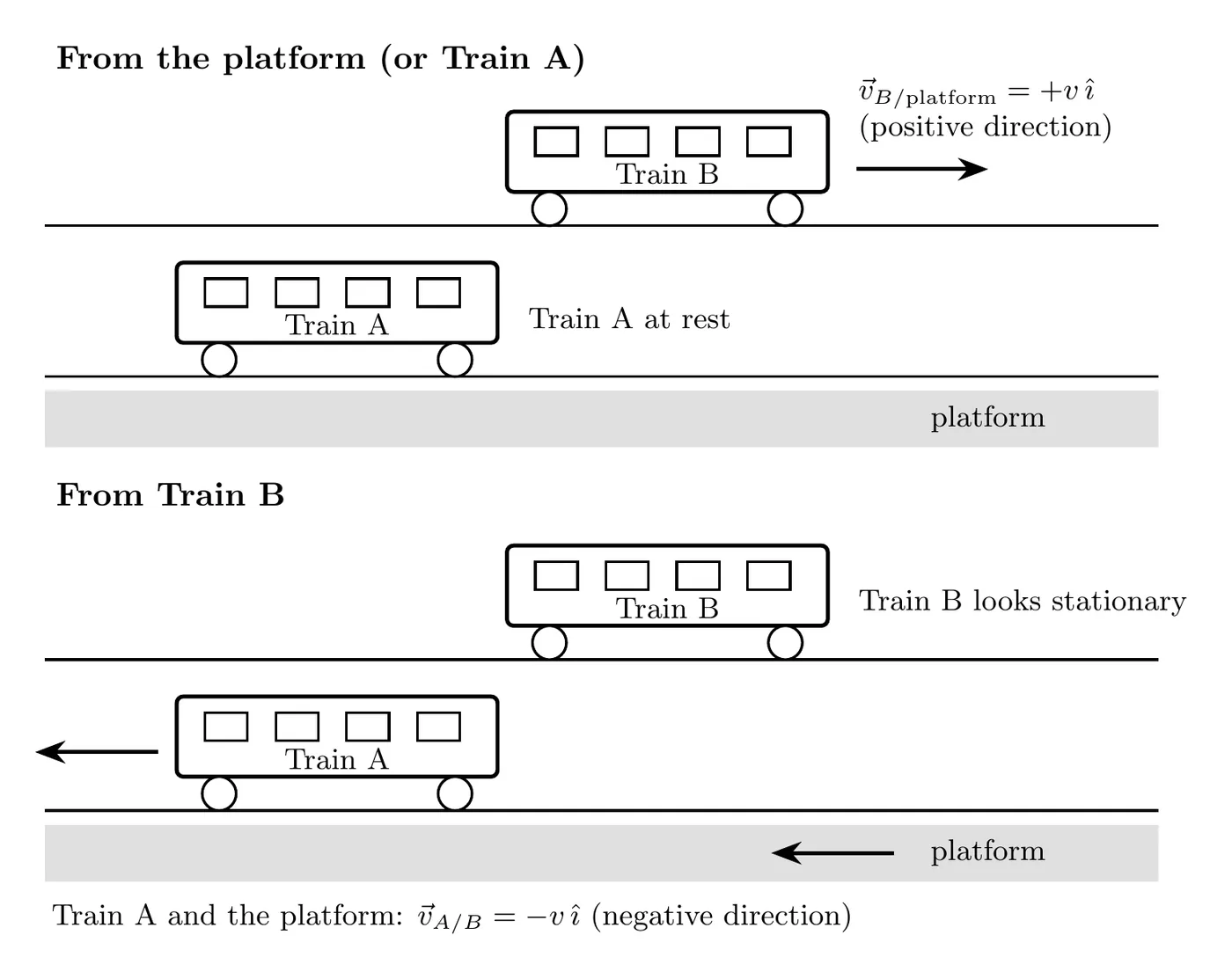
From the platform’s (or Train A’s) perspective:
- Train A is stationary.
- Train B moves in the positive direction: .
From Train B’s perspective:
- Train B looks stationary.
- Train A and the platform appear to move in the negative direction: .
Relative Motion Notation
For relative motion, use subscript notation:
This reads as “velocity of A relative to B,” or “velocity of A as seen from B’s reference frame.”
General Formula
To find the velocity of object A relative to object B:
This same formula works for acceleration and position:
The same rule as an addition: rearranged, it reads . The velocity you see from the ground is the object’s velocity in the moving frame plus the frame’s own velocity. Read the subscripts like a chain: A relative to B, plus B relative to the ground, gives A relative to the ground.
Swapping the subscripts flips the sign: . That’s why Train A sees Train B moving forward while Train B sees Train A moving backward at the same speed.
Example Problem: Perpendicular Motion
Problem: A boat travels in the positive x-direction at 6 m/s. As the boat passes a swimmer treading water, the swimmer starts accelerating at 0.4 m/s² in the positive y-direction.
- What is the boat’s acceleration relative to the swimmer?
- What is the boat’s velocity relative to the swimmer at seconds after the swimmer starts moving?
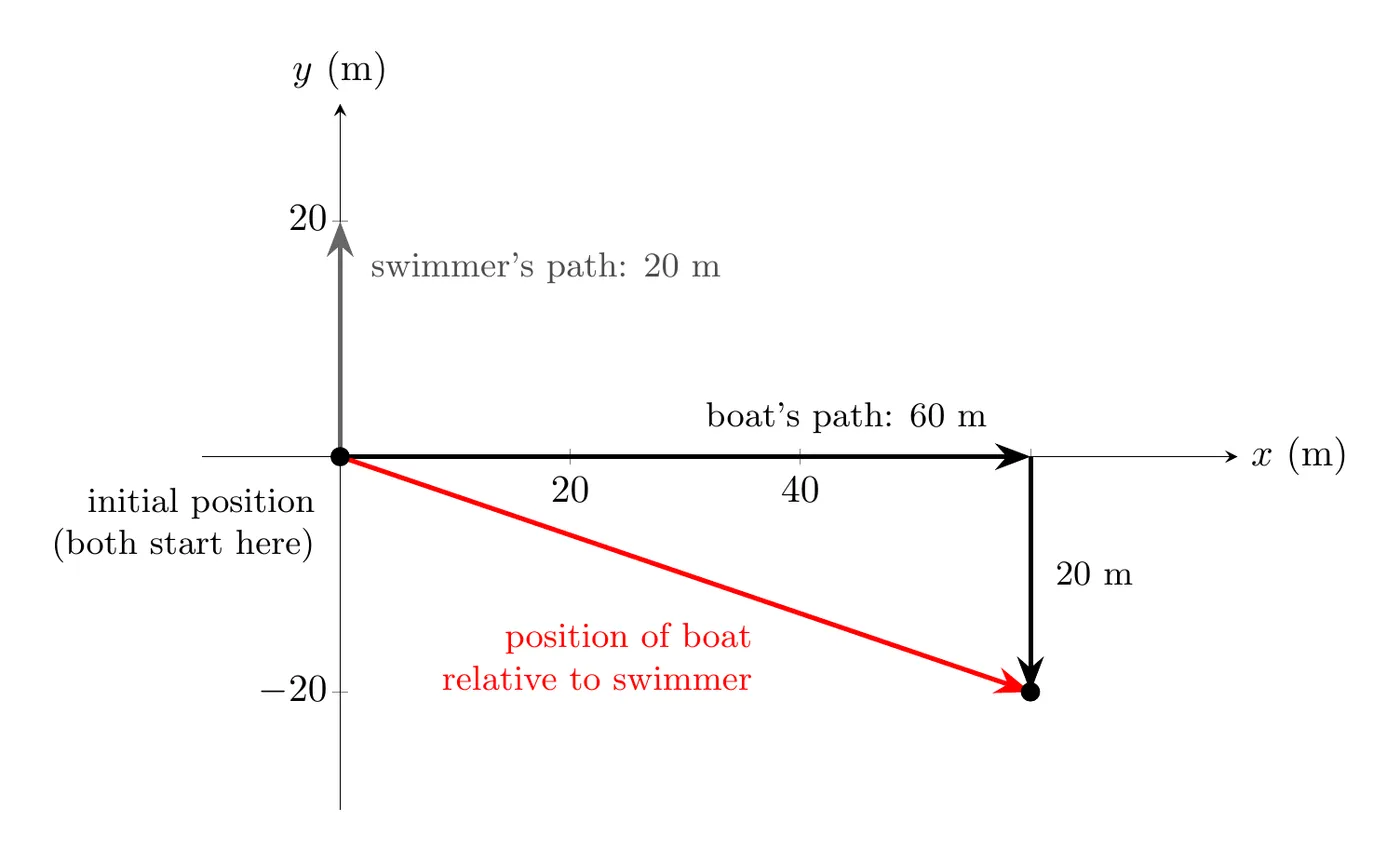
- What is the boat’s position relative to the swimmer at seconds after the swimmer starts moving?
Part (a): Finding Relative Acceleration
Boat’s acceleration relative to the ground:
The boat moves at constant velocity in the x-direction:
Swimmer’s acceleration relative to the ground:
The swimmer accelerates in the positive y-direction:
Boat’s acceleration relative to the swimmer:
Answer: m/s².
The read: from the swimmer’s point of view, the boat looks like it has a negative y-acceleration, because the swimmer is accelerating in the positive y-direction while the boat holds a constant velocity.
This doesn’t break the rule that acceleration is the same in all inertial frames. The swimmer is accelerating, so the swimmer’s frame isn’t inertial, and measurements made from it can show accelerations that no one on the shore would measure.
Part (b): Finding Relative Velocity at t = 10 seconds
Use the velocity equation:
The initial velocity of the boat relative to the swimmer (at ): the swimmer isn’t moving yet, so
Velocity at seconds:
Answer: at seconds, m/s.
Part (c): Finding Relative Position at t = 10 seconds
Use the position equation:
For the boat relative to the swimmer:
Substitute the values:
Answer: at seconds, m.
The read:
- The boat has moved 60 m in the positive x-direction, which checks out: .
- From the swimmer’s point of view, the boat is 20 m in the negative y-direction, because the swimmer moved in the positive y-direction.
Finding Magnitude (if needed)
If a problem asks for the magnitude of the displacement or velocity vector, use the Pythagorean theorem.
For :
Using our problem:
Example Problem: Crossing a River
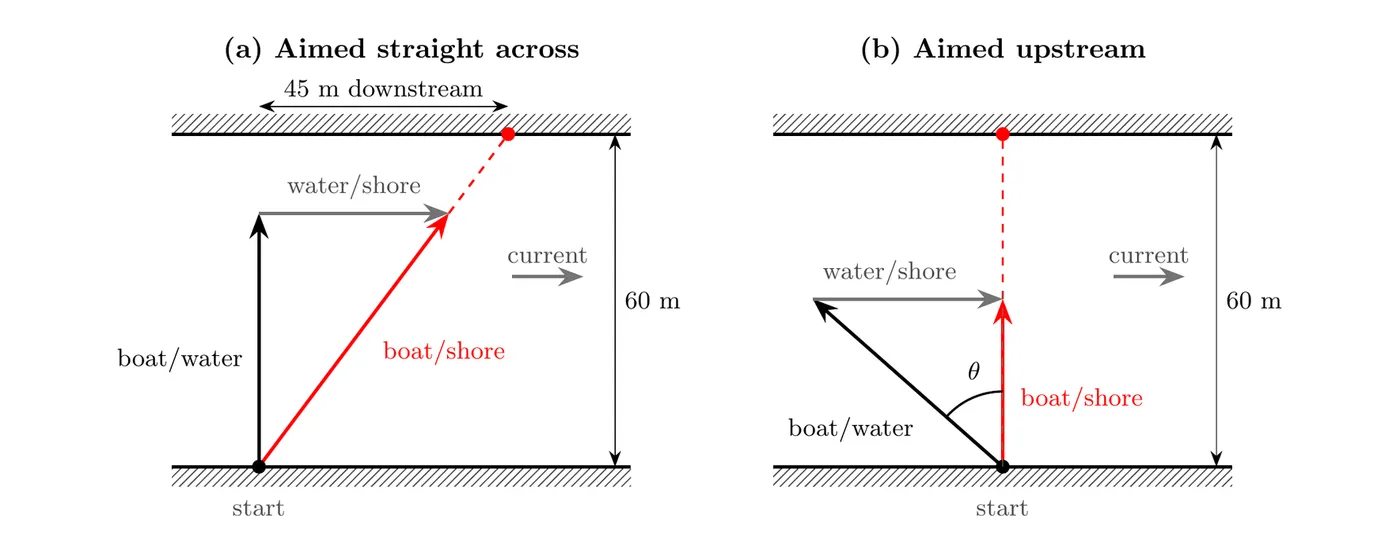
Problem: a boat moves at 4.0 m/s relative to the water. It crosses a river 60 m wide that flows east at 3.0 m/s. Take as east (downstream) and as straight across.
- The boat points straight across. What is its velocity relative to the shore, how long does the crossing take, and how far downstream does it land?
- At what angle upstream must the boat point to land directly across from where it started? How long does that crossing take?
Part (a): Aimed Straight Across
Add the boat’s velocity in the water’s frame to the water’s velocity in the shore’s frame:
Its speed relative to the shore is m/s. Only the component carries the boat across, and the current can’t change it (perpendicular motions are independent):
Part (b): Aimed Upstream
To go straight across, the boat’s upstream component has to cancel the current: , where is measured from the straight-across direction.
What’s left of the boat’s velocity carries it across:
The read: aiming upstream gets the boat to the spot directly across, but the trip takes longer (23 s instead of 15 s), because part of the boat’s velocity is used up canceling the current.
Common Mistakes
- Subtracting in the wrong order. Remember, , not the reverse. The object being observed comes first, and the reference frame comes second.
- Forgetting initial conditions. When one object “begins” moving at , it may start at zero velocity, but the other object might already be moving.
- Mixing up components. Keep track of which motion is in the x-direction and which is in the y-direction. Don’t swap the and components.
- Not noticing when acceleration is zero. An object moving at constant velocity has zero acceleration, even though it’s moving.
- Confusing position with displacement. is the change in position. If both objects start at the same point, then is the relative position.
- Forgetting that relative motion applies to everything. Reference frame ideas apply equally to position, velocity, and acceleration.
- Calculating magnitude when it’s not asked for. If the problem wants the velocity or position vector, give the answer in component form. Only find the magnitude if it’s specifically requested.
- Adding speeds instead of vectors. A boat moving at 4.0 m/s straight across a 3.0 m/s current moves at 5.0 m/s relative to the shore, not 7.0 m/s. Only add the numbers directly when the velocities point along the same line.