

5.2 - Connecting Linear and Rotational Motion
The Arc Length Equation
For a point at distance from a fixed axis of rotation, the linear distance traveled equals the arc length.
Formula
or simply:
where:
- (or ) = arc length, the linear distance traveled (m)
- = radius, the distance from the axis of rotation (m)
- (or ) = angular displacement (rad)
Important: the angle must be in radians for this to work.
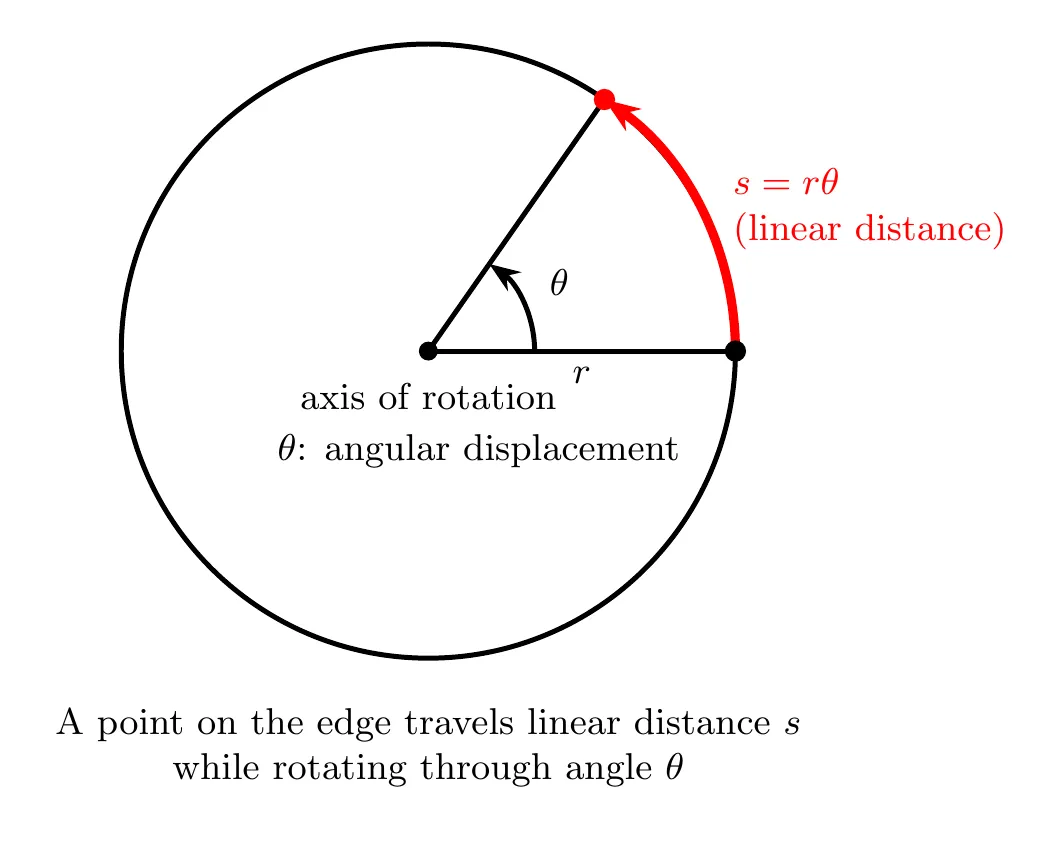
The physical read:
If you roll a wheel through one full revolution:
- Angular displacement: rad (360°).
- Linear distance: , the circumference.
If you roll it only part of the way, through an angle :
- Linear distance: , a slice of the circumference.
Tangential Velocity
The linear (tangential) velocity of a point on a rotating object connects to its angular velocity.
Formula
where:
- = tangential velocity (m/s)
- = radius, the distance from the axis of rotation (m)
- = angular velocity (rad/s)
Deriving it from arc length: start with and take the time derivative:
Since and :
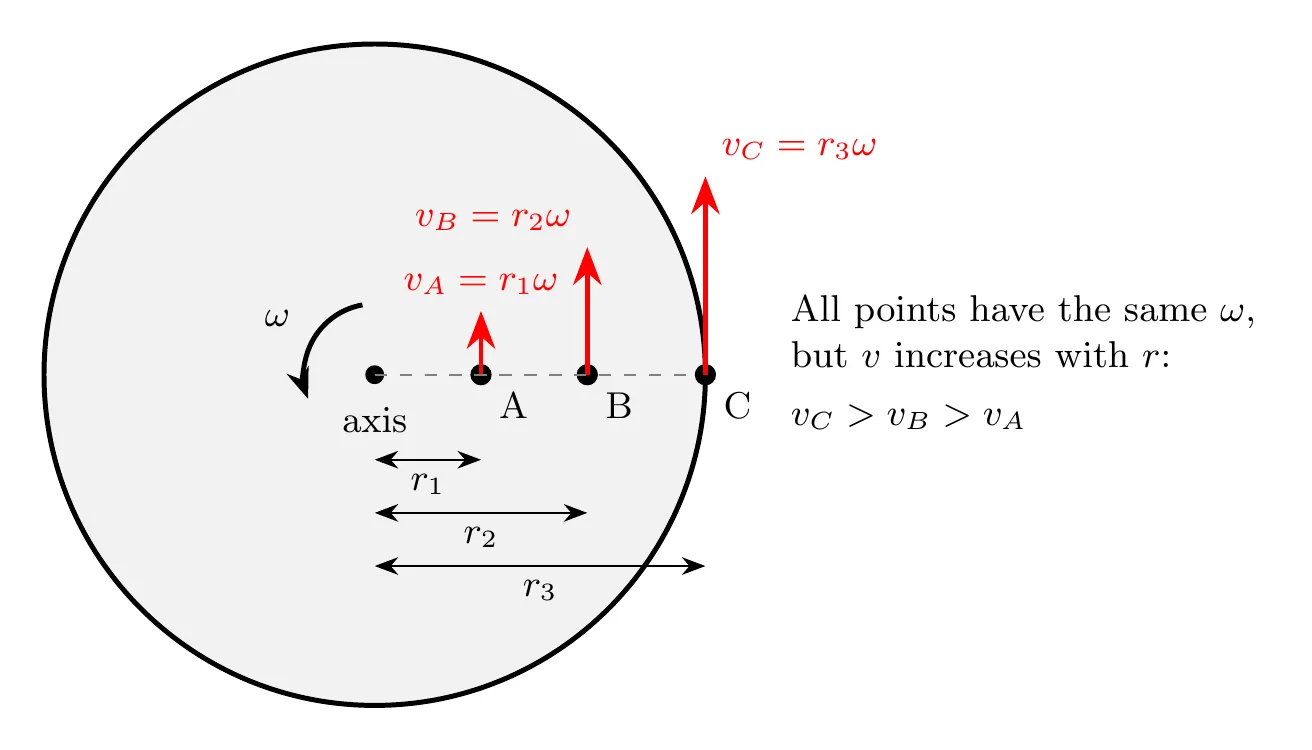
The read: points farther from the axis (bigger ) move faster linearly, even though every point has the same angular velocity.
Tangential Acceleration
The tangential (linear) acceleration of a point on a rotating object connects to its angular acceleration.
Formula
where:
- = tangential acceleration (m/s²)
- = radius, the distance from the axis of rotation (m)
- = angular acceleration (rad/s²)
The subscript “t” means tangential acceleration, which runs along the circle, as opposed to centripetal acceleration, which points toward the center.
Deriving it: start with and take the time derivative:
Since and :
The read: points farther from the axis get more tangential acceleration for the same angular acceleration.
Summary of Linear-Angular Relationships
Linear Quantity | Angular Quantity | Relationship |
Position: or (m) | Angular position: (rad) | |
Velocity: (m/s) | Angular velocity: (rad/s) | |
Tangential acceleration: (m/s²) | Angular acceleration: (rad/s²) |
The pattern: linear quantity = × angular quantity.
Key Principle: Rigid Body Rotation
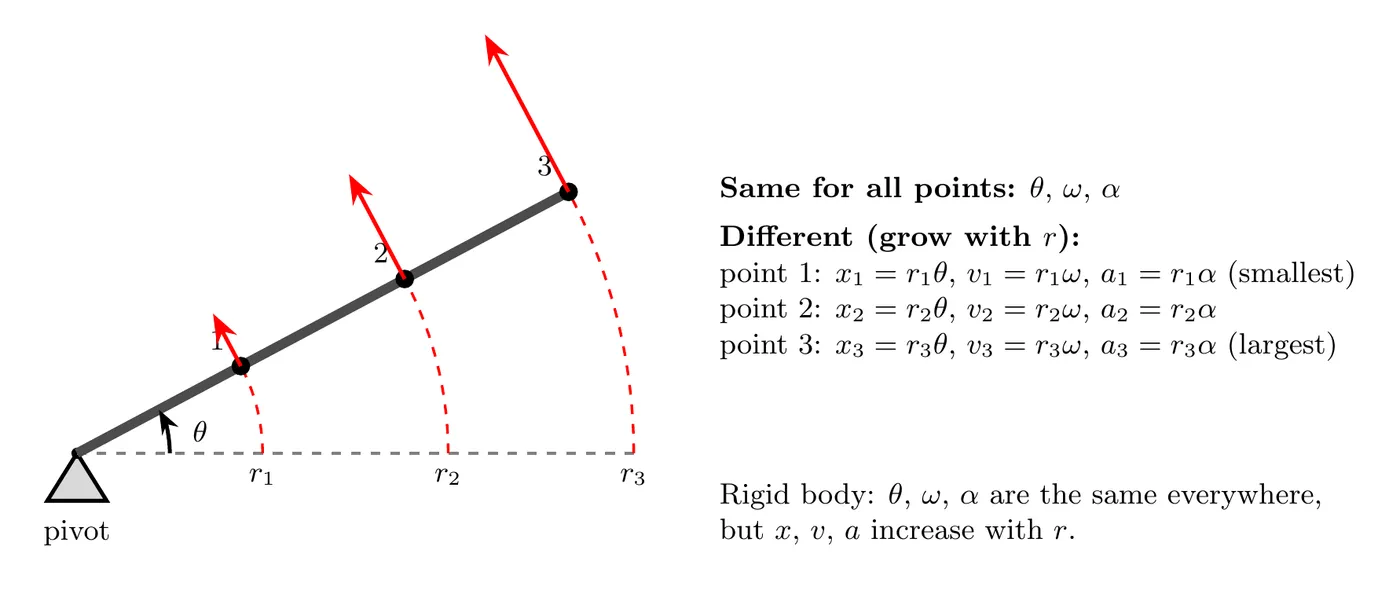
For rigid bodies (objects that don’t deform), all the points share the same angular quantities but have different linear quantities.
What’s the Same Everywhere
The angular quantities are uniform across the whole rigid body:
- (angular position) is the same for all points.
- (angular velocity) is the same for all points.
- (angular acceleration) is the same for all points.
Every point on the object sweeps through the same angle in the same amount of time.
What’s Different from Point to Point
The linear quantities depend on the distance from the axis ():
- depends on .
- depends on .
- depends on .
Points farther from the axis:
- Cover more linear distance.
- Have larger tangential velocities.
- Have larger tangential accelerations.
This comes up on AP exams a lot, both in free-response (“justify your answer”) and in conceptual multiple-choice questions.
Units Check
Always verify your units line up.
Angular Position to Linear Distance
Radians are dimensionless, so this works out: . ✓
Angular Velocity to Linear Velocity
Since radians are dimensionless: . ✓
Angular Acceleration to Linear Acceleration
Since radians are dimensionless: . ✓
Units Summary
Quantity | Symbol | Units |
Angular position | rad (radians) | |
Angular velocity | rad/s | |
Angular acceleration | rad/s² | |
Linear position | or | m (meters) |
Linear velocity | m/s | |
Linear acceleration | m/s² |
Critical: angles have to be in radians, not degrees, for these formulas to work.
Example Problem: Rolling Wheel
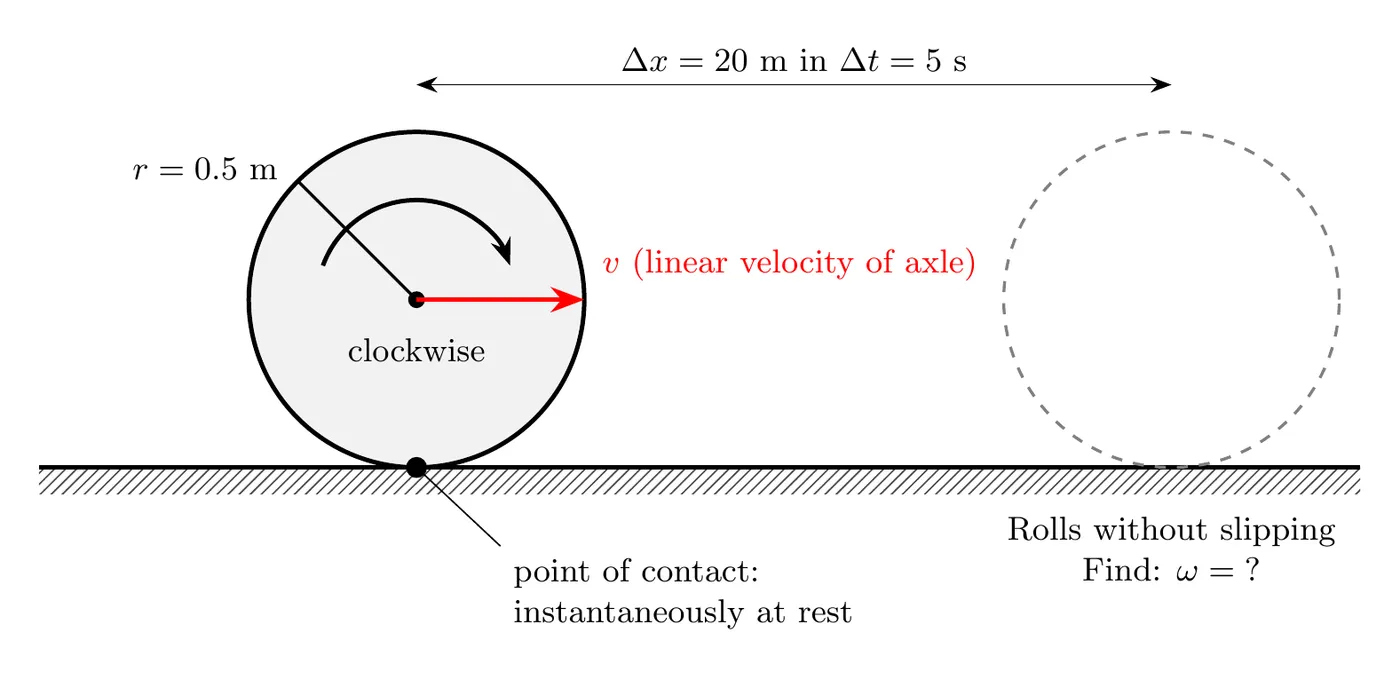
Problem: A wheel of radius 0.5 m rolls without slipping on a horizontal surface. The axle moves at constant velocity, covering 20 m in 5 seconds. What is the angular speed of the wheel?
Solution
Step 1: Find the linear velocity
The wheel’s center (the axle) covers 20 m in 5 seconds:
Step 2: Use the linear-angular relationship
Step 3: Solve for the angular velocity
Step 4: Substitute the values
Answer: the angular speed of the wheel is 8 rad/s.
The read: the wheel completes
so about 1.27 revolutions per second.
Verification: in one full revolution ( rad), the wheel travels
At 1.27 rev/s, that’s
which matches our linear velocity.
Example Problem: Fan Blade Speeding Up
Problem: A ceiling fan starts from rest and speeds up with a constant angular acceleration of 2.5 rad/s². Each blade tip is 0.60 m from the axis. At s, find (a) the fan’s angular velocity, (b) the linear speed of a blade tip, (c) the tip’s tangential, centripetal, and total acceleration, and (d) the arc length the tip has traveled. (e) What changes for a point halfway out along the blade?
Solution
(a) Rotational kinematics first:
(b) Angular to linear:
(c) The tangential acceleration comes from , and the centripetal acceleration comes from :
The two are perpendicular ( runs along the circle and points at the axis), so add them like the legs of a right triangle:
At this moment the tip’s acceleration points almost straight at the axis (only about 6° off), because is ten times . As the fan keeps speeding up, keeps growing while stays the same.
(d) Find the angle first, then the arc length:
(e) A point 0.30 m from the axis is part of the same rigid system, so it has the same rad/s and the same rad/s². Every linear quantity is proportional to , so each one is cut in half: m/s, m/s², m/s², and m.
Rolling Without Slipping
An important idea: when an object rolls without slipping, the point touching the surface is instantaneously at rest.
That constraint gives you:
where is the velocity of the object’s center (the axle).
If there is slipping:
- , so there’s no direct relationship.
- The object slides while it rotates.
Rolling without slipping is the most common setup in problems, and it’s what guarantees the simple relationship holds.
Common Mistakes
- Using degrees instead of radians. The formulas , , and only work with radians. Convert with .
- Thinking all points have the same linear velocity. On a rigid body, is the same everywhere, but the linear velocity grows with distance from the axis.
- Confusing tangential and centripetal acceleration. is tangential, running along the circle. Centripetal acceleration points toward the center, so it’s a different direction and a different formula.
- Using the wrong radius. is the distance from the axis of rotation to the point you care about, which isn’t necessarily the radius of the whole object.
- Forgetting the “without slipping” condition. If a problem says “rolls without slipping,” then . If it’s slipping, that relationship doesn’t hold.
- Mixing up which quantities are constant. For a rigid body, , , and are the same across the body. The linear quantities , , and vary with .
- Not recognizing when to use these formulas. Use when you have rotational motion and need to connect the linear and angular quantities. Don’t reach for it in pure translation (no rotation) or pure rotation (when only angular quantities are asked for).
- Unit confusion. Make sure the angular velocity is in rad/s (not rev/s or deg/s) before you use . Convert if you need to: .
- Thinking the radius affects the angular quantities. The radius doesn’t show up in the equations for , , or on their own. It only links angular quantities to linear ones.
- Not drawing a clear diagram. For rotation problems, always sketch the rotating object, mark the axis, label , and show the direction of rotation. It prevents sign errors and conceptual slips.
- Confusing distance from the axis with distance traveled. is a fixed distance from the axis. is the arc length, the distance traveled along the curved path.
- Assuming is the whole story. That gives tangential acceleration only. The total acceleration of a point also includes centripetal acceleration: .
- Getting the velocity direction wrong. Tangential velocity is perpendicular to the radius (tangent to the circle), not radial. Use the right-hand rule or just picture the direction of motion along the circle.
- Not sanity-checking the answer. If you calculate m/s for a wheel spinning at rad/s with radius 0.5 m, something’s off. Check: m/s, not 100.
- Forgetting to convert between rev/s and rad/s. If you’re given a frequency (rev/s or Hz), convert to angular velocity with . Don’t plug rev/s straight into .