

5.4 - Rotational Inertia
Introduction: The Rotational Version of Mass
Rotational inertia (also called moment of inertia) is the rotational stand-in for mass.
Symbol: (capital I).
Units: kg·m².
What it means: rotational inertia measures how hard it is to:
- Get an object spinning.
- Stop an object from spinning.
- Change how it’s spinning.
The analogy to linear motion:
- Mass () resists changes in linear motion.
- Rotational inertia () resists changes in rotational motion.
Rotational Inertia Depends On Two Things
The key insight: unlike mass, which is just a fixed property, rotational inertia depends on where the axis of rotation sits and how the mass is arranged around that axis.
Point Mass
For a single point mass at distance from an axis:
where:
- = rotational inertia (kg·m²).
- = mass (kg).
- = perpendicular distance from the axis to the mass (m).
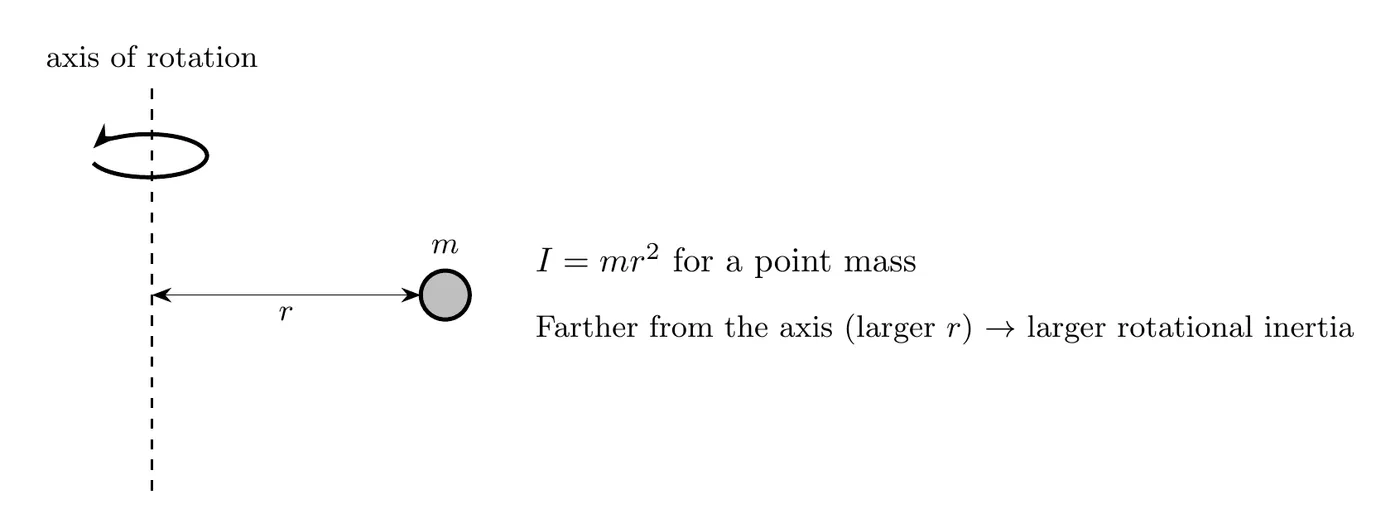
Important: that is the perpendicular distance from the axis, not just any old distance.
Multiple Point Masses (System of Particles)
For a system of several point masses, the total rotational inertia is just the sum of the individual ones:
About signs: the distance always ends up positive in because it gets squared. You might use signed coordinates when locating things, but the squaring makes every contribution positive.
Example: two planets orbiting a star.
- Planet 1 at distance from the star contributes .
- Planet 2 at distance contributes .
- Total: .
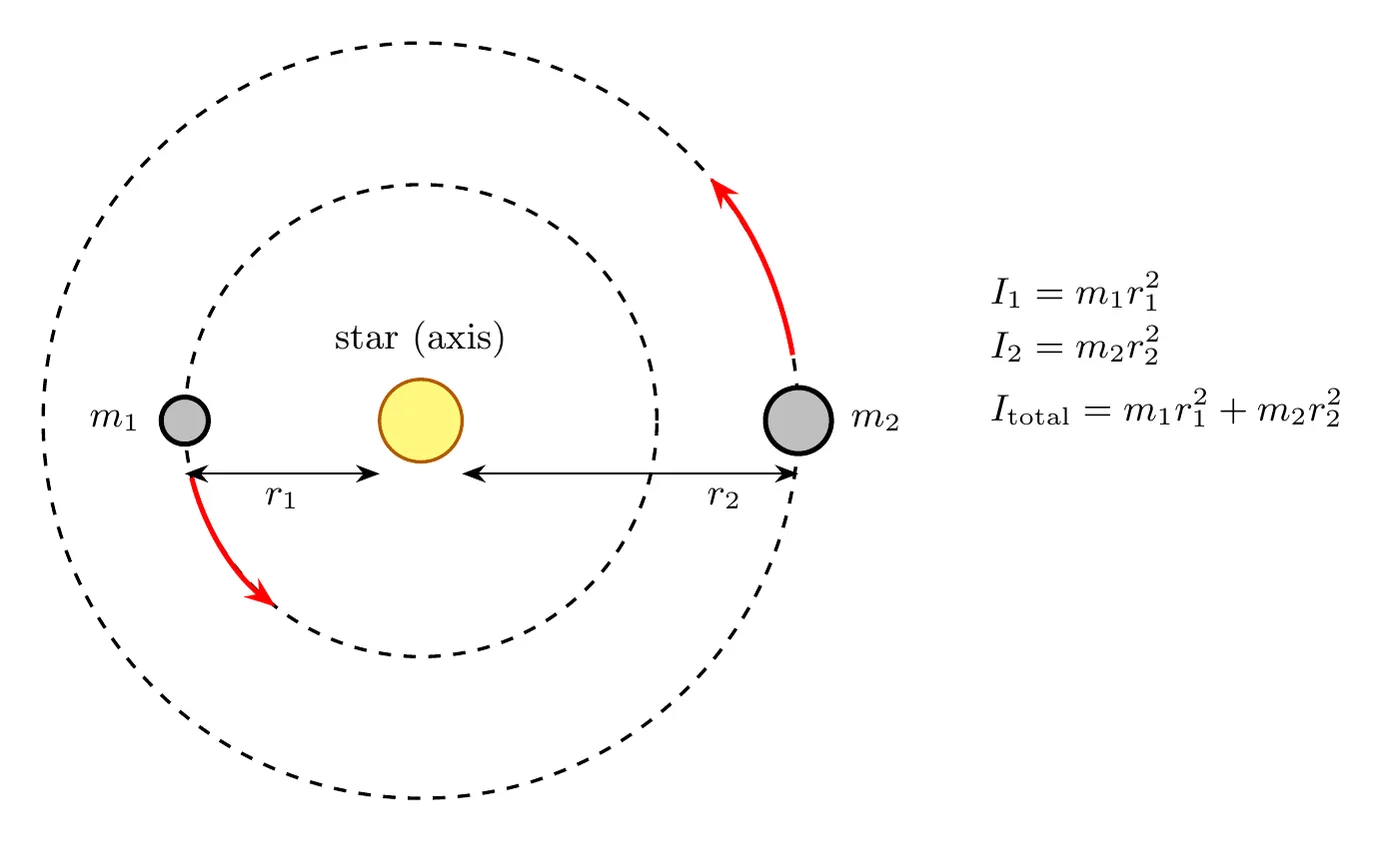
This is the approach from AP Physics 1 for discrete systems of point masses.
Rigid Objects (Continuous Mass Distribution)
For rigid objects where the mass is spread out continuously, you need calculus:
where:
- = an infinitesimally small chunk of mass.
- = the distance of that chunk from the axis.
This part is new in AP Physics C, and it means chopping the object into infinitely small pieces.
Linear Mass Density and dm
To actually evaluate , you need to rewrite in terms of a position variable.
Linear Mass Density
Linear mass density () is mass per unit length:
Units: kg/m.
For non-uniform objects, changes with position:
Solving for dm:
And that’s what goes into the integral:
Note: the variable might be , , , or whatever position coordinate the geometry calls for.
Deriving I for a Uniform Rod
For a uniform rod of mass and length , the mass is spread evenly, so is a constant and . Put at the axis and measure along the rod. Each piece’s distance from the axis is , and squaring it takes care of the sign.
Axis through the center: the rod runs from to .
Axis a quarter of the way from one end: now the rod runs from to .
Check it with the parallel axis theorem (further down this page): the new axis is from the center, so . ✓ Moving the axis away from the center makes bigger: about at the center, a quarter of the way in, and at the end.
With numbers: a uniform 0.150 kg meter stick ( m) spinning about its center has kg·m².
Deriving I for a Hoop, Disk, and Annular Ring
Round objects spinning about their central axis can be built out of thin rings that all share the same center. Every bit of a thin ring of radius is the same distance from the axis, so a ring of mass adds to the rotational inertia.
Thin hoop or thin cylindrical shell: all of the mass sits at the same radius , so comes out of the integral:
Uniform solid disk: the mass is spread evenly over the face, so use the surface mass density (mass per area), . Slice the disk into thin rings of radius and width . Unrolled, each ring is a thin strip long and wide, so its area is and its mass is .
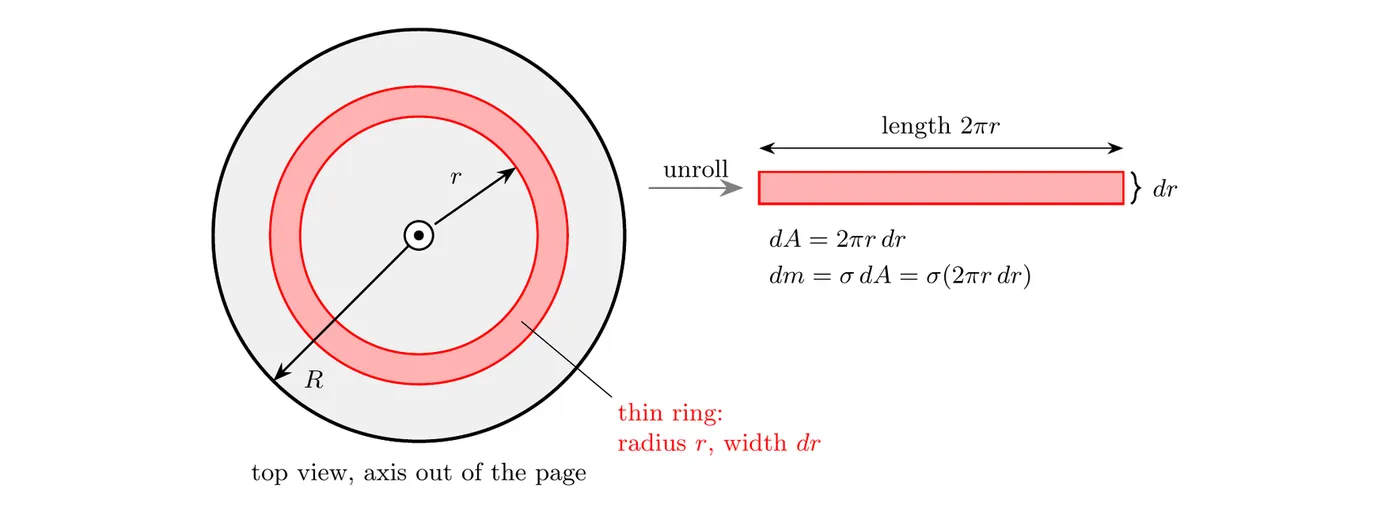
A disk has half the rotational inertia of a hoop with the same mass and radius because its mass is spread from the center out to the rim instead of all sitting at the rim.
Annular ring (a disk with a hole, like a washer): same setup, but the rings only run from the inner radius to the outer radius , and :
Check the limits: with no hole () this becomes the disk, , and when the ring gets very thin () it becomes the hoop, .
With numbers: a 0.0200 kg washer with inner radius 0.0100 m and outer radius 0.0250 m has kg·m².
Common Rotational Inertia Formulas
The AP exam gives you the rotational inertia formulas when you need them, unless the whole point is to derive one.
Here are the usual suspects:
Object | Axis | Rotational Inertia |
Point mass | Distance from axis | |
Thin rod | Through center, perpendicular | |
Thin rod | Through end, perpendicular | |
Thin hoop/ring | Through center, perpendicular to plane | |
Solid disk/cylinder | Through center, along axis | |
Hollow cylinder/hoop | Through center, along axis | |
Solid sphere | Through center | |
Hollow sphere | Through center |
The pattern: they all look like , where is some number (like or ) that depends on how the mass is spread out.
Mass Distribution and Rotational Inertia
The core principle: for two objects with the same mass and size, whichever one has its mass farther from the axis has the bigger rotational inertia.
Think of it as “hugging the axis”:
- Mass bunched up near the axis means smaller , so it’s easier to spin.
- Mass pushed out far from the axis means bigger , so it’s harder to spin.
Comparison with the same mass and radius :
Object | Rotational Inertia | Mass Distribution |
Solid disk | Mass spread through the interior (smallest ) | |
Hollow cylinder | All the mass out at the edge (biggest ) |
Racing down a ramp: when objects roll without slipping (Unit 6), the one whose rotational inertia is the smaller fraction of gets to the bottom first, no matter its mass or radius.
- The solid sphere () wins.
- The hollow sphere () is slower.
Hollow objects always lose to solid ones of the same shape because their mass sits far from the axis.
Minimum Rotational Inertia
For any rigid object, the smallest possible rotational inertia happens when the axis runs through the center of mass.
Any other axis gives you a bigger value.
Example: a rod.
- Through the center: (the minimum).
- Through the end: (bigger).
Parallel Axis Theorem
The parallel axis theorem lets you find the rotational inertia about any axis that’s parallel to one through the center of mass.
The Formula
where:
- = rotational inertia about the new axis.
- = rotational inertia about a parallel axis through the center of mass.
- = total mass.
- = perpendicular distance between the two parallel axes.
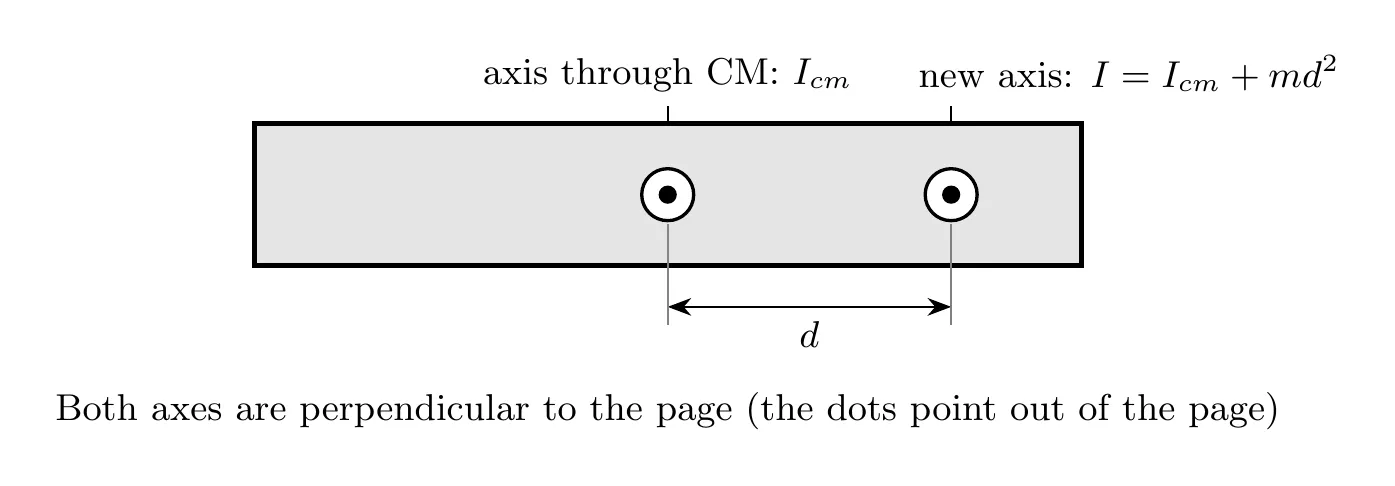
When to use it: whenever you know and need about some other axis.
Example: a rod of length .
- (through the center).
- For an axis through one end, .
✓
Which matches the table.
Example Problem: Rod with a Ball on the End
Problem: A uniform rod of mass 1.50 kg and length 0.800 m has a small 0.500 kg ball (treat it as a point mass) fixed to one end. Find the system’s rotational inertia about three axes, all perpendicular to the rod: (a) through the bare end O, (b) through the system’s center of mass, and (c) through the rod’s midpoint.
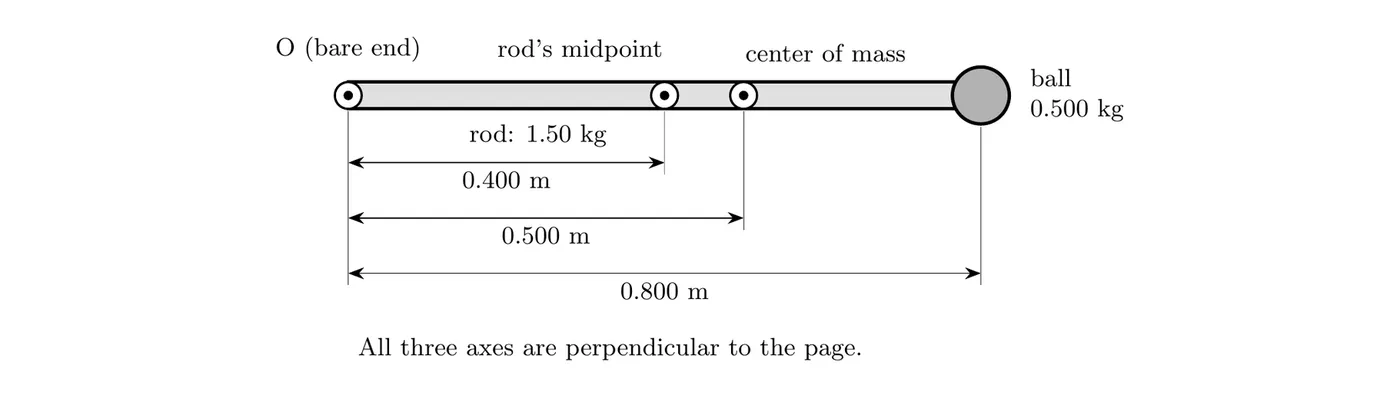
Solution
(a) Add the pieces. The rod about its end is , and the ball is a point mass 0.800 m from O:
(b) Find the center of mass, then use the parallel axis theorem. Measured from O, the rod’s mass is centered at its midpoint (0.400 m) and the ball is at 0.800 m:
The O axis is m from the center of mass, and the total mass is 2.00 kg, so gives
(c) Midpoint axis. The rod’s midpoint is 0.100 m from the center of mass:
Check by adding the pieces directly: the rod about its own center is , and the ball, 0.400 m away, adds , for a total of 0.160 kg·m². ✓
The read:
- The axis through the center of mass gives the smallest value, 0.140 kg·m². Every other parallel axis gives more.
- The parallel axis theorem only works when one of the two axes passes through the center of mass. Jumping straight from the midpoint to the end with m gives kg·m², which is wrong (the right answer is 0.640 kg·m²).
Example Problem: Deriving Rotational Inertia
Problem: a tapered rod of length and total mass has a non-uniform linear mass density:
where and is the distance from point P at the left end of the rod. Using integral calculus, show that the rotational inertia about an axis through P and perpendicular to the page is:
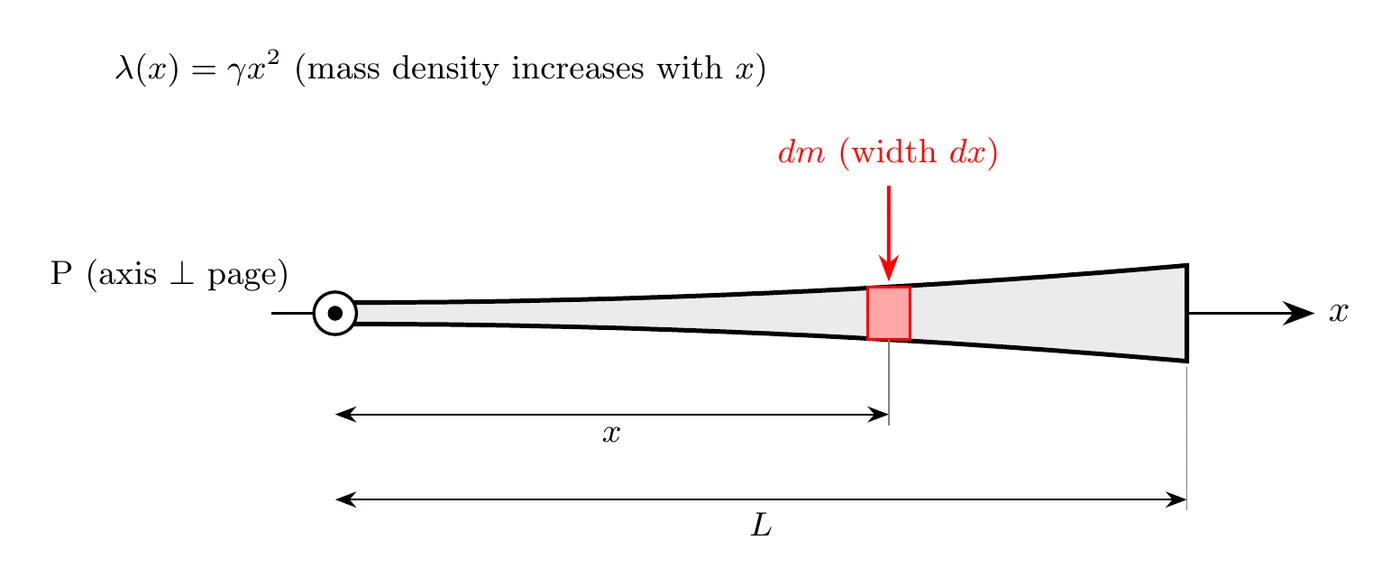
Solution
Step 1: Write the rotational inertia integral
For a continuous object:
Here, the distance from the axis (point P) to any mass element is just , so :
Step 2: Get dm in terms of x
Linear mass density is .
Solving for :
Step 3: Plug in the given
Step 4: Substitute into the integral
Step 5: Pull the constant out front
Step 6: Integrate with the power rule
Step 7: Evaluate the definite integral
Step 8: Substitute
Answer: we’ve shown ✓
What it tells you: this rod carries more of its mass toward the right end, which is farther from P, so its rotational inertia is on the large side. That coefficient is what the lopsided distribution buys you.
Important Considerations for Integration Problems
Limits of Integration
The limits come from where the axis sits relative to the object.
The usual cases:
- Axis at the left end:
- Axis at the center:
- Axis a quarter of the way from the left:
Always work out the limits from the geometry and the axis placement.
The General Pattern
Rotational inertia formulas basically always boil down to:
That number depends on:
- The shape of the object.
- How the mass is distributed.
- Where the axis is.
Common Mistakes
- Forgetting that I depends on the axis. Rotational inertia is NOT a fixed property like mass. Move the axis and it changes.
- Using diameter instead of radius. The formulas use radius , not diameter. If you’re handed a diameter, cut it in half first.
- Not squaring the distance. It’s , not . Square it every time.
- Wrong limits of integration. Pin down where the axis is and set your limits from there. The axis location sets the origin of your coordinate system.
- Forgetting to substitute for or other constants. In derivation problems your final answer has to be in terms of the given variables (, , and so on), not leftovers like .
- Botching the power rule. . For that’s , not .
- Adding rotational inertias wrong. With the parallel axis theorem it’s , not .
- Thinking hollow objects are faster. In ramp races, the object whose is the smaller fraction of wins. Hollow objects have a bigger fraction (their mass sits out at the rim), so they’re slower.
- Confusing center of mass with geometric center. For non-uniform objects these can be different spots. The minimum is about an axis through the center of mass, which isn’t always the geometric center.
- Not realizing calculus is needed. Continuous bodies (rods, disks, spheres) call for calculus. Discrete point masses just need a summation.
- Wrong expression for dm. It’s , where is the linear mass density. If varies, sub in the function .
- Forgetting what means in the integral. In , the is the distance from the axis of rotation to the mass element , which depends on your coordinate system and axis choice.
- Not simplifying before substituting. Pull the constants out of the integral first. It makes the integration cleaner and cuts down on errors.
- Failing dimensional analysis. Check yourself: rotational inertia is in kg·m², so your answer should be a mass times a length squared.
- Misusing the table formulas. Those formulas are for specific axes, usually through the center of mass. If the problem uses a different axis, either apply the parallel axis theorem or derive it from scratch.