

5.5/5.6 - Newton’s Law of Rotation
Newton’s Laws Applied to Rotation
Newton’s laws run linear motion, and they run rotational motion too, just in a matching rotational form.
Rotational Equilibrium (Newton’s First Law of Rotation)
Newton’s First Law of Rotation: when a system is in rotational equilibrium, its angular velocity is constant (possibly zero).
In words: the net torque on the object is zero.
Which means:
- Angular velocity stays constant.
- Angular acceleration .
- The object spins at a steady rate, or just sits there.
It also works the other way. A system has a constant angular velocity only if the net torque on it is zero. So if the torques on a rigid system are not balanced, its angular velocity must be changing: it speeds up, slows down, or reverses. That’s the rotational corollary to Newton’s second law, and the second law of rotation below turns it into an equation.
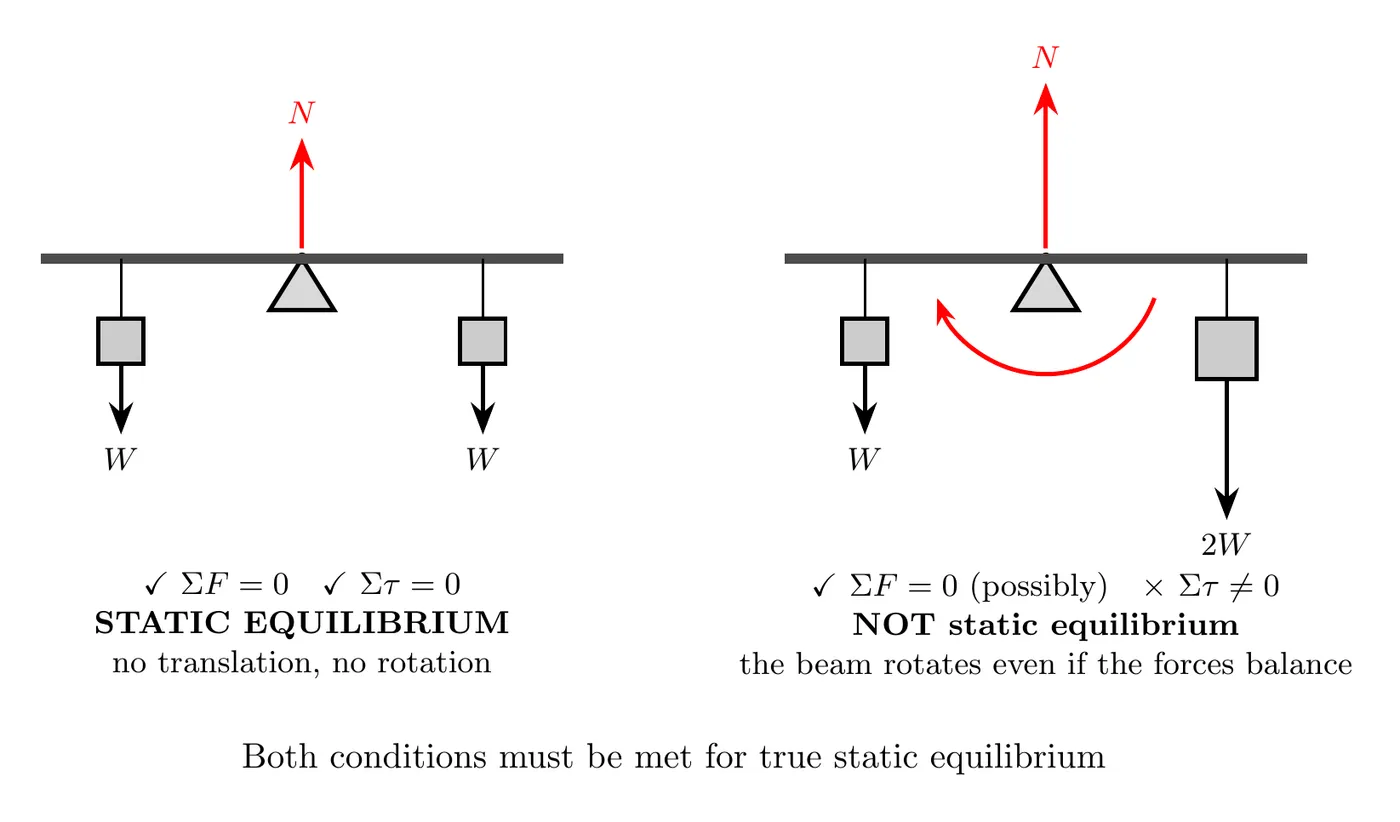
Important: an object can be in rotational equilibrium WITHOUT being in translational equilibrium, and vice versa.
Examples:
- A wheel spinning at a steady rate is in rotational equilibrium (), even though there may be forces on its axle.
- A stationary beam holding unequal weights can be in both translational and rotational equilibrium.
One without the other: net force and net torque are separate conditions, so check each one on its own.
- Rotational equilibrium without translational equilibrium: toss a spinning baton. Gravity acts at its center of mass, so it makes no torque about the center of mass, and the baton keeps spinning at the same rate the whole flight (ignoring air resistance). But gravity is an unbalanced force, so the center of mass accelerates downward along a projectile path.
- Translational equilibrium without rotational equilibrium: spin a cross-shaped tire wrench on a loose lug nut by pushing down on one arm and pulling up on the opposite arm with equal-sized forces. The two forces add to zero, so the wrench’s center doesn’t accelerate, but both forces twist it the same way, so the net torque isn’t zero and its angular velocity changes.
Static Equilibrium (the Complete Kind)
For an object to be in true static equilibrium, BOTH conditions have to hold:
Translational equilibrium:
- No linear acceleration.
- The center of mass is at rest or moving at constant velocity.
Rotational equilibrium:
- No angular acceleration.
- Constant angular velocity, or at rest.
Both have to be true for static equilibrium. If either one fails, the object is accelerating somehow.
Example Problem: Beam, Cable, and Sign
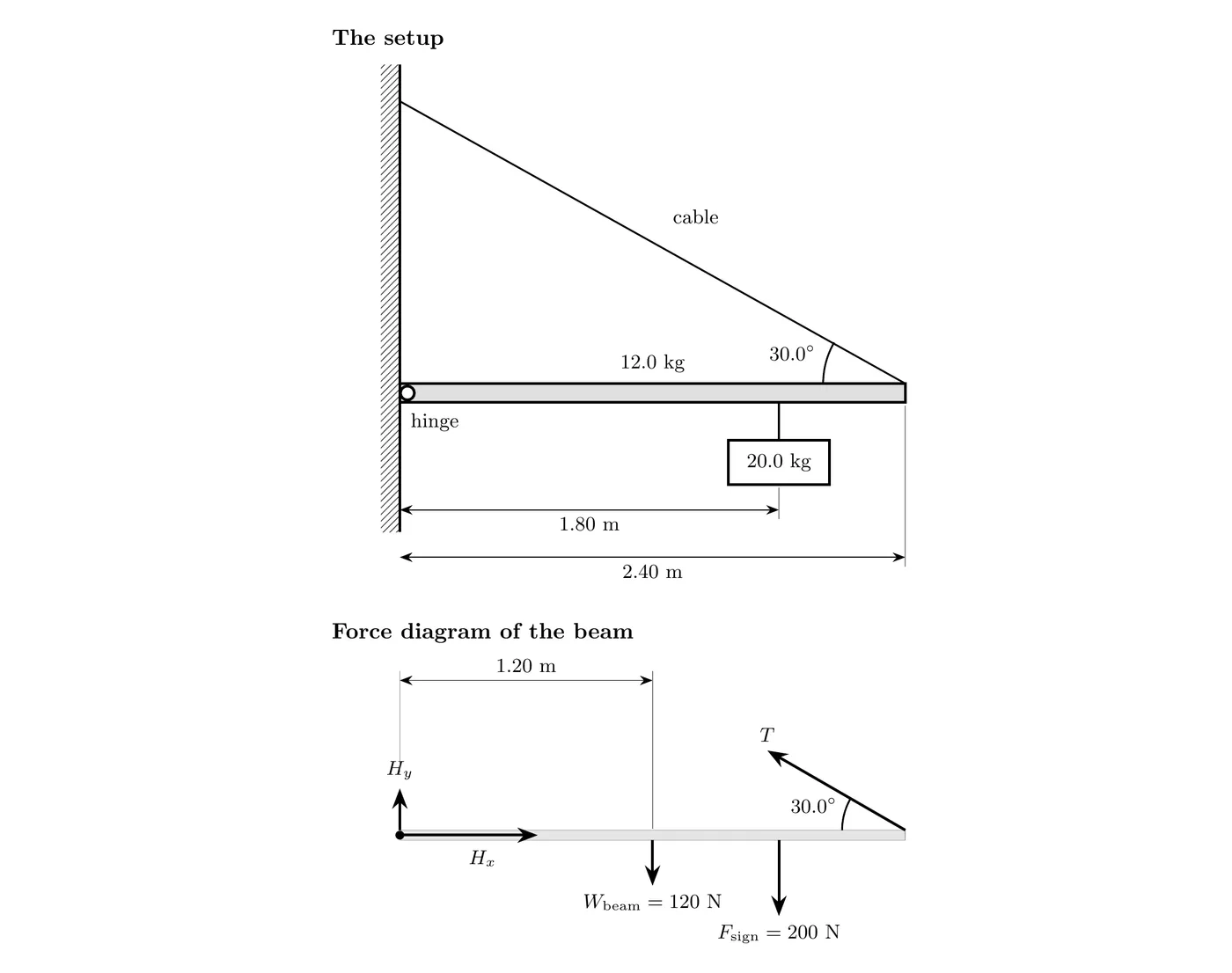
Problem: A uniform 12.0 kg beam, 2.40 m long, sticks straight out from a wall. A hinge holds its left end, and a cable from its right end up to the wall makes a 30.0° angle with the beam. A 20.0 kg sign hangs from the beam 1.80 m from the wall. Find the tension in the cable and the force the hinge exerts on the beam. Use m/s².
Solution
Step 1: Draw the force diagram of the beam.
- The beam’s weight, N, acts at its center, 1.20 m from the hinge.
- The sign’s cord pulls down on the beam with a force equal to the sign’s weight, N, 1.80 m from the hinge.
- The cable pulls with tension at the right end, 2.40 m from the hinge, at 30.0° above the beam, toward the wall.
- The hinge pushes with unknown components and .
Step 2: Sum the torques about the hinge. Choosing the hinge as the axis makes both unknown hinge components drop out (). Only the part of the tension perpendicular to the beam, , makes torque. The cable’s torque is counterclockwise, and both weights are clockwise:
Step 3: Sum the forces.
So the hinge force has a magnitude of N, pointing above the beam, away from the wall. The cable pulls the beam toward the wall, so the hinge has to push it back out (that’s ).
Step 4: Check with a different axis. About the cable’s attachment point at the right end, and make no torque (both lines of action pass through that point). , 2.40 m away, turns the beam clockwise, while the beam’s weight (1.20 m away) and the sign (0.600 m away) turn it counterclockwise:
Newton’s Second Law of Rotation
Newton’s Second Law of Rotation: the net torque on an object equals its rotational inertia times its angular acceleration.
Next to the linear version:
Linear Motion | Rotational Motion |
Force causes linear acceleration | Torque causes angular acceleration |
Mass resists the change | Rotational inertia resists the change |
In words: apply a net torque to something and it picks up angular acceleration proportional to that torque and inversely proportional to its rotational inertia.
The AP equation sheet writes the same law solved for the angular acceleration of the system:
Read it as two proportions:
- is directly proportional to the net torque and points the same way. A net counterclockwise torque gives a counterclockwise angular acceleration, and doubling the net torque doubles .
- is inversely proportional to the rotational inertia. With the same net torque, a hoop () gets half the angular acceleration of a solid disk () with the same mass and radius.
Force Diagrams for Rotation (Rigid Body Diagrams)
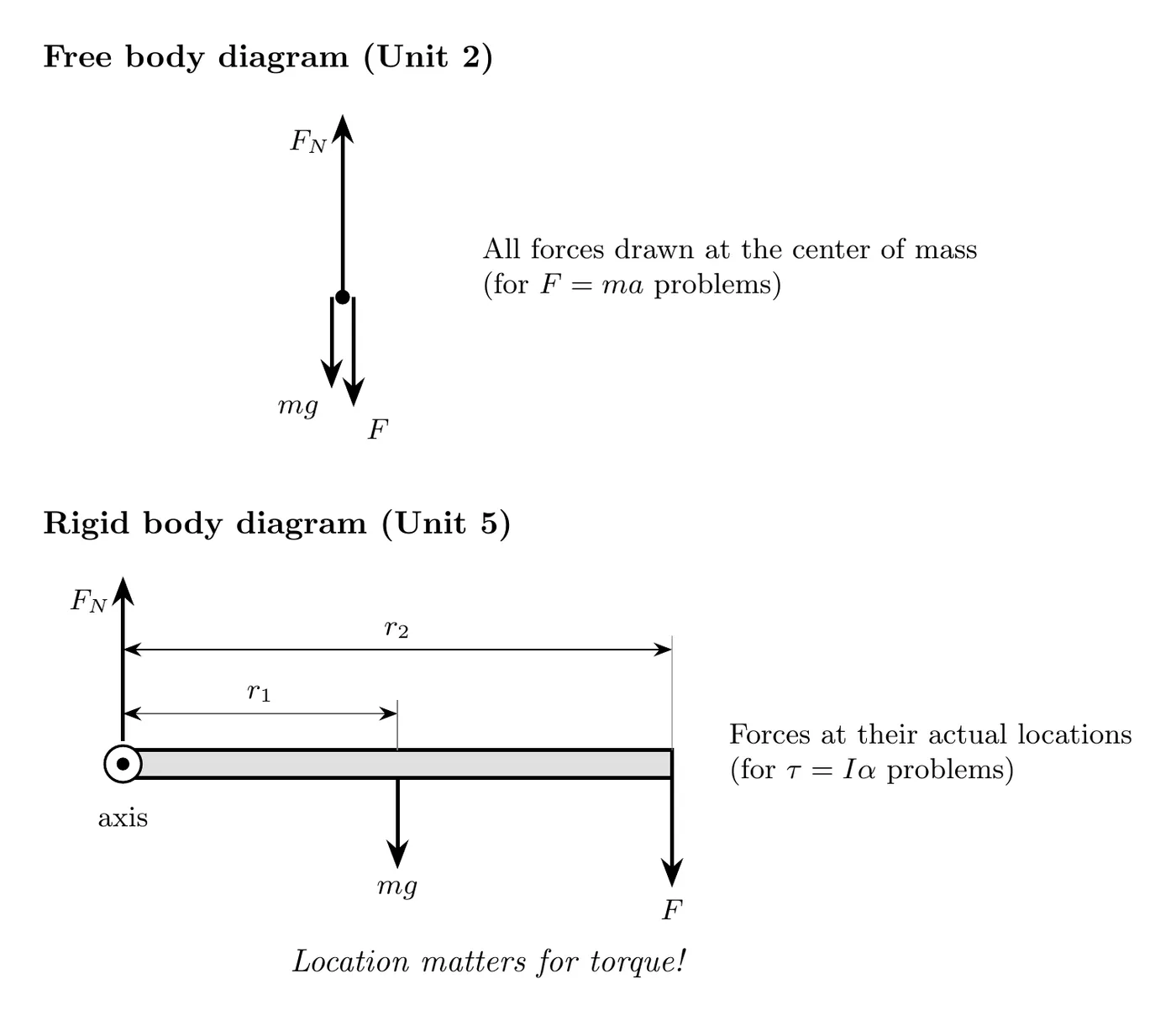
For rotational problems we draw force diagrams (or rigid body diagrams), and they’re different from the free body diagrams you’re used to.
What changes:
1. Forces get drawn where they actually act, not all bunched at the center of mass.
2. Location matters, because torque depends on where a force is applied.
3. You have to show the extended body, not just a dot.
Why? Because you need the distance from the axis to work out the torque: .
Compare two diagram styles:
Atwood Machines with Massive Pulleys
Back in Unit 2, pulleys were massless and frictionless, just gadgets for redirecting tension.
Now in Unit 5, pulleys get to have mass and rotational inertia, which changes everything.
How you’ll know: the problem will say something like:
- “The pulley has mass and radius .”
- “The rotational inertia of the pulley is .”
- “Massive pulley” or “pulley with non-negligible mass.”
You Need Three Force Diagrams
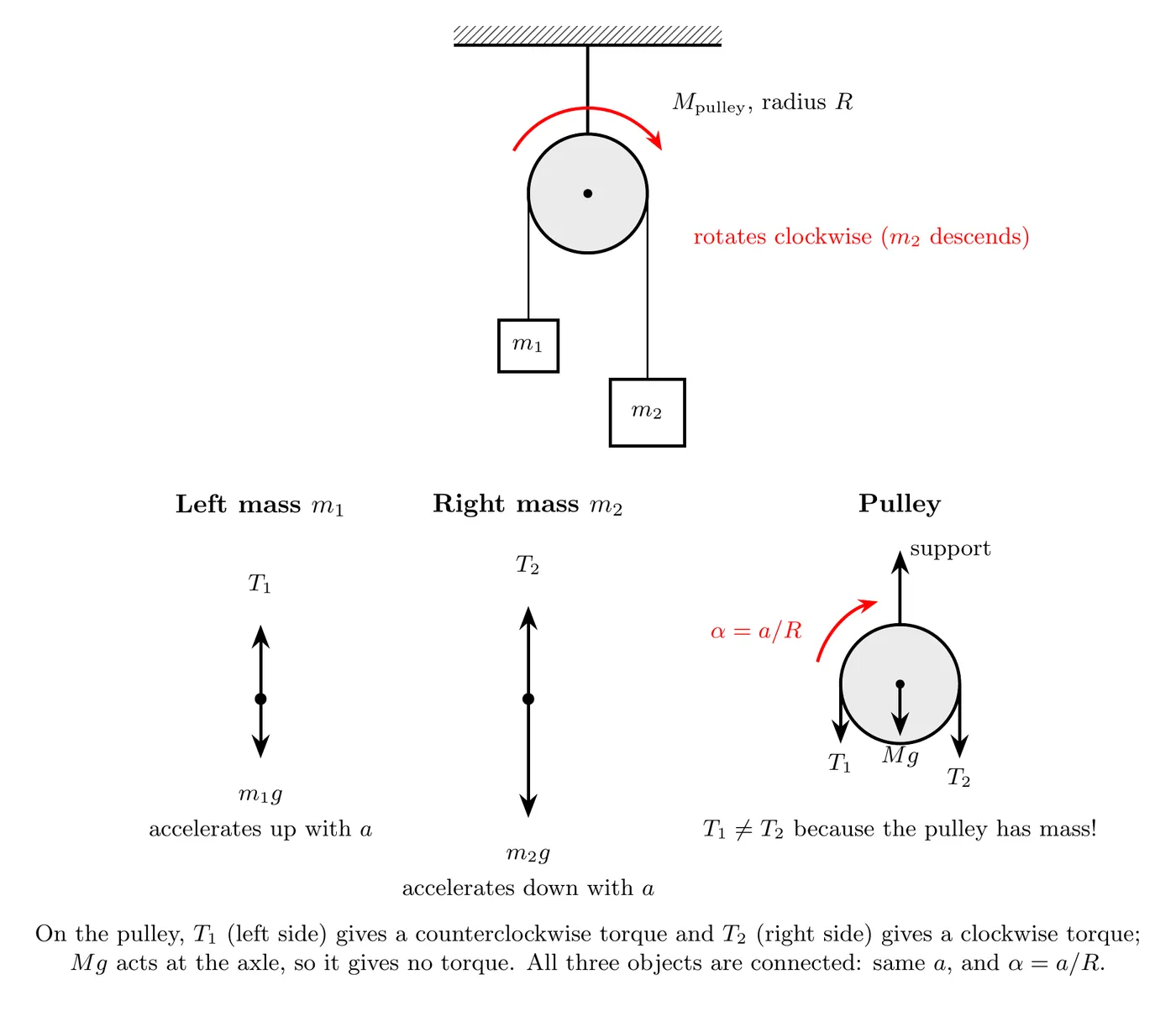
For an Atwood machine with a massive pulley, draw THREE diagrams:
- Left hanging mass: an FBD with its weight and tension.
- Right hanging mass: an FBD with its weight and tension.
- Pulley: a rigid body diagram with the weight and the tensions creating torque.
The key insight: the tensions on the two sides are no longer equal, because the pulley has rotational inertia now.
The connecting equations:
- The masses have linear acceleration .
- The pulley has angular acceleration .
- They’re tied together by , which links the linear and rotational motion.
Example Problem: Atwood Machine with a Massive Pulley
Problem: In the Atwood machine above, kg, kg, and the pulley is a uniform disk with kg and m. The string doesn’t slip on the pulley, and the axle is frictionless. Find the acceleration of the blocks, both tensions, and the pulley’s angular acceleration. Use m/s².
Solution
Step 1: Newton’s second law for each object, with each one’s positive direction along the way it moves:
- Left block (up is positive):
- Right block (down is positive):
- Pulley (clockwise is positive):
Step 2: Connect the pulley to the blocks. With and , the pulley equation becomes
Step 3: Add all three equations. The tensions cancel:
Step 4: Back-substitute.
Check: the net torque on the pulley is N·m, and kg·m², so rad/s². ✓
The read: with a massless pulley you’d get m/s² and equal tensions of 15.0 N. The massive pulley lowers to 4.00 m/s², because the falling block now also has to spin up the pulley. Spinning it up takes a net torque, which is why has to be bigger than .
Example Problem: Disc and Hanging Block
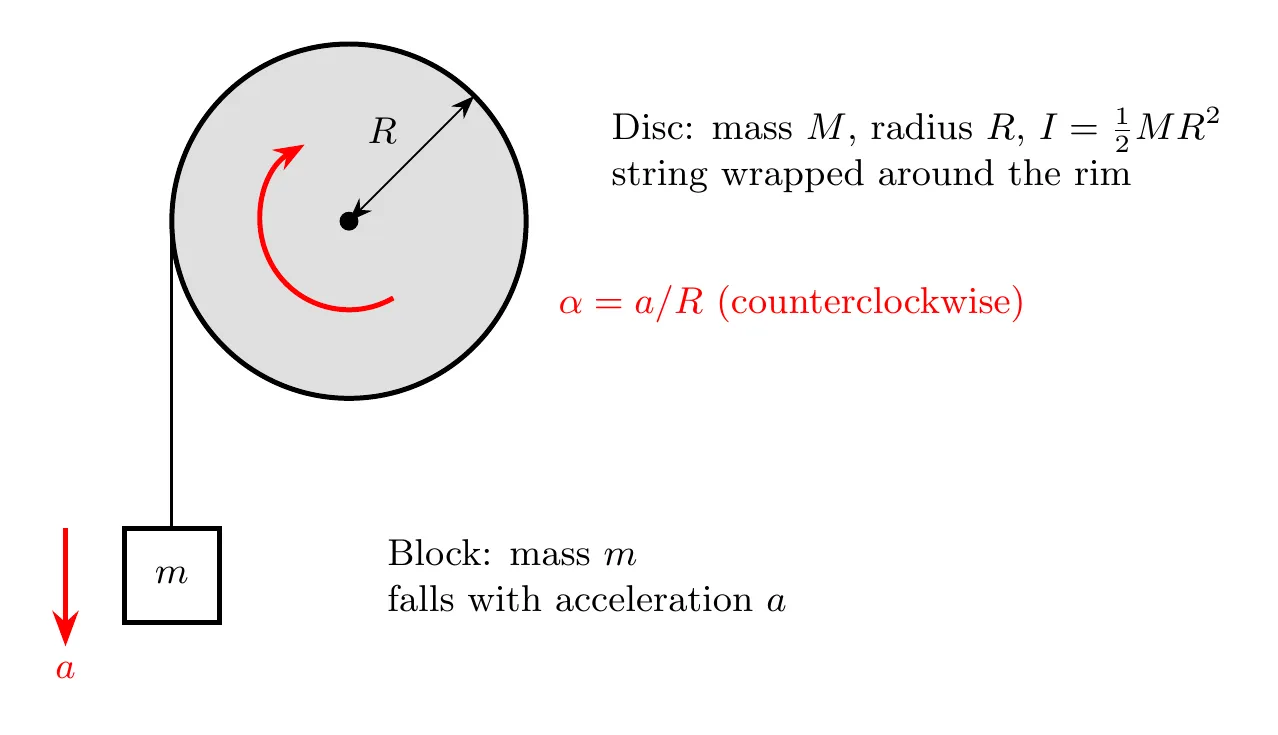
Problem: a solid disc of unknown mass and known radius is used in a lab. A small block of mass hangs from a string, and the other end of that string is attached to a rope wrapped several times around the disc. The block is released from rest and takes time to fall a distance to the floor.
Find the linear acceleration of the falling block in terms of , , and fundamental constants. Then use the measured fall (distance in time ) to find the disc’s unknown mass .
Given: the rotational inertia of a solid disc is .
Solution
Step 1: Draw the force diagrams
For the hanging block (mass ):
- Weight: (downward).
- Tension: (upward).
For the disc:
- Weight: at the center, which does NOT create torque since there.
- Tension: tangent to the rim, which DOES create torque.
Step 2: Apply Newton’s Second Law to the block
Take down as positive (that’s the way it’s moving):
Solve for the tension:
Step 3: Apply Newton’s Second Law of Rotation to the disc
Only the tension makes torque here, since the weight acts right at the axis where :
Step 4: Plug in the rotational inertia and connect to
We’re given , and we know , so :
Divide both sides by :
Step 5: Combine the two equations
From the block: .
From the disc: .
Set them equal:
Add to both sides:
Factor out the :
Solve for :
Multiply the top and bottom by 2:
Another form:
Or factoring out the :
Answer: the acceleration is , or equivalently .
Physical Interpretation
Check the limiting cases:
Case 1: massless pulley ()
The block just free-falls at . ✓ That checks out, since there’s no pulley mass fighting the motion.
Case 2: super heavy pulley ()
The acceleration gets tiny. ✓ Also makes sense, since a heavy pulley really resists angular acceleration.
In general: always, because the pulley has inertia you have to overcome.
Why isn’t just ?
Because the falling mass has to:
1. Accelerate itself ().
2. Also spin up the disc (, which works out to ).
The “effective mass” getting accelerated is , and that’s exactly what shows up in the denominator.
Using the Measurement: Finding the Disc’s Mass
The block starts from rest and has a constant acceleration, so the measured fall gives directly:
Now solve the dynamics result for the unknown mass:
With numbers: a 0.200 kg block falls 1.50 m in 1.25 s. Then m/s², and kg (using m/s²).
Problem-Solving Strategy for Rotational Dynamics
Step 1: DRAW the force diagrams
- Find every object that moves, whether it translates or rotates.
- Draw a force diagram for each one.
- Put the forces where they actually act.
- Mark the axis of rotation.
Step 2: SUM the forces and torques
- For translating objects: .
- For rotating objects: .
- For static equilibrium: and .
Step 3: CONNECT the linear and angular quantities
- Use (or ) to link them.
- Decide whether the tensions are equal or different.
Step 4: SOLVE the system of equations
- Substitute and knock out unknowns.
- Solve for whatever you’re after.
Step 5: CHECK
- Are the units right?
- Does it make physical sense?
- Do the limiting cases work out?
Example Problem: Linear and Rotational Analyses Done Separately
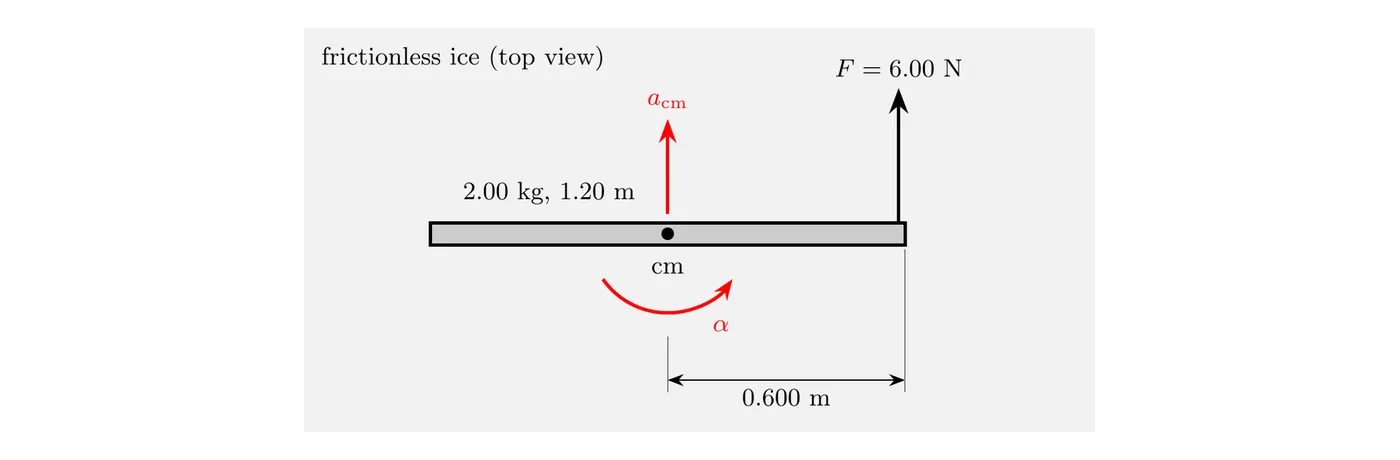
Problem: A uniform 2.00 kg rod, 1.20 m long, lies at rest on frictionless ice. A hockey stick pushes one end with a 6.00 N force, perpendicular to the rod and along the ice. Right when the push starts, find (a) the acceleration of the rod’s center of mass and (b) the rod’s angular acceleration.
Solution
Nothing ties this rod’s spin to its sliding (it isn’t rolling on anything, and no pivot holds it), so the linear and rotational analyses have to be done separately. A free rigid system turns about its own center of mass, so that’s the axis for the rotational part.
(a) Linear analysis (the rod as an object): gravity and the normal force from the ice cancel, and there’s no friction, so the push is the net force. Newton’s second law for the center of mass doesn’t care where on the rod the force acts:
(b) Rotational analysis (the rod as a rigid system): the push acts 0.600 m from the center of mass, perpendicular to the rod:
The read:
- Push the center instead, with the same 6.00 N, and is still 3.00 m/s², but there’s no torque about the center of mass, so the rod slides without turning. Where the force acts changes the rotation, not the motion of the center of mass.
- Here m/s² doesn’t equal m/s². There’s no rolling condition linking them, which is exactly why the two analyses are separate.
Common Mistakes
- Assuming the tensions are equal on both sides of the pulley. Once the pulley has mass, the tensions are DIFFERENT. They’re only equal for massless pulleys.
- Forgetting that a force at the axis makes no torque. A force acting right at the axis of rotation () gives zero torque, no matter how big it is.
- Using the wrong rotational inertia formula. A solid disc is . A hoop is . Don’t swap them.
- Not connecting and properly. For a rope wrapped around a pulley of radius , it’s . Don’t drop the radius.
- Drawing forces at the center of mass for torque problems. For torque, the forces have to sit at their actual points of application, not all piled at the center.
- Only using one equilibrium condition. Static equilibrium needs AND . One without the other doesn’t cut it.
- Wrong sign for torques. Counterclockwise is positive, clockwise is negative. Stay consistent all the way through.
- Mixing up which tension makes which torque. On the pulley, both tensions pull down on the rope, but they twist in opposite directions because they act on opposite sides.
- Not writing enough equations. For an Atwood machine with a massive pulley, you need at least 3 equations (one per object) to solve for 3 unknowns (usually , , and ).
- Algebra errors when solving. When you have , factor carefully: it’s , not .
- Misreading the limiting cases. Always check whether your answer collapses to the expected result when a mass goes to zero or blows up to infinity. This catches a ton of mistakes.
- Thinking equilibrium means nothing’s moving. Rotational equilibrium means constant , which could be some nonzero value. Something can be spinning steadily and still be in equilibrium.
- Putting support forces into the torque equation when they’re at the axis. The support force at a hinge or pivot acts right at the axis and makes no torque. Leave it out of (but do include it in if you’re checking translational equilibrium).
- Confusing and . Rotational inertia is in kg·m², not kg. Mass is in kg. They’re different quantities, and both show up in these problems.
- Not noticing when the pulley’s mass matters. If the problem hands you a pulley mass or rotational inertia, it matters. You can’t fall back on the massless-pulley shortcut from Unit 2.
Summary: Key Equations
Concept | Equation | When to Use |
Newton’s 1st (rotation) | Rotational equilibrium | |
Newton’s 2nd (rotation) | Angular acceleration | |
Static equilibrium | AND | Complete equilibrium |
Linear-angular connection | Relating rope and pulley motion | |
Torque | Calculating individual torques |
That wraps up Unit 5 (Rotational Kinematics and Dynamics). Unit 6 takes the conservation laws into rotational motion: angular momentum and rotational kinetic energy.