

6.6 - Motion of Orbiting Satellites
System Setup: Central Object and Satellite
For a system with a massive central object (a planet or star) and an orbiting satellite of negligible mass, you assume the central object basically doesn’t move. You treat it as stationary and focus only on the satellite. That means ignoring the planet’s spin on its axis and any wobble the satellite causes, which is fine as long as the satellite’s mass is far smaller than the central object’s.
How negligible? By Newton’s third law, the satellite pulls on the planet just as hard as the planet pulls on the satellite, but the planet’s acceleration is smaller by the ratio of the masses. For a 1200 kg satellite orbiting Earth ( kg) at m:
That gives the satellite an acceleration of about m/s², but gives Earth only m/s². Earth’s motion really is negligible.
Conservation Laws: Circular vs. Elliptical Orbits
Satellite motion is constrained by conservation laws, but which quantities stay constant depends on the orbit shape.
Circular orbits have a constant radius, and everything stays constant: the system’s mechanical energy () and gravitational potential energy (), and the satellite’s kinetic energy () and angular momentum (). That’s because the distance from the central object never changes, so the speed and the potential energy both stay put.
Elliptical orbits have a radius that varies with position. The mechanical energy () and angular momentum () are still constant, but the kinetic energy () and potential energy () are not, since each changes with position. As the satellite swings closer in, it speeds up (KE rises, PE falls); as it moves out, it slows down (KE falls, PE rises). The total stays constant through all of it.
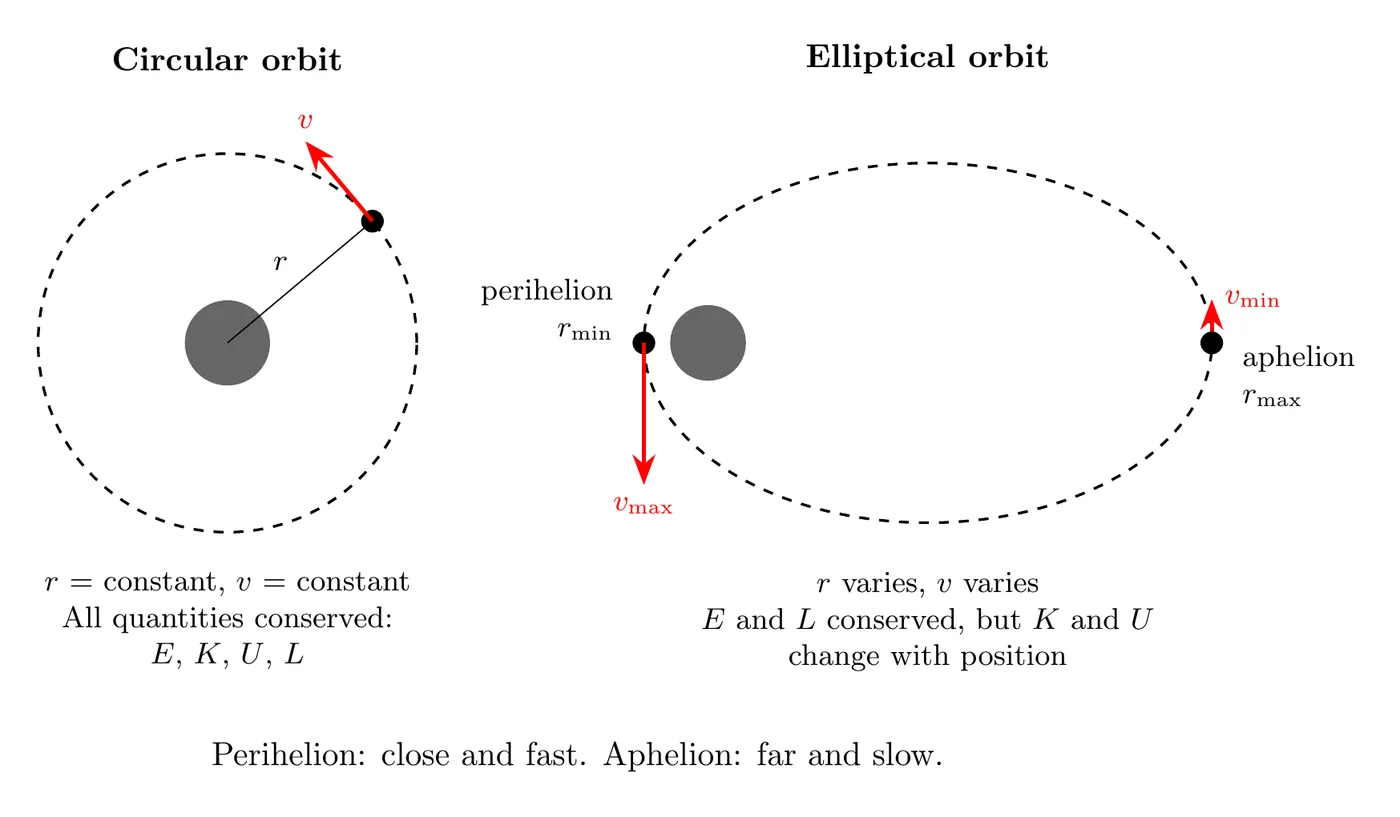
Example Problem: Speeds and Energies in an Elliptical Orbit
Problem: a 300 kg satellite orbits Earth ( kg) in an ellipse. Its closest distance to Earth’s center is m, where it moves at m/s. Its farthest distance is m. Find (a) its speed at the farthest point and (b) , , and at both points.
(a) Angular momentum is constant. Gravity points straight at Earth’s center, so it exerts no torque about that point. At the closest and farthest points the velocity is perpendicular to , so there :
(b) Energies, using and from the equation sheet:
Quantity | Closest point | Farthest point |
J | J | |
J | J | |
J | J |
and each change a lot, but they trade off exactly: the satellite loses J of kinetic energy on the way out, and the system gains J of potential energy, so stays at J.
Gravitational Potential Energy (Zero at Infinity)
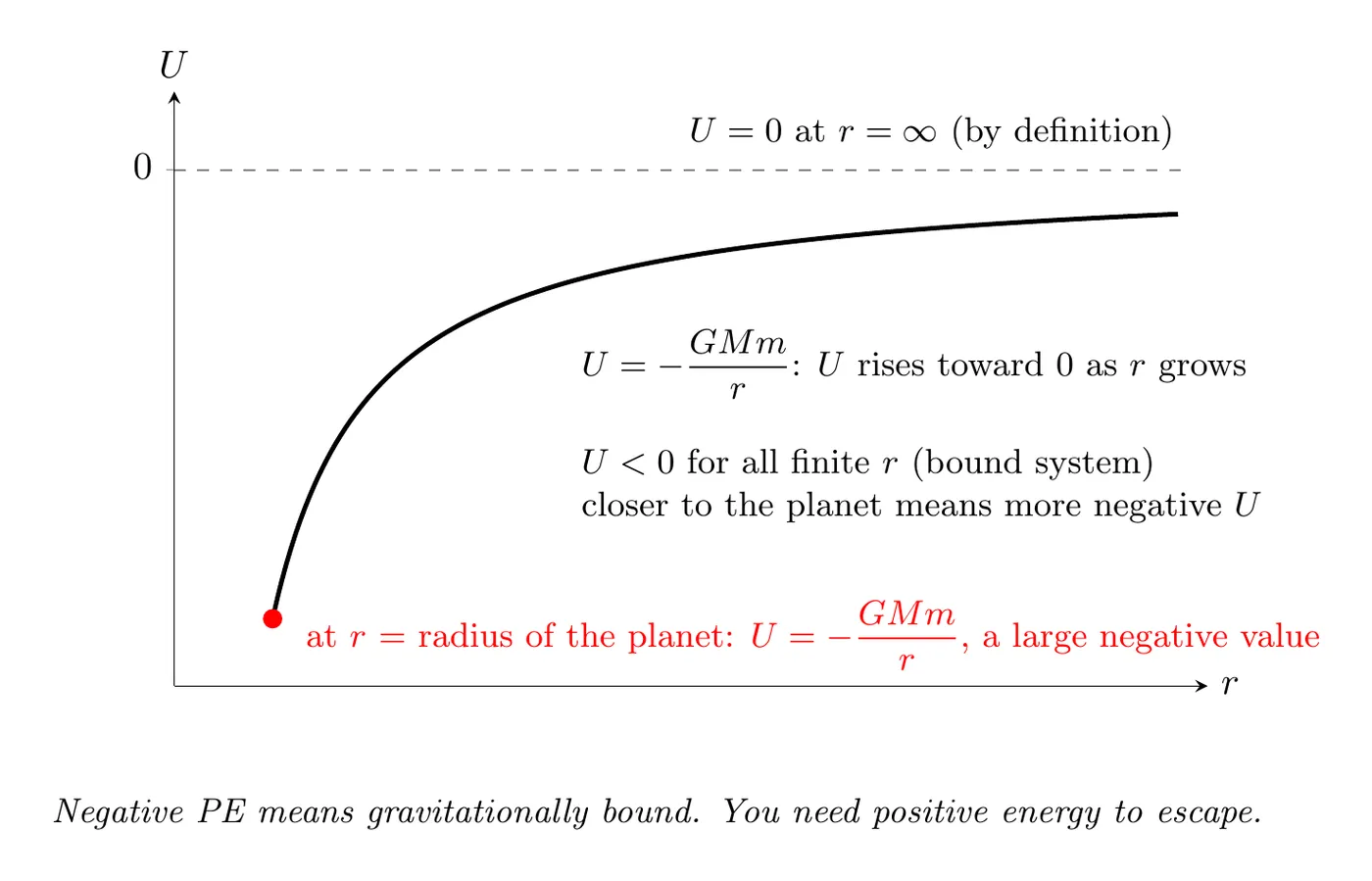
For orbiting objects, gravitational potential energy is defined with zero at infinite separation:
where:
- = gravitational potential energy (J)
- = universal gravitational constant ( N·m²/kg²)
- = mass of the central object (kg)
- = mass of the satellite (kg)
- = orbital radius (m)
The negative sign says the potential energy is negative, meaning the objects are gravitationally bound.
Why negative? The convention is at . As objects fall together from infinity, gravity does positive work, so the potential energy drops from zero down into negative values, and energy gets released (the objects speed up as they fall in). A negative PE means the system is bound: you have to add energy to pull the objects apart to infinity.
Orbital Radius
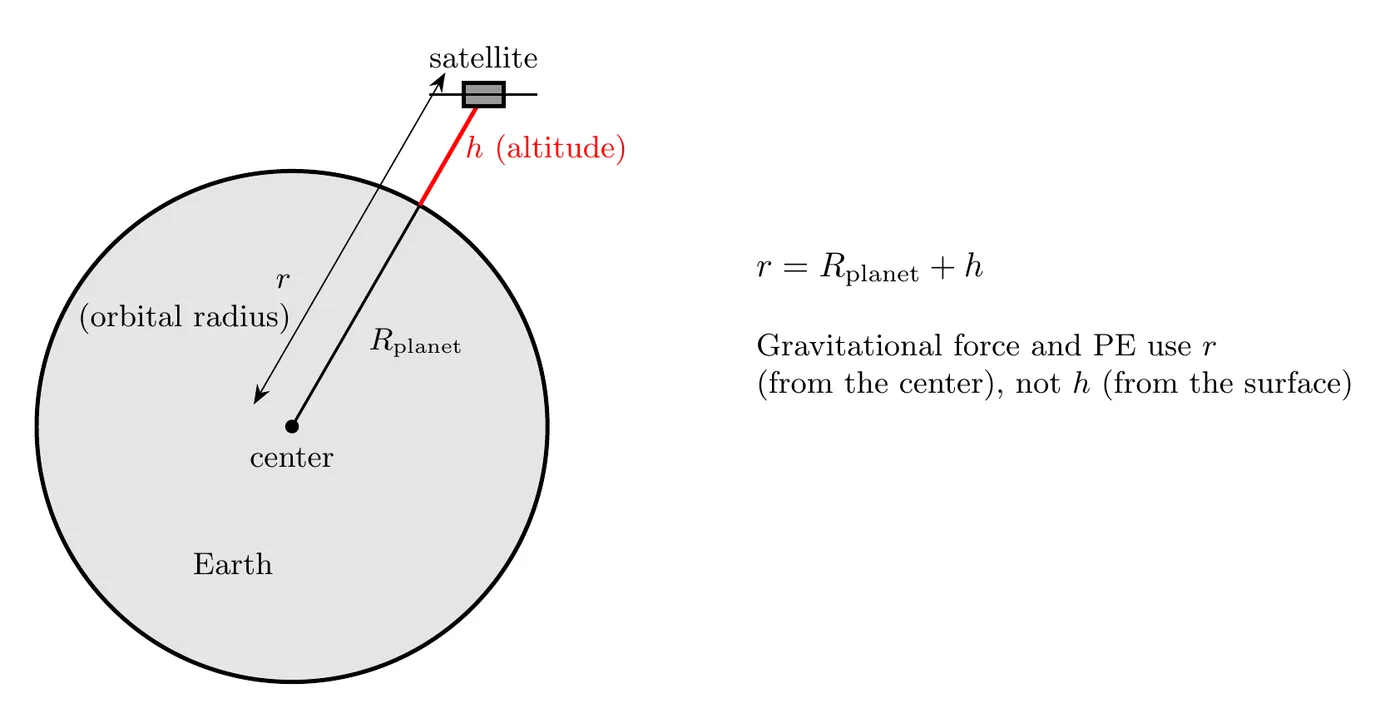
The orbital radius is the distance from the center of the central object out to the satellite:
where is the planet’s radius (m) and is the altitude above the surface (m). Note that the orbital radius is measured from the center of the planet, not from its surface.
Total Energy of an Orbiting Object
The total mechanical energy of an orbit is:
Circular orbits have a special relationship. For a circular orbit, gravity supplies the centripetal force:
Solving for kinetic energy:
But the potential energy is , so notice that , or equivalently . The total energy is then:
which is also just .
So for circular orbits: (negative, a bound system), , and .
Example Problem: Energy of a Satellite in a Circular Orbit
Problem: a 1200 kg satellite is in a circular orbit m above Earth’s surface ( kg, m). Find (a) its speed, (b) , , and , (c) the energy needed to move it to a circular orbit of radius m, and (d) the energy needed for it to escape from its original orbit.
(a) The orbital radius is measured from Earth’s center: m. Gravity supplies the centripetal force, so:
(b)
(Check: J.) The graph shows , , and for circular orbits of this satellite at every radius. Everywhere, and :
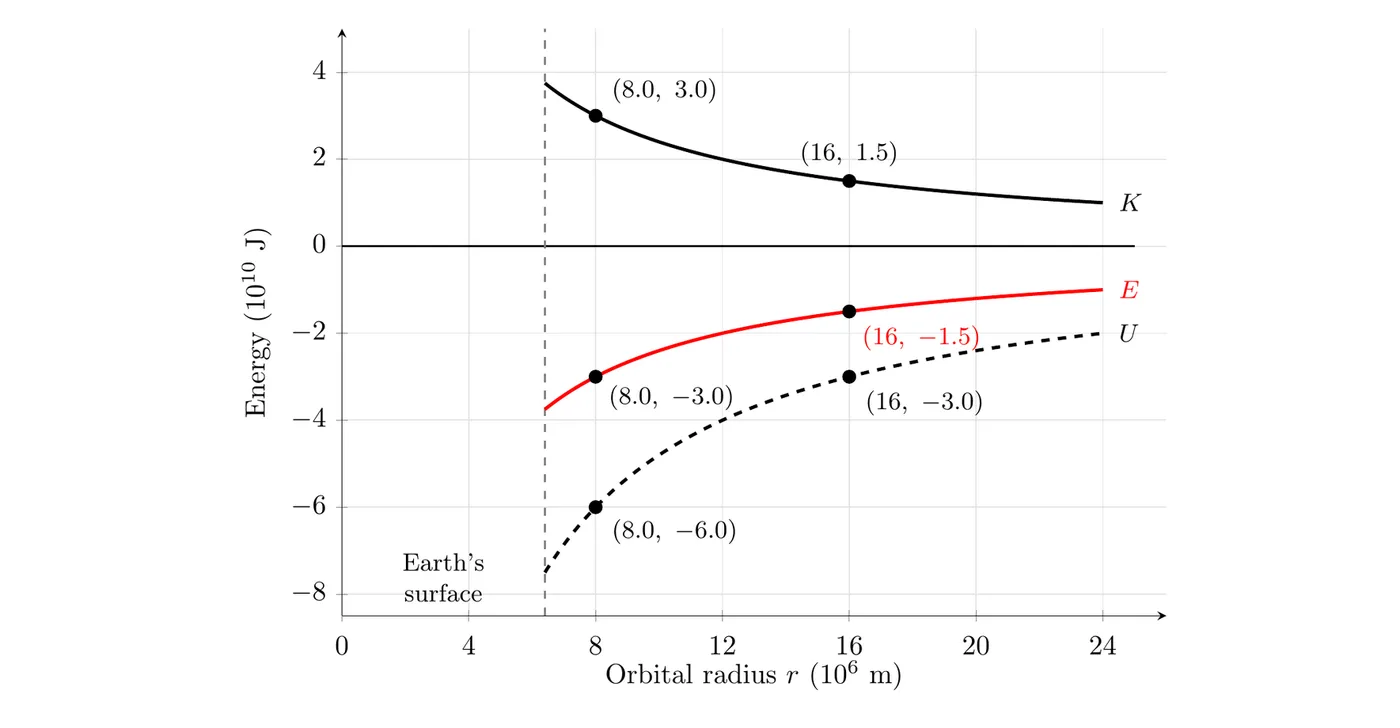
(c) Doubling the radius halves each energy: at m, J, J, and J. The energy the rocket engines have to add is:
Here’s the surprise: you add energy, yet the satellite ends up slower ( drops from to J). The added energy, plus the kinetic energy it gave up, all goes into potential energy, which rises by J.
(d) To escape, the total energy has to reach zero, so you have to add J. Put another way, at that radius the satellite needs a speed of:
That’s times its orbital speed.
Escape Velocity
Escape velocity is the minimum speed needed to break free of a gravitational field, reaching infinite distance with zero speed left over.
To escape, an object needs enough kinetic energy to cancel out the gravitational potential energy, so the total energy is exactly zero (it just barely reaches infinity with nothing to spare):
Launching from a planet’s surface:
Launch at this speed or faster and you escape to infinity. Launch slower and you either fall back or settle into orbit. For Earth, km/s from the surface.
Example Problem: Rocket at Half Escape Velocity
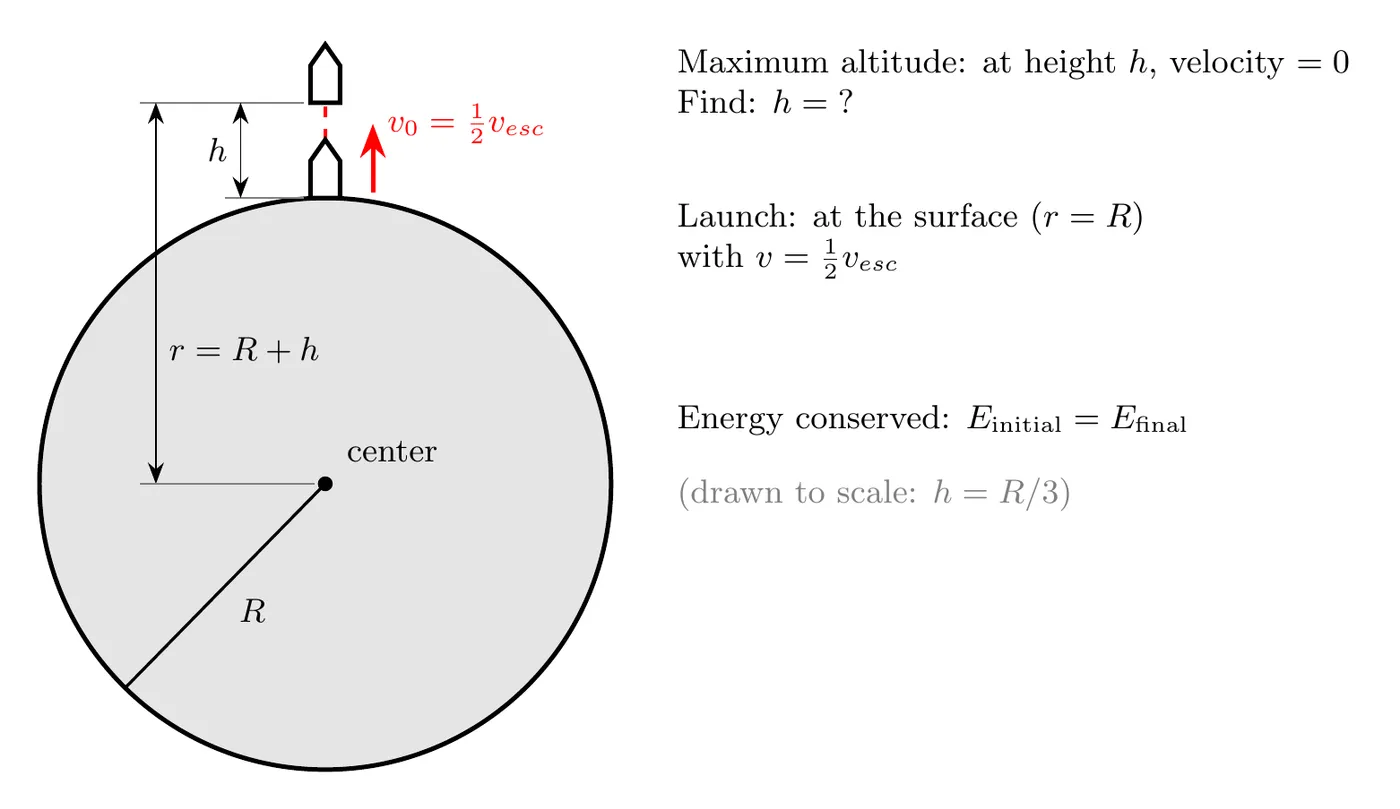
A rocket of mass launches from Earth’s surface at exactly half the escape speed. Earth’s mass is kg and its radius is m. What’s the rocket’s maximum altitude? Ignore air resistance.
Solution
Step 1: The escape velocity is .
Step 2: Initial kinetic energy. The rocket launches at half that speed:
Step 3: Set up energy conservation. At maximum altitude the velocity is zero, so :
Step 4: Simplify. Divide out :
Step 5: Solve for h. Take the reciprocal of both sides:
Step 6: Get the number.
So the maximum altitude is m, about 2130 km.
Physical Interpretation
At half escape velocity the rocket doesn’t have the energy to get away (, still bound). It climbs to above the surface, where all its kinetic energy has turned into potential energy, and then it falls back to Earth. Tracking the energy: it starts with some KE (it’s moving) and a large negative PE (it’s at the surface); at maximum height it has zero KE (stopped) and a less negative PE (it’s farther out); and the total energy stays negative the whole time, which is what “bound” means. For comparison, at full escape velocity (it gets away completely), at half escape velocity (it falls back), and at zero velocity (it never leaves).
Summary of Key Formulas
Concept | Formula | Notes |
Gravitational PE | Negative, zero at infinity | |
Orbital radius | From the center, not the surface | |
Total energy (circular) | Negative (bound) | |
Escape velocity | Minimum speed to escape | |
Energy conservation | No non-conservative forces | |
Circular orbit relations | , | Special to circular orbits |
Energy Conservation in Orbit Problems
The general recipe: identify the initial state (position , velocity ), identify the final state (position , velocity ), write both energies as and , set them equal since the mechanical energy is constant (only gravity acts), and solve for whatever’s unknown.
Common setups: launching from the surface (, find the max height where ), changing orbits ( and known, relate and ), and escape problems ( at ).
Common Mistakes
- Wrong sign on PE. Gravitational PE is negative: . Don’t drop that minus sign.
- Confusing altitude with orbital radius. The orbital radius is , measured from the center. Altitude is from the surface. Always use in the formulas.
- Assuming PE is zero at the surface. It’s zero at infinity, not at the surface. At the surface, , a big negative number.
- Not squaring the half. If , then , not . Square the whole thing.
- Thinking KE and PE are each constant in elliptical orbits. Only the total stays constant. Each piece changes with position.
- Misusing energy conservation. It’s , meaning . Don’t set just the kinetic or just the potential terms equal.
- Botching the reciprocal. If , then . Flip both sides properly.
- Using the surface gravity formula. Don’t use at large altitudes. That approximation only works near the surface. Use for orbits.
- Forgetting that mass cancels. In many orbit problems the satellite’s mass drops out. Don’t get stuck hunting for it if it isn’t given.
- Confusing escape velocity with orbital velocity. Escape is , circular orbital speed is , smaller by a factor of .
- Wrong sign on circular orbit energy. It’s , negative. Bound systems have negative total energy.
- Thinking the rocket keeps going up. At maximum altitude , the rocket stops and then falls back. It doesn’t drift upward at zero speed.
- Not noticing when mechanical energy is constant. If air resistance is negligible and only gravity acts, the system’s mechanical energy is constant, so use .
- Skipping dimensional checks. Energy should come out in joules. If you end up with m/s or kg, something’s wrong.
- Thinking circular and elliptical orbits have the same total energy. They can differ. What matters is the mechanical energy for that particular orbit, which is constant for that orbit but different from orbit to orbit.