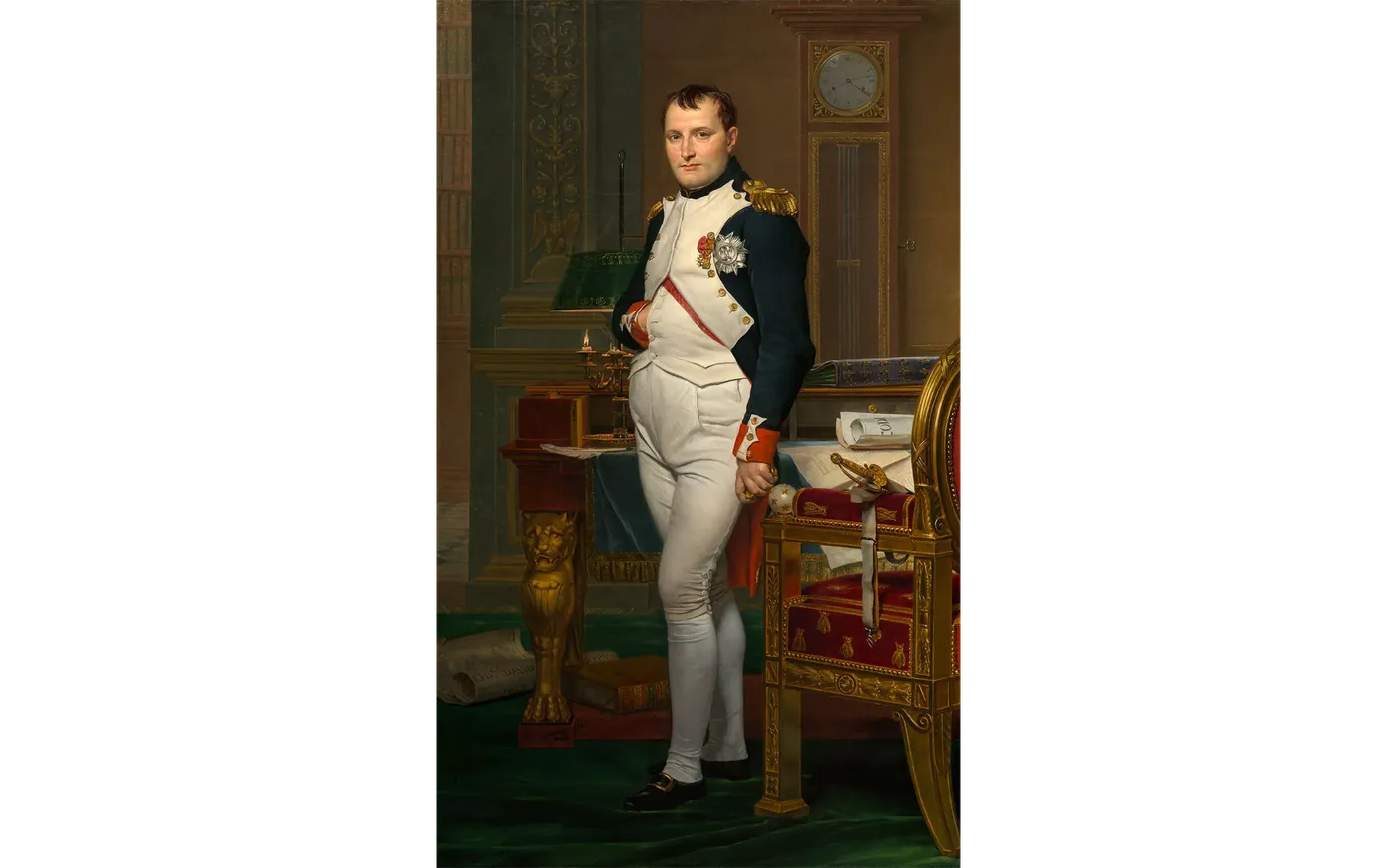
5.6 - Napoleon's Rise, Dominance, and Defeat
Napoleon Bonaparte and the Aftermath of the French Revolution
- Rise of Napoleon Bonaparte
- Following the chaos of the French Revolution, Napoleon Bonaparte emerged as a leader who promised stability.
- Napoleon rose to the rank of General by 1794 and gained a strong reputation for his military leadership in Italy.
- Despite a failed campaign in Egypt, Napoleon returned to France and led a coup in 1799, overthrowing the Directory and establishing the Consulate with himself as First Consul.
- By 1804, Napoleon crowned himself Emperor Napoleon I, marking a return to a form of monarchy in France, albeit with a different face.
- Why Did the French Accept Napoleon?
- The radical phase of the French Revolution had dismantled long-standing social and cultural institutions, leading to widespread instability.
- After the Reign of Terror, the French people were desperate for order, which Napoleon promised to deliver.
- Napoleon claimed to embody the principles of the Revolution (liberty, equality, fraternity) while also providing the strong leadership that many felt was necessary to restore stability.
- Napoleon’s Domestic Reforms
- Napoleonic Code (1804):
- Reasserted the equality of all male citizens before the law.
- Protected wealth and private property.
- Introduced a degree of religious toleration.
- Confirmed the end of feudalism and noble privilege, and protected the land sales of the Revolution, so peasants and middle-class buyers kept the Church and noble lands they had bought.
- The Code spread to lands Napoleon conquered and still shapes the law of France, Belgium, and many other countries today.
- Centralization of Government:
- Napoleon created a bureaucracy based on merit rather than birthright, awarding positions to the most qualified individuals.
- Each department was run by a prefect appointed by Napoleon, so orders flowed from Paris to every corner of France.
- Careers open to talent: Government and army jobs went to people with ability and education, not noble birth. Napoleon created the Legion of Honor (1802) to reward service to the state.
- Education: Napoleon set up state high schools called lycées (1802) to train future officers and officials, and in 1808 the Imperial University put all of French education under state control.
- Economy: He founded the Bank of France (1800) and made tax collection more efficient, which restored confidence after the money troubles of the 1790s.
- Religious Reform: Concordat of 1801:
- Restored some religious freedoms to French Catholics while keeping the Church subservient to the state. Napoleon retained the right to nominate and pay bishops and priests.
- Why: Most French people were still Catholic, and the fight over the Civil Constitution of the Clergy (see 5.4) had turned many peasants against the government. The Concordat made peace with the pope, who in return accepted that the Church would not get back the lands taken during the Revolution. It lasted until 1905.
- Limitations on Rights Under Napoleon
- Secret Police:
- Napoleon's police, run by Joseph Fouché as minister of police, used spies and informers to watch for opponents. Suspects could be arrested, held without trial, or sent into exile.
- Censorship:
- Freedom of the press, gained during the Revolution, was severely restricted under Napoleon’s rule, with state-sponsored censors overseeing French newspapers.
- In 1800 Napoleon shut down most of the political newspapers in Paris, leaving only about a dozen, and by 1811 only four were left.
- Marginalization of Women:
- Women lost many of the rights they had gained during the Revolution, becoming legally dependent on their husbands and fathers under the Napoleonic Code.
- Under the Code, a wife had to obey her husband and needed his consent to buy or sell property or run a business, and divorce became much harder for women to get.
- A Façade of Representative Institutions:
- Napoleon held national votes (plebiscites) to approve each step in his rise: the new constitution (1800), First Consul for life (1802), and emperor (1804). Each passed by a huge margin (the 1800 results were inflated), which let him claim the people had chosen him.
- The legislature still existed but had little power: one assembly (the Tribunate) could debate laws but not vote on them, and another (the Legislative Body) could vote but not debate. Real power belonged to Napoleon.
- He also used newspapers, paintings by artists like Jacques-Louis David, and grand ceremonies to build an image of himself as the savior of France.
- Napoleonic Wars and European Conquest
- Napoleon waged wars across Europe, claiming to spread the ideals of the Revolution but also aiming to dominate the continent.
- New Military Tactics: Napoleon used the huge citizen armies created by the levée en masse (see 5.4) and split them into corps, small self-contained armies with their own infantry, cavalry, and artillery that could march separately and then join for battle. His armies moved fast, lived off the land instead of waiting for supply wagons, massed their artillery at key points, and aimed to destroy the enemy army in one decisive battle. Officers were promoted for ability, not birth.
- By 1806, he had defeated Austria, Prussia, and Russia, significantly redrawing the map of Europe.
- His greatest victories were Austerlitz (1805) over Austria and Russia and Jena (1806) over Prussia. In the Treaties of Tilsit (1807), Russia became Napoleon's ally and Prussia lost about half its territory.
- By 1810, Napoleon saw himself not just as the Emperor of France but as the Emperor of Europe.
- Direct and Indirect Control:
- Direct rule: France annexed Belgium, the German lands west of the Rhine, the Netherlands (1810), and parts of Italy, and ruled them as French departments.
- Family members on thrones: His brothers became kings of Holland (Louis), Westphalia (Jérôme), and Naples and then Spain (Joseph).
- Dependent states: He ended the Holy Roman Empire in 1806, grouped most western and southern German states into the Confederation of the Rhine under his protection, and created the Grand Duchy of Warsaw (1807) out of Prussia's Polish lands. Defeated Austria and Prussia had to send troops for his wars.
- Spreading the Revolution: In many lands he controlled, Napoleon abolished serfdom and feudal dues, ended noble and Church privileges, brought in the Napoleonic Code, allowed religious toleration, and gave Jews equal rights in some states. Many of these changes outlasted his empire, especially in western Germany and northern Italy.
- Continental System:
- Napoleon attempted to blockade British trade with the Continental System, mandating that no British ships could dock at any port controlled by France.
- Napoleon turned to economic war because he could not beat Britain at sea. At Trafalgar (1805), the British navy under Horatio Nelson destroyed the French and Spanish fleets, ending any chance of invading Britain. The Berlin Decree (1806) began the blockade.
- Effects: The blockade failed. Britain still ruled the seas and traded with the rest of the world, while European merchants lost British customers and paid more for goods like sugar and coffee, so smuggling spread. Portugal's refusal to join led Napoleon into Portugal and Spain (1807-1808), and Russia's break with the system in 1810 led to the invasion of 1812.
- Nationalistic Responses and Challenges
- Napoleon’s dominance stirred nationalist sentiments across Europe:
- Spain (1808): Napoleon forced the Spanish royal family to give up the throne and made his brother Joseph king of Spain. Spaniards, loyal to their Church and their own royal family, rose up and fought a brutal guerrilla war ("little war" in Spanish) of ambushes and raids, while a British army under the Duke of Wellington fought the French in the Peninsular War (1808-1814). The war tied down hundreds of thousands of French troops for years.
- Russia (1812): After Russia broke with the Continental System, Napoleon invaded with a massive army of about 600,000 soldiers. The Russians retreated and used a scorched earth policy, burning crops and villages so the French could not live off the land. Napoleon took Moscow in September, but much of the city burned and the tsar refused to negotiate. On the retreat through the Russian winter, cold, hunger, disease, and Russian attacks destroyed the army, and only a small part of it made it back.
- German States: Defeat by Napoleon sparked German nationalism. In his Addresses to the German Nation (1807-1808), given in French-occupied Berlin, the philosopher Johann Gottlieb Fichte urged Germans to see themselves as one nation with one language and culture. Prussia reformed so it could fight back: it abolished serfdom (1807) and rebuilt its army. In 1813 university students and other young volunteers joined the War of Liberation against France.
- Why Nationalism Grew: Napoleon's rule brought heavy taxes, drafts of local young men into his armies, looting, and rulers who were French or Napoleon's relatives. People who resented this began to see themselves as Germans, Spaniards, or Russians united against a foreign ruler. The French Revolution had also taught that the nation, not the king, was the true source of power, and conquered peoples turned that idea against France.
- Napoleon’s Downfall
- The failed Russian campaign left Napoleon's forces severely weakened.
- In 1813 Prussia, Russia, Austria, Britain, and Sweden joined in a new coalition and beat Napoleon at the Battle of Leipzig (October 1813), also called the Battle of the Nations. The allies invaded France and took Paris in March 1814.
- By 1814, Napoleon was forced to abdicate and was exiled to Elba.
- He escaped in 1815 and briefly regained power during the Hundred Days, only to be defeated at the Battle of Waterloo.
- At Waterloo (June 1815, in today's Belgium), a British-led army under Wellington and a Prussian army under Blücher defeated him.
- After this final defeat, Napoleon was exiled to Saint Helena, where he spent the rest of his life.