

4.3 - Price Discrimination
What It Is
Price discrimination happens when a firm sells the same product at different prices to different customers, even though production cost is identical across the board. The goal is to capture more of the market’s total value by pricing based on what each buyer is willing to pay.
Conditions Needed
- Market power: the firm needs to be a price seeker, typically a monopoly.
- Market segmentation: the firm has to be able to sort customers by willingness to pay, tied to how elastic their demand is.
- Inelastic demand → charge more.
- Elastic demand → charge less.
- No resale: the firm has to prevent arbitrage, where someone buys cheap and resells to the higher-paying group.
The Three Degrees
Third-degree (group pricing): different prices for different groups based on observable traits. Example: a movie theater charging full price for adults but discounting for students or veterans, groups with more elastic, price-sensitive demand.
Second-degree (quantity pricing): price depends on quantity purchased. Example: a grocery store charging less per pound for a 50 lb bag of rice than for its 1 lb box, targeting bulk buyers.
First-degree (perfect price discrimination): a theoretical extreme where the firm charges each individual exactly what they’re willing to pay. Real-world example: college financial aid, where the sticker price gets adjusted to a net price closer to each student’s actual ability to pay.
Graphical Analysis
In a standard single-price monopoly, the firm charges one price, leaving a box of profit alongside some consumer surplus and deadweight loss.
Under perfect price discrimination:
- Since the firm no longer has to lower price for earlier customers, MR merges into the demand curve ().
- The firm still produces where MR = MC, but since MR shifted, it now produces a higher quantity () than a single-price monopoly would.
- All consumer surplus turns into economic profit.
- Because the last unit sells at , the firm is allocatively efficient, no deadweight loss.
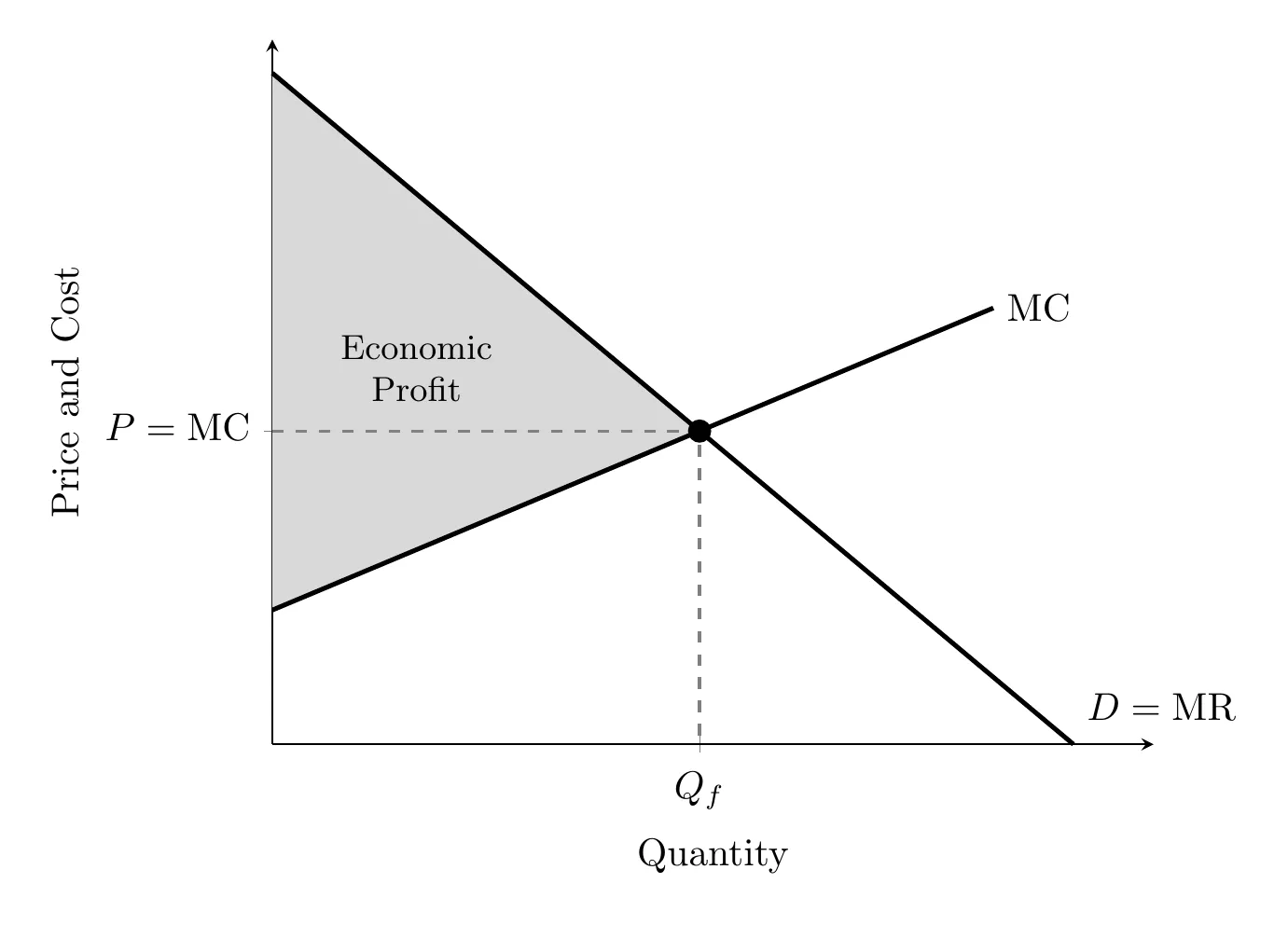
Example: take the monopoly from 4.2 (demand , MC = ATC = $4) and compare one price for everyone with perfect price discrimination:
Single-price monopoly | Perfect price discrimination | |
Quantity | 8 | 16 (where P = MC) |
Price | $12 for every buyer | Each buyer’s maximum, from $20 down to $4 |
Consumer surplus | ½ × 8 × $8 = $32 | $0 |
Profit (producer surplus) | $8 × 8 = $64 | ½ × 16 × $16 = $128 |
Deadweight loss | ½ × 8 × $8 = $32 | $0 |
Perfect price discrimination creates the same $128 of total surplus as a competitive market, but the firm keeps all of it.
Bottom line: price discrimination boosts a monopoly’s profit substantially, but it usually wipes out consumer surplus. By pricing according to demand elasticity, firms can expand to the allocatively efficient quantity, eliminating the deadweight loss you’d see in a single-price monopoly.