

4.4 - Monopolistic Competition
Market Characteristics
Monopolistic competition blends features of perfect competition and monopoly:
- Many sellers: highly competitive, lots of firms.
- Low entry barriers: cheap to start, minimal regulation.
- Product differentiation: goods aren’t identical, they’re differentiated by brand, quality, or features. Example: independent coffee shops. They all sell lattes, but differ on bean origin, vibe, and branding.
- Advertising: firms typically advertise to set their product apart and build brand loyalty. If it works, demand for the firm’s product increases and becomes less elastic, since buyers see fewer close substitutes. Advertising also costs money, which raises ATC. It’s a form of non-price competition (competing on brand, quality, location, or service instead of price).
- Long-run profit: thanks to low barriers, firms settle at zero economic profit (normal profit) in the long run.
Demand and Marginal Revenue
Since products are differentiated, firms are price seekers with downward-sloping demand.
- Raising price loses some customers to substitutes, but not all, thanks to brand loyalty.
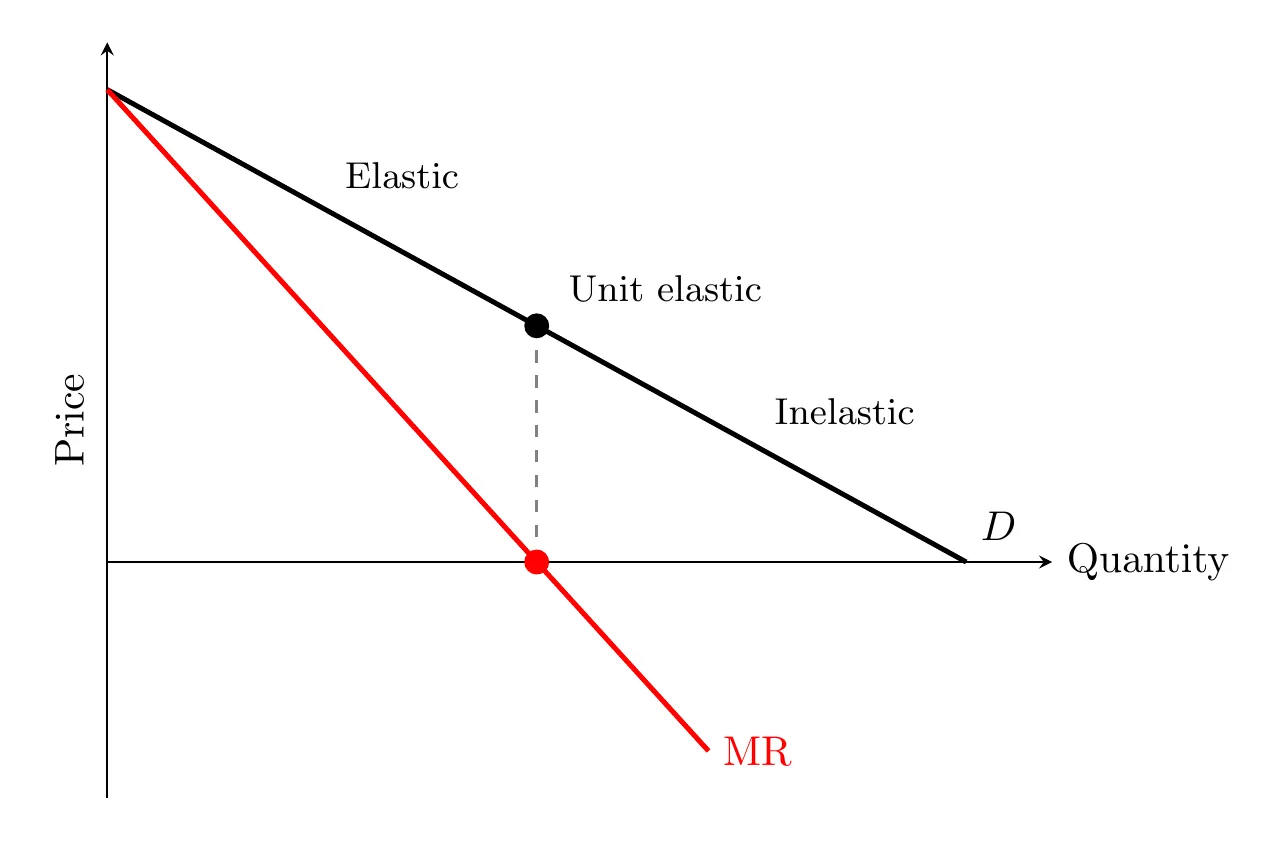
- To sell more, the firm has to lower price on the new unit and every unit before it, so MR < price, and MR graphs below demand.
- Elasticity zones: elastic where MR is positive, unit elastic where MR is zero (revenue maximized), inelastic where MR is negative.
Short-Run Outcomes
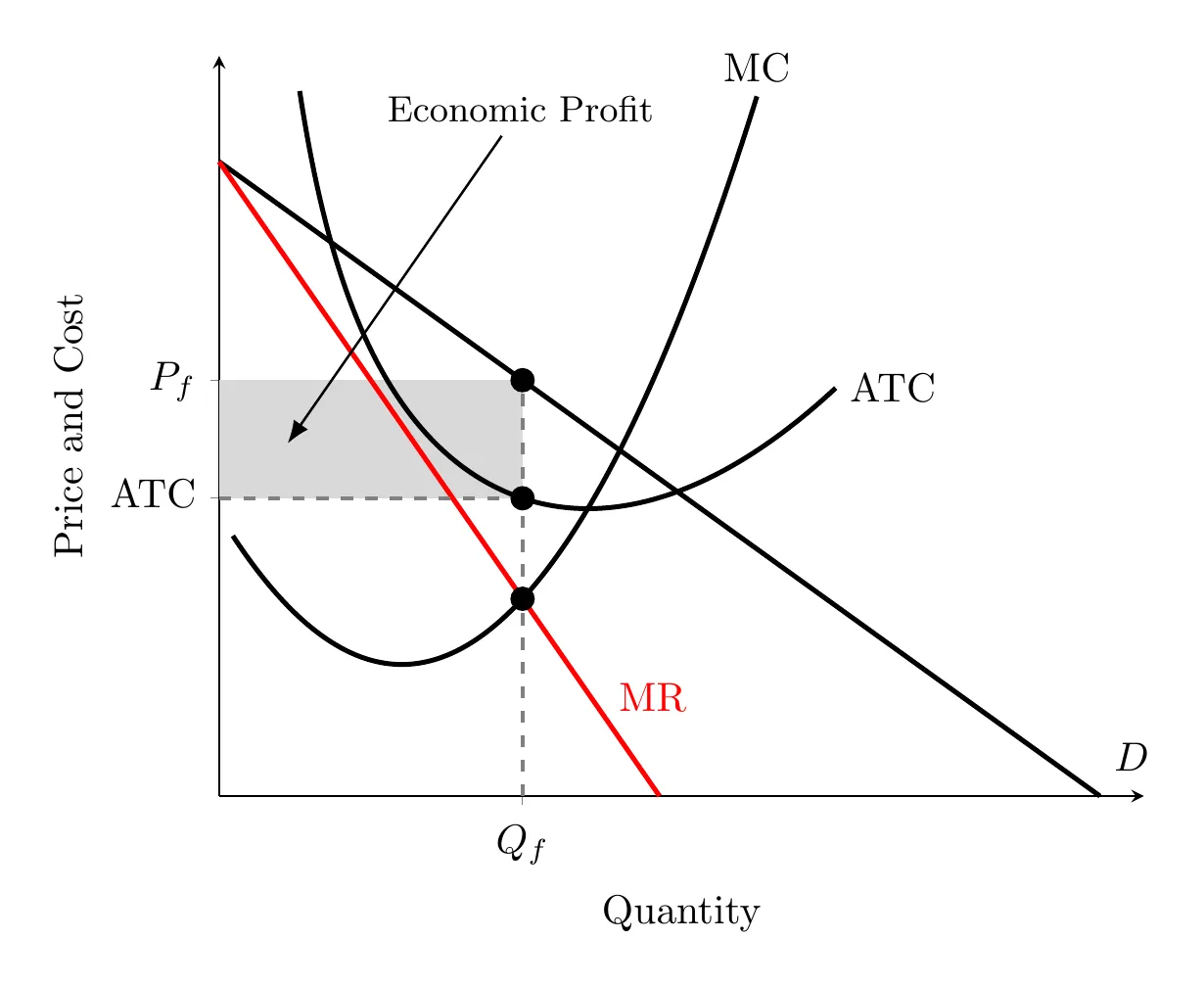
Firms follow MR = MC to maximize profit or minimize loss.
- Economic profit: ATC below price at that quantity.
- Economic loss: ATC above price.
- Breaking even: ATC equal to price, so zero economic profit (normal profit).
- Operating decision: a losing firm stays open as long as price exceeds AVC, since it can still cover variable costs and chip away at fixed costs.
Long-Run Equilibrium
Short-run profits and losses don’t last, thanks to easy entry and exit.
- When profits exist: new firms enter chasing gains, adding substitutes. This shifts the individual firm’s demand and MR curves left and makes demand more elastic.
- When losses exist: firms exit, leaving remaining firms a bigger share. Demand and MR shift right and become less elastic.
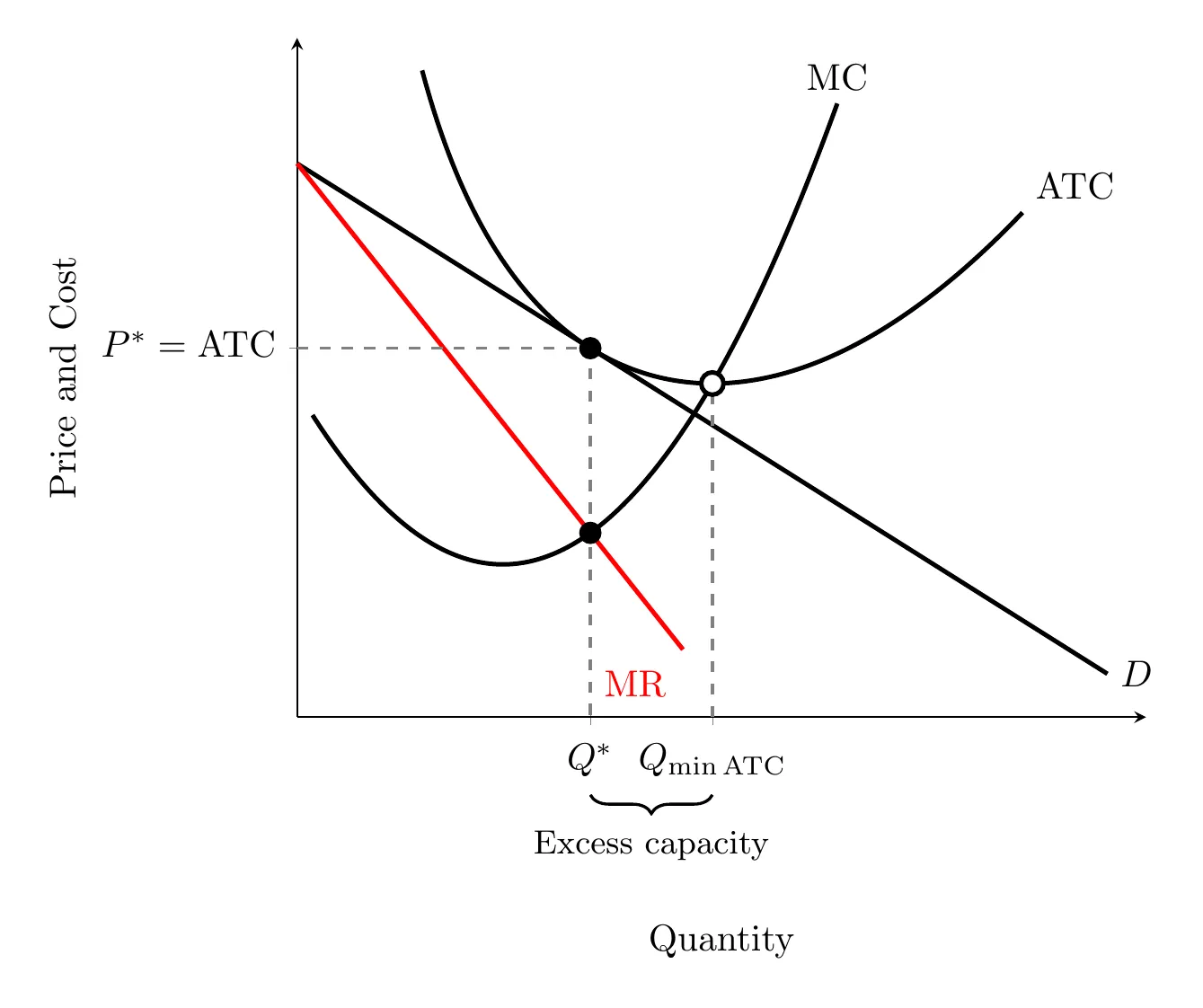
- Equilibrium: entry and exit continue until firms break even, graphically, ATC becomes tangent to demand right at the MR = MC quantity.
Efficiency and the “Variety Benefit”
Monopolistic competition doesn’t hit the efficiency standards of perfect competition.
- Productive inefficiency: firms produce on the downward-sloping part of ATC, not at the lowest possible cost, this gap is called excess capacity.
- Allocative inefficiency: price sits above marginal cost (a markup), so firms under-produce, creating deadweight loss.
- The trade-off: despite the inefficiency, differentiation gives real value through variety, having lots of choices (sneaker brands, restaurant styles) can outweigh the efficiency cost.
Changes in Costs
- Fixed cost changes (like a lump-sum tax): shift ATC only. Short-run price and quantity stay the same, but profits or losses can appear. Advertising is different: it adds a fixed cost, but if it works it also raises demand, so price and quantity can change.
- Variable cost changes (like a per-unit tax or higher wages): shift both MC and ATC, leading to a new price and quantity.
Bottom line: monopolistically competitive markets have many sellers and differentiated products. Firms can see short-run swings, but low barriers push them to a normal profit in the long run. They’re technically inefficient, producing with excess capacity and a price markup, but society gains real value from the resulting variety.