

4.1 - Introduction to Imperfectly Competitive Markets
The Spectrum
Perfect competition is a useful theoretical model, but most real businesses actually operate somewhere on the imperfect competition spectrum, categorized by number of sellers and product uniqueness:
Monopolistic competition
- Many sellers, differentiated products.
- Low entry/exit barriers.
- Zero economic profit in the long run, just like perfect competition, since new competitors compete away any extra gains.
- Example: local hair salons. There are tons of them, and while they all cut hair, they differentiate on style, brand, and experience, giving them some pricing power.
Oligopoly
- A few large firms dominate.
- Very high entry barriers, huge startup costs, heavy regulation, or strong brand loyalty.
- Example: wireless carriers. A handful of giant companies control almost the whole market because building the infrastructure is so expensive.
Monopoly
- One seller dominates the entire market.
- The good has no close substitutes.
- Entry is essentially impossible.
- Example: a local water or electric utility, the only provider in town, with real pricing power.
These three are all product markets, where firms sell goods and services. Imperfect competition also shows up in factor markets, where firms buy resources like labor:
Monopsony
- One buyer of a resource instead of one seller (a monopoly on the buying side).
- Usually a single big employer that hires most of the workers in an area, which gives it the power to set the wage.
- Example: a large hospital in a small town that hires nearly all of the area’s nurses.
- Covered in Unit 5 (5.4 - Monopsonistic Markets).
Barriers to Entry
In perfect competition, economic profit pulls in new firms until the profit is gone. Barriers to entry are anything that makes it hard for new firms to get into a market. They weaken that incentive to enter, which is how imperfectly competitive markets last over time. The main types:
- High fixed (start-up) costs: a new firm has to spend a huge amount before it sells a single unit, like building a power plant or a nationwide cell network. Big firms already in the market also have economies of scale, so a small newcomer would have higher costs per unit and couldn’t match their prices.
- Legal barriers: the government limits who can sell. A patent gives an inventor the only right to sell a new product (like a new medicine) for about 20 years. Copyrights, licenses, and government franchises (like a city letting only one company provide water) work the same way.
- Exclusive ownership of a key resource: one firm controls an input that every competitor would need. Example: for most of the 1900s, De Beers controlled most of the world’s supply of rough diamonds.
Low barriers (monopolistic competition) let new firms enter until long-run economic profit is zero. High barriers (oligopoly and monopoly) let firms keep earning economic profit in the long run.
Demand Curves and Pricing Power
Unlike price-taking competitive firms, imperfectly competitive firms are price seekers.
- Downward-sloping demand: with some pricing power, these firms have to lower price to sell more.
- MR < Price: to sell one more unit, the firm has to lower the price on all previous units too, so marginal revenue falls faster than price.
- Example: a firm sells 2 units at $8 each (TR = $16). To sell a 3rd unit, it has to drop the price to $7 for all three (TR = $21). MR of the 3rd unit is $21 − $16 = $5, less than its $7 price: the firm gains $7 from the new sale but loses $1 on each of the 2 units it used to sell for $8.
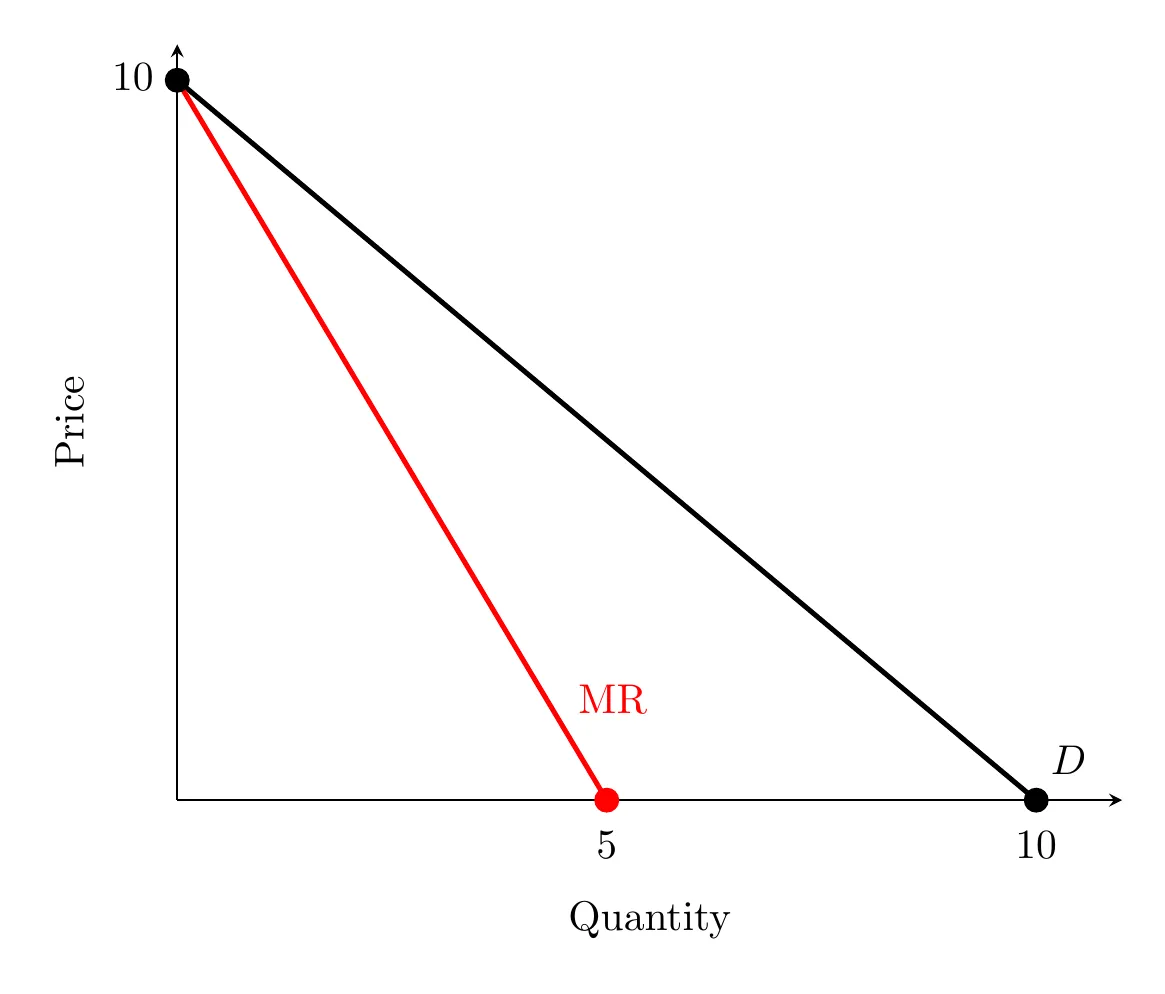
- Graph rule: MR always sits below demand, and typically falls about twice as fast.
- Straight-line demand: MR starts at the same point on the price axis but is exactly twice as steep, so it hits the quantity axis halfway to where demand does. In the graph below, demand is and MR is , so MR hits zero at Q = 5 and demand reaches the axis at Q = 10.
Efficiency and Market Failure
Perfectly competitive firms hit . Imperfectly competitive firms don’t:
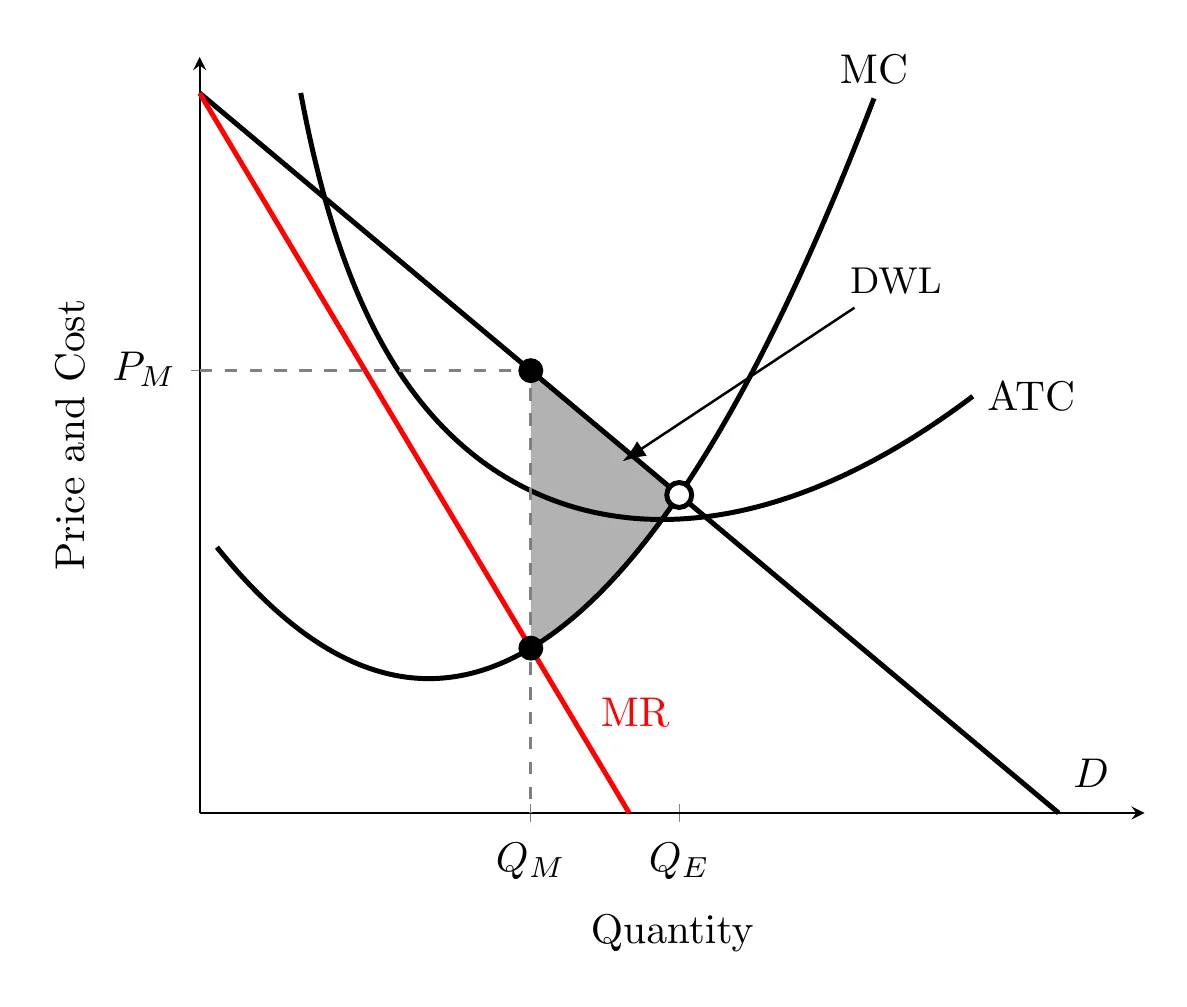
- They still produce where MR = MC.
- But they charge the highest price consumers will bear, found up on the demand curve.
- Since at that quantity, they’re allocatively inefficient, under-producing and overcharging.
- This creates deadweight loss, since the firm doesn’t produce the quantity society actually values most (where MC meets demand).
- Why the price sends the wrong signal: price shows how much buyers value one more unit (their marginal benefit). Since , some buyers would gladly pay more than it costs to make another unit, but the firm won’t sell it to them, because it would have to cut the price on every unit. So unlike in perfect competition, the price doesn’t lead buyers and sellers to make every trade that’s worth making, and those missing trades are the deadweight loss.
Bottom line: most modern businesses are price seekers in imperfectly competitive markets, ranging from monopolistic competition all the way to monopoly. Because they must lower prices to sell more, MR always sits below price. This leads to restricted output, higher prices, and deadweight loss for society.