

6.1 - Socially Efficient and Inefficient Market Outcomes
Defining Market Failure
Free markets are often efficient, but a market failure happens when a market doesn’t reach the socially optimal (allocatively efficient) outcome, meaning it doesn’t produce the quantity society actually wants.
The Socially Optimal Standard
The socially optimal outcome happens where Marginal Social Benefit (MSB) equals Marginal Social Cost (MSC). Just like individuals weigh their own costs and benefits, society is best off continuing an activity as long as MSB ≥ MSC. If output lands above or below that point, you get a triangle of deadweight loss.
This is what social efficiency (also called allocative efficiency) means: the marginal benefit of consuming the last unit equals the marginal cost of producing it. At that quantity, total economic surplus (the total gain to everyone: consumers, producers, and anyone else affected) is as big as it can get. Stop short and you skip units that were worth more than they cost. Go past it and you make units that cost more than they’re worth.
Sources of Market Failure
1. Externalities: costs or benefits landing on people not involved in the transaction.
- Negative externalities (like pollution) impose costs on bystanders, so the free market over-produces relative to the social optimum.
- Positive externalities (like a neighborhood’s security cameras) benefit bystanders, so the market under-produces since buyers don’t factor in the extra benefit to others.
2. Monopoly power: monopolies and other imperfectly competitive firms (oligopolies and monopolistically competitive firms) under-produce and overcharge, since price exceeds marginal cost, missing the socially optimal quantity. All of them face a downward-sloping demand curve, so selling more means cutting price, and they stop short of the quantity where .
3. Monopsony: under-hires and under-pays workers relative to a competitive market. Reaching the social optimum would mean hiring more and paying more, where social cost and benefit of labor line up.
4. Public goods: since people can free ride on goods that are non-excludable, private firms can’t get enough people to pay, so they produce too little or none at all (see 6.3).
5. Asymmetric information: one side of a deal knows more than the other, so people can’t judge what they’re really paying for. In the used car market, sellers know whether their car is a lemon, but buyers can’t tell, so buyers only offer an average price. Owners of good cars won’t sell for that, so they drop out, and fewer trades happen than would be efficient. Insurance has the same problem: the people most eager to buy coverage are often the ones who know they’re high risk. Fixes include warranties, inspections, and disclosure or licensing laws.
Private Incentives vs. Social Efficiency
Market failures don’t happen because people act irrationally. They happen because each buyer and seller makes the best choice for themselves, and the best private choice isn’t always the best one for society.
- Private MB = private MC: rational agents keep going until their own marginal benefit equals their own marginal cost. If some benefits or costs land on other people, that private stopping point misses the social optimum. A driver weighs the cost of gas and time, not the smog everyone else breathes, so people drive more than is socially efficient.
- Market power: a firm’s ability to raise its price above marginal cost without losing all of its customers. Firms use it for their own gain: a monopolist earns the most profit at MR = MC, which means making less than the socially optimal quantity and charging a price above MC. Smart for the firm, inefficient for society.
- Cost-benefit analysis: policymakers use the same marginal thinking to pick a fix. They compare what a policy gains (the deadweight loss it removes) with what it costs (running it, enforcing it, and any new inefficiency it creates), then choose the option with the biggest net benefit. If no option is worth its cost, leaving the market alone can be the best call.
- Designing the fix: a market inefficiency is eliminated when a policy gets the market to produce the quantity where MSB = MSC. A per-unit tax equal to the external cost, a per-unit subsidy equal to the external benefit, or a price ceiling at on a monopoly all do this (more in 6.2 and 6.4).
Efficiency Across Structures
- Competitive markets (no externalities): the supply curve is MSC, demand is MSB, so the free-market equilibrium is already socially optimal.
- This only works when every social benefit and cost is internalized, meaning the buyers and sellers in the market feel all of it themselves. Then the market equilibrium quantity equals the socially optimal quantity, and total economic surplus (CS + PS) is maximized there. If some benefit or cost spills onto outsiders, the two quantities split apart (that’s an externality, 6.2).
- Perfectly competitive firms: maximizing profit at MR=MC also means , so no market failure.
- Imperfectly competitive firms: restrict output to where price (marginal benefit) is still above marginal cost, missing the social optimum.
Calculating Deadweight Loss
Producing any quantity other than the socially optimal one creates deadweight loss. On a graph it’s a triangle, so its area is :
- Base: the gap between the quantity produced and the socially optimal quantity.
- Height: the gap between MSB and MSC at the quantity produced.
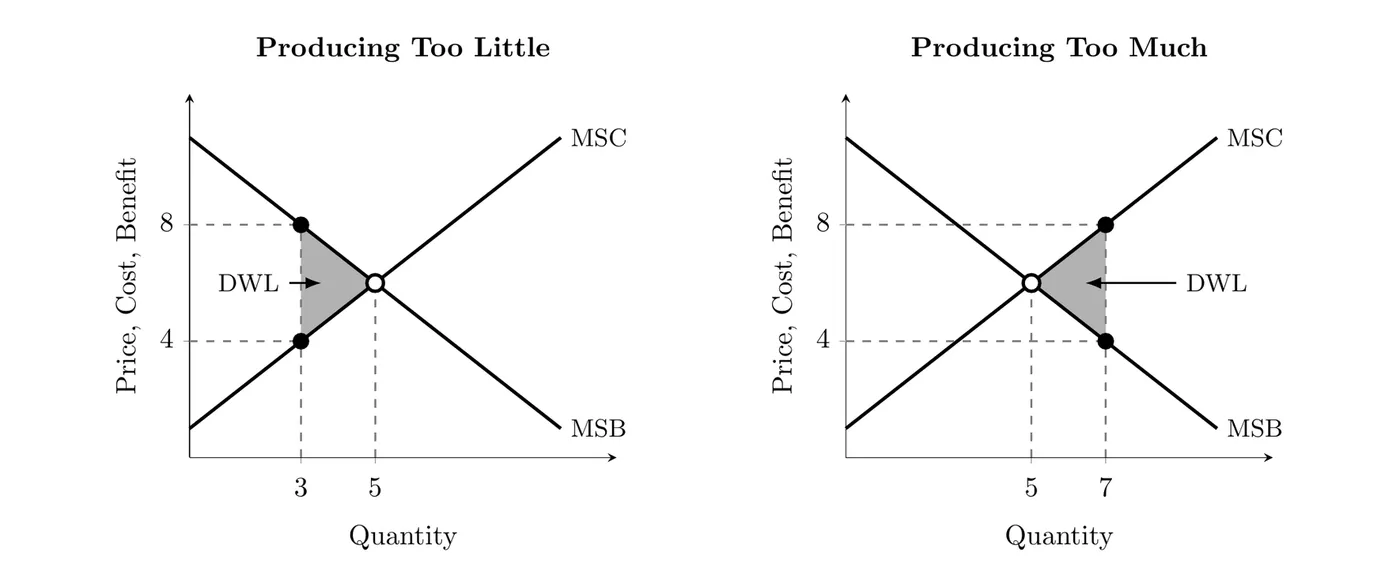
Example: here MSB is and MSC is . They cross where , so the socially optimal quantity is 5.
- Producing too little (Q = 3): at Q = 3, MSB = $8 but MSC = $4. The units between 3 and 5 were worth more than they cost but never got made. DWL = .
- Producing too much (Q = 7): at Q = 7, MSC = $8 but MSB = $4. The units between 5 and 7 cost more than they were worth. DWL = .
Bottom line: a market is socially efficient only when it accounts for every cost and benefit to society. Competitive markets usually get there on their own, but monopolies, monopsonies, and externalities distort output. That distortion means too much of a harmful good, or too little of a beneficial one, both showing up as deadweight loss.