

6.2 - Externalities
Understanding Externalities
An externality is a cost or benefit that lands on people who weren’t part of buying or producing a good.
- Negative externalities (spillover costs): pollution, traffic, unpleasant smells.
- Positive externalities (spillover benefits): beautiful music in a park, neighborhood upgrades, local security cameras.
Why externalities happen: they come from a lack of well-defined property rights and/or high transaction costs.
- No clear property rights: nobody owns the air or a river, so a factory can dump smoke or waste into it for free. If someone owned that river, the factory would have to pay them to use it.
- High transaction costs: even when rights are clear, striking a deal can cost too much. A factory can’t realistically negotiate with thousands of people living downwind.
- Private, not social: rational buyers and sellers respond to their own private costs and benefits, not external ones. The factory weighs its own production costs, not the town’s cleanup bill, so the external cost never enters its decision.
- Free riding: when a benefit is non-excludable, people can enjoy it without paying, so everyone has an incentive to let someone else pay. If most of your neighbors get a flu shot, you’re less likely to catch the flu even without one, which shrinks your own reason to get vaccinated.
Production vs. Consumption Externalities
In consumption (caused by the consumer):
- Negative: cigarette butts, smog from driving.
- Positive: a neighbor’s nice landscaping, or vaccinations, which protect people nearby who didn’t even get the shot.
In production (caused by the producer):
- Negative: factory pollution, pesticide runoff.
- Positive: bees pollinating a nearby orchard as a side effect of a honey farmer’s bees, or job safety training that benefits society broadly.
Graphical Analysis
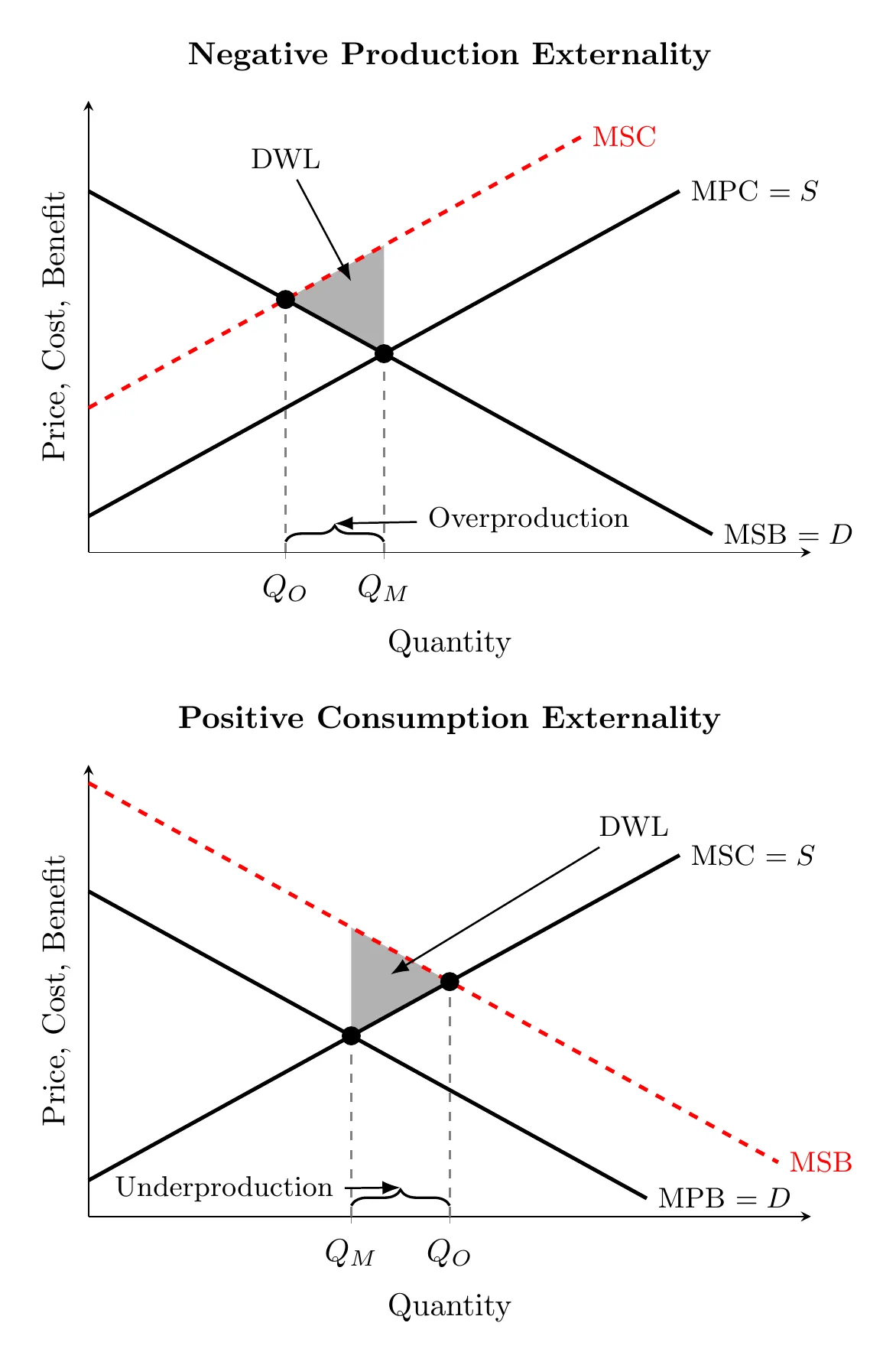
Negative production externalities: supply is Marginal Private Cost (MPC), demand is MSB. Since there’s an external cost, MSC sits above supply. The free market produces at the supply-demand crossing, but the social optimum () is where MSC = MSB, so the market over-produces.
Positive consumption externalities: supply is MSC, but demand is only Marginal Private Benefit (MPB). Since there’s an external benefit, MSB sits above demand. The social optimum is where MSB meets MSC, so the market under-produces.
Private vs. social curves: the social curve is the private curve plus the external part.
- , where MEC is the marginal external cost (the harm to outsiders from one more unit).
- , where MEB is the marginal external benefit.
- So the vertical gap between MPC and MSC (or between MPB and MSB) is the external cost (or benefit) per unit. When the gap is the same at every quantity, that’s exactly the per-unit tax (or subsidy) that fixes the market.
Government Interventions
- Correcting negative externalities: a per-unit tax on production, if set equal to the external cost, shifts supply left until quantity matches the social optimum. Other tools: quantity restrictions, cap-and-trade permits.
- Correcting positive externalities: a per-unit subsidy, set equal to the external benefit, shifts demand (or supply) right until it reaches the social optimum. Other tools: direct government provision.
- Environmental regulation: rules that limit pollution directly, like emission limits on factories or required pollution controls on cars. It cuts the external cost, though it can cost more than a tax since every firm has to cut back, even the ones for whom cutting is most expensive.
- Assigning property rights: give someone clear ownership of the resource. If a town owns the rights to its lake, a factory has to pay the town to dump waste there, so the pollution becomes part of the factory’s private cost.
- Reassigning property rights through private transactions: once rights are clear and transaction costs are low, the two sides can bargain. If the town holds the right, the factory can buy permission to pollute some. If the factory holds it, the town can pay the factory to pollute less. Either way they end up at the efficient amount without a tax (the Coase theorem). Cap-and-trade works the same way: the government caps total pollution and hands out permits, and firms buy and sell them, so the cuts happen at the firms that can make them most cheaply.
Bottom line: externalities are a clear market failure since price and quantity don’t reflect spillover effects on society. That means over-production of harmful goods and under-production of beneficial ones, both generating deadweight loss. Per-unit taxes fix negative externalities, per-unit subsidies fix positive ones, moving the market toward social efficiency.