Dove's LibraryDove's Library

8.1 - Finding the Average Value of a Function on an Interval

Related Ideas Worth Untangling First

These four things sound alike and get mixed up constantly.

Intermediate Value Theorem (Unit 1)

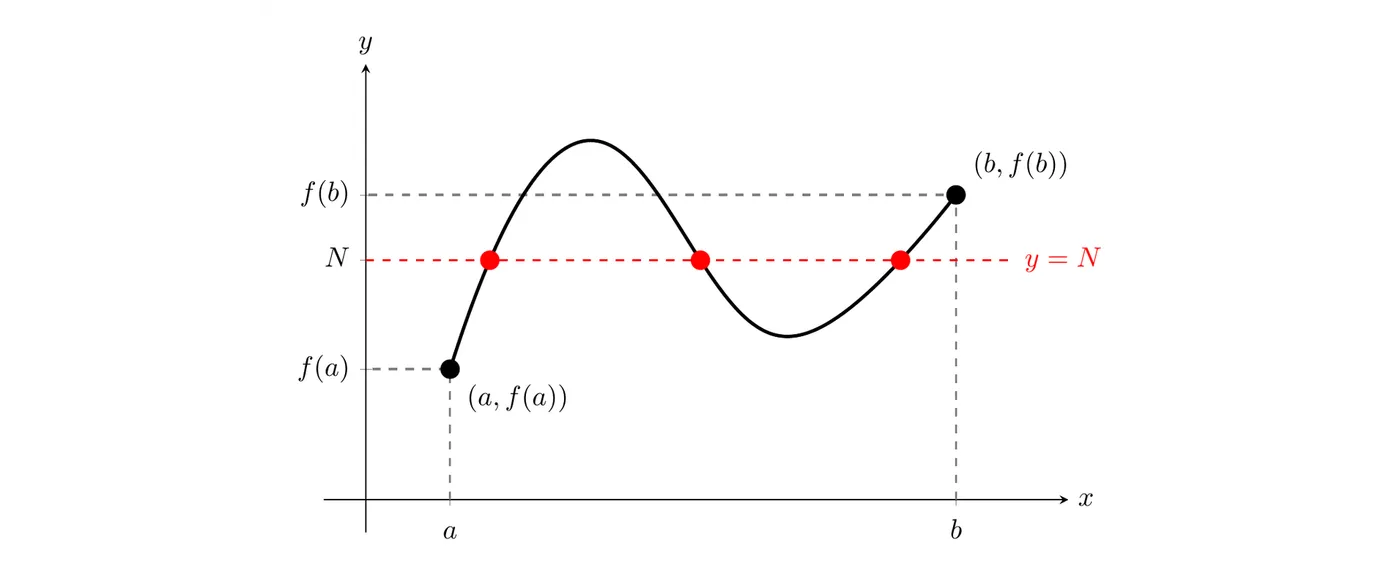
If f(x)f(x) is continuous on [a,b][a, b], then ff takes on every value between f(a)f(a) and f(b)f(b) somewhere in the interval.
8.1 - Finding the Average Value of a Function on an Interval

Average Rate of Change (Unit 2)

Average Rate of Change=ΔyΔx=f(b)−f(a)b−a\text{Average Rate of Change} = \frac{\Delta y}{\Delta x} = \frac{f(b) - f(a)}{b - a}
That’s the slope of the secant line connecting (a,f(a))(a, f(a)) and (b,f(b))(b, f(b)).

Mean Value Theorem (Unit 5)

If ff is continuous on [a,b][a, b] and differentiable on (a,b)(a, b), there’s at least one point cc in (a,b)(a, b) where
f′(c)=f(b)−f(a)b−af'(c) = \frac{f(b) - f(a)}{b - a}
In other words, the instantaneous rate of change equals the average rate of change somewhere.

Average Value of a Function

For a continuous function f(x)f(x) on [a,b][a, b]:
favg=1b−a∫abf(x) dxf_{\text{avg}} = \frac{1}{b - a} \int_a^b f(x) \, dx
In words: integrate the function over the interval, then divide by the length of the interval.
Intuition: the integral adds up all the y-values (weighted by width), and dividing by (b−a)(b - a) turns that total into an average.

Example 1: Finding Average Value

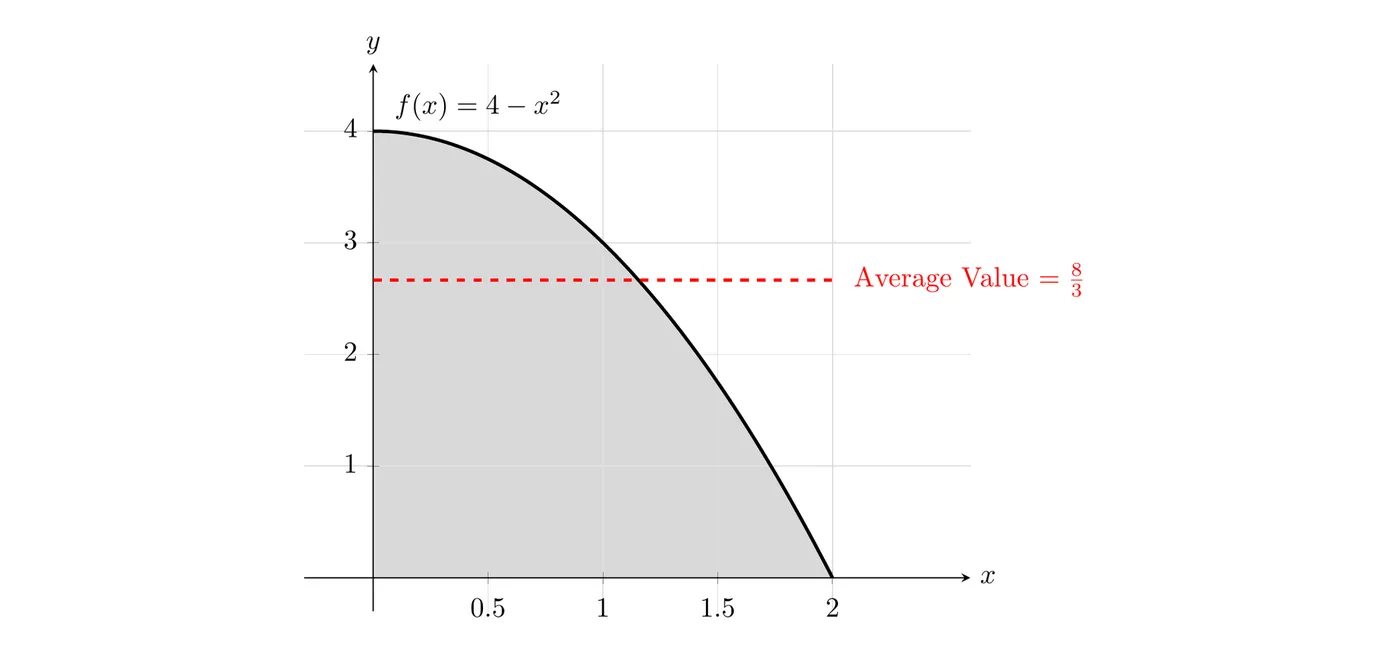
Find the average value of f(x)=4−x2f(x) = 4 - x^2 on [0,2][0, 2].
Step 1: Set up.
favg=12∫02(4−x2) dxf_{\text{avg}} = \frac{1}{2} \int_0^2 (4 - x^2) \, dx
Step 2: Evaluate.
=12[4x−x33]02=12[8−83]=12⋅163=83= \frac{1}{2} \left[4x - \frac{x^3}{3}\right]_0^2 = \frac{1}{2}\left[8 - \frac{8}{3}\right] = \frac{1}{2} \cdot \frac{16}{3} = \frac{8}{3}
Answer: 83≈2.67\frac{8}{3} \approx 2.67
8.1 - Finding the Average Value of a Function on an Interval

Example 2: Where Does the Function Equal Its Average?

Continuing from Example 1, at what xx does f(x)=4−x2f(x) = 4 - x^2 equal its average value of 83\frac{8}{3}?
4−x2=83⇒x2=43⇒x=±2334 - x^2 = \frac{8}{3} \quad \Rightarrow \quad x^2 = \frac{4}{3} \quad \Rightarrow \quad x = \pm\frac{2\sqrt{3}}{3}
We only care about [0,2][0, 2], so take the positive value:
x=233≈1.155x = \frac{2\sqrt{3}}{3} \approx 1.155

Example 3: Average Height

A ball’s height in feet is h(t)=−16t2+48t+5h(t) = -16t^2 + 48t + 5, with tt in seconds. Find the average height from t=0t = 0 to t=2t = 2.
Key insight: “average height” means average value of h(t)h(t).
havg=12∫02(−16t2+48t+5) dth_{\text{avg}} = \frac{1}{2} \int_0^2 (-16t^2 + 48t + 5) \, dt=12[−16t33+24t2+5t]02=12[−1283+96+10]= \frac{1}{2} \left[-\frac{16t^3}{3} + 24t^2 + 5t\right]_0^2 = \frac{1}{2}\left[-\frac{128}{3} + 96 + 10\right]=12⋅1903=953≈31.67 feet= \frac{1}{2} \cdot \frac{190}{3} = \frac{95}{3} \approx 31.67 \text{ feet}

Critical Distinction: Average Value vs. Average Rate of Change

This is where people lose points.

Scenario: Given a Position Function

Say s(t)=t3−6t2+9ts(t) = t^3 - 6t^2 + 9t is position in meters, tt in seconds.
Question A: What is the average velocity from t=0t = 0 to t=3t = 3?
Velocity is the rate of change of position, so use the slope formula:
vavg=s(3)−s(0)3−0v_{\text{avg}} = \frac{s(3) - s(0)}{3 - 0}
Question B: What is the average of the velocity from t=0t = 0 to t=3t = 3?
First find v(t)=s′(t)=3t2−12t+9v(t) = s'(t) = 3t^2 - 12t + 9, then take its average value:
vavg=13∫03(3t2−12t+9) dtv_{\text{avg}} = \frac{1}{3} \int_0^3 (3t^2 - 12t + 9) \, dt
Here’s the thing: both methods give the same answer. By the Fundamental Theorem of Calculus,
1b−a∫abv(t) dt=1b−a∫abs′(t) dt=s(b)−s(a)b−a\frac{1}{b-a}\int_a^b v(t) \, dt = \frac{1}{b-a}\int_a^b s'(t) \, dt = \frac{s(b) - s(a)}{b-a}

Example 4: Rate Function Context

Water flows into a tank at a rate of
R(t)=5+2sin⁡(t) gallons per minuteR(t) = 5 + 2\sin(t) \text{ gallons per minute}
with tt in minutes.

Part A: Average Rate

Question: what is the average rate of flow from t=0t = 0 to t=πt = \pi?
R(t)R(t) is already a rate, and we want the average value of that rate:
Ravg=1π∫0π(5+2sin⁡t) dt=1π[5t−2cos⁡t]0πR_{\text{avg}} = \frac{1}{\pi} \int_0^\pi (5 + 2\sin t) \, dt = \frac{1}{\pi}\left[5t - 2\cos t\right]_0^\pi=1π[(5π+2)−(−2)]=5π+4π=5+4π≈6.27 gal/min= \frac{1}{\pi}\left[(5\pi + 2) - (-2)\right] = \frac{5\pi + 4}{\pi} = 5 + \frac{4}{\pi} \approx 6.27 \text{ gal/min}

Part B: Average Change in the Rate

Question: what is the average change of the rate from t=0t = 0 to t=πt = \pi?
Now we want the rate of change of the rate, so use the slope formula:
R(π)−R(0)π−0=[5+2sin⁡π]−[5+2sin⁡0]π=5−5π=0\frac{R(\pi) - R(0)}{\pi - 0} = \frac{[5 + 2\sin\pi] - [5 + 2\sin 0]}{\pi} = \frac{5 - 5}{\pi} = 0
Units here are gallons per minute per minute.

Decision Tree: Which Formula?

First ask: is the given function already a rate?
If NO (it’s a position, area, population, etc.):
Question asks for
Use
Average value of the function
1b−a∫abf(x) dx\frac{1}{b-a}\int_a^b f(x)\,dx
Average rate of change
f(b)−f(a)b−a\frac{f(b) - f(a)}{b - a}
If YES (it’s a velocity, growth rate, flow rate, etc.):
Question asks for
Use
Average rate
1b−a∫abR(x) dx\frac{1}{b-a}\int_a^b R(x)\,dx (average value)
Average change of the rate
R(b)−R(a)b−a\frac{R(b) - R(a)}{b - a} (slope)

Example 5: Complete Problem

Let f(x)=x2−4x+5f(x) = x^2 - 4x + 5 on [1,4][1, 4].
Part A: Average value of ff.
favg=13∫14(x2−4x+5) dx=13[x33−2x2+5x]14f_{\text{avg}} = \frac{1}{3} \int_1^4 (x^2 - 4x + 5) \, dx = \frac{1}{3}\left[\frac{x^3}{3} - 2x^2 + 5x\right]_1^4
At x=4x = 4: 643−32+20=643−12\frac{64}{3} - 32 + 20 = \frac{64}{3} - 12
At x=1x = 1: 13−2+5=13+3\frac{1}{3} - 2 + 5 = \frac{1}{3} + 3
=13[633−15]=13[21−15]=63=2= \frac{1}{3}\left[\frac{63}{3} - 15\right] = \frac{1}{3}\left[21 - 15\right] = \frac{6}{3} = 2
Average value: 22
Part B: Average rate of change on [1,4][1, 4].
f(4)−f(1)4−1=5−23=1\frac{f(4) - f(1)}{4 - 1} = \frac{5 - 2}{3} = 1
Part C: Find all cc in [1,4][1, 4] where f(c)=favgf(c) = f_{\text{avg}}.
x2−4x+5=2⇒x2−4x+3=0⇒(x−1)(x−3)=0x^2 - 4x + 5 = 2 \quad \Rightarrow \quad x^2 - 4x + 3 = 0 \quad \Rightarrow \quad (x-1)(x-3) = 0c=1 and c=3c = 1 \text{ and } c = 3
Both are in [1,4][1, 4].

Calculator Tips

Common mistake: computing only ∫abf(x) dx\int_a^b f(x)\,dx and forgetting to divide by (b−a)(b - a).
Correct approach:
(1/(b-a)) * fnInt(f(x), x, a, b)
Reusing functions: store the function in Y₁, then reference it as Y₁ in your calculations. Y₁(3) evaluates it at x=3x = 3.

Common Mistakes

Mistake 1: confusing average value with average rate. Given a position function s(t)s(t), average velocity is s(b)−s(a)b−a\frac{s(b) - s(a)}{b - a} or 1b−a∫abv(t) dt\frac{1}{b-a}\int_a^b v(t)\,dt, NOT 1b−a∫abs(t) dt\frac{1}{b-a}\int_a^b s(t)\,dt.
Mistake 2: forgetting the 1b−a\frac{1}{b-a} factor. The integral alone gives total accumulation, not an average.
Mistake 3: misreading the function type. Always ask whether you’ve been handed an amount or a rate.
Mistake 4: wrong units. Average value carries the same units as the function’s outputs. The average of a height in feet is in feet, and the average of a flow rate in gallons per minute is in gallons per minute (like Example 4, Part A). Dividing by (b−a)(b - a) cancels the time unit the integral picked up, so you never tack on an extra “per time.”

Key Takeaways

  • Average value formula: favg=1b−a∫abf(x) dxf_{\text{avg}} = \frac{1}{b - a} \int_a^b f(x) \, dx
  • Don’t forget the 1b−a\frac{1}{b-a} on the calculator
  • Average rate of change uses the slope formula: f(b)−f(a)b−a\frac{f(b) - f(a)}{b - a}
  • The Mean Value Theorem guarantees f′(c)=f(b)−f(a)b−af'(c) = \frac{f(b) - f(a)}{b - a} for some cc
  • Read carefully: is the given function a rate or an amount? That decides the formula
  • The average of a rate uses the average value formula (an integral)
  • Average velocity can be computed either way, they agree
  • Average value has the same units as the function’s output

AP® is a registered trademark of the College Board, which is not affiliated with Dove's Library and was not involved in the production of, and does not endorse, this website.

Providing free, high-quality AP notes to help students succeed, earn college credit, and reach their educational goals, ensuring everyone has access to the resources they need.

© 2026 Standard Learning Group, Inc., which operates Dove's Library. All rights reserved.