

2.2 - Intramolecular Force and Potential Energy
Overview
When two atoms form a bond, their potential energy drops. A graph of potential energy against the distance between the two nuclei shows how far apart bonded atoms sit (the bond length) and how much energy it takes to pull them apart (the bond energy). This topic shows how to read and sketch that graph, why some bonds are shorter and stronger than others, and how Coulomb's law predicts the strength of the attraction between ions.
Intramolecular forces are the forces inside a molecule or ionic compound: the covalent, ionic, and metallic bonds from Topic 2.1. Don't mix them up with intermolecular forces, the weaker attractions between separate molecules, which come in Unit 3. (Intra means within; inter means between.)
Potential energy and internuclear distance
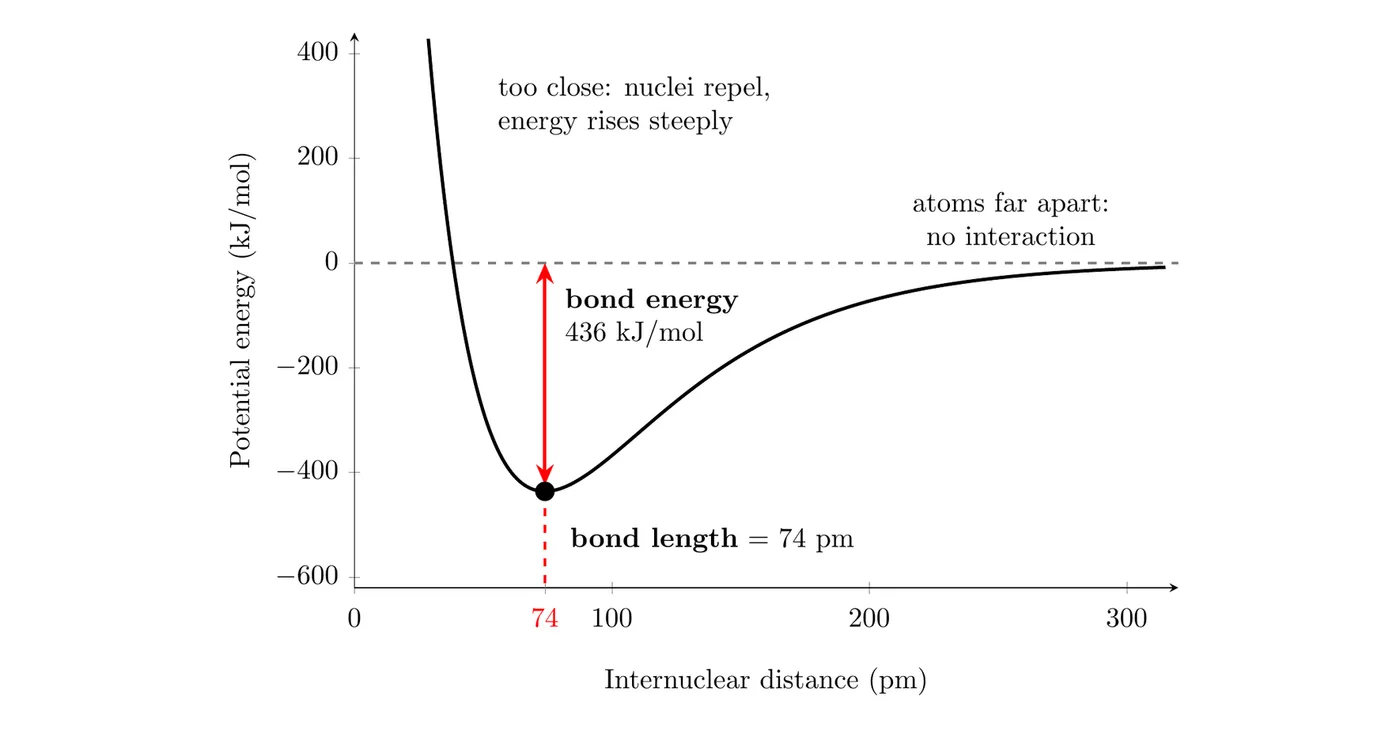
Picture two hydrogen atoms starting far apart and moving toward each other. The internuclear distance is the distance between their nuclei. As it changes, so does the potential energy of the pair, the energy stored in the interactions between their charged particles.
- Far apart. The atoms don't interact. By convention, the potential energy is zero here.
- Getting closer. Each nucleus starts attracting the other atom's electron. Attraction lowers the potential energy, so the curve dips below zero.
- Too close. The two nuclei (both positive) repel each other, and so do the two electrons. Repulsion takes over, and the potential energy shoots up above zero.
The bottom of the dip is where attraction and repulsion balance. That's where the atoms settle, and that's the bond.
Bond length and bond energy
- Bond length (the equilibrium bond length) is the internuclear distance at the minimum of the curve, where the potential energy is lowest. For , it's 74 pm.
- Bond energy is the energy needed to separate the bonded atoms completely: the depth of the well, measured from the minimum up to zero. For , it's 436 kJ/mol.
Distances are usually given in picometers () or angstroms (), and bond energies in kilojoules per mole of bonds.
Breaking bonds takes energy
A very common misconception is that breaking a bond releases energy. It doesn't. On the graph, going from the bottom of the well back up to zero means the potential energy goes up, so energy has to be added. Breaking a bond always requires energy, and forming a bond always releases energy. When two H atoms form , 436 kJ is released per mole of bonds formed, and the same 436 kJ/mol has to be put back in to break them:
A reaction gives off energy only when the new bonds that form are stronger than the bonds that break. Unit 6 builds on this.
Sketching the curve on the exam
Free-response questions sometimes ask you to draw or add to this graph. Get these features right:
- Label both axes with the quantity and units: potential energy (kJ/mol) up the side, internuclear distance (pm) along the bottom.
- Level off at zero on the right, where the atoms are far apart.
- Dip to a single minimum at the bond length. The depth below zero is the bond energy.
- Rise steeply on the left, well above zero, because repulsion grows very fast at short distances.
Example 1: Reading the energy needed to break bonds
Use the potential energy curve for above. (a) What are the bond length and bond energy? (b) How much energy is needed to break all the H-H bonds in 3.20 g of ? (c) How much energy, in joules, does it take to break one H-H bond?
(a) The minimum is at 74 pm, so the bond length is 74 pm. The well is 436 kJ/mol deep, so the bond energy is 436 kJ/mol.
(b) Convert grams to moles. Each molecule has one H-H bond, so moles of bonds equal moles of . The molar mass is g/mol.
It takes 692 kJ (3 significant figures, from 3.20 g and 436 kJ/mol). The extra digit in 1.587 mol was kept until the end so rounding doesn't creep in.
(c) Divide the energy per mole of bonds by Avogadro's number, after converting kJ to J:
What sets bond length and bond energy
Every pair of bonded atoms has its own curve. The CED names two factors that decide where its minimum sits: the size of the atoms and the bond order.
Atom size
Larger atoms have larger cores (more inner shells of electrons), so their nuclei can't get as close together. Bonds to larger atoms are longer, and because the shared electrons are farther from the nuclei, they're usually weaker:
Bond | Bond length (pm) | Bond energy (kJ/mol) |
H-F | 92 | 567 |
H-Cl | 127 | 431 |
H-Br | 141 | 366 |
H-I | 161 | 299 |
Going down group 17, the halogen atom gets larger, so the bond to hydrogen gets longer and weaker.
Bond order
Bond order is the number of electron pairs shared between two atoms: 1 for a single bond, 2 for a double bond, 3 for a triple bond. More shared electrons pull the two nuclei together more strongly, so bonds with a higher order are shorter and have larger bond energies.
Bond | Bond order | Bond length (pm) | Bond energy (kJ/mol) |
C-C | 1 | 154 | 348 |
C=C | 2 | 134 | 614 |
C≡C | 3 | 120 | 839 |
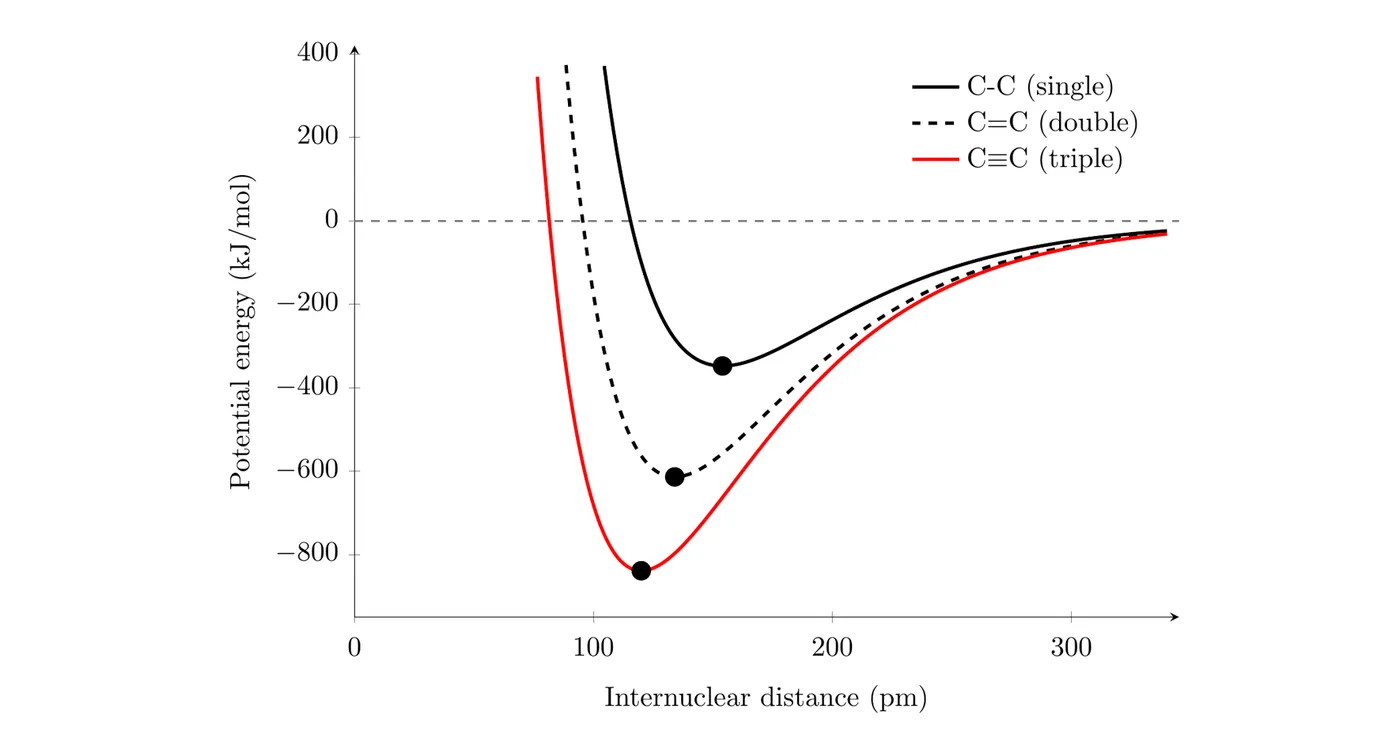
On the graph, a higher bond order shows up as a well that is deeper (larger bond energy) and shifted left (shorter bond). A triple bond is stronger than a single bond but not three times as strong: 839 kJ/mol is about 2.41 times 348 kJ/mol. Topic 2.7 explains why (the second and third bonds are pi bonds, which are weaker than the first).
The carbon values are averages over many compounds; the hydrogen halide values are for those single molecules. On the exam, use whatever values the question gives you.
Example 2: Matching curves to molecules (AP-style)
The graph shows potential energy curves for and . (a) Which curve represents ? Justify your answer. (b) Describe how the curve for would compare.
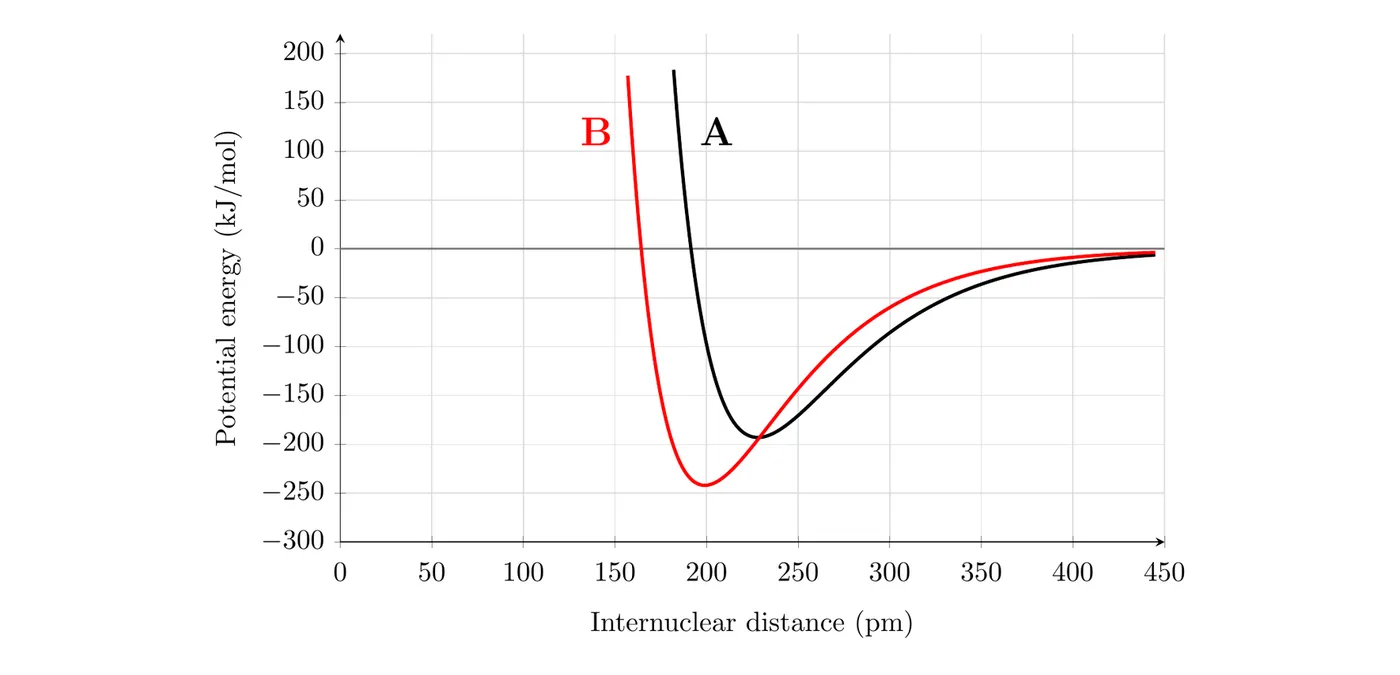
(a) Curve B is . Curve B has its minimum at a shorter distance (about 199 pm, versus about 228 pm for A) and a deeper well (about 242 kJ/mol, versus about 193 kJ/mol). A chlorine atom is smaller than a bromine atom because its valence electrons are in the third shell instead of the fourth, so two Cl nuclei can get closer together. The shorter bond holds the shared electrons closer to both nuclei, which makes it stronger.
(b) Iodine atoms are larger still, so the curve would have its minimum farther to the right than curve A (a longer bond) and a shallower well (a smaller bond energy). The measured values are 267 pm and 151 kJ/mol.
Coulomb's law and ionic interactions
In an ionic compound, the attraction is between cations and anions. Coulomb's law predicts how strong it is:
Here and are the charges on the two ions and is the distance between their centers (their nuclei). For ions that touch, is about the cation's radius plus the anion's radius. Two things follow:
- Larger charges mean stronger attraction. The force is proportional to the charge on each ion. A 2+ ion and a 2 ion attract four times as strongly as a 1+ ion and a 1 ion at the same distance, since .
- Smaller ions mean stronger attraction. The force increases as decreases, so smaller ions, whose centers can get closer, attract each other more strongly.
Stronger attraction between ions shows up as a higher melting point, because more energy is needed to pull the ions out of their places:
Compound | Ion charges | = sum of ionic radii (pm) | Melting point (°C) |
and | 102 + 133 = 235 | 993 | |
and | 102 + 181 = 283 | 801 | |
and | 102 + 196 = 298 | 747 | |
and | 102 + 220 = 322 | 661 | |
and | 72 + 140 = 212 | 2,852 |
In the sodium halides, the charges are the same, so size decides. The anion grows from to , so grows, the attraction weakens, and the melting point drops. beats all of them because its ions have double the charges and are smaller.
When the charges differ, charge usually matters more than size. Doubling both charges multiplies the force by 4, while realistic differences in ionic radius change by much less.
Example 3: Ranking ionic attractions with Coulomb's law (AP-style)
Rank , , and from strongest to weakest attraction between ions, and justify with Coulomb's law. Then estimate how many times stronger the attraction is in the strongest compound than in . Ionic radii: 138 pm, 102 pm, 100 pm, 181 pm, 140 pm.
Step 1: Compare charges. has 2+ and 2 ions. The other two have 1+ and 1 ions. Charge has the biggest effect, so is strongest.
Step 2: Compare sizes for the same charges. For , pm. For , pm. The smaller ion lets the centers get closer, so has the stronger attraction.
Ranking: . The melting points agree: 2,613 °C, 801 °C, and 770 °C.
Step 3: Estimate the ratio. For , pm. Set up the ratio of forces; the proportionality constant cancels:
The attraction in is about 5.6 times as strong. The charges account for a factor of 4 and the smaller distance for the rest.
Common mistakes
- Saying energy is released when a bond breaks. Breaking a bond always takes energy; forming one releases it.
- Reading the bond length where the curve crosses zero. The bond length is at the minimum of the curve.
- Giving the bond energy as a negative number. The minimum sits at kJ/mol on the graph, but the bond energy (the energy needed to break the bond) is +436 kJ/mol.
- Using one ion's radius for . In Coulomb's law, is the distance between the two nuclei, about the sum of the two radii.
- Forgetting charge. When the ions have different charges, compare charges first, then size.
- Mixing up intramolecular and intermolecular forces. Bonds are intramolecular (this unit); attractions between separate molecules are intermolecular (Unit 3).