

2.7 - VSEPR and Hybridization
Overview
A Lewis diagram tells you which atoms are connected. VSEPR theory turns that into a 3-D shape, and the shape decides the bond angles and whether the molecule is polar. This topic also covers hybridization (, , ), sigma and pi bonds, and how bond order sets bond length and strength. You need the Lewis diagram and VSEPR together to explain a molecule's structure (shape, angles, bond lengths) and its electron properties (polarity, hybridization, sigma and pi bonding), and the AP exam tests both all the time.
VSEPR theory
VSEPR stands for valence shell electron pair repulsion. The electron pairs around a central atom are all negatively charged, so by Coulomb's law they repel each other. They spread out as far apart as possible, and that lowest-repulsion arrangement sets the shape.
Counting electron domains
An electron domain is any region of electron density around the central atom. Each of these counts as one domain: a lone pair, a single bond, a double bond, or a triple bond. A double bond counts the same as a single bond, because all of its electrons point in the same direction.
Electron geometry vs. molecular geometry
- Electron-domain geometry: the arrangement of all the domains, bonds and lone pairs.
- Molecular geometry (the shape): the arrangement of the atoms only. Lone pairs take up space, but they aren't part of the shape's name.
With no lone pairs on the central atom, the two are the same. With lone pairs, they're different, and the AP exam almost always wants the molecular geometry. A handy shorthand is : A is the central atom, X is an atom bonded to it, and E is a lone pair on it. is .
The method:
- Draw the Lewis diagram (Topic 2.5).
- Count the electron domains on the central atom.
- Use the number of domains to get the electron-domain geometry.
- Use the number of lone pairs to get the molecular geometry.
Electron domains | Electron-domain geometry | Ideal bond angles |
2 | Linear | 180° |
3 | Trigonal planar | 120° |
4 | Tetrahedral | 109.5° |
5 | Trigonal bipyramidal | 90°, 120°, and 180° |
6 | Octahedral | 90° and 180° |
Molecular geometries and bond angles
Two and three domains
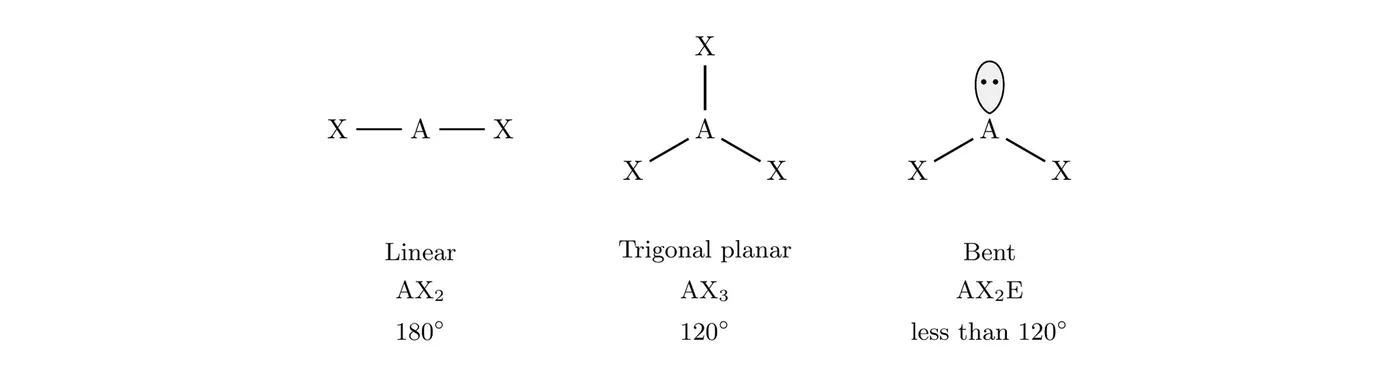
Two domains sit on opposite sides of the central atom (linear, 180°). Three point to the corners of a triangle (trigonal planar, 120°). If one of the three is a lone pair, the shape is bent and the angle squeezes a little below 120°.
Four domains, and why lone pairs squeeze bond angles
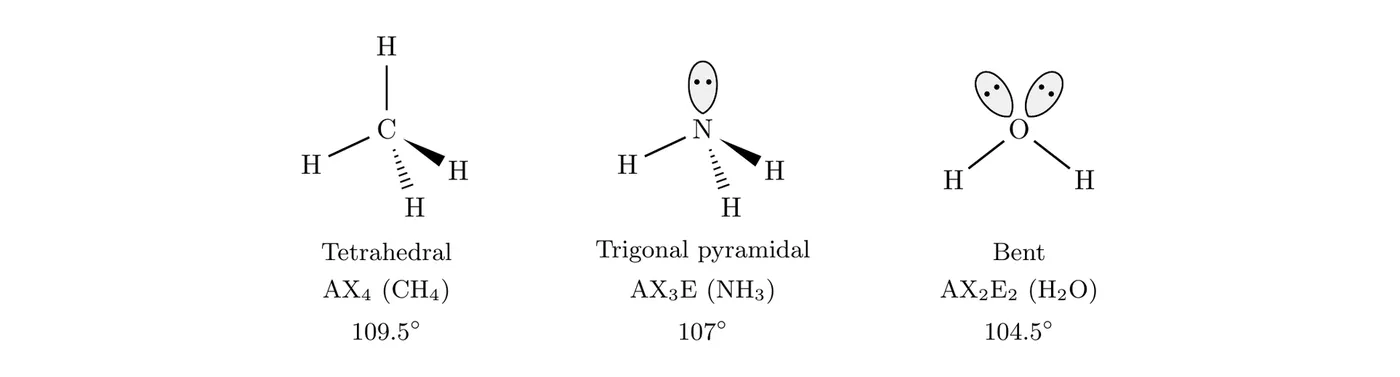
Lone pairs repel more strongly than bonding pairs. A bonding pair is pulled out between two nuclei, but a lone pair is held by only one nucleus, so it spreads out close to the central atom and pushes harder on its neighbors. The order is lone pair to lone pair > lone pair to bonding pair > bonding pair to bonding pair.
That's why the angle drops from 109.5° in to 107° in (one lone pair) to 104.5° in (two lone pairs), even though all three have four domains and a tetrahedral electron geometry. On the exam, "less than 109.5° because the lone pair repels more strongly" is the expected answer; you don't need the exact values.
Five domains
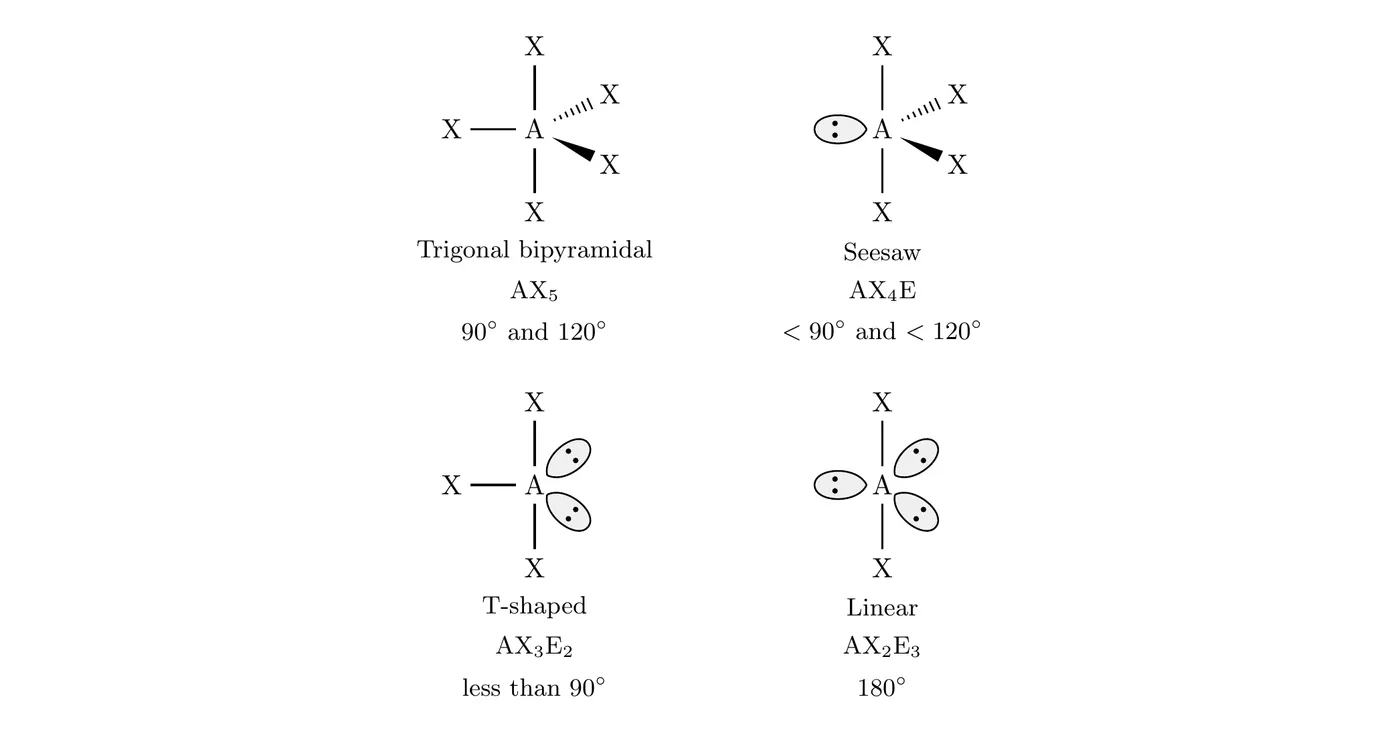
A trigonal bipyramid has two kinds of positions: two axial (straight up and down) and three equatorial (around the middle, 120° apart). Lone pairs always go equatorial, where they have only two neighbors at 90° instead of three. Replacing equatorial atoms with lone pairs one at a time gives seesaw, T-shaped, and linear.
Six domains
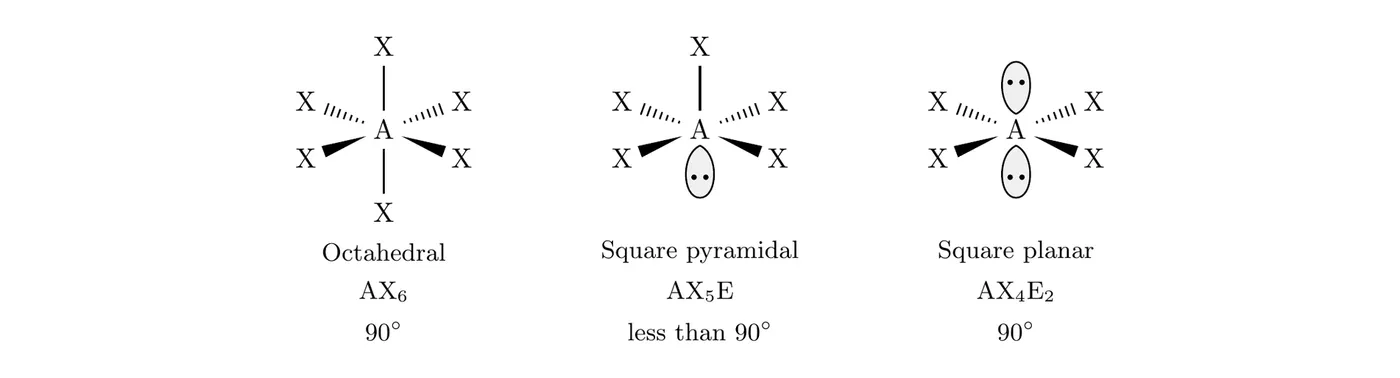
All six positions of an octahedron are equivalent, 90° from their neighbors. One lone pair gives a square pyramid. A second lone pair goes directly opposite the first (180° away), which leaves the four atoms in a flat square: square planar.
All the shapes
Domains | Bonded atoms | Lone pairs | Molecular geometry | Bond angle | Example |
2 | 2 | 0 | Linear | 180° | |
3 | 3 | 0 | Trigonal planar | 120° | |
3 | 2 | 1 | Bent | less than 120° | |
4 | 4 | 0 | Tetrahedral | 109.5° | |
4 | 3 | 1 | Trigonal pyramidal | less than 109.5° (107°) | |
4 | 2 | 2 | Bent | less than 109.5° (104.5°) | |
5 | 5 | 0 | Trigonal bipyramidal | 90° and 120° | |
5 | 4 | 1 | Seesaw | less than 90° and less than 120° | |
5 | 3 | 2 | T-shaped | less than 90° | |
5 | 2 | 3 | Linear | 180° | |
6 | 6 | 0 | Octahedral | 90° | |
6 | 5 | 1 | Square pyramidal | less than 90° | |
6 | 4 | 2 | Square planar | 90° |
Example 1: The nitrite ion (a double bond counts once)
Predict the shape and O-N-O bond angle of , and compare its two N-O bonds.
Step 1: valence electrons. Two single bonds use 4, the O atoms take 12 as lone pairs, and the last 2 go on N as a lone pair. N then has only 6 electrons, so one O lone pair becomes an N=O double bond. Either O can do it, so there are two resonance structures (each 3 bonding pairs + 6 lone pairs = 18 electrons).

Step 2: N has 2 bonds (the double bond counts as one domain) + 1 lone pair = 3 domains: trigonal planar electron geometry.
Answer: bent (), with an O-N-O angle a bit less than 120° (it measures about 115°). Because of resonance, both N-O bonds have a bond order of and the same length.
Example 2: Xenon tetrafluoride
Predict the shape of .
Step 1: valence electrons. Four Xe-F bonds use 8 (), the F octets use 24 (), and the last 4 go on Xe as two lone pairs. Xe is in period 5, so 12 electrons around it is allowed.
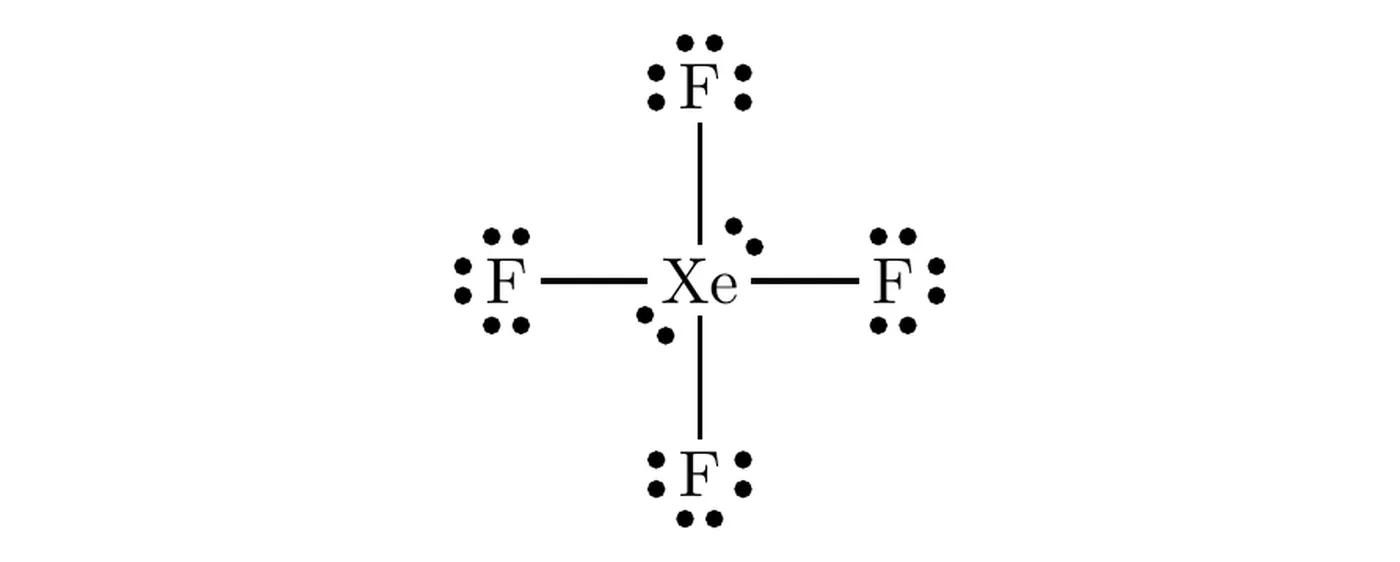
Check: 4 bonding pairs + 14 lone pairs = 18 pairs = 36 electrons.
Step 2: Xe has 4 bonds + 2 lone pairs = 6 domains: octahedral electron geometry.
Answer: the two lone pairs sit opposite each other, so the shape is square planar () with 90° F-Xe-F angles. The flat Lewis diagram doesn't show where the lone pairs really point, so always count domains instead of reading the shape off the drawing.
Hybridization
When an atom forms bonds, its valence and orbitals can be described as mixing into a new set of equal-energy hybrid atomic orbitals that point in the directions VSEPR predicts. The name tells you which orbitals mixed: means one and three orbitals, which make four hybrid orbitals.
The rule: the number of electron domains equals the number of hybrid orbitals.
Electron domains | Hybridization | Ideal bond angle | Examples |
2 | 180° | C in , C and N in | |
3 | 120° | B in , C in , N in | |
4 | 109.5° | C in , N in , O in |
Hybridization applies to any atom with more than one domain, not just the central atom. In , the N has a triple bond and a lone pair, which is 2 domains, so it's .
What the AP exam does and doesn't test: you need the , , and labels and their ideal angles. Drawing or deriving hybrid orbitals isn't tested, and neither is hybridization involving orbitals. For atoms with five or six domains, you're only responsible for the shape.
Sigma and pi bonds
A covalent bond forms when atomic orbitals on two atoms overlap, and the shared electrons spend most of their time in the overlap region. There are two ways the orbitals can overlap:

- Sigma () bond: head-on overlap, with the electron density right on the axis between the two nuclei. Every single bond is a bond, and every multiple bond contains exactly one.
- Pi () bond: side-by-side overlap of two parallel orbitals, with the electron density above and below the axis.
Bond | bonds | bonds |
Single | 1 | 0 |
Double | 1 | 1 |
Triple | 1 | 2 |
Sigma bonds are stronger than pi bonds
Head-on overlap is more effective than side-by-side overlap, so a bond has a greater bond energy than a bond. Average carbon-carbon bond energies show it: adding a bond to a C-C single bond adds less energy than the bond itself provides.
The bond is worth about 266 kJ/mol, less than the 348 kJ/mol of the bond. A double bond is stronger than a single bond overall, but its part is the weaker part.
Pi bonds block rotation
Atoms can spin freely around a single bond, because head-on overlap is the same at any angle. A bond only works while the two orbitals stay parallel, so twisting one end would break it. That means there's no free rotation around a double bond, and the groups on each carbon are locked in place. This leads to geometric isomers (cis-trans isomers): the same atoms with the same bonds, arranged differently in space.

Both isomers of 1,2-dichloroethene, , have 24 valence electrons (6 bonding pairs + 6 lone pairs). They're different compounds with different properties: in the trans isomer the two C-Cl bond dipoles point opposite ways and cancel, so it's nonpolar, while the cis isomer is polar. The cis isomer boils at about 60 °C and the trans isomer at about 48 °C.
Example 3: Sigma bonds, pi bonds, and hybridization in acrylonitrile
Acrylonitrile, , is used to make acrylic fibers. (a) How many and bonds does it have? (b) Give the hybridization of each C and the N.
Lewis diagram: valence electrons, drawn as 9 bonding pairs + 1 lone pair = 10 pairs = 20 electrons.

(a) Every bond has exactly one bond: 3 C-H, the C=C, the C-C, and the C≡N make 6 bonds. The C=C adds one bond and the C≡N adds two, for 3 bonds.
(b) Count the domains on each atom:
Atom | Domains | Hybridization | Angles around it |
C in | 3 (two C-H, one C=C) | 120° | |
C in | 3 (C=C, C-H, C-C) | 120° | |
C bonded to N | 2 (C-C, C≡N) | 180° | |
N | 2 (C≡N, lone pair) | only one bonded atom |
Bond order, bond length, and bond energy
Bond order is the number of electron pairs shared between two atoms: 1 for a single bond, 2 for a double, 3 for a triple, and a fraction when resonance spreads bonds out (Topic 2.6). A higher bond order puts more shared electrons between the nuclei, which pulls the nuclei closer with a stronger Coulombic attraction. So higher bond order means a shorter, stronger bond (higher bond energy).
Atomic radius matters too. For the same bond order, bigger atoms make longer, weaker bonds, because the shared electrons sit farther from the nuclei. Topic 2.2 has the data for both trends: carbon-carbon single, double, and triple bonds, and the hydrogen halides from H-F to H-I.
Example 4: Ranking carbon-oxygen bonds (AP-style)
Rank the carbon-oxygen bonds in , , and from shortest to longest. Justify your answer.
Step 1: Draw the Lewis diagrams. has valence electrons (3 bonding pairs + 2 lone pairs), has (4 bonding pairs + 4 lone pairs), and has , with three resonance structures (each 4 bonding pairs + 8 lone pairs).
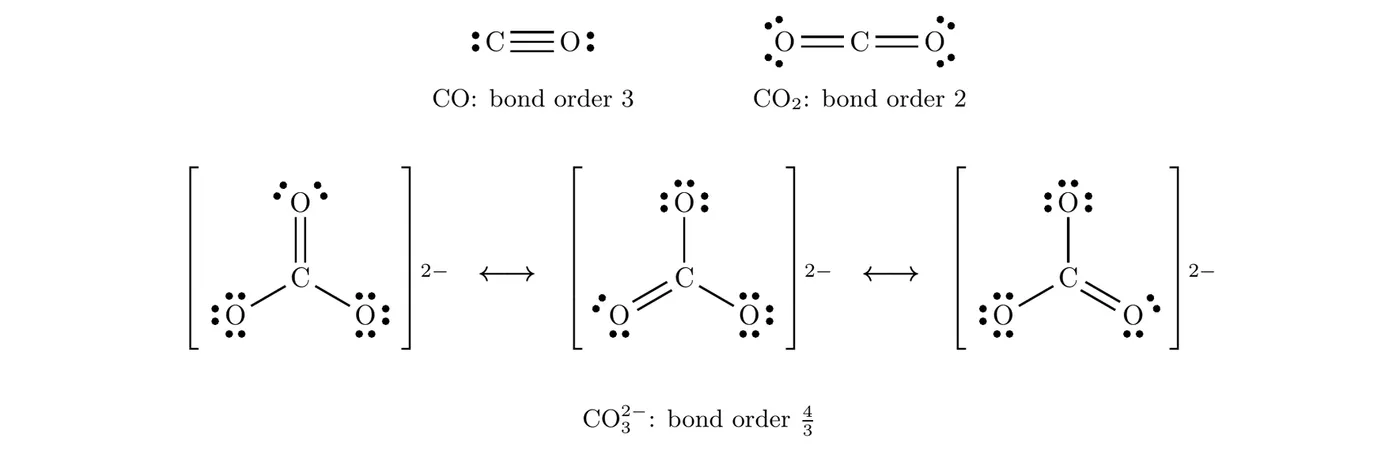
Step 2: Find the bond orders. CO has a triple bond (3). Each bond in is double (2). Carbonate spreads 4 bonding pairs over 3 bonds:
Answer: shortest to longest: . A higher bond order means more electrons shared between C and O, which pulls the atoms closer together. The bond energies run the other way, with the C-O bond in the strongest. A full-credit answer names the bond order for each species, including the resonance in carbonate.
Molecular polarity and dipole moment
Each polar bond has a bond dipole (Topic 2.1), drawn as an arrow toward the more electronegative atom with a cross on the tail at the end. A molecule's dipole moment is the sum of its bond dipoles, added as arrows with direction. So polarity depends on the bonds and on the shape.
- Polar molecule: the bond dipoles don't cancel, so there's a net dipole moment.
- Nonpolar molecule: the bonds are nonpolar, or the bond dipoles cancel because the shape is symmetric.

Both and have polar bonds. In linear , the two C=O dipoles are equal and point in opposite directions, so they cancel. In bent , both O-H dipoles point partly toward the O side, so they add up to a net dipole.
Quick rules that work for the AP exam:
- A central atom with no lone pairs and identical outer atoms gives a nonpolar molecule: , , , , .
- Lone pairs on the central atom usually make a molecule polar: , , , , . The exceptions are shapes where the lone pairs sit symmetrically: (linear) and (square planar) are nonpolar.
- Different outer atoms can make a symmetric shape polar. is tetrahedral, but the C-Cl dipole isn't balanced by the C-H bonds, so it's polar.
Polarity matters because it controls the intermolecular forces in Unit 3, and with them boiling points and solubility.
Example 5: Boron trifluoride vs. nitrogen trifluoride (AP-style)
and both have three polar bonds to fluorine. Explain why is nonpolar but is polar.
: 24 valence electrons. B has 3 bonds and no lone pair, so 3 domains: trigonal planar, with the F atoms 120° apart. The three equal B-F dipoles point to the corners of a triangle and cancel.
: 26 valence electrons. N has 3 bonds and 1 lone pair, so 4 domains: trigonal pyramidal. The three N-F dipoles all tilt toward the base of the pyramid, so they can't cancel.
Answer: the lone pair on N makes trigonal pyramidal, so its bond dipoles don't cancel and it's polar. has no lone pair on B, so it's trigonal planar and symmetric, and its bond dipoles cancel. A full-credit answer names each shape, ties it to the lone pairs in the Lewis diagram, and says whether the dipoles cancel.
Common mistakes
- Giving the electron geometry when the question asks for the shape. is trigonal pyramidal, not tetrahedral.
- Counting a double or triple bond as more than one domain.
- Missing a lone pair on the central atom, which changes the shape ( is seesaw, not tetrahedral).
- Assuming polar bonds always make a polar molecule. Check the shape.
- Putting lone pairs in the axial positions of a trigonal bipyramid. They go equatorial.
- Saying the angle in is 109.5°. It's less, because of the two lone pairs.
- Thinking a bond is stronger than a bond because double bonds are stronger than single bonds.
- Writing hybridizations like for five or six domains. The exam only asks for the shape there.