

2.3 - Structure of Ionic Solids
Overview
An ionic solid isn't made of separate molecules. It's a huge, repeating 3-D arrangement of cations and anions held together by Coulombic attraction. This topic covers how those ions are arranged and why, how to draw a particle model of an ionic solid that the AP exam will accept, and how that model explains properties like high melting points and brittleness.
The ionic crystal lattice
In an ionic solid, the cations and anions are arranged in a systematic, periodic 3-D array: the same pattern of ions repeats in every direction, over and over, throughout the crystal. This arrangement is called a crystal lattice.
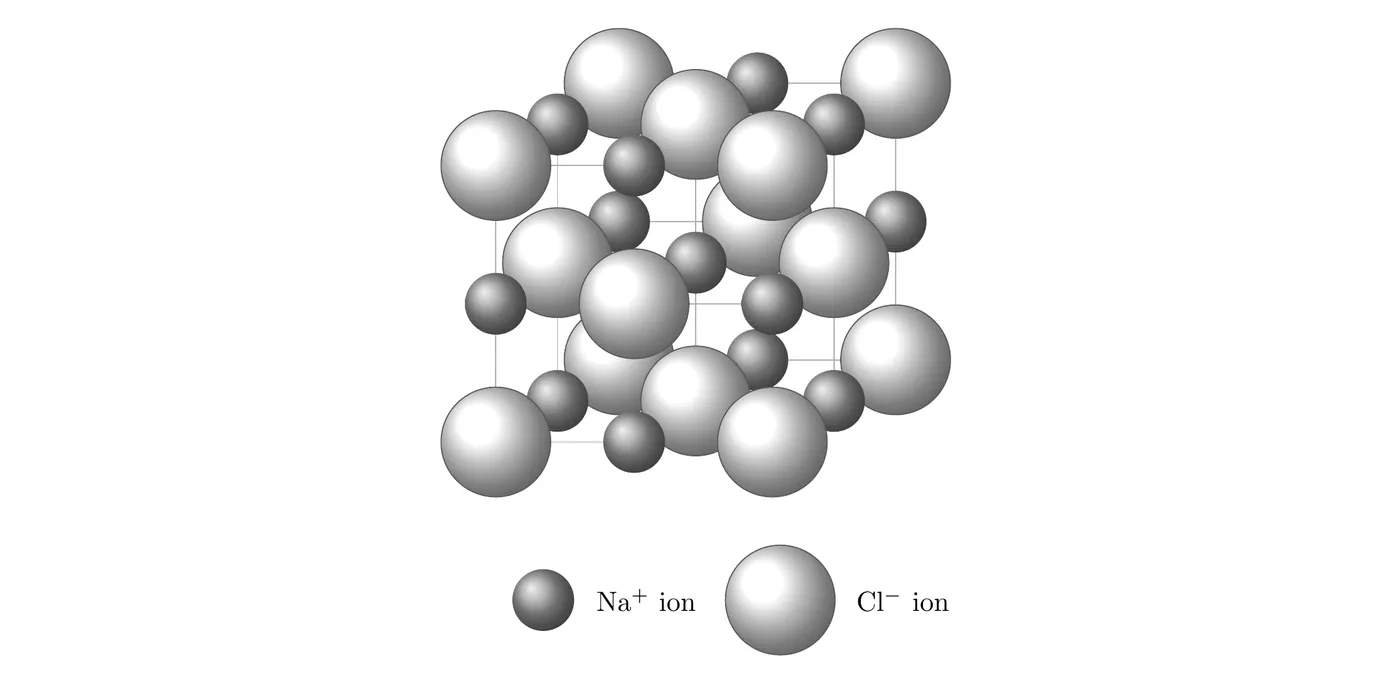
The figure shows a small piece of solid sodium chloride, with the ions drawn smaller than they really are so you can see inside (the thin gray lines just mark the rows; they aren't bonds). Every ion is surrounded by ions, and every ion is surrounded by ions. No ion has an ion of the same charge as a nearest neighbor.
Why the ions arrange this way
The arrangement maximizes the attractions between cations and anions while minimizing the repulsions between ions with the same charge. That's Coulomb's law at work:
- Each ion's nearest neighbors are ions of the opposite charge, as close as the ions' sizes allow. Opposite charges at a short distance attract strongly.
- Ions with the same charge are kept farther apart, with an oppositely charged ion between them. Since the force weakens with distance, these repulsions are smaller than the attractions.
The result is a strong net attraction that holds the whole crystal together. Each ion is attracted to every oppositely charged neighbor around it, not just one partner.
Formula units, not molecules
Because the lattice is one continuous network, there's no single "molecule" of . The formula only gives the ratio of ions: means one for every , and means one for every two . The smallest group of ions in that ratio is called a formula unit. The ratio always makes the total charge zero.
Not on the exam: you don't need to know specific crystal structures, like the exact geometry of the or lattice. You do need the general idea: a regular, repeating pattern in which every ion is surrounded by oppositely charged ions.
Drawing a particle model of an ionic solid
The AP exam often asks you to draw or choose a particle diagram of an ionic solid. A 2-D slice of the lattice is enough. A good diagram is consistent with Coulomb's law and with the properties of the ions:
- Alternate the charges. Surround each cation with anions and each anion with cations. Never put two ions of the same charge side by side.
- Get the relative sizes right. A cation is smaller than its neutral atom (it lost electrons), and an anion is larger than its neutral atom (it gained electrons). In most common compounds the cation is the smaller ion: is 102 pm and is 181 pm.
- Match the formula's ratio. For , draw twice as many ions as ions.
- Show the charges (or include a key), and pack the ions closely in a regular pattern.
- Leave out what isn't there: no bond lines, no separate pairs or molecules, and no water (water only belongs in a diagram of a solution, which is Unit 3).
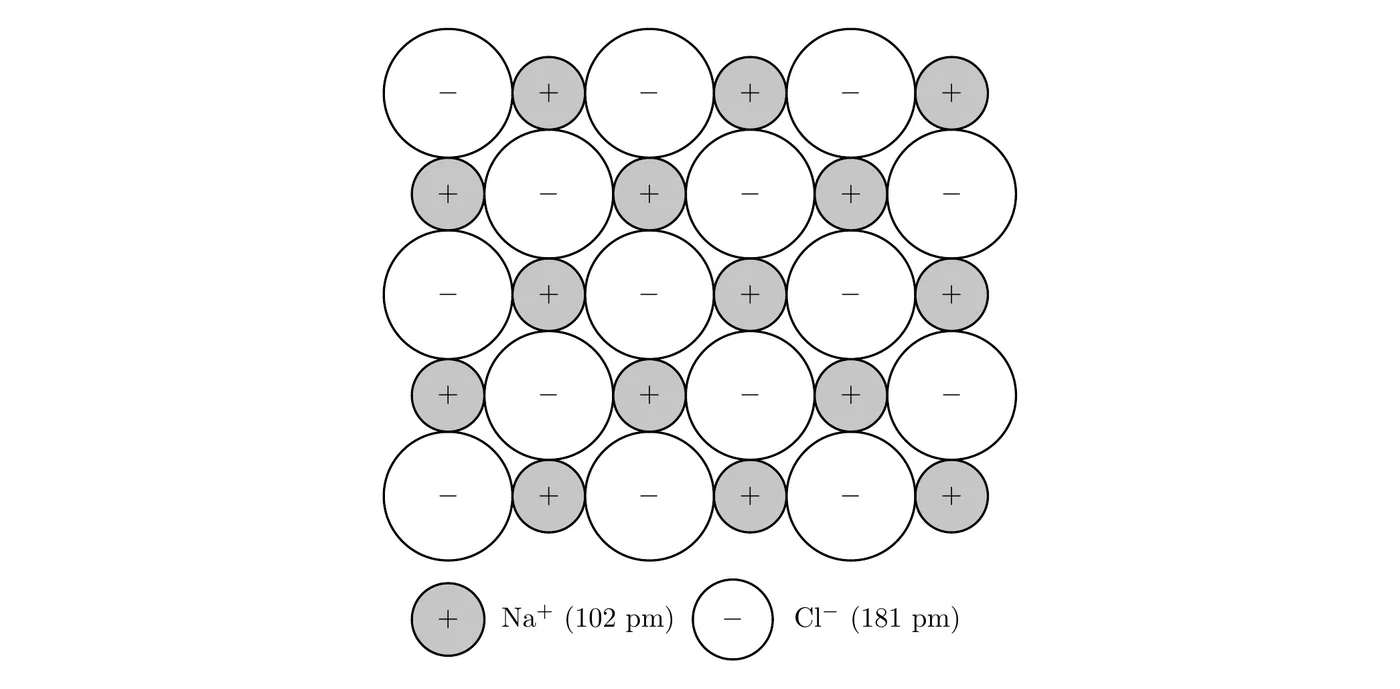
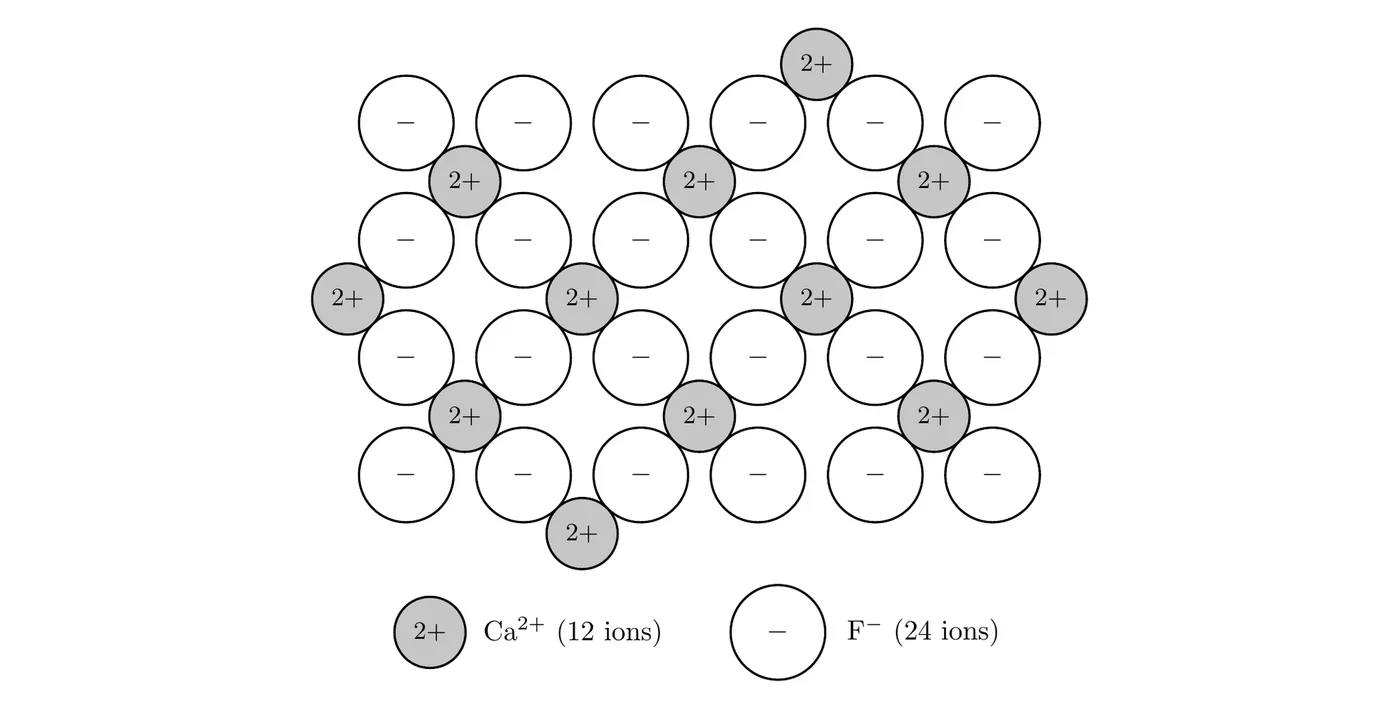
For a compound with a 1:2 ratio, the pattern changes but the rules don't. The model of below is a simplified flat slice, not the real 3-D crystal, but it follows every rule: each ion in the middle touches four ions, no two ions of the same charge touch, and there are exactly twice as many fluoride ions as calcium ions (24 and 12, counting the ions on the edges).
Example 1: Choosing the correct particle diagram (AP-style)
Which diagram best represents a small region of solid lithium chloride, ? The radius of is 76 pm and the radius of is 181 pm. Justify your choice and explain what is wrong with the other two.
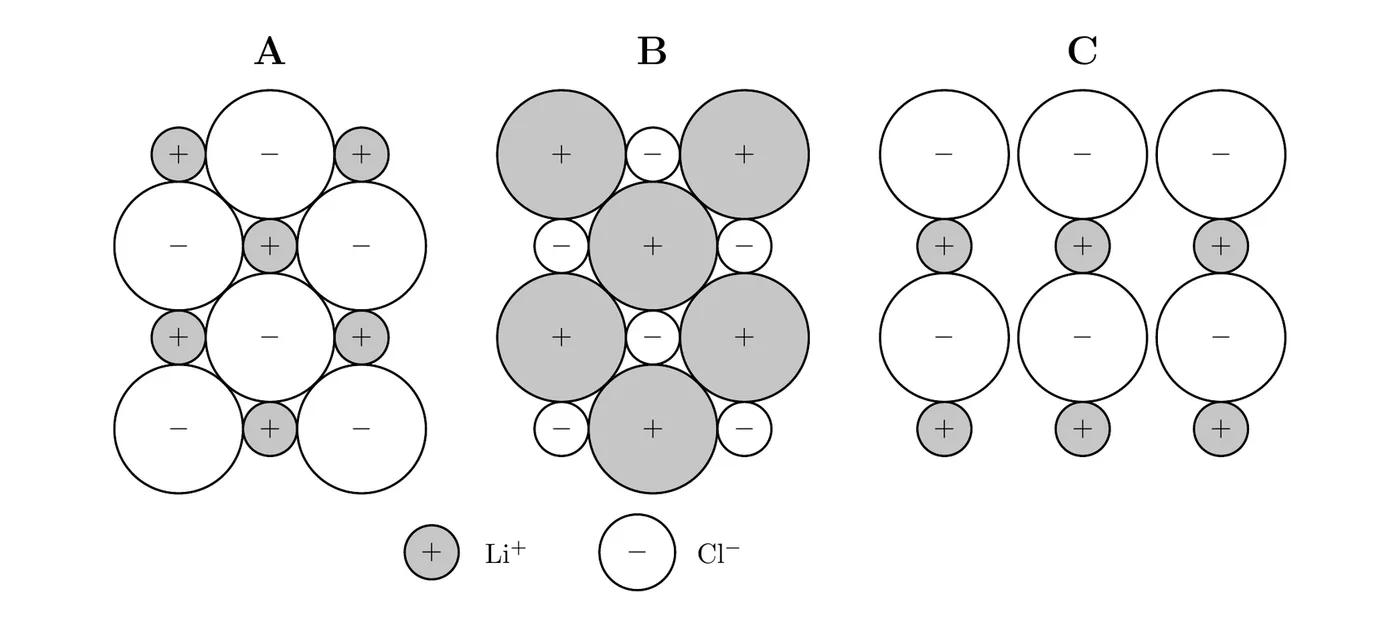
Diagram A is correct. The charges alternate in every direction, each ion is surrounded by oppositely charged ions, the ions are drawn smaller than the ions, and the ratio is 1:1 (6 of each). This arrangement maximizes attractions and minimizes repulsions.
- B has the sizes backward. The pattern alternates correctly, but is drawn larger than . has lost its only valence electron and has just one occupied shell, so it is much smaller than .
- C puts like charges side by side. Each ion sits right next to other ions in its row. Those repulsions aren't minimized, so a real crystal wouldn't form this way. The ratio and sizes are fine, but the arrangement isn't.
Example 2: Counting ions in a model
A particle diagram of solid aluminum oxide, , shows 6 aluminum ions. How many oxide ions should it show?
The formula gives a ratio of 2 to 3 :
Check the charge: . The diagram should show 9 oxide ions, drawn larger than the aluminum ions.
Connecting the model to properties
The particle model explains what you see in the lab. Topic 3.2 covers the properties of solids in full; here's the connection for ionic solids:
- High melting points. Every ion is held by strong Coulombic attractions to all of its neighbors. Melting means pulling ions out of their fixed places, which takes a lot of energy.
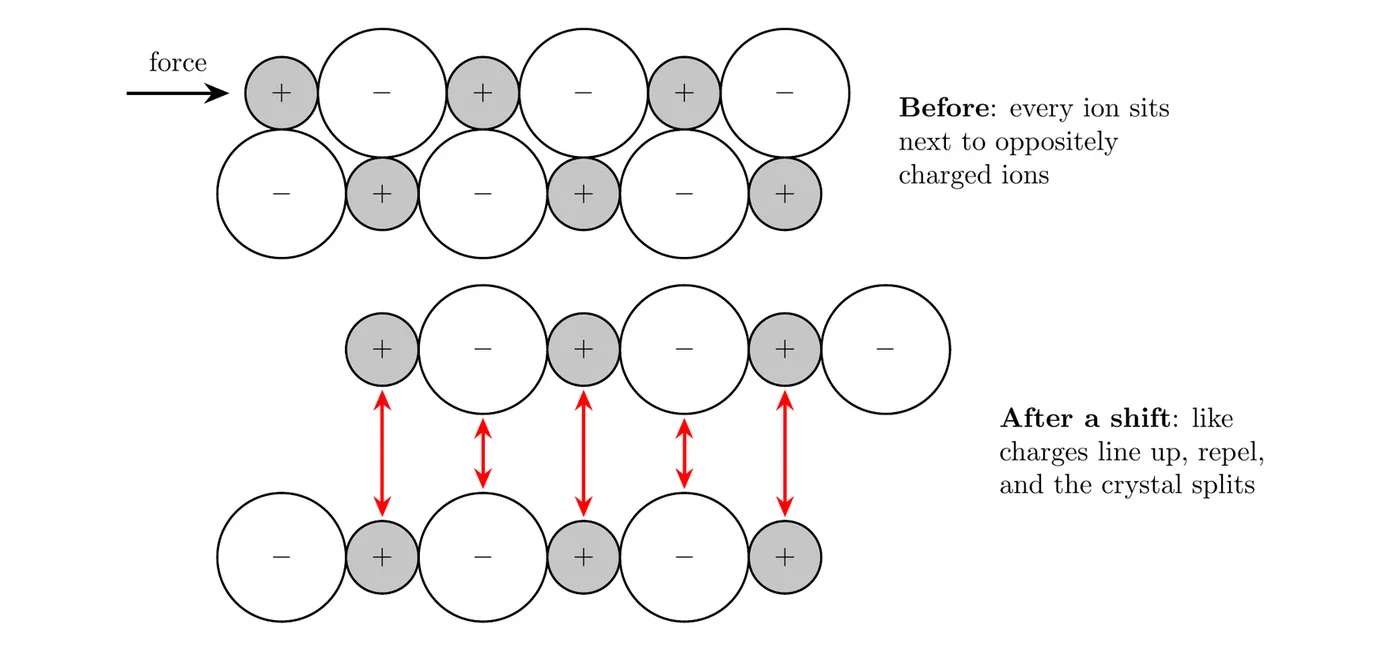
- Brittle, not bendable. If a force pushes one layer of ions past the next by one ion's width, ions of the same charge end up next to each other. They repel, and the crystal cracks apart (see the figure).
- No conductivity as a solid. The ions are locked in place, so no charged particles can move. Melted or dissolved in water, the ions are free to move, and the substance conducts.
Example 3: Describing a model of magnesium oxide
Describe a particle diagram of solid magnesium oxide, , and use it to explain why melts at 2,852 °C while melts at 801 °C. Radii: 72 pm, 140 pm.
- Ratio: the charges are 2+ and 2, so the ratio is 1:1, the same as .
- Sizes: is about 1.9 times the radius of (), so draw the oxide ions about twice as wide.
- Pattern: alternate and in every direction, like the diagram, with each ion labeled 2+ or 2.
Explanation: the model looks like 's, but each ion carries twice the charge, and both ions are smaller, so the centers are closer together. By Coulomb's law, both changes make the attraction between neighboring ions much stronger, so far more energy is needed to pull the ions apart and melt the solid.
Common mistakes
- Drawing ionic compounds as molecules. Don't draw separate Na-Cl pairs or bond lines. An ionic solid is one continuous lattice.
- Putting like charges next to each other. Every nearest neighbor should have the opposite charge.
- Drawing the cation bigger than the anion in compounds like , , and . Cations shrink and anions grow compared with their atoms.
- Ignoring the formula's ratio. Count the ions in your diagram and check that the total charge is zero.
- Saying ionic solids conduct because they contain ions. The ions have to be able to move, which only happens when the solid melts or dissolves.
- Memorizing crystal structures. They aren't tested. Focus on the alternating pattern and Coulomb's law.