

2.5 - Lewis Diagrams
Overview
A Lewis diagram (also called a Lewis structure or Lewis electron-dot diagram) shows every valence electron in a molecule or polyatomic ion: which atoms are bonded, how many electron pairs each bond shares, and where the lone pairs sit. Almost everything else in Unit 2 starts here: resonance and formal charge (Topic 2.6), shapes, polarity, and hybridization (Topic 2.7), and later the intermolecular forces in Unit 3. Lewis diagrams are built from a fixed set of rules, and this page walks through them one step at a time. When a free-response question asks for a "complete" Lewis diagram, it means every lone pair, including the ones on outer atoms, plus brackets and the charge for an ion.
Valence electrons and Lewis symbols
Only valence electrons appear in a Lewis diagram. These are the electrons in the outermost shell, the ones atoms share or transfer when they bond. Core electrons are held tightly by the nucleus and don't take part, so they're left out. For main-group elements, read the count from the periodic table:
- Groups 1 and 2: 1 and 2 valence electrons.
- Groups 13 to 18: the group number minus 10. Nitrogen (group 15) has 5, chlorine (group 17) has 7. Helium is the exception, with 2.
A Lewis symbol (or electron-dot symbol) is the element's symbol with one dot for each valence electron, spread around four sides. Put one dot on each side before you start pairing them up.

The unpaired dots hint at how many bonds an atom usually forms: carbon has four unpaired electrons and usually forms four bonds, nitrogen forms three, oxygen two, and fluorine one.
Bonding pairs, lone pairs, and the octet rule
- Bonding pair: two electrons shared between two atoms, drawn as a line. One line always means 2 electrons.
- Lone pair (nonbonding pair): two electrons that belong to one atom only, drawn as two dots.
- Single, double, and triple bonds share one, two, and three pairs (2, 4, and 6 electrons).
The octet rule says main-group atoms tend to bond until they're surrounded by eight valence electrons. That fills the and subshells of the valence shell (), the same arrangement a noble gas has. Hydrogen only needs two electrons (a duet), since its orbital holds two.
To count the electrons around an atom, count both electrons of every bond that touches it, plus its own lone-pair electrons. Shared electrons count for both atoms.
These bonding patterns for neutral atoms come up constantly, and they're a fast way to check a diagram:
Atom | Valence electrons | Usual bonds | Lone pairs | Electrons around it |
H | 1 | 1 | 0 | 2 |
C | 4 | 4 | 0 | 8 |
N | 5 | 3 | 1 | 8 |
O | 6 | 2 | 2 | 8 |
F, Cl, Br, I | 7 | 1 | 3 | 8 |
If you draw nitrogen with four bonds and no lone pair, either the species is an ion (like below) or something is off. Topic 2.6 explains why with formal charge.
How to draw a Lewis diagram
- Count the valence electrons. Add them up for every atom. For a negative ion, add one electron for each negative charge. For a positive ion, subtract one for each positive charge.
- Pick the central atom and draw the skeleton. Connect each outer atom to the central atom with a single bond. The central atom is usually the least electronegative atom (not counting H), and often the one there's only one of. H and F are always on the outside, because they form only one bond.
- Subtract the electrons in the skeleton. Each single bond uses 2 electrons.
- Complete the octets of the outer atoms with lone pairs. H gets none, since its bond already gives it 2.
- Put any leftover electrons on the central atom as lone pairs.
- Check the central atom. If it has fewer than 8 electrons, turn a lone pair on an outer atom into a shared pair, making a double bond. Repeat (a double can become a triple) until the central atom has 8. The lone pairs that move are usually on C, N, O, or S. Outer halogens almost never form double bonds.
- Check your work. The electrons you drew must equal the count from step 1, and every atom should have an octet (2 for H) unless it's one of the exceptions below. An ion goes in square brackets with its charge at the upper right.
When a formula is written to show connections, like or , the atoms are usually bonded in the order written.
Example 1: Nitrogen trifluoride
Draw the Lewis diagram for .
Step 1: Count valence electrons. N is in group 15 and F is in group 17.
Step 2: N is less electronegative than F, and F is always on the outside, so N goes in the center with a single bond to each F.
Step 3: Three single bonds use 6 electrons.
Step 4: Each F needs three lone pairs (6 electrons) to reach 8.
Step 5: The last 2 electrons go on N as a lone pair.
Step 6: N now has 3 bonds (6 electrons) plus 1 lone pair (2 electrons), so it has 8. No multiple bonds are needed.

Answer: N in the center with single bonds to three F atoms, one lone pair on N, and three lone pairs on each F. Check: 3 bonding pairs + 10 lone pairs = 13 pairs = 26 electrons.
Example 2: Formaldehyde (a double bond)
Draw the Lewis diagram for formaldehyde, .
Step 1: valence electrons.
Step 2: H can't be central, and C is less electronegative than O, so C goes in the middle, bonded to two H atoms and the O.
Steps 3 to 5: Three single bonds use 6 electrons, leaving 6. Those go on O as three lone pairs, leaving nothing for C.
Step 6: C has only 3 bonds, which is 6 electrons. Move one lone pair from O into the C-O bond to make a C=O double bond (red below).

Answer: a C=O double bond, two C-H single bonds, and two lone pairs on O. C has electrons and O has . Check: 4 bonding pairs + 2 lone pairs = 6 pairs = 12 electrons.
Example 3: Hydrogen cyanide (a triple bond)
Draw the Lewis diagram for .
Step 1: valence electrons.
Steps 2 to 5: The skeleton is H-C-N (H on the outside, C in the middle, in the order written). Two single bonds use 4 electrons, leaving 6, which go on N as three lone pairs.
Step 6: C has only 2 bonds (4 electrons) and needs 4 more, so two lone pairs from N move into the C-N bond, making a triple bond.

Answer: H-C≡N with one lone pair on N. C has electrons and N has . Check: 4 bonding pairs + 1 lone pair = 5 pairs = 10 electrons.
Lewis diagrams for polyatomic ions
Ions follow the same steps. The only differences: the charge changes the electron count in step 1, and the finished diagram goes in square brackets with the charge outside.
Example 4: The ammonium ion
Draw the Lewis diagram for .
Step 1: The charge means one electron is missing.
Steps 2 to 6: N goes in the center with four single bonds to H. That uses all 8 electrons, so there's no lone pair left for N. N has 8 electrons and each H has 2.

Answer: four N-H bonds, no lone pairs, in brackets with a charge. Check: 4 bonding pairs = 8 electrons. Nitrogen breaks its usual pattern here (four bonds, no lone pair), which is the sign of the positive charge. Topic 2.6 shows that this N has a formal charge of .
When the octet rule doesn't hold
Fewer than eight electrons
Boron and beryllium are stable with fewer than eight electrons. In there are valence electrons. The three B-F bonds and the octets on the three F atoms use all 24, which leaves B with only 6. Don't fix it with a B=F double bond: fluorine almost never shares a second pair, and Topic 2.6 shows formal charge agrees. Beryllium can end up with only 4.

Check: 3 bonding pairs + 9 lone pairs = 12 pairs = 24 electrons.
More than eight electrons
Central atoms from period 3 and below (P, S, Cl, Br, I, Xe) can hold more than eight electrons. These bigger atoms have room for more electron pairs around them. Period 2 atoms (C, N, O, F) never go past eight. Examples: P has 10 electrons around it in , and S has 12 in .
In practice: if electrons are left over after step 4, put them on the central atom as lone pairs, even if that takes it past eight. That's only allowed when the central atom is in period 3 or below.
Odd numbers of electrons
If the total is odd, as in (11 electrons) or (17), one electron has to stay unpaired, so at least one atom ends up with fewer than eight. Topic 2.6 treats these as a limitation of the Lewis model.
Example 5: Sulfur tetrafluoride (AP-style)
Draw the complete Lewis diagram for . How many electrons surround the sulfur atom?
Step 1: S is in group 16 and F is in group 17.
Steps 2 and 3: S goes in the center with four single bonds, which use 8 electrons: left.
Step 4: Each F gets three lone pairs: left.
Step 5: The last 2 electrons go on S as a lone pair, even though S now has more than eight. That's allowed because S is in period 3.
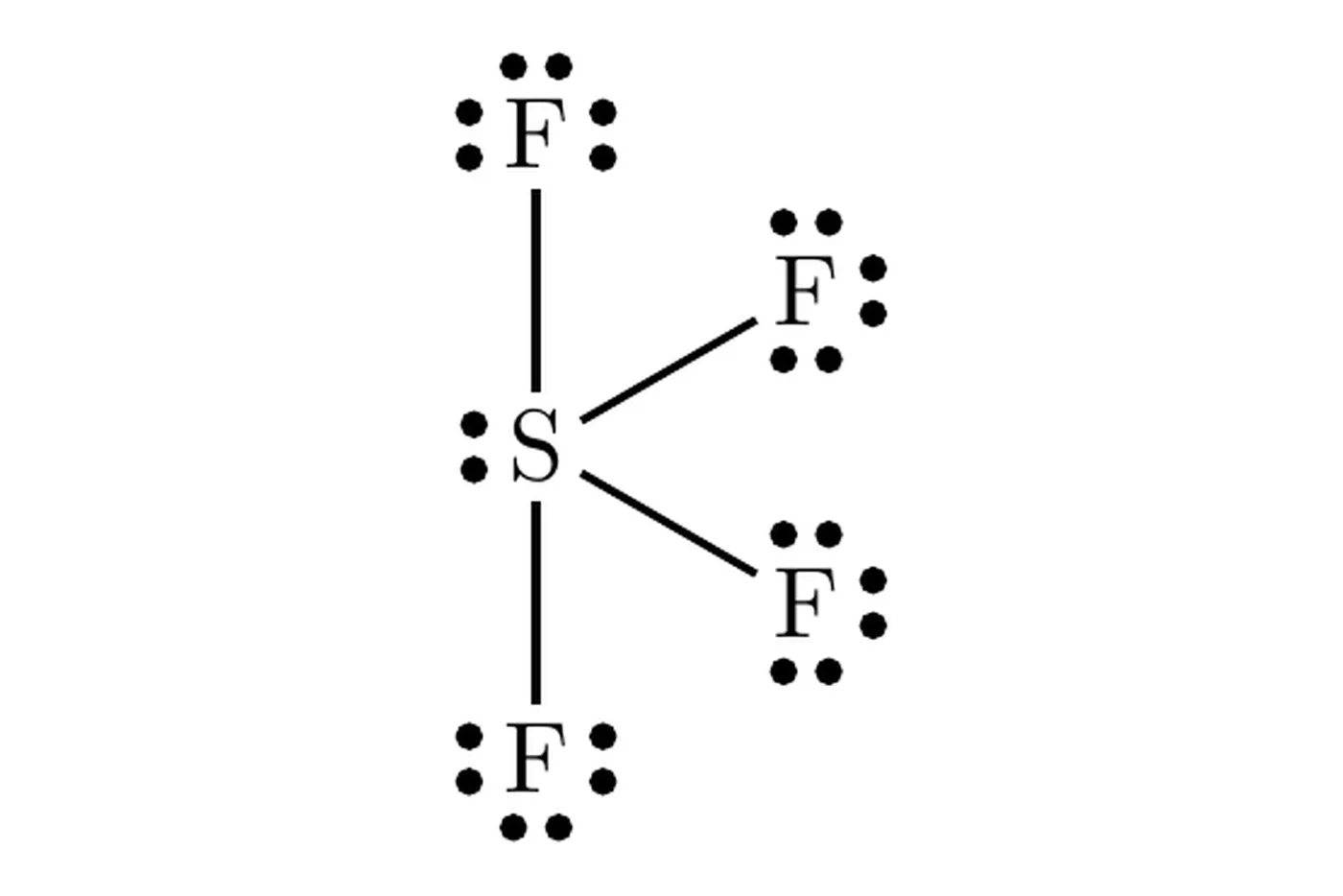
Answer: S has four bonds and one lone pair, so 10 electrons surround it. Check: 4 bonding pairs + 13 lone pairs = 17 pairs = 34 electrons. A common wrong answer leaves off the lone pair on S (only 32 electrons drawn). That mistake carries forward: in Topic 2.7 it gives a tetrahedral shape instead of the correct seesaw.
Common mistakes
- Forgetting the charge in the electron count: has 8 valence electrons, not 9, and has 8, not 7.
- Leaving off the lone pairs on outer atoms, especially halogens.
- Putting H in the middle, or giving it two bonds.
- Giving C, N, O, or F more than eight electrons.
- Counting a bond line as one electron instead of two.
- Making a double bond when leftover electrons should have gone on a period 3 central atom.
- Forgetting the brackets and charge on an ion.