

2.4 - Structure of Metals and Alloys
Overview
Metals are held together by a kind of bonding unlike ionic or covalent bonds: positive metal ions sitting in a sea of shared, mobile electrons. This topic covers that model, the two ways a metal can mix with another element to form an alloy (substitutional and interstitial), and how each structure explains the properties of metals and alloys.
Metallic bonding: the electron sea model
In a metallic solid, each metal atom gives up its valence electrons to the whole solid. Those electrons are delocalized: they aren't tied to any one atom or any one bond, and they move freely through the metal. What's left is an orderly array of positive metal ions (the atoms' cores) surrounded by a sea of electrons.
Metallic bonding is the Coulombic attraction between the positive metal ions and the negative electron sea. It has no particular direction: each ion is attracted to the electrons all around it, not to one neighbor.
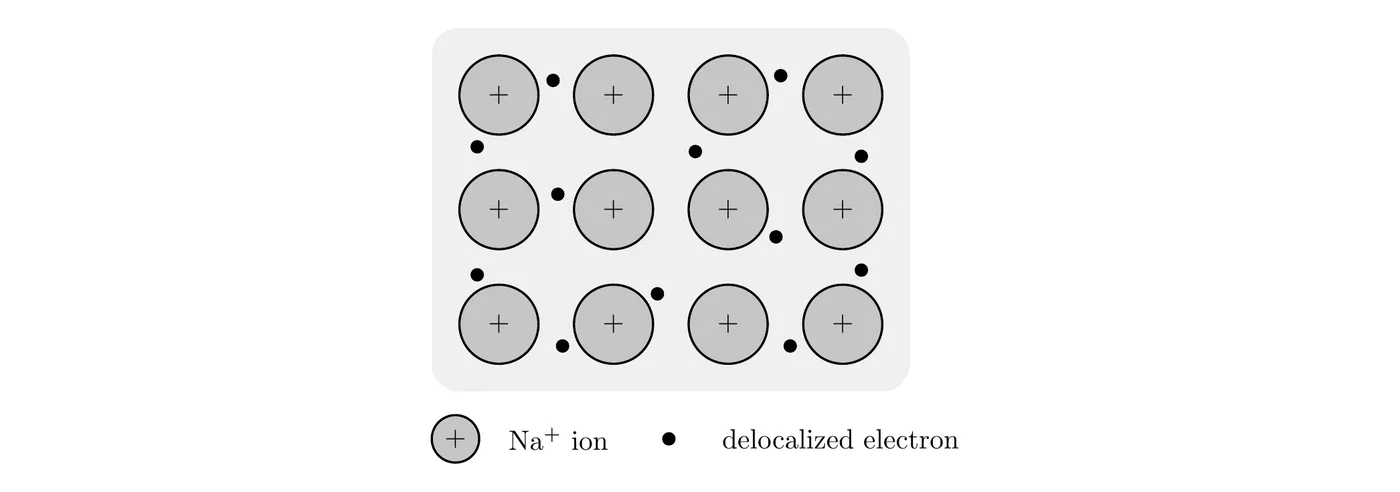
In this model of sodium, each Na atom has one valence electron (), so each ion adds one electron to the sea: 12 ions and 12 electrons, so the metal is neutral overall. A model of magnesium would show ions with two electrons in the sea for each ion.
Drawing a metallic solid
- Pack the metal ions closely in a regular, repeating array, all the same size.
- Label them as cations (, ) when you're showing the electron sea.
- Scatter the electrons between the ions, not attached to any one ion.
- Keep the total charge zero: number of electrons = (number of ions) (charge on each ion).
How the model explains properties
- Electrical conductivity: the delocalized electrons can move through the metal, so metals conduct as solids. Apply a voltage and the electron sea flows.
- Thermal conductivity: the mobile electrons also carry energy quickly through the solid.
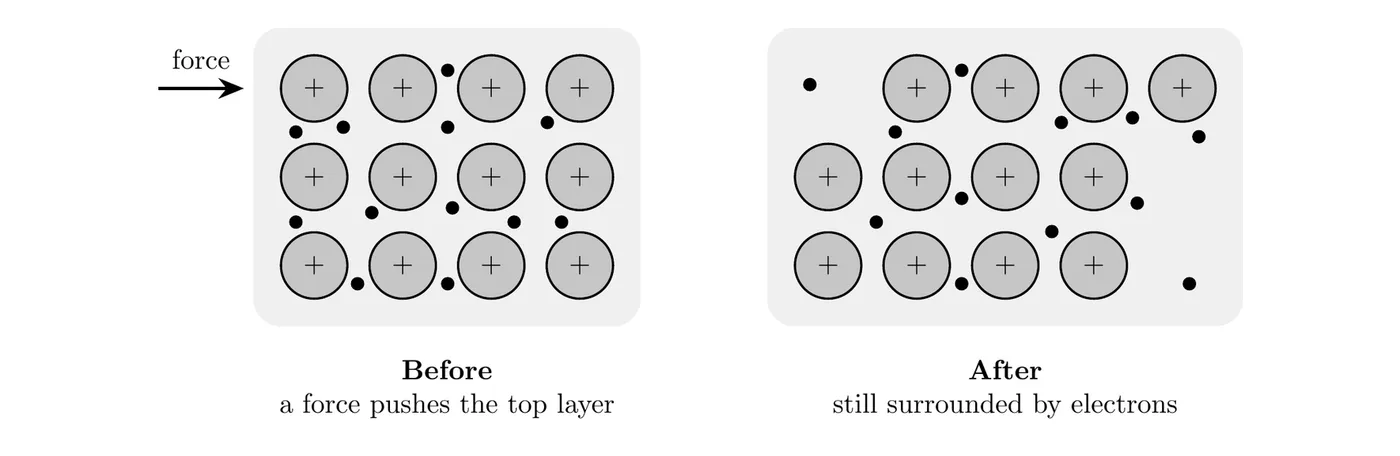
- Malleability and ductility: metals can be hammered into sheets (malleable) and drawn into wires (ductile). When one layer of ions slides past another, the electron sea moves with it, so every ion is still surrounded by electrons and no like charges are left facing each other. An ionic solid shatters instead (Topic 2.3).
Alloys
An alloy is a solid mixture of a metal with one or more other elements that keeps the properties of a metal. Alloys still contain a sea of mobile electrons, so they still conduct electricity. The CED sorts them into two types based on the relative sizes of the atoms.
Substitutional alloys
A substitutional alloy forms between atoms of comparable radius. Atoms of the added element take the place of (substitute for) some of the host metal's atoms at their usual spots in the lattice.
Example: brass. In many brass alloys, zinc atoms substitute for copper atoms. Copper's atomic radius is 128 pm and zinc's is 134 pm, close enough that a zinc atom fits in a copper atom's spot.
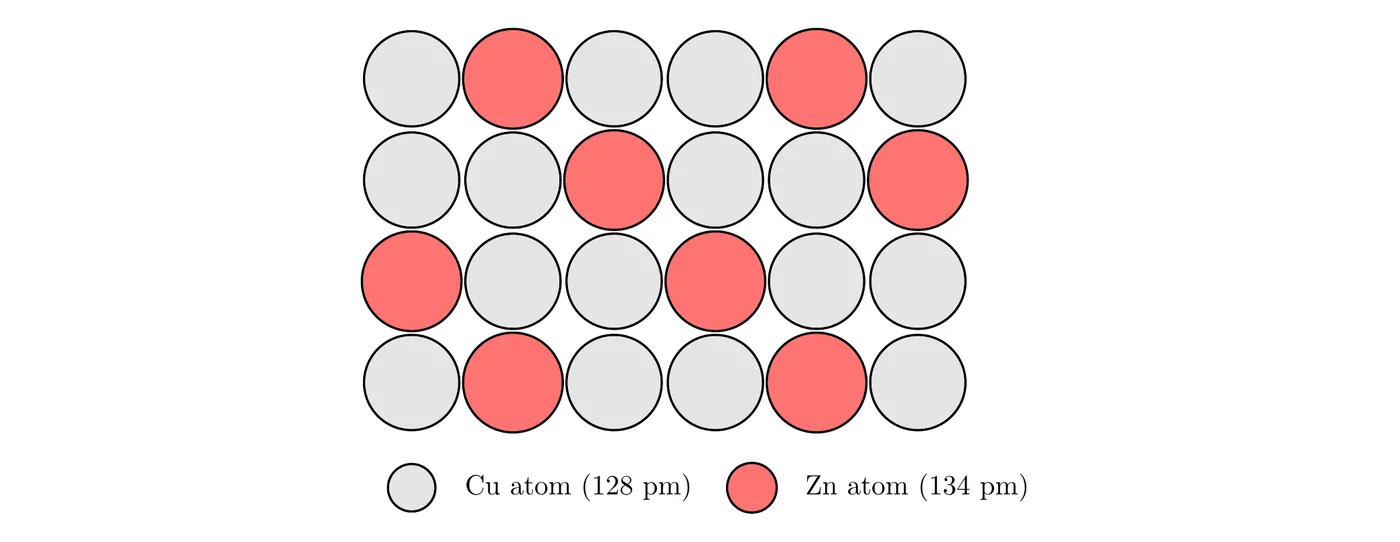
Because the atoms differ a little in size, the rows of atoms are slightly distorted and slide past each other less easily. That's why brass is harder and stronger than pure copper, while still being malleable and a good conductor. Another example is the copper-nickel alloy used in coins (Example 1).
Interstitial alloys
An interstitial alloy forms between atoms of significantly different radii. The smaller atoms fill the interstices, the small gaps between the larger atoms in the lattice, while the larger atoms stay in place.
Example: steel. Carbon atoms (radius 77 pm) are much smaller than iron atoms (126 pm), so carbon atoms sit in the holes between iron atoms. Other small atoms that form interstitial alloys include hydrogen, boron, and nitrogen.
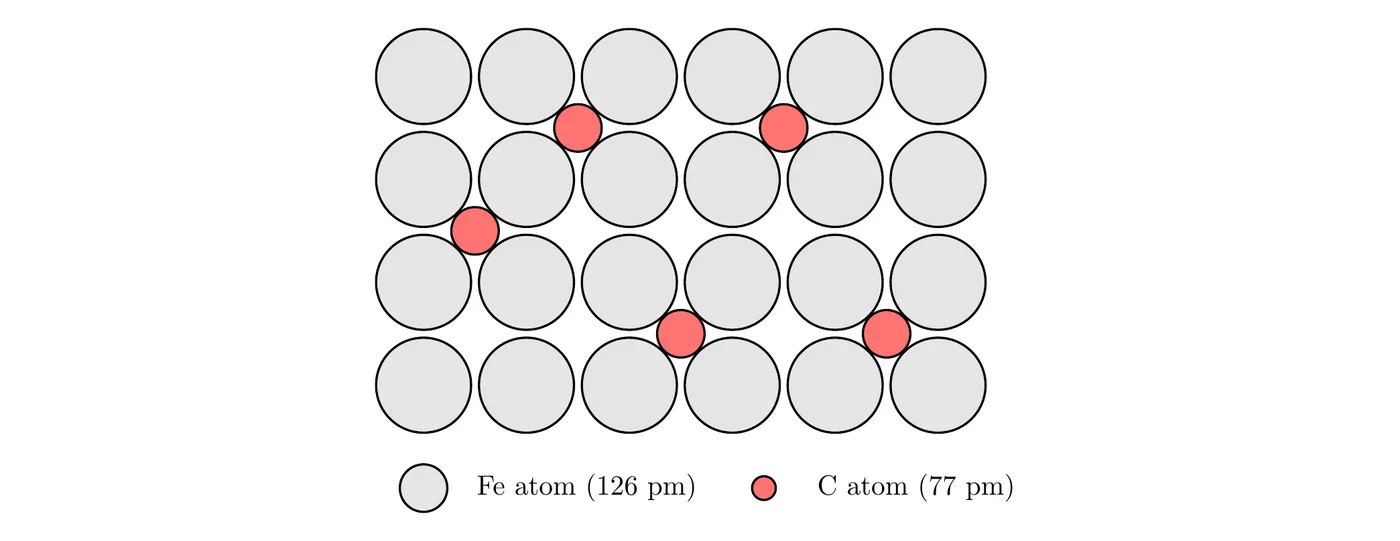
The atoms in the holes act like pins. They make it harder for layers of iron to slide, so the lattice is more rigid: steel is harder and stronger than pure iron, but less malleable and ductile. It still conducts, because the electron sea is still there.
Real carbon steel contains only a few carbon atoms: a steel that is 0.80% carbon by mass has about one carbon atom for every 27 iron atoms (Example 2). Particle diagrams usually show more of the small atoms than that, just so you can see where they go.
Comparing the two types
Substitutional alloy | Interstitial alloy | |
Atom sizes | Comparable radii | Very different radii |
Where the added atoms go | In place of host atoms, at lattice sites | In the gaps between host atoms |
Example | Brass (Zn in Cu) | Steel (C in Fe) |
Effect on properties | Harder and stronger than the pure metal; still malleable; still conducts | More rigid: harder and stronger, less malleable and ductile; still conducts |
Some alloys are both. Stainless steel has chromium and nickel atoms substituted for some of the iron atoms (radii 128 pm and 124 pm, close to iron's 126 pm) and carbon atoms in the holes.
Example 1: Predicting the type of alloy
Use the atomic radii to predict whether each alloy is substitutional or interstitial: (a) copper and nickel (Cu 128 pm, Ni 124 pm), (b) iron and nitrogen (Fe 126 pm, N 75 pm), (c) gold and silver (Au 144 pm, Ag 144 pm).
Compare the smaller radius to the larger one. Atoms within roughly 15% of each other's size can trade places; a much smaller atom fits into the holes instead.
Pair | Ratio of radii | Type |
Cu and Ni | Substitutional | |
Fe and N | Interstitial | |
Au and Ag | Substitutional |
(a) Nickel substitutes for copper: this is the cupronickel used in coins. (b) Nitrogen atoms are much smaller, so they fill the holes between iron atoms (this hardens the surface of nitrided steel). (c) Gold and silver atoms are the same size, so they substitute freely; the natural gold-silver alloy is called electrum.
Example 2: From mass percent to a particle diagram
(a) A brass is 67.0% copper and 33.0% zinc by mass. What is the ratio of copper atoms to zinc atoms, and how many of each should a 24-atom particle diagram show? (b) A steel is 0.80% carbon and 99.20% iron by mass. About how many iron atoms are there for each carbon atom?
(a) Assume 100.0 g of brass, so there are 67.0 g Cu and 33.0 g Zn. Convert each to moles:
There are about 2.09 copper atoms per zinc atom, close to 2 to 1. Zinc makes up of the atoms, and , so a 24-atom diagram should show 8 zinc atoms and 16 copper atoms, which is what the brass figure above shows.
(b) In 100.0 g of steel there are 0.80 g C and 99.20 g Fe:
There are about 27 iron atoms for every carbon atom (2 significant figures, limited by 0.80%; the extra digit in 0.0666 mol was carried to the end). Even a small number of interstitial atoms changes the properties a lot.
Example 3: Explaining properties with models (AP-style)
A rod of pure iron and a rod of steel are both struck with a hammer. The iron rod bends easily, but the steel rod resists bending. Both rods conduct electricity. (a) Use particle-level models to explain why steel is less malleable than iron. (b) Explain why steel still conducts electricity.
(a) In pure iron, the iron ions are all the same size and sit in regular layers. Under a force, one layer can slide past the next while the electron sea keeps holding the ions together, so the rod bends. In steel, small carbon atoms fill some of the interstices between the iron atoms. These carbon atoms get in the way when a layer tries to slide, which makes the lattice more rigid, so steel resists bending.
(b) Adding carbon doesn't remove the delocalized valence electrons from the iron. Steel still has a sea of mobile electrons that can move through the solid when a voltage is applied, so it conducts.
Common mistakes
- Describing metallic bonding as sharing between two atoms or as a transfer. The valence electrons are delocalized over the whole solid.
- Losing track of charge in an electron sea diagram. The number of electrons should equal the number of ions times the charge on each ion.
- Mixing up the two alloy types. Substitutional: similar sizes, atoms trade places. Interstitial: small atoms fill the holes.
- Drawing small atoms replacing host atoms, or atoms of very different sizes swapped into lattice sites. That mixes up the two models.
- Saying steel is more malleable than iron. Interstitial carbon makes the lattice more rigid, so steel is harder and less malleable.
- Saying alloys stop conducting. The electron sea is still there, so alloys still conduct.