

2.1 - Types of Chemical Bonds
Overview
A chemical bond is the Coulombic attraction that holds atoms together: positive nuclei attracting negative electrons. What makes one bond different from another is where the valence electrons end up. They can be shared equally, shared unequally, transferred from one atom to another, or spread out over a whole piece of metal. This topic covers the three types of bonding (covalent, ionic, and metallic), how electronegativity predicts which one forms, and how to back up that claim with a substance's properties. The rest of Unit 2 and most of Unit 3 build on it.
Three types of chemical bonds
Bond type | What the valence electrons do | Usually forms between | Examples |
Covalent | Shared between two atoms | Two nonmetals | , , |
Ionic | Transferred from one atom to another, making cations and anions that attract each other | A metal and a nonmetal | , |
Metallic | Delocalized: shared by all the atoms in the solid | Metal atoms | , , brass |
The property that predicts which type forms is electronegativity.
Electronegativity
Electronegativity is how strongly an atom in a bond attracts the shared electrons toward itself. The usual scale (the Pauling scale) has no units. Fluorine is the most electronegative element at 3.98, and the metals at the bottom left of the periodic table are the least, below 1.
The trends
- Across a period (left to right), electronegativity increases. Lithium is 0.98 and fluorine is 3.98.
- Down a group, electronegativity decreases. Fluorine is 3.98 and iodine is 2.66.
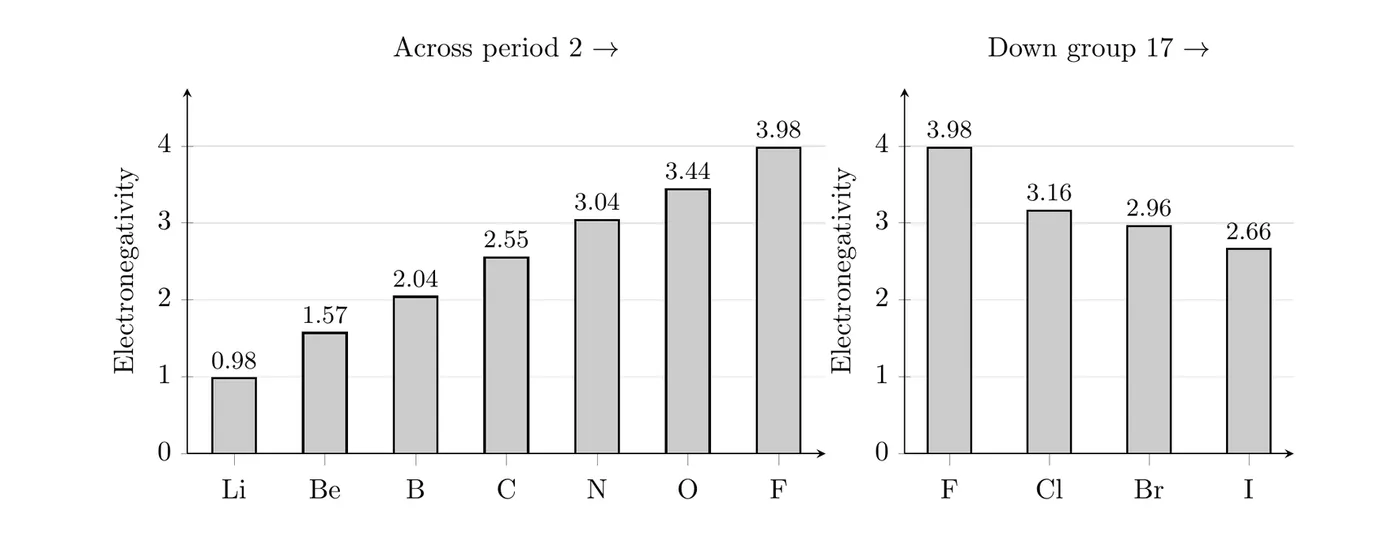
So the most electronegative elements sit at the top right of the table (F, O, N, Cl) and the least sit at the bottom left (Cs, K, Na). Noble gases are usually left out because they rarely form bonds. You won't need to memorize values: the AP exam gives them when a question needs them, but you should know the trends.
Why the trends happen
On the exam you explain these trends, not just state them, with Coulomb's law and the shell model (Topics 1.5 and 1.7). For electronegativity, the charge that matters is the nuclear charge the shared electrons feel after shielding by the inner electrons, and the distance is from the nucleus to those electrons.
- Across a period: each element has one more proton than the one before it, but its valence electrons are in the same shell, so the inner (core) electrons shield them about the same amount. The shared electrons feel a larger effective nuclear charge and sit closer to the nucleus, so the atom attracts them more strongly.
- Down a group: the valence electrons are in a higher shell, farther from the nucleus and shielded by more core electrons. The larger distance weakens the attraction, so electronegativity drops even though the nucleus has more protons.
It's the same reasoning as for ionization energy in Topic 1.7: a small atom with a high effective nuclear charge holds its own electrons tightly and pulls hard on shared ones.
Nonpolar covalent bonds
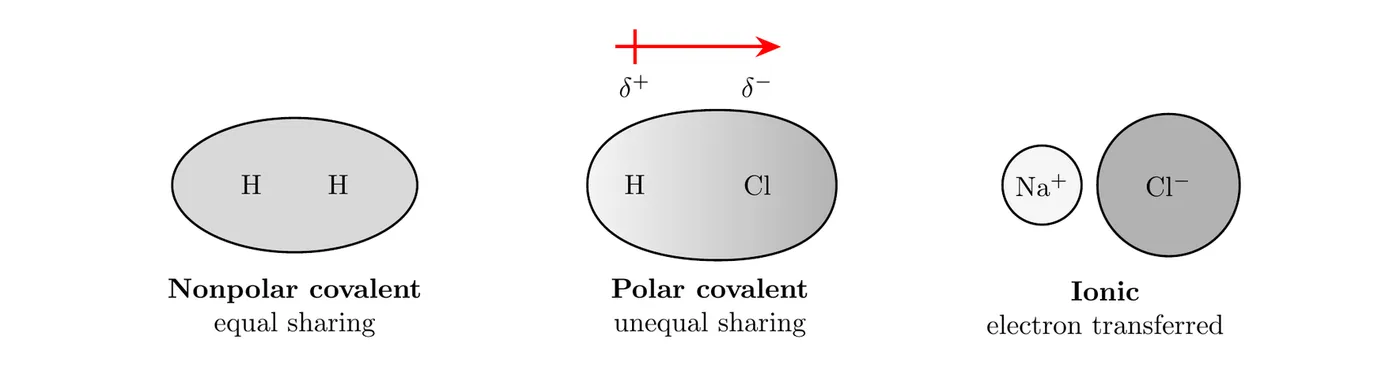
In a covalent bond, two atoms share a pair of valence electrons. When the two atoms have the same or very similar electronegativity, they pull on the shared electrons about equally. That's a nonpolar covalent bond: the electrons are spread evenly between the atoms, and neither end of the bond carries a charge.
- Bonds between identical atoms are perfectly nonpolar: H-H in , Cl-Cl in , and O=O in .
- C-H bonds are treated as nonpolar. Carbon (2.55) is slightly more electronegative than hydrogen (2.20), but the difference of 0.35 is so small that the bond behaves as nonpolar. That's why hydrocarbons such as methane and octane act as nonpolar substances, which you'll use a lot in Unit 3.
Polar covalent bonds
When two atoms with different electronegativities share electrons, the more electronegative atom pulls the shared pair closer to itself. That's a polar covalent bond. The electrons spend more time near one atom, so the bond has a slightly negative end and a slightly positive end. This separation of charge is called a bond dipole.
Which end is negative
The atom with the higher electronegativity gets a partial negative charge, written . The other atom gets a partial positive charge, . The charges are partial because the electrons are still shared, not handed over completely.
In , chlorine (3.16) is more electronegative than hydrogen (2.20), so chlorine is and hydrogen is . A bond dipole is often drawn as an arrow pointing toward the negative end, with a small cross at the positive end, as in the figure.
Bigger difference, bigger dipole
For single bonds, a greater difference in electronegativity () means a larger bond dipole. The hydrogen halides show it cleanly:
Bond | Bond dipole | |
H-F | Largest | |
H-Cl | ||
H-Br | ||
H-I | Smallest |
The CED limits this rule to single bonds, since bond length and the number of shared electrons also affect a dipole. Compare single bonds with single bonds.
Ionic character is a continuum
There's no sharp line between polar covalent and ionic. Every polar bond has some ionic character, and the larger is, the more ionic the bond behaves. Think of a sliding scale: equal sharing at one end, nearly complete transfer at the other, and most bonds somewhere in between.
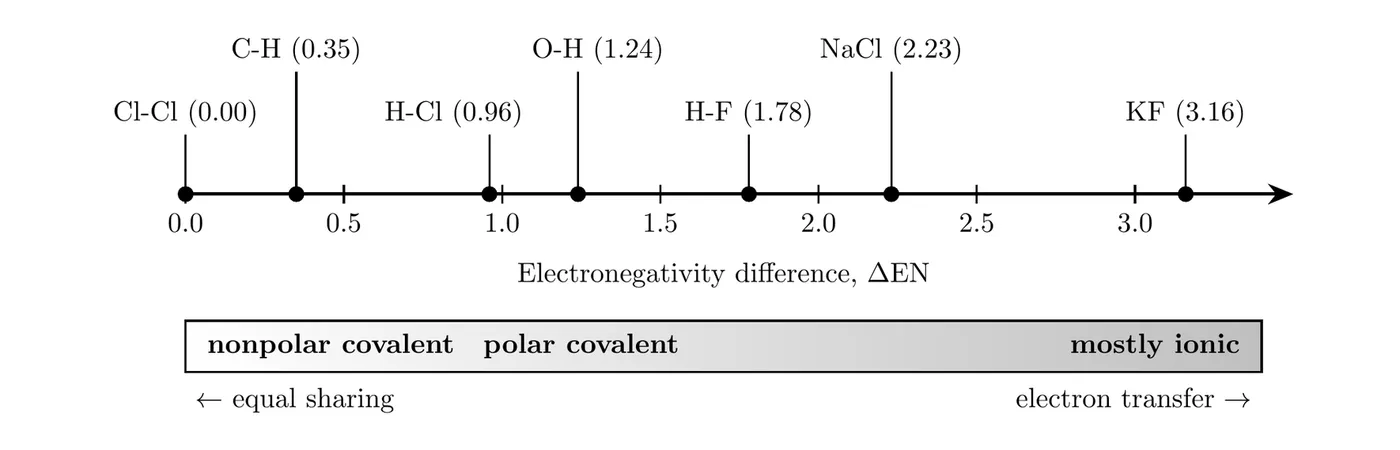
Some textbooks give cutoffs, such as calling a bond ionic when is above about 1.8. Treat those as rough guides at best. The next section shows how a cutoff can mislead you.
Example 1: Ranking bond polarity
Rank these single bonds from most polar to least polar, and name the atom with the partial negative charge in each: C-F, N-H, O-H, C-H. Electronegativities: C 2.55, H 2.20, N 3.04, O 3.44, F 3.98.
Step 1: Find for each bond (larger value minus smaller value). The more electronegative atom is the end.
Bond | Calculation | atom | |
C-F | 1.43 | F | |
O-H | 1.24 | O | |
N-H | 0.84 | N | |
C-H | 0.35 | C |
Step 2: All four are single bonds, so the larger , the larger the bond dipole.
Answer: C-F > O-H > N-H > C-H. The partial negative charge is on F, O, N, and C. The C-H bond has the smallest difference and is the one treated as nonpolar.
Deciding between ionic and covalent
Electronegativity difference isn't the only factor that decides whether a bond is ionic or covalent. Two rules of thumb work better:
- A metal bonded to a nonmetal is ionic. Examples: , , , .
- Two nonmetals bonded together are covalent. Examples: , , , .
Here's where a cutoff fails. has , and has . The differences are almost the same, but is made of covalent molecules (it boils at about 20 °C) while is an ionic solid that melts at about 840 °C.
The best way to decide what kind of bonding a substance has is to look at its properties. Ionic, covalent, and metallic substances behave differently in ways you can measure in a lab:
Property | Ionic | Covalent (molecular) | Metallic |
Particles | Cations and anions | Separate molecules | Metal cations in a sea of electrons |
Melting point | High | Low | Usually high, but varies widely |
Conducts as a solid? | No | No | Yes |
Conducts when melted? | Yes | No | Yes |
Conducts when dissolved in water? | Yes (if it dissolves) | Usually no (acids are an exception) | Doesn't dissolve |
The solid is | Hard and brittle | Often soft | Malleable and ductile |
Topic 3.2 covers every type of solid in more detail, including covalent network solids like diamond and quartz ().
Example 2: Predicting the type of bonding
Predict the type of bonding in (a) , (b) , (c) , (d) solid nickel, and (e) .
- (a) Ionic. Calcium is a metal and chlorine is a nonmetal. Calcium loses two electrons to form , and each chlorine gains one to form .
- (b) Nonpolar covalent. Two identical nonmetal atoms, so .
- (c) Polar covalent. Two nonmetals, so covalent. Nitrogen (3.04) is more electronegative than hydrogen (2.20), so each N-H bond is polar, with N as the end.
- (d) Metallic. Only metal atoms, so the valence electrons are delocalized.
- (e) Polar covalent. Two nonmetals. , so each P-Cl bond is polar, with Cl as the end.
Example 3: Identifying bonding from lab data (AP-style)
A student tests three unknown solids, W, X, and Y. The results are below. Identify the type of bonding in each solid and justify each claim with the data.
Solid | Melting point (°C) | Conducts as a solid? | Dissolves in water? | Water solution conducts? |
W | 734 | No | Yes | Yes |
X | 146 | No | Yes | No |
Y | 660 | Yes | No | (doesn't dissolve) |
- W is ionic. It doesn't conduct as a solid but its water solution does. In the solid, the ions are locked in place; once it dissolves, the ions can move and carry charge. The high melting point fits the strong attractions between ions.
- X is covalent (molecular). It dissolves, but the solution doesn't conduct, so it dissolves as whole molecules, not ions. Its melting point is also much lower than W's.
- Y is metallic. It conducts as a solid, which only happens when there are mobile, delocalized electrons. Its melting point is lower than W's, which is why melting point alone can't identify a metal.
The conductivity tests do most of the work. Conducting as a solid points to metallic bonding. Conducting only when melted or dissolved points to ionic bonding. Never conducting points to covalent bonding. (These data match potassium bromide, glucose, and aluminum.)
Metallic bonding
In a metal, the valence electrons aren't held by one atom or shared between two. They are delocalized: they move freely through the whole solid and belong to no single atom. What's left is an array of positive metal ions in a "sea" of mobile electrons, and the attraction between the ions and the electron sea holds the metal together.
Those mobile electrons explain why metals conduct electricity as solids and bend instead of shattering. Topic 2.4 covers this model, and alloys, in detail.
Common mistakes
- Getting the group trend backward. Electronegativity decreases down a group, because the valence electrons are farther from the nucleus and more shielded.
- Explaining with "wants electrons." On the AP exam, explain trends with Coulomb's law: nuclear charge, shielding, and distance.
- Putting on the wrong atom. The more electronegative atom pulls the electrons closer, so it gets .
- Using a cutoff as a hard rule. Use metal plus nonmetal versus two nonmetals, and use properties when you have them.
- Calling C-H bonds polar. They're treated as nonpolar.
- Saying ionic solids conduct because they contain ions. The ions have to be free to move, which only happens when the compound is melted or dissolved.