

2.1 - Systems and Center of Mass
Defining a System
A system is either a single object or a group of objects you choose to study together.
Single object examples: a sliding block, a falling ball, a moving car treated as one unit
Group examples: two masses connected by a string over a pulley (an Atwood machine), several connected blocks on a surface, a person standing on a boat
Treating a System as One Object
System properties come from what’s inside. A system’s properties, like its total mass, where its center of mass is, and how much energy it stores, are set by the objects inside it and how those objects interact with each other. Two carts held together with a compressed spring between them store energy in that spring, and the spring’s push between the carts decides how they fly apart once they’re released.
The object model: if what happens inside a system doesn’t matter for the question you’re asking, you can treat the whole system as a single object. A car on a highway has spinning wheels, moving pistons, and passengers bouncing around, but if all you want is how long the car takes to reach the next exit, none of that matters, so the car is just one object. Most AP Physics 1 problems use this model.
When the inside does matter: a system’s internal structure changes how you analyze it. Drop a solid rubber ball and a water balloon of the same mass from the same height, and (ignoring air resistance) they hit the ground at the same time, so up to that point each one can be treated as a single object. On impact, though, the rubber ball bounces as one piece while the water balloon bursts and splashes in every direction, so the balloon can no longer be treated as one object.
The objects inside a system can also move differently from each other and from the system as a whole. Two ice skaters who push off each other glide in opposite directions at different speeds, while the two-skater system’s center of mass doesn’t move at all (more on this in 2.3).
Outside changes can change the inside: when something outside a system changes, the system’s substructure can change too. Push a stack of books gently and the stack slides as one object. Push much harder (a bigger external force) and the top book slides off, so now the stack has to be treated as separate pieces that move differently. In the same way, a car’s crumple zone keeps its shape during normal driving but crushes in a collision, when the outside forces get huge.
System Boundaries
The system boundary is an imaginary line separating what’s “inside” your system from what’s “outside” it. Everything inside gets analyzed together, and everything outside counts as external, capable of exerting forces on the system.
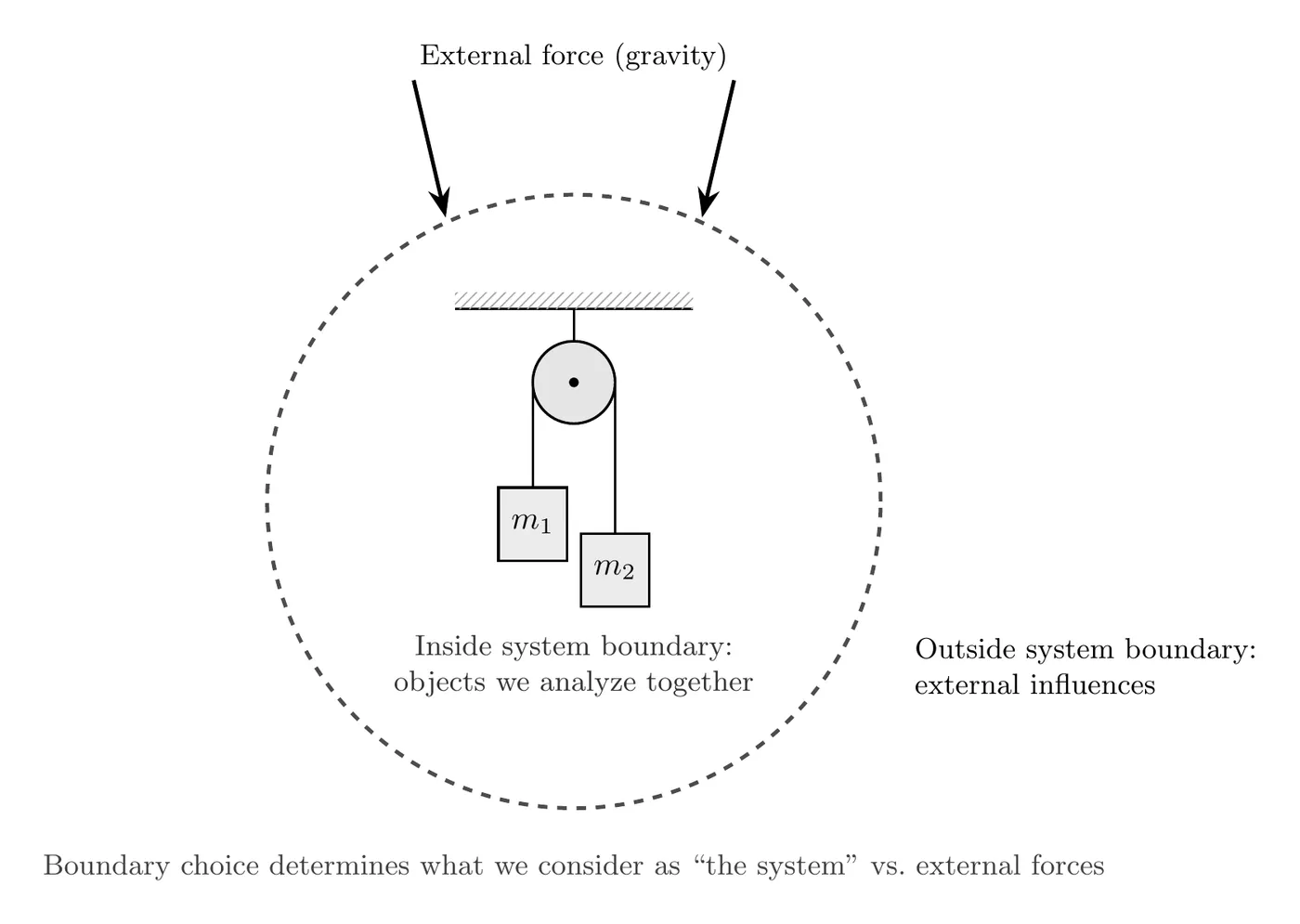
Why this matters: picking the right boundary can massively simplify a problem. If you treat two connected masses as one system, the internal tension forces cancel out completely. If you treat them as two separate systems, you have to track the tension between them.
Open, Closed, and Isolated Systems
An open system can exchange both matter and energy with its surroundings, like a pot of boiling water, where steam escapes and heat moves in and out.
A closed system doesn’t exchange matter with its surroundings, but energy can still cross its boundary, like a sealed pot of soup warming on a stove. An isolated system exchanges neither matter nor energy, like a sealed, insulated container.
The AP Physics 1 course framework doesn’t actually use these labels. Instead, it asks what crosses the boundary of the system you chose. If the net external force on the system is zero, internal interactions can’t change its total momentum or the motion of its center of mass (Unit 4), and if no work is done on it from outside, its total energy stays constant (Unit 3). That’s why conservation laws apply cleanly and center of mass calculations get simpler. So when a problem says something like “a system with no net external force,” that’s the condition to look for.
Transfers across the boundary: a system can interact with its environment (everything outside the boundary), and those interactions can move energy or mass into or out of the system. A rocket burning fuel loses mass every second as exhaust shoots out of the nozzle. A ball tossed upward, taken as a system by itself, loses kinetic energy as it rises because Earth (outside the system) pulls down on it. Redraw the boundary to include Earth, and that same pull becomes an internal interaction, so the energy stays inside the ball and Earth system and just changes form. Where you draw the boundary decides what counts as a transfer, an idea that comes back in Unit 3.
Equilibrium
A system is in equilibrium when it isn’t changing over time.
Static equilibrium: at rest and staying at rest, velocity is 0, acceleration is 0. Example: a book sitting on a table.
Dynamic equilibrium: moving, but at a steady state, velocity is constant (possibly nonzero), acceleration is 0. Example: a car cruising at constant speed on the highway.
The general condition is , which happens either when the object is stationary () or moving at constant velocity (). This previews Newton’s First Law: objects in equilibrium stay at rest or keep moving at constant velocity when there’s no net force.
Center of Mass: The Basics
The center of mass of a system is the point representing the average position of all its mass.
Physically, if you could balance the whole system on one single point, that point is the center of mass. It moves as though all the mass were concentrated right there, and any external force appears to act on this single point.
Hammer throw example: as a thrown hammer spins through the air, the handle and head each trace complicated paths, but one point, the center of mass, follows a smooth parabola. Everything else is just rotating around that point.
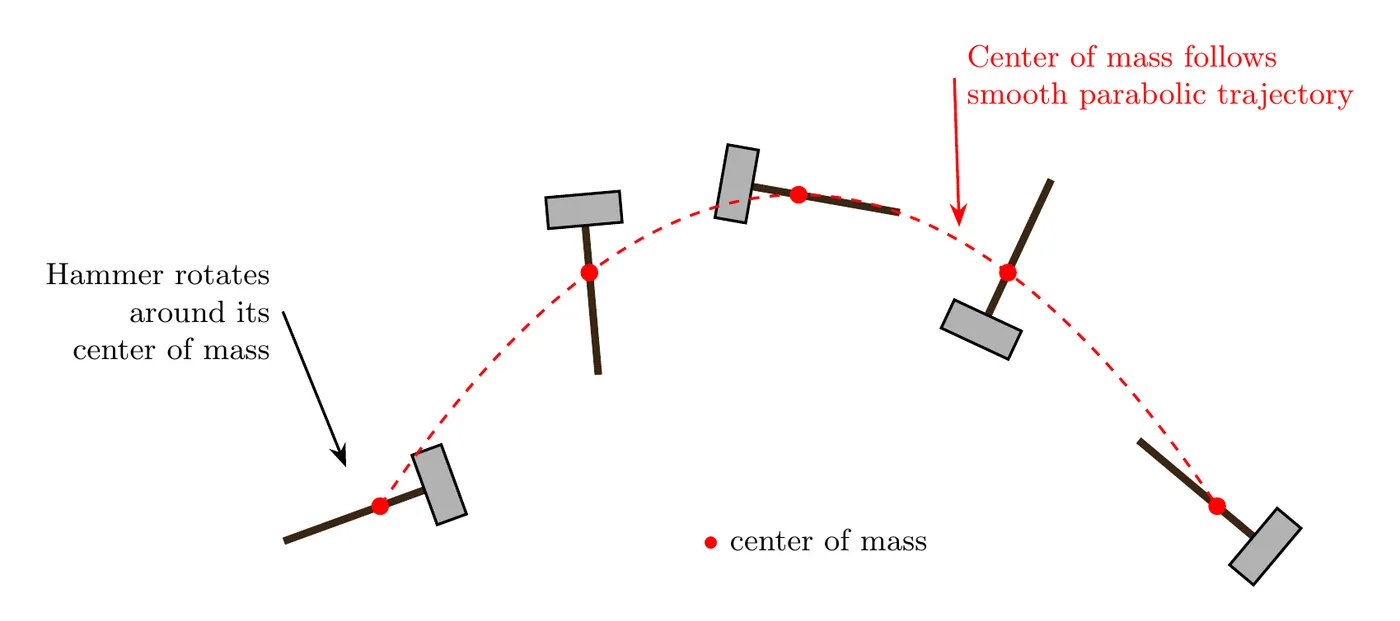
The handle and head trace complicated curves, while the center of mass path stays a clean parabola.
Even though individual parts of an object can follow complicated paths, the center of mass itself follows simple, predictable motion.
Calculating Center of Mass Position
You need two things for each piece of the system: its mass () and its position (, , or ).
One dimension:
Here is the center of mass position, and are the mass and position of piece , and is the total mass (often written or ).
Even if a piece sits right at , its mass still has to be counted in the denominator.
The same idea extends to other directions:
For 2D or 3D systems, just calculate each direction separately.
The AP equation sheet writes this in vector form, , which is shorthand for doing the and directions separately. On the exam you’ll only have to calculate it for up to five objects in two dimensions, or for objects that are highly symmetric.
Uniform vs. Non-Uniform Mass Distribution
If a problem says “uniform mass distribution,” the center of mass sits right at the geometric center, like the midpoint of a uniform rod, the center of a uniform sphere, or where the diagonals cross on a uniform rectangular plate.
Symmetry shortcut: if an object’s or a system’s mass is spread out symmetrically, the center of mass lies on every line of symmetry. So when there’s more than one line of symmetry, the center of mass is where they cross. For a uniform rod, that’s its midpoint. For a uniform square plate, or four equal masses at the corners of a square, it’s the center of the square. Check for symmetry before reaching for the formula, it often gives the answer with no math.
The center of mass doesn’t even have to be on the object. For a uniform ring, like a hula hoop, every line of symmetry passes through the empty middle, so that’s where the center of mass is.
If the mass isn’t spread evenly, the center of mass shifts toward the heavier region. A baseball bat has more mass in the barrel, so its center of mass sits closer to the barrel than the handle. A hammer’s heavy head pulls its center of mass toward the head. A person’s center of mass sits roughly near the navel, but shifts around as limbs move.
Center of Mass Velocity and Acceleration
Velocity works the same way as position:
Use sign conventions carefully here, opposite directions get opposite signs.
Acceleration follows the same pattern:
Conservation of Center of Mass
Here’s an important idea: for a system with no net external force, if the center of mass starts at rest, its position never changes.
Objects inside the system can move around and shift individual pieces, but the center of mass location stays fixed. This is the whole foundation behind “person walking on a boat” type problems. If you walk forward on a frictionless skateboard, you move forward, but the skateboard slides backward just enough to keep the overall center of mass in place.
Worked Example 1: Three People Standing
Three people stand on a long platform:
- Person A: 55 kg at m
- Person B: 70 kg at m
- Person C: 90 kg at m
Find the center of mass position, then the velocity of the center of mass under two different scenarios.
Part A: initial center of mass position
Total mass: kg
So the center of mass sits at 4.33 m, past Person B but closer to Person C, since C is the heaviest.
Part B: only Person C moves, running right at 4 m/s
The center of mass moves right at 1.67 m/s, since only Person C is moving.
Part C: Person A runs left at 5 m/s while Person C runs right at 4 m/s
The center of mass still moves right, just more slowly, at 0.40 m/s. Even though Person A moves faster (5 m/s vs. 4 m/s), Person C is heavier (90 kg vs. 55 kg), so the net motion still ends up rightward. Lighter objects moving faster can only partially cancel out heavier objects moving slower.
Worked Example 2: Person Walking on a Boat
A 40 kg person stands at the back of an 80 kg boat, floating freely with no friction against the water. The person walks 4 meters forward relative to the boat, from stern to bow. How far does the boat move?
Since there’s no external horizontal force (no friction, no wind), the net external force on the person and boat system is zero horizontally, so its center of mass can’t move sideways: .
Let kg (person), kg (boat). If the boat shifts backward by distance , the person’s actual displacement relative to the water is , and the boat’s displacement is (negative since it moves backward).
Setting the center of mass change to zero:
So the boat slides backward 1.33 m while the person walks 4 m forward relative to the boat. The person’s actual displacement relative to the water is m forward.
Quick check: ✓ (small rounding difference)
Why does the boat move backward? When the person pushes backward on the boat to walk forward, the boat pushes forward on the person (Newton’s Third Law), and with no external friction to stop it, the boat slides backward in response.
Why not the full 4 meters? The boat is twice as massive as the person, so for the center of mass to stay put, it only needs to move half as far in the opposite direction.
General formula for these problems:
where is how far the person walks relative to the boat.
Worked Example 3: Center of Mass in Two Dimensions
Four small balls are fixed to the corners of a light square frame (its mass is negligible) that is 0.40 m on each side. Put the origin at the bottom left corner:
- Ball A: 1.0 kg at
- Ball B: 2.0 kg at
- Ball C: 1.0 kg at
- Ball D: 1.0 kg at
Find the center of mass of the system.
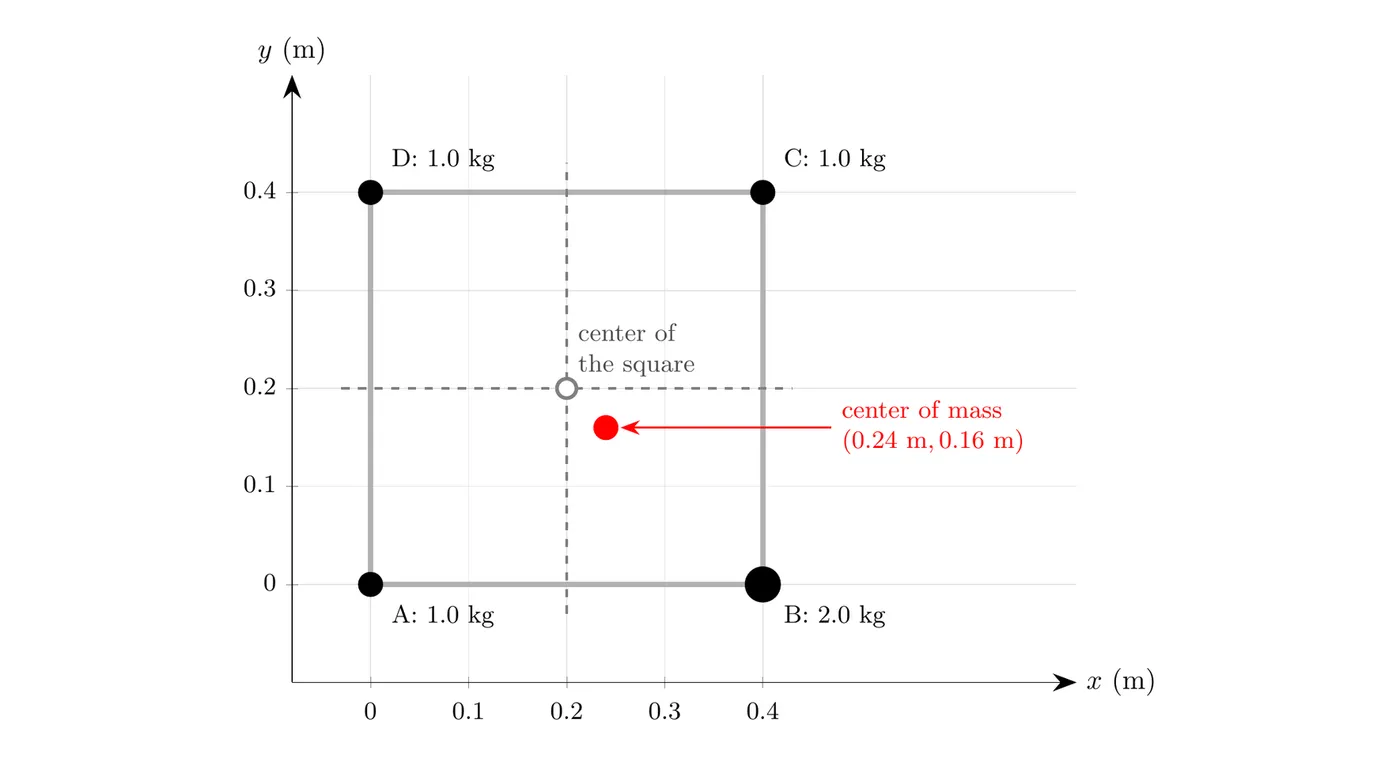
Total mass: kg
x-direction: only B and C have nonzero positions, but all four masses still go in the denominator.
y-direction: only C and D are above the origin.
So the center of mass is at .
Check with symmetry: if all four balls had the same mass, the center of mass would sit where the square’s lines of symmetry cross, at . Ball B is the heavy one, at the bottom right, so the center of mass should shift right (bigger ) and down (smaller ). It did: and .
Common Exam Scenarios
Boat problem: a person walks from one end of a floating boat to the other, what happens to the boat? It moves the opposite direction so the center of mass stays exactly where it was.
Two objects and a spring: two different masses on a frictionless surface, connected by a compressed spring, are released and fly apart. Where does the center of mass go? Nowhere, it stays put. The heavier object moves slower, the lighter one moves faster, but the center of mass never budges.
Exploding projectile: a projectile explodes mid-air into pieces. What path does the center of mass follow? The same parabolic path it was already on, as if nothing happened (ignoring air resistance).
Key Takeaways
- A system is a single object or a group of objects analyzed together
- The system boundary marks what’s inside (the system) versus outside (external influences)
- Open systems exchange matter and energy with their surroundings, closed systems exchange only energy, and isolated systems exchange neither
- Equilibrium means , either (static) or (dynamic)
- Center of mass is the mass-weighted average position of everything in a system
- Position: (same idea for and )
- Velocity:
- Acceleration:
- Uniform distribution puts the center of mass at the geometric center
- Non-uniform distribution shifts it toward the heavier region
- For symmetric mass distributions, the center of mass lies on every line of symmetry (where they cross)
- For a system with no net external force that starts at rest,
- The person on a boat formula:
- Include every mass in the denominator, even at zero position or velocity
- Watch your sign conventions carefully for direction
- Center of mass always moves simply and predictably, even when individual pieces move chaotically
- If what’s inside a system doesn’t matter for the question, treat the system as one object located at its center of mass
- Objects inside a system can move differently from each other and from the system as a whole
- Interactions across the system boundary can transfer energy or mass into or out of the system
- In 2D, find and separately with the same formula