

2.9 - Circular Motion
Acceleration from Changing Direction
An object accelerates whenever its velocity changes, and since velocity is a vector with both magnitude (speed) and direction, that acceleration can come from speed changing (speeding up or slowing down), direction changing (turning, even at constant speed), or both changing at once (typical real-world motion).
Here’s the key insight: an object moving in a circle at constant speed is still accelerating, because its direction is continuously changing. This is called centripetal acceleration.
Centripetal Acceleration
Centripetal acceleration is the piece of an object’s acceleration pointed toward the center of its circular path. The word comes from Latin, centrum meaning center and petere meaning to seek, so centripetal essentially means “center-seeking.”
where is centripetal acceleration in m/s², is the linear speed along the circular path in m/s, and is the radius of the circle in meters. It always points toward the center of the circle, perpendicular to the velocity.
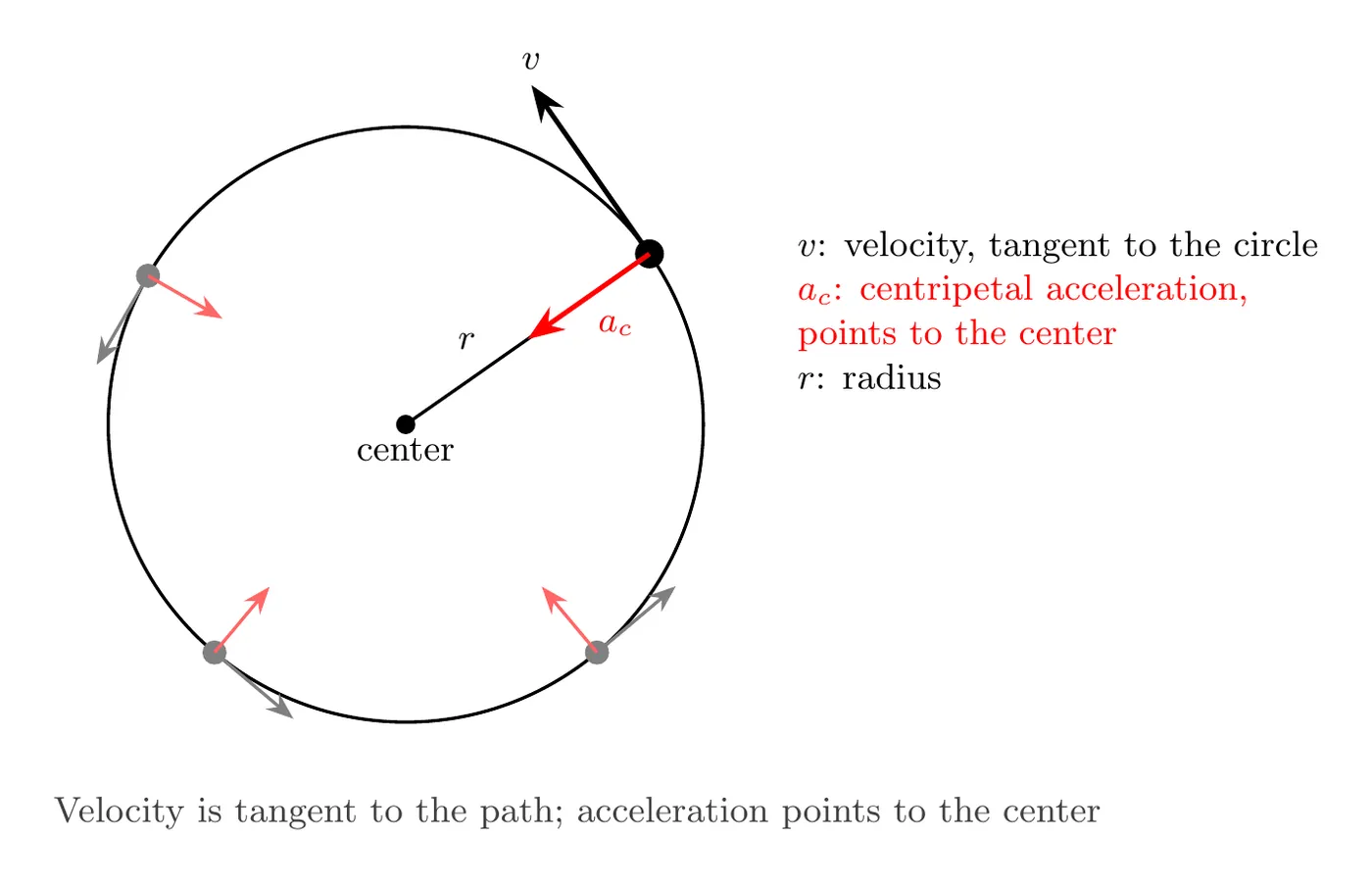
Why speed squared? Higher speeds need sharper changes in direction to stay on the circle, creating more acceleration, and the relationship is quadratic: double the speed and you get quadruple the acceleration, triple the speed and you get nine times the acceleration.
Why radius in the denominator? Tighter circles (smaller radius) need more dramatic direction changes: smaller radius means sharper turn means greater acceleration, and larger radius means gentler turn means less acceleration. A highway off-ramp at 60 mph uses a large radius (a gentle, comfortable curve), while a parking lot turn at 10 mph uses a small radius (a sharp but still manageable turn), and taking highway speeds through that same parking lot radius would produce dangerously high acceleration.
Any curved path, even non-circular ones, can be analyzed as circular motion, or approximated locally as a series of circular arcs, each with its own radius. A sharp turn is a small radius circle (high centripetal acceleration), a gentle curve is a large radius circle (low centripetal acceleration), and a lane change is an extremely large radius (barely any centripetal acceleration at all).
Tangential Acceleration and Net Acceleration
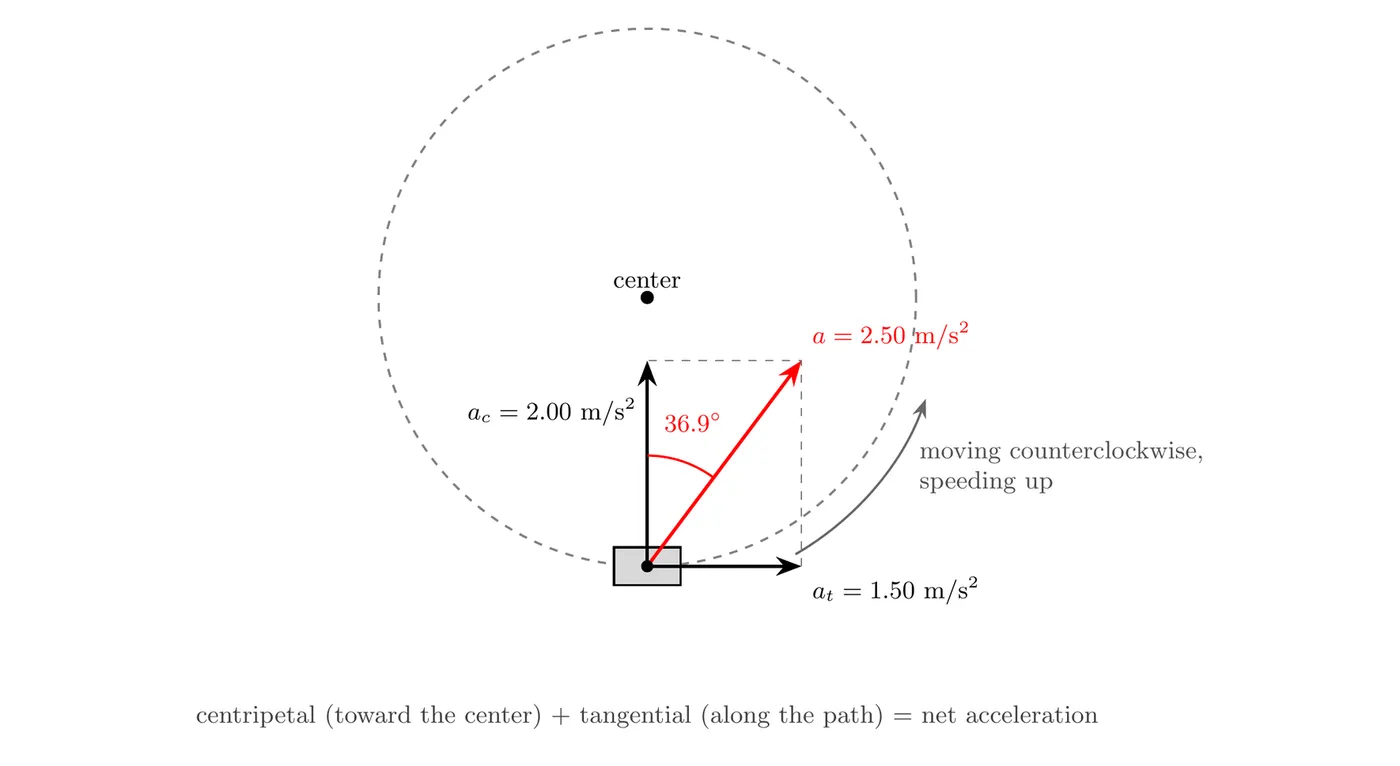
Centripetal acceleration only handles the change in direction. If the object’s speed is also changing, it has a second piece of acceleration, the tangential acceleration (). It’s the rate at which the object’s speed changes, and it points along the tangent to the circle: forward (the same way as the velocity) when speeding up, backward when slowing down.
The object’s net acceleration is the vector sum of the two pieces. Since centripetal (toward the center) and tangential (along the path) are always perpendicular, the Pythagorean theorem gives its size:
In uniform circular motion (constant speed), and the net acceleration points straight at the center. If the object is speeding up or slowing down, the net acceleration tilts away from the center, forward or backward.
Example: a car on a circular track of radius 50.0 m is moving at 10.0 m/s and speeding up at 1.50 m/s². Its centripetal acceleration is toward the center, and its tangential acceleration is 1.50 m/s² forward. The net acceleration is:
It points inward and tilted forward, away from the direction toward the center.
Centripetal Force
Since acceleration requires force, circular motion requires a centripetal force.
where is centripetal force in Newtons, is mass in kg, is speed in m/s, and is radius in meters.
Here’s an important idea: centripetal force is not a new type of force to add to your free body diagram. Instead, it’s the net force pointing toward the center, and it can come from a single force (like tension in a string), multiple forces combined (like normal force minus weight), or components of forces (like friction during a turn). “Centripetal force” describes the role a force is playing (causing circular motion), not a brand new physical force.
Common Sources of Centripetal Force
Friction: in a car turning on a flat road, friction between the tires and the road provides the inward force needed to change direction. Take a turn at 15 m/s and friction points toward the center of the turn, but with no friction, the car just continues straight (Newton’s First Law).
Tension: for an object attached to a string swung in a horizontal or vertical circle, the string pulls inward, providing centripetal force. Spin a ball on a rope overhead and tension points toward the center along the rope, but break the rope and the ball flies off tangentially.
Normal force: in a roller coaster loop, a car going over a hill, or an object on a spinning platform, the contact force from a surface provides part or all of the centripetal force. At the top of a roller coaster loop, both normal force and weight point downward, toward the center, and together they provide the centripetal force.
Gravity: for a satellite orbiting Earth, or planets orbiting the Sun, gravitational attraction provides the centripetal force for orbital motion. For the Moon orbiting Earth, gravity pulls it toward Earth (centripetal), while its tangential velocity keeps it from actually falling in.
Free Body Diagrams for Circular Motion
The approach is similar to other Newton’s Law problems, but with a key difference: instead of horizontal/vertical or parallel/perpendicular to a surface, use circular and non-circular directions. The circular direction is toward or away from the center of the path (radial), and the non-circular direction is tangent to the path (tangential). The convention is that pointing into the center (the centripetal direction) counts as positive.
Example: car taking a turn on a flat road. A car turns left on a horizontal, flat road at constant speed. The forces are weight (, down), normal force (, up), and friction (, toward the center of the turn, providing the centripetal force).
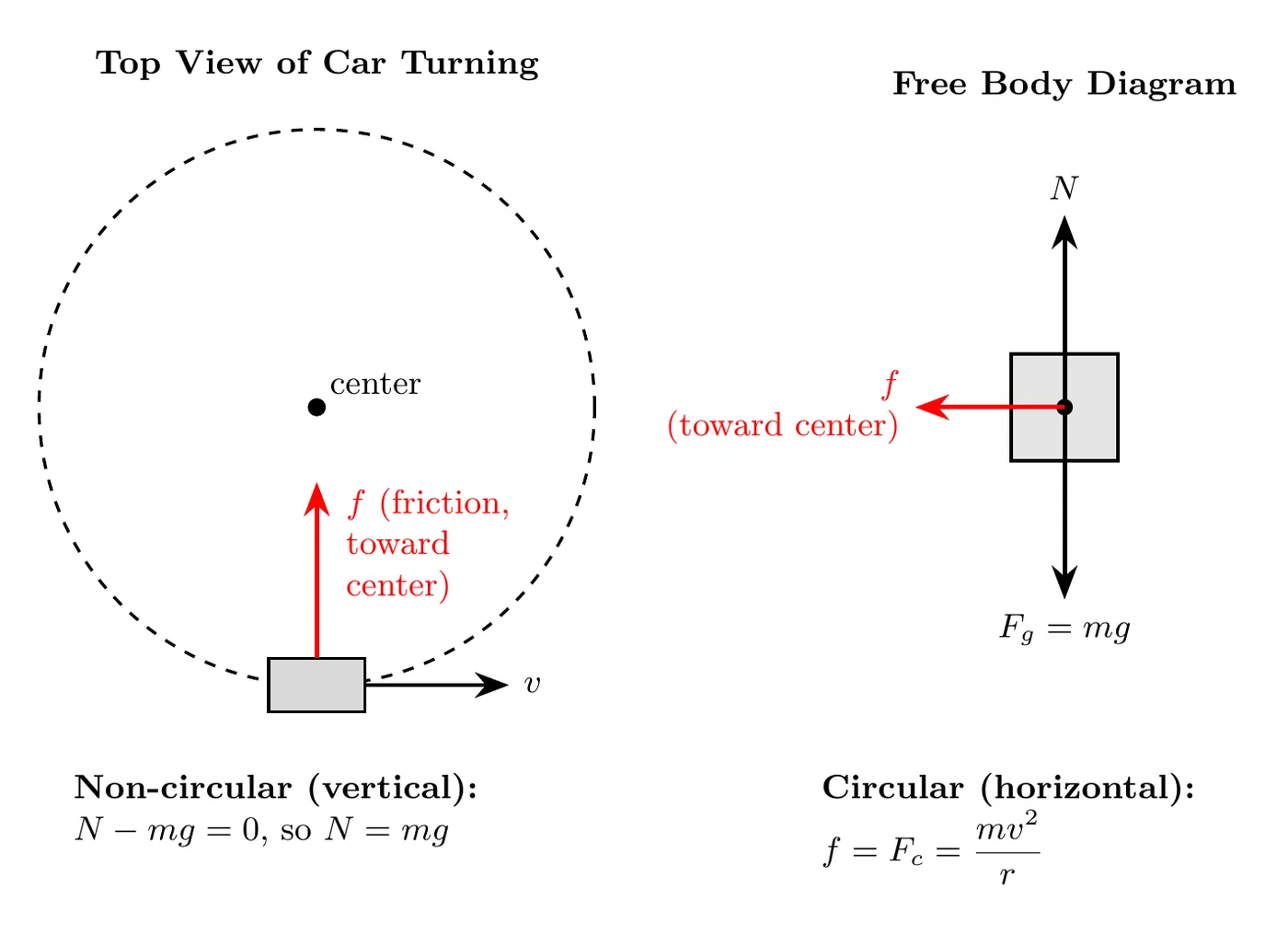
In the non-circular (vertical) direction there’s no acceleration since the car doesn’t leave the road:
In the circular (horizontal, toward center) direction:
Friction provides the centripetal force. Substituting the friction formula, , and then :
The maximum safe turning speed depends on the friction coefficient, gravity, and the turn’s radius, but not on the car’s mass. Heavy trucks and light cars can take the exact same turn at the exact same maximum speed as long as their tires have the same friction coefficient.
Example: roller coaster at the top of a loop. At the highest point of a vertical loop, the forces are weight (, downward, toward the center) and normal force (, downward, toward the center, since the seat pushes down on the rider). At the top of the loop, both forces point downward, toward the center of the circular path.
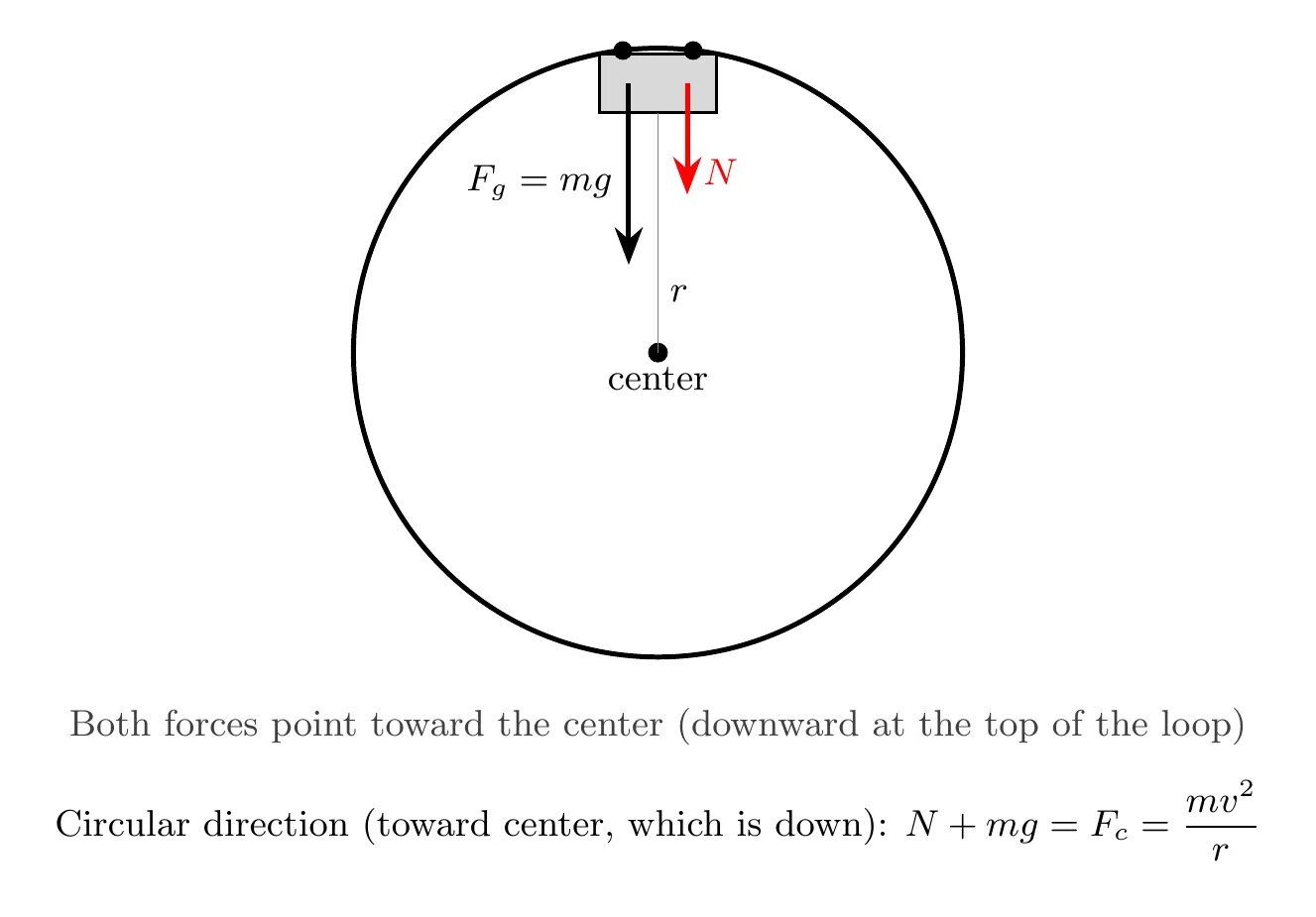
In the circular direction, since both forces point toward the center:
Solving for normal force:
At high speed, , so , and the rider feels pressed into the seat. At the minimum speed, , so , and the rider feels weightless, just barely staying in the seat. If it’s too slow, , giving , which is physically impossible, the rider would fall (which is why restraints are needed).
The minimum speed to maintain contact comes from setting :
Banked Curves
Highway curves and racetracks are often tilted (banked) toward the center of the turn. On a banked road, the normal force is perpendicular to the tilted surface, so it points partly up and partly toward the center. That inward part of the normal force can supply the centripetal force, even with no friction at all.
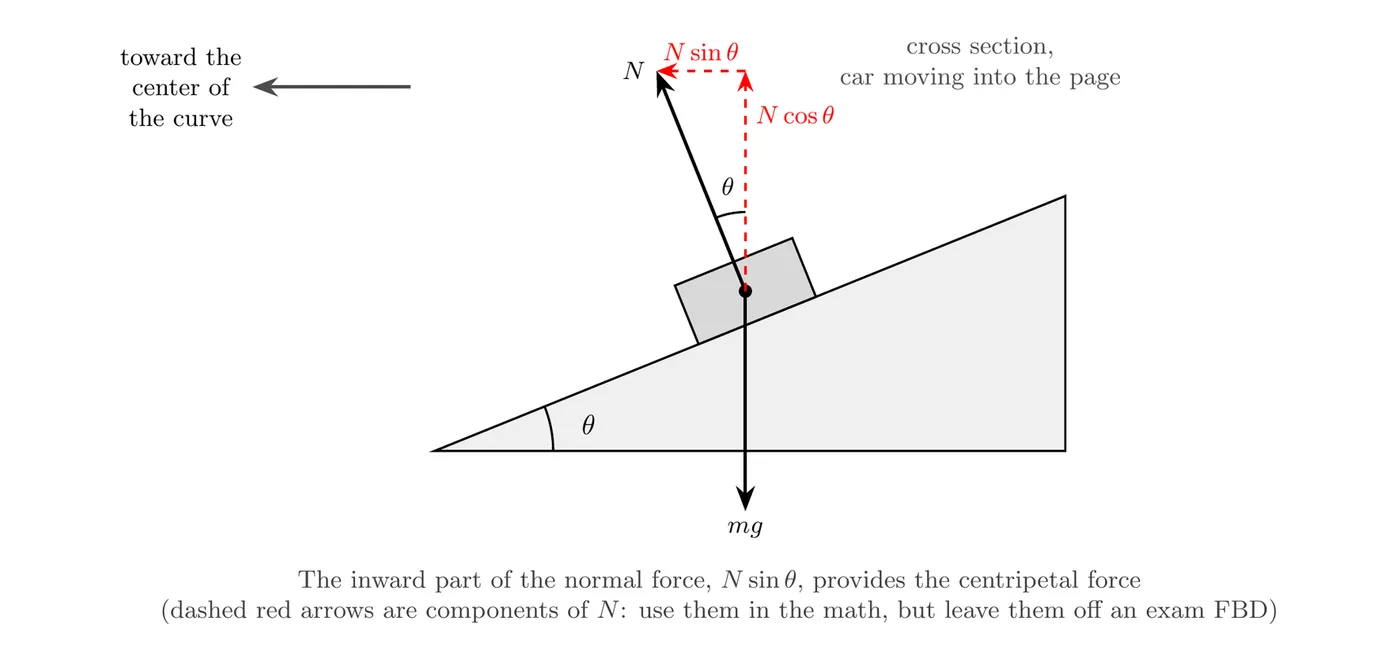
No friction needed (the design speed): take a car moving at speed around a curve of radius banked at angle , on an icy (frictionless) road. The only forces are (perpendicular to the road) and (down). Split into a vertical part and a horizontal part that points toward the center:
Dividing the second equation by the first cancels and :
So for a given radius and bank angle, there’s exactly one speed at which a car can take the curve with no friction, and it doesn’t depend on the car’s mass.
Example: a highway curve has a radius of 125 m. What bank angle lets a car take the curve at 20.0 m/s with no help from friction? Use .
With friction (qualitative only on the AP exam): if a car goes faster than the design speed, the inward part of the normal force isn’t enough by itself, and the car tends to slide up and out, so static friction points down the slope to help pull it inward. If the car goes slower than the design speed, it tends to slide down the bank, so static friction points up the slope. Either way, components of both the normal force and static friction add up to the net force toward the center.
Conical Pendulum
A conical pendulum is a mass on a string swinging in a horizontal circle, so the string traces out a cone. The forces on the mass are tension along the string and weight straight down. Gravity has no horizontal part, so the horizontal component of the tension is the only inward force, and it provides the centripetal force, while the vertical component of the tension holds the mass up.
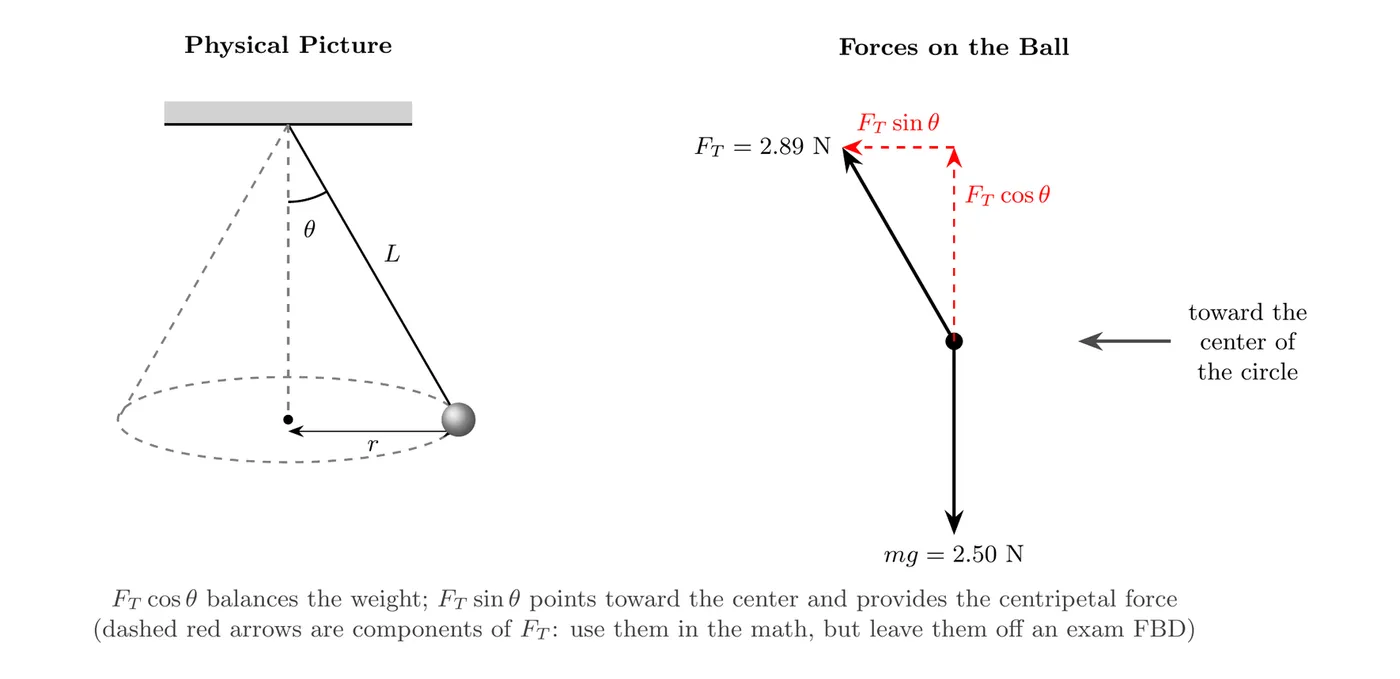
With the string at angle from vertical and a circle of radius :
Dividing gives , the same relationship as the frictionless banked curve. In both cases, one force tilted at from vertical balances gravity with its vertical part and supplies the centripetal force with its horizontal part.
Example: a 0.250 kg ball on a 1.20 m string swings in a horizontal circle with the string at 30.0° from vertical. Use .
Tension: N, more than the ball’s 2.50 N weight, because only part of the tension holds the ball up.
Radius: m
Speed: m/s
Period: s
Uniform Circular Motion: Period and Frequency
Uniform circular motion happens when an object travels in a circle at constant speed. Even though speed stays constant, velocity keeps changing direction, so acceleration still exists.
Period () is the time to complete one full revolution, measured in seconds. For example, a merry-go-round completing one rotation in 8 seconds has s.
Frequency () is the number of complete cycles per unit time, measured in cycles per second, or Hertz (Hz). For example, a ceiling fan completing 3 rotations per second has Hz.
Period and frequency are reciprocals of each other:
A high frequency means a short period (many cycles per second), while a low frequency means a long period (few cycles per second).
The distance traveled in one revolution is the circle’s circumference, . Since speed is distance over time, for one complete cycle:
Or in terms of frequency, since :
These connect linear speed to the rotational quantities of period and frequency.
Orbital Motion
Circular motion principles apply beautifully to orbital mechanics, where gravity supplies the centripetal force.
For a satellite orbiting a planet at constant speed, gravitational force provides the centripetal force:
where is the planet’s mass, is the satellite’s mass, is the orbital radius (center of planet to satellite), and is the universal gravitational constant. Canceling one and one :
Orbital speed depends only on the planet’s mass and the orbital radius, not on the satellite’s own mass.
Finding orbital period: substitute into the orbital speed equation:
Squaring both sides:
Solving for :
This is Kepler’s Third Law of Planetary Motion: the square of the orbital period is proportional to the cube of the orbital radius, . Physically, satellites farther from a planet move slower and take longer to orbit, and both effects add up to a longer period.
Worked Example: Orbital Period of a Satellite
A satellite orbits Earth in a circle m (400 km) above the surface, about the height of the International Space Station. Earth’s mass is kg and its radius is m. Find the orbital period.
Orbital radius (center to center): m
Kepler’s third law:
That’s about 92.4 minutes per orbit. The satellite’s own mass never showed up, so anything orbiting at this radius takes the same time. Its speed is m/s, and its centripetal acceleration matches the gravitational field strength at that height (see 2.6), as it should, since gravity is the only force on it.
Worked Example: Object on Rotating Platform
A 2.5 kg block sits on a horizontal platform rotating about a vertical axis, 1.2 m from the axis. The coefficient of static friction between block and platform is 0.40. Use . Find the maximum speed before the block slides, and determine whether the block slides if the platform’s period is 4.0 seconds.
Draw: the forces on the block are weight (, down), normal force (, up), and friction (, toward the center, providing the centripetal force).
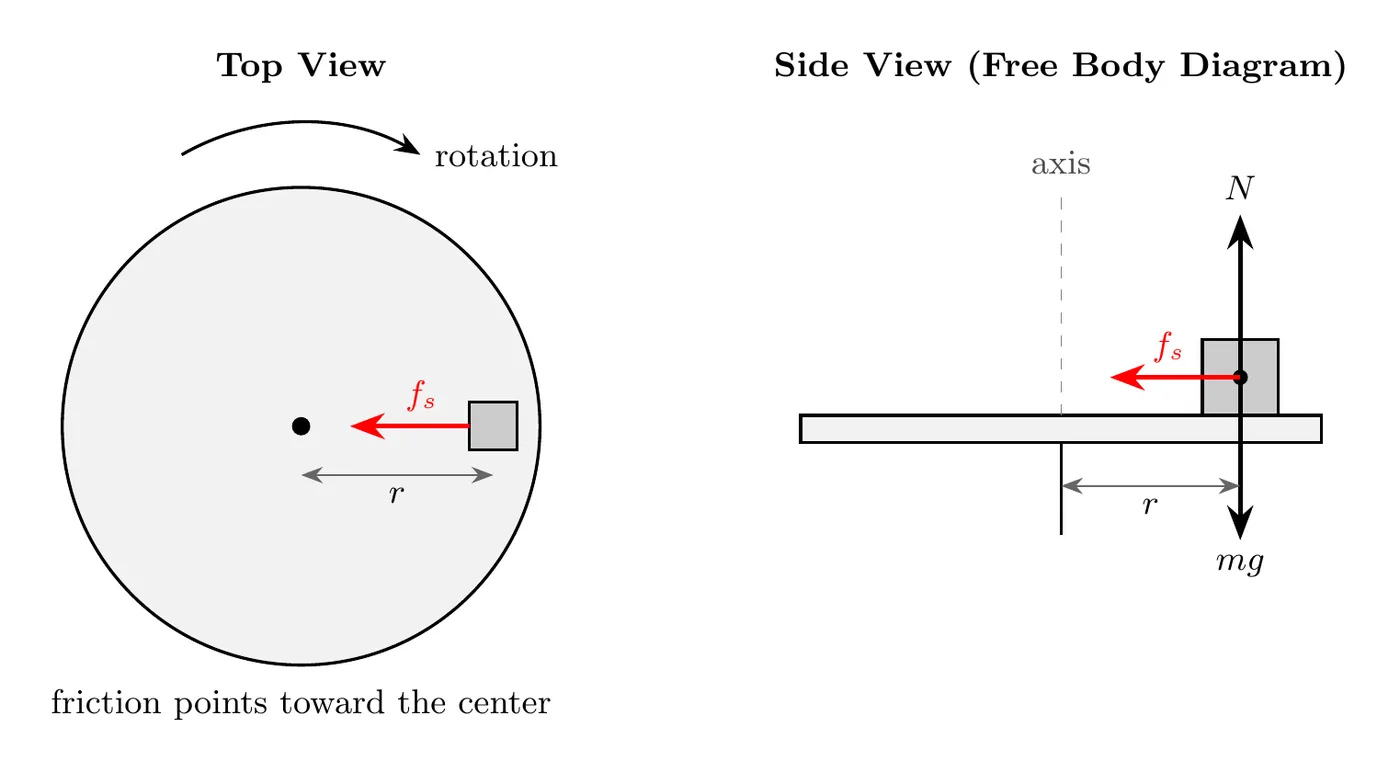
Sum: in the non-circular (vertical) direction, .
In the circular (horizontal, toward center) direction, .
At the maximum speed, static friction hits its cap, .
Solve for maximum speed: setting maximum friction equal to the required centripetal force,
Plugging in numbers:
The block can spin at speeds up to 2.19 m/s without sliding. Beyond that, friction can’t supply enough centripetal force, and the block slides outward.
Checking s: find the actual speed at this period.
Comparing to the maximum: actual speed is 1.88 m/s, maximum speed is 2.19 m/s. Since the actual speed is less than the maximum, the block does not slide, it stays below the threshold where friction maxes out. The required friction is N, which is less than the maximum static friction of N, confirming that static friction can handle it.
Problem-Solving Strategy
Draw: free body diagram with all forces, identify the center of the circular path, and figure out which forces point toward or away from center.
Sum: split forces into circular (radial) and non-circular (tangential) directions. Circular: (toward center is positive). Non-circular: often for uniform circular motion.
Solve: use algebra to find the unknowns, possibly relating speed to period through , and check that the answer makes sense.
Common Problem Scenarios
Maximum safe speed: given a friction coefficient and radius, find the maximum speed before sliding or skidding, with .
Minimum speed in vertical circles: given a loop’s radius, find the minimum speed to maintain contact at the top, with .
Tension in a string: given mass, speed, and radius, find the tension, which provides or contributes to the centripetal force.
Orbital period: given the mass of a planet and orbital radius, find the satellite’s period, using .
Real-World Applications
Banked highway curves: roads tilt inward on curves so the normal force, not just friction, contributes to centripetal force, allowing safer high-speed turns even on icy roads with low friction.
Washing machine spin cycles: rapid rotation creates high centripetal acceleration. Water droplets can’t maintain that circular motion since nothing pulls them inward, so they fly outward through holes in the drum, leaving clothes drier.
Gravitational assist maneuvers: spacecraft use a planet’s gravity (which provides centripetal force during a close approach) to change direction and speed, reaching distant destinations without burning excessive fuel.
Centrifuges: lab and industrial centrifuges spin samples at very high speeds. Denser materials need more centripetal force to keep up, so they move outward, separating from less dense materials.
Key Takeaways
- Centripetal acceleration: , always pointing toward the center of a circular path
- Acceleration exists even at constant speed, because direction is always changing
- Centripetal force: , is the net force toward the center, not a new type of force
- Common sources include friction, tension, normal force, and gravity, depending on the scenario
- Positive direction is toward the center (centripetal direction)
- Split forces into circular (radial, toward/away from center) and non-circular (tangential)
- Period: time for one full revolution,
- Frequency: cycles per unit time,
- Speed from period:
- Maximum turning speed with friction: , independent of mass
- Minimum loop speed at the top of a vertical circle: to maintain contact
- Orbital motion: gravity provides the centripetal force, with and
- Mass cancels out in many circular motion problems, similar to inclines and gravitational orbits
- Centripetal means center-seeking, the force always points toward the circle’s center
- Use the Draw-Sum-Solve framework with circular/non-circular force analysis
- Tangential acceleration changes the speed and points along the path; net acceleration
- Frictionless banked curve: the inward part of the normal force is the centripetal force, and
- On a banked curve with friction, static friction points down the slope above the design speed and up the slope below it
- Conical pendulum: the horizontal part of the tension is the centripetal force, and
- Kepler’s third law: , which doesn’t depend on the satellite’s mass