

5.2 - Connecting Linear and Rotational Motion
Building the Bridge
We’re now connecting the rotational quantities from 5.1 (, , ) to the familiar linear quantities from Unit 1 (, , ). The key insight is that radius provides the conversion factor between angular and linear descriptions of the same motion. A point at distance from the rotation axis travels a longer linear distance than a point closer to the axis, even though both sweep through the same angle.
Arc Length and Angular Displacement
Arc length is the linear distance a point travels along a circular path.
where (or ) is the linear distance along the arc in meters, is the radius (distance from the rotation axis) in meters, and is the angular displacement, which must be in radians for this formula to work.
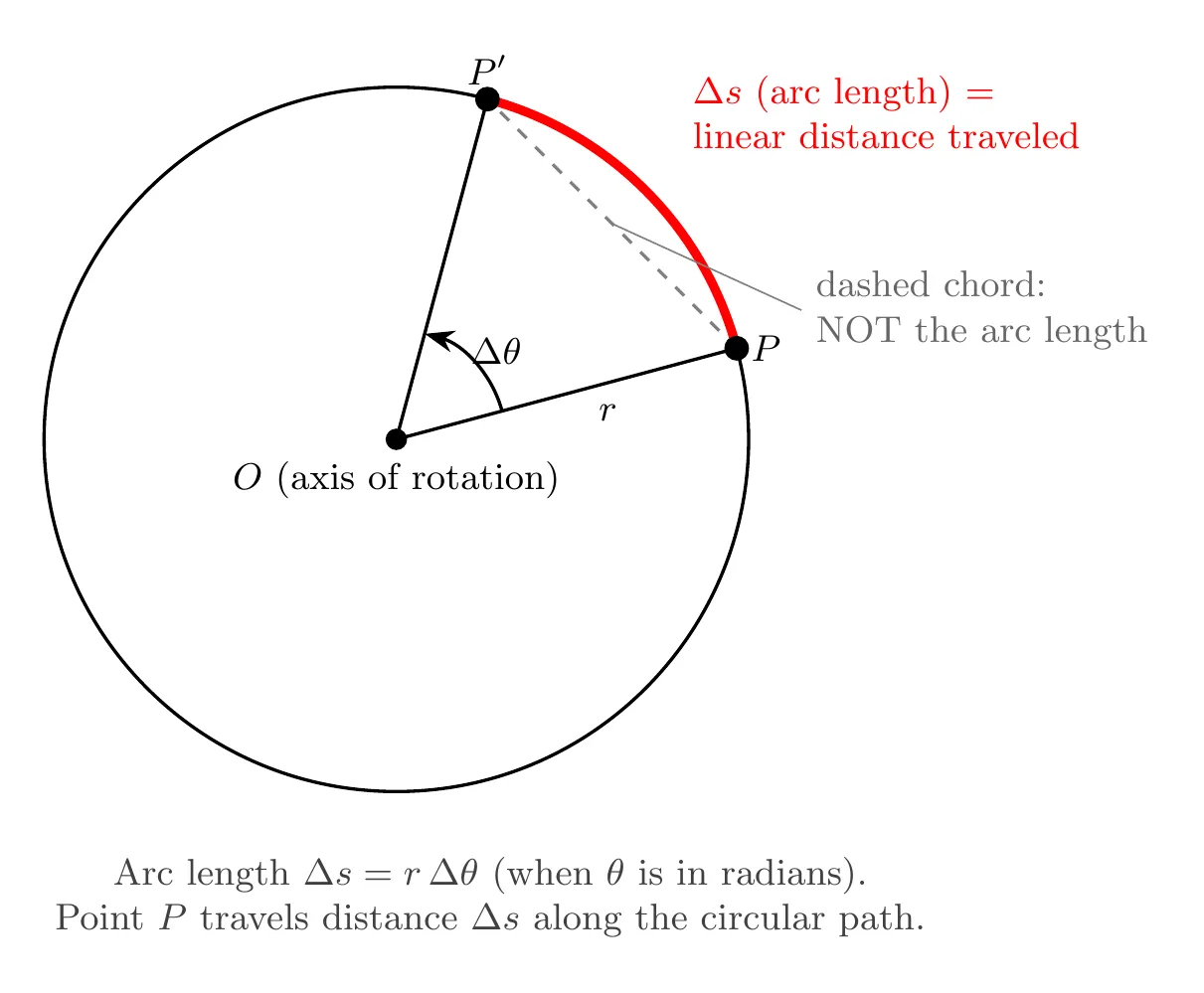
The farther from the axis, the greater the linear distance traveled for the same angular displacement. For example, two points on a spinning disk both rotate through rad (a quarter turn): Point A at m travels m, while Point B at m travels m, three times farther, even though both swept the same angle.
The formula only works with radians because that’s literally how a radian is defined: one radian is the angle that produces an arc length equal to the radius, . That’s why the formula is so clean, it’s built right into the definition.
Tangential Velocity and Angular Velocity
Tangential velocity is the linear speed of a point moving along a circular path.
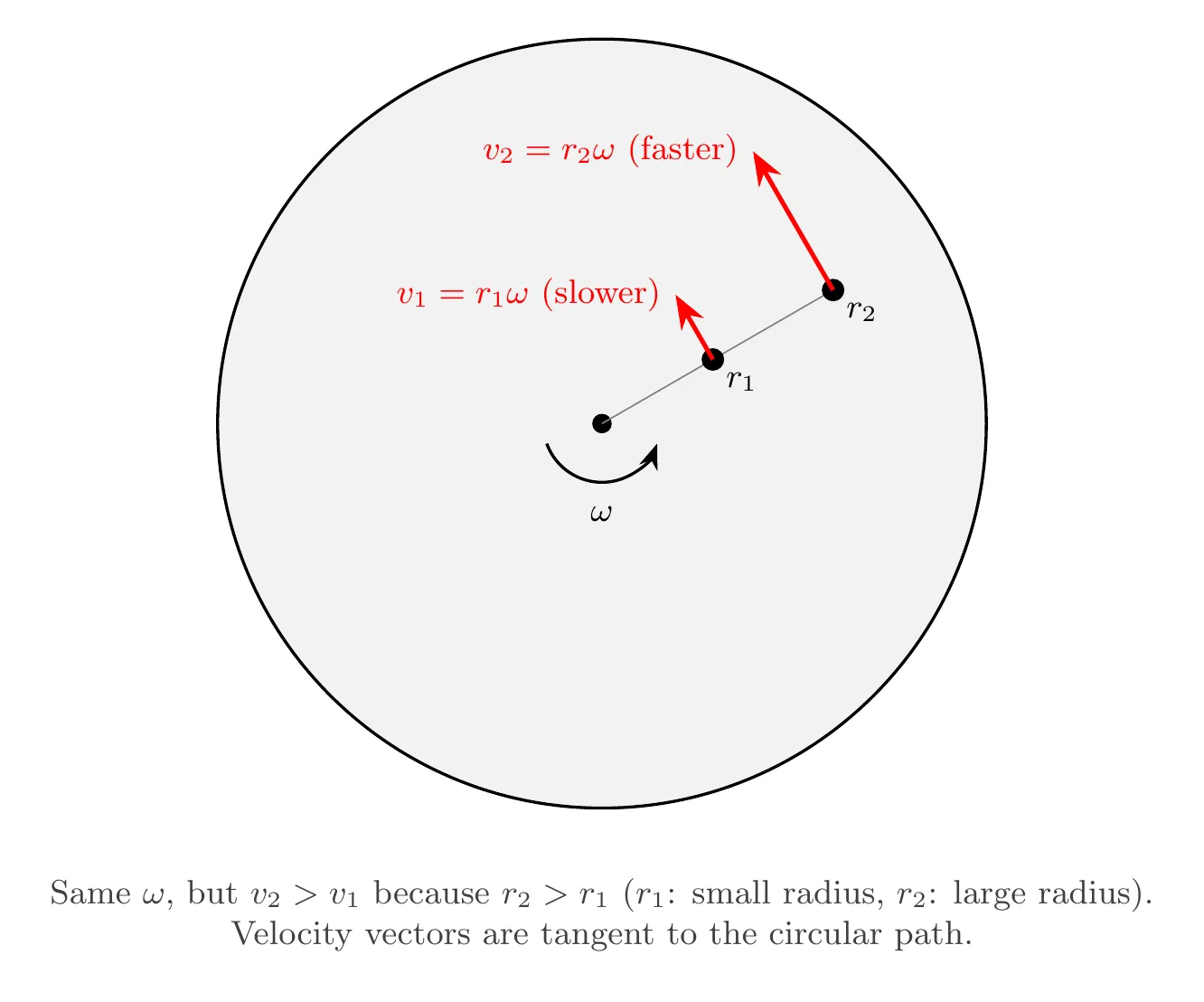
where is tangential velocity in m/s, is radius in meters, and is angular velocity in rad/s. This velocity always points tangent to the circle, perpendicular to the radius, at the point’s current position.
Deriving it: starting from , dividing both sides by time gives , and recognizing the definitions of linear and angular velocity gives .
Points farther from the axis move faster linearly, even with the same angular velocity. Take a merry-go-round: Child A at m and Child B at m both complete one rotation in 10 seconds, giving them the same angular velocity, rad/s. But their linear velocities differ: Child A moves at m/s, while Child B moves at m/s, three times as fast. This is exactly why the outer horses on a merry-go-round move faster.
Tangential Acceleration and Angular Acceleration
Tangential acceleration is the linear acceleration along the circular path, speeding up or slowing down the rotation.
where is tangential acceleration in m/s², is radius in meters, and is angular acceleration in rad/s². The subscript “t” is a reminder this is tangential (along the circle), not centripetal (toward the center), which exists even at constant angular velocity and gets covered separately.
Deriving it: starting from , taking the rate of change with respect to time, , and recognizing the definitions gives .
For a bicycle wheel spinning up at rad/s²: the hub ( m) accelerates at m/s², while the rim ( m) accelerates at m/s², seven times faster linearly than the hub.
Sign Convention
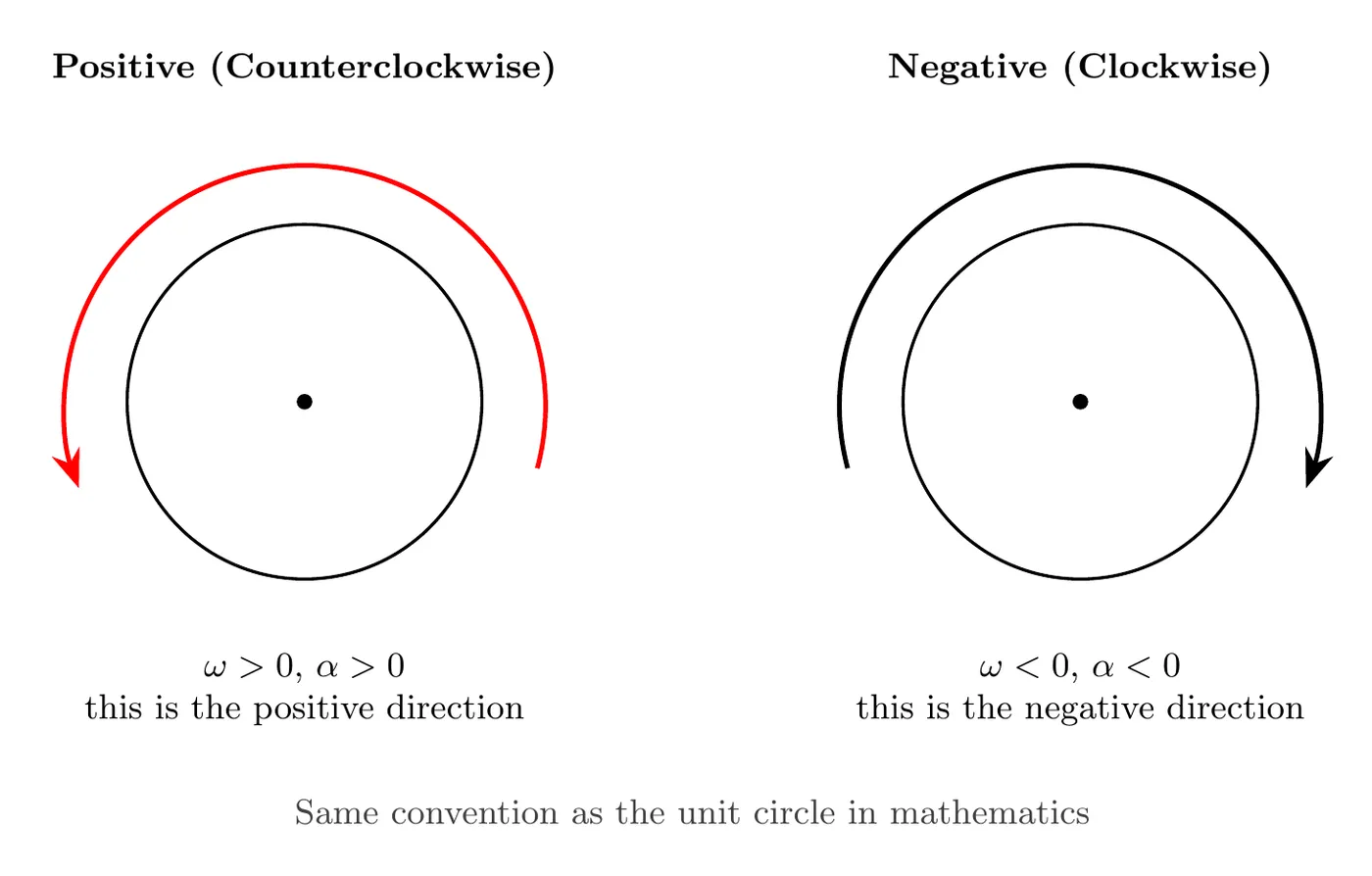
The standard convention: counterclockwise is positive (positive angular displacement, angular velocity, and angular acceleration), while clockwise is negative. Think of a clock’s hands moving clockwise (the negative direction) and the opposite being counterclockwise (positive), matching the unit circle convention from pre-calculus, where positive angles are measured counterclockwise.
Same Angular Quantities at Every Radius
Every point on a rigid rotating object shares the same angular displacement, angular velocity, and angular acceleration, no matter how far it is from the axis. But linear quantities, distance, velocity, acceleration, all depend on the radius.
Quantity | Same for all radii? | Formula |
Angular displacement () | Yes | doesn’t depend on |
Angular velocity () | Yes | doesn’t depend on |
Angular acceleration () | Yes | doesn’t depend on |
Linear distance () | No | |
Linear velocity () | No | |
Tangential acceleration () | No |
So when analyzing a rotating system, use angular quantities to describe the rotation as a whole, and linear quantities to describe the motion of specific points.
Example, a spinning disk with two clay lumps: Lump A near the center ( m) and Lump B near the edge ( m) both share the same angular quantities, rotating through rad (one full turn) with rad/s and rad/s². But their linear quantities differ: Lump A travels m per rotation while Lump B travels m per rotation, five times farther; and Lump A moves at m/s while Lump B moves at m/s, five times as fast.
Worked Example: Fishing Reel
A fishing reel with radius cm m accelerates at rad/s² for s, starting from rest, previously found to have final angular velocity rad/s and angular displacement rad. Find the linear speed of the fishing line after 2 seconds, and how much line came out.
Linear speed of the line: the line unwraps from the edge of the reel, so use the reel’s radius with :
After 2 seconds of acceleration, the line pulls out at 9.9 meters per second.
Length of line released: using arc length, :
During those 2 seconds, 9.9 meters of line unwraps from the reel.
Interestingly, both values come out to 9.9 here, purely coincidental for these particular numbers. In general, (a speed) and (a distance) are different quantities that will usually have different numerical values, don’t assume they’ll always match.
As for context, is 9.9 meters a lot of fishing line? Not really, recreational spools typically carry 100 to 300 meters, and deep-sea spools carry 500 to 1500 meters, so 9.9 meters is a small fraction of a typical spool, leaving the fish plenty of line to swim with.
Worked Example: Linear to Rotational (Crane Drum)
Going the other way works the same. A crane lifts a crate by winding its cable onto a drum of radius 0.25 m. The crate rises at a steady 0.80 m/s. Find the drum’s angular velocity and the number of revolutions it makes while the crate rises 6.0 m.
Angular velocity: the cable comes off the edge of the drum, so the cable’s speed equals the tangential speed of the drum’s rim. Solving for :
Revolutions: 6.0 m of cable winds onto the drum, which is the arc length traveled by a point on the rim. Solving for :
Since the crate rises at a steady speed, is constant and . If the crate were speeding up at 0.40 m/s² instead, the drum’s angular acceleration would be rad/s².
Summary of Conversion Formulas
Linear Quantity | Formula | Rotational Quantity |
Distance | Angular displacement | |
Velocity | Angular velocity | |
Tangential acceleration | Angular acceleration |
The radius appears in all three, acting as the conversion factor between the two descriptions. Checking units: meters equals meters times radians, m/s equals meters times rad/s, and m/s² equals meters times rad/s², which all work out correctly since radians are dimensionless (a ratio of two lengths).
Real-World Applications
Car speedometers: a speedometer actually measures wheel rotation () but displays linear speed (), calculated using with the wheel’s radius. This is exactly why changing your tire size can throw off speedometer accuracy.
Drill bits: high-speed drills are rated in RPM (angular velocity), but the actual cutting speed at the bit’s edge (linear velocity) is what determines cutting effectiveness. For a 1 cm radius bit at 3000 RPM: rad/s, giving m/s.
Record players: vinyl records spin at a constant 33⅓ RPM (constant ), but the needle moves slower near the center and faster near the edge, which is why sound quality can vary slightly across a record, the needle encounters different linear speeds depending on where it is.
Wind turbines: blade tips move much faster than the roots. For a 50 m blade rotating at rad/s, the tip speed is m/s while the root speed is nearly zero, meaning blade tips can reach dangerous speeds even when the rotation looks slow.
Common Mistakes
Forgetting to convert radius to meters: don’t use cm directly in the formulas, convert to meters first, m.
Using degrees instead of radians: don’t plug into , convert first, rad.
Assuming the same linear velocity at every radius: don’t assume two points spinning at the same move at the same speed, same still gives different depending on .
Confusing tangential and centripetal: is tangential (along the circle), not centripetal (toward the center), those are two separate quantities.