

5.4 - Rotational Inertia
The Rotational Analog of Mass
Continuing the parallels between linear and rotational motion, rotational inertia is the rotational equivalent of mass. In linear motion, mass resists linear acceleration, more mass means harder to accelerate, and ties force, mass, and acceleration together. In rotational motion, rotational inertia resists angular acceleration, more rotational inertia means harder to accelerate rotationally, and ties torque, rotational inertia, and angular acceleration together (covered next). The symbol is , and it’s also called the moment of inertia.
What is Rotational Inertia?
Rotational inertia measures how much a system resists changes to its rotational motion, and it depends on two things: the mass of the system (more mass means more rotational inertia) and how that mass is distributed (the same total mass arranged differently gives different rotational inertia). Unlike linear motion, where only total mass matters, rotational motion cares about where the mass sits relative to the axis.
Imagine two objects with the same total mass: Object A has all its mass concentrated near the axis, giving it low rotational inertia and making it easy to spin up or down. Object B has all its mass far from the axis, giving it high rotational inertia and making it hard to spin up or down. This is exactly why figure skaters pull their arms in to spin faster.
Rotational Inertia for a Point Mass
For a single point mass rotating at distance from the axis:
where is rotational inertia in kg·m², is mass in kg, and is the distance from the axis in meters.
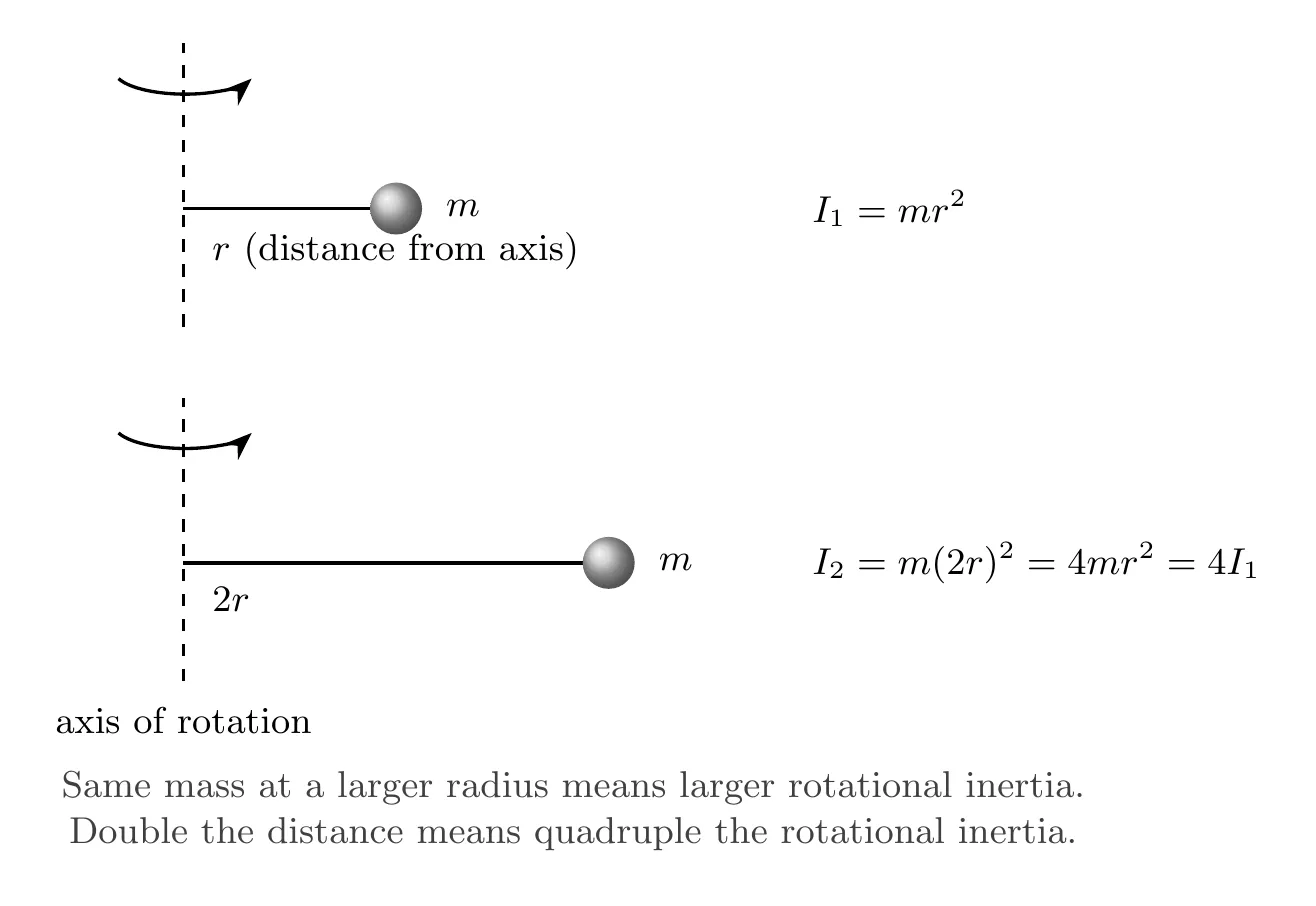
Why the square? Because masses farther out move faster linearly for the same angular velocity (), giving them more momentum to change, making rotation harder to start or stop. For example, two identical masses, Mass 1 at m gives , while Mass 2 at m gives , four times the rotational inertia despite being only twice as far.
Rotational Inertia for a System of Objects
For a collection of point masses rotating about the same axis:
Each mass contributes its own term, and the total is just the sum.
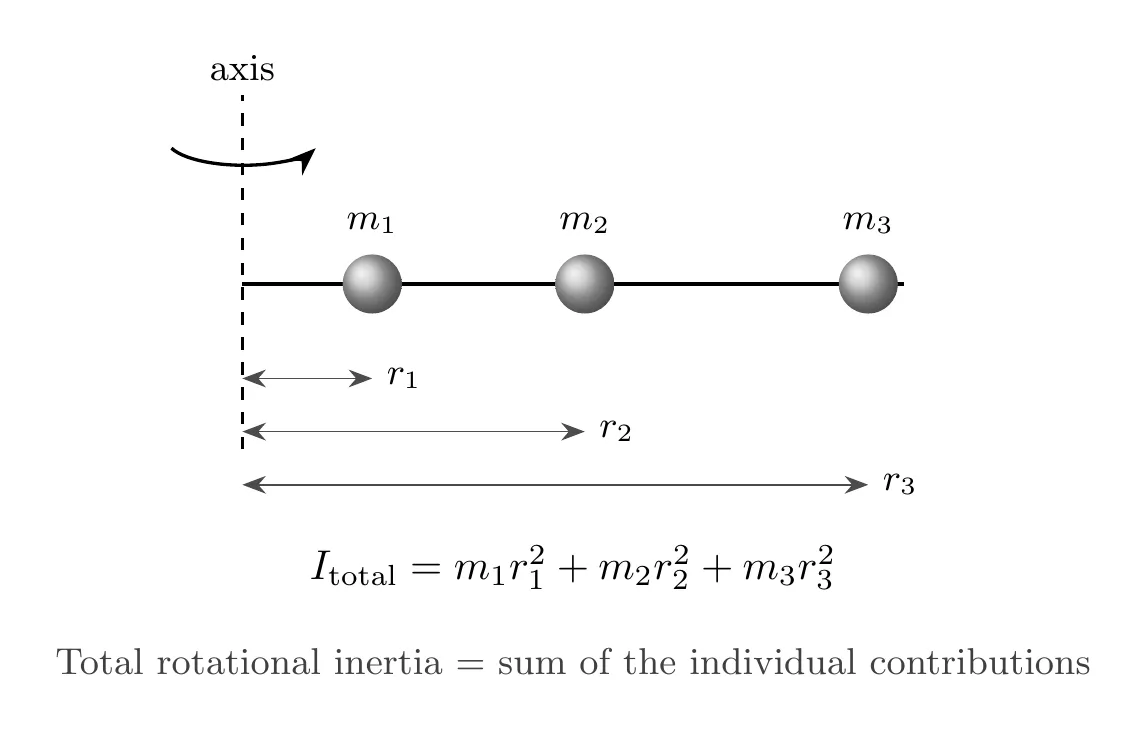
Example, a dumbbell system: two masses on a light rod, rotating about the center. Mass A (2 kg) at m and Mass B (3 kg) at m (opposite side):
Rotational Inertia for Rigid Bodies
Real objects are continuous distributions of mass, not point masses, so their rotational inertia depends on both total mass and shape.
Object | Axis | Rotational Inertia |
Thin hoop/ring | Through center, perpendicular to plane | |
Solid disk/cylinder | Through center, along central axis | |
Solid sphere | Through center | |
Thin spherical shell | Through center | |
Thin rod | Through center, perpendicular to rod |
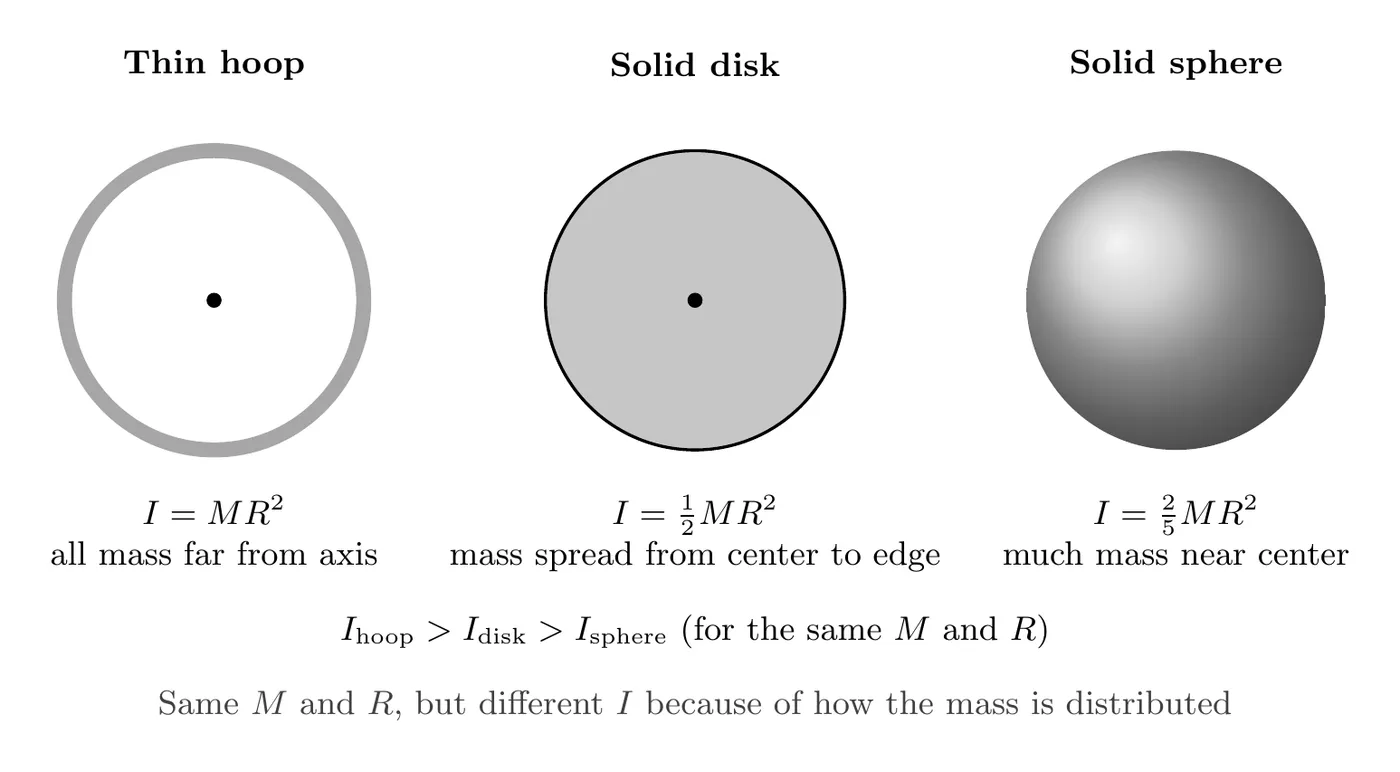
where is total mass, is radius, and is length for a rod. You don’t need to memorize these. They aren’t on the AP Physics 1 equation sheet, and the exam gives you the rotational inertia of any extended object when a problem needs it. What you do need is the idea behind them: the farther the mass sits from the axis, the larger is, which is why a hoop has more rotational inertia than a solid disk of the same mass and radius.
Notice they all take the form , where is a dimensionless coefficient depending on shape and mass distribution. That coefficient tells you about how the mass is spread out. For a hoop, , meaning all the mass sits at the maximum radius, contributing as much as possible to rotational inertia, making it the hardest to rotate for a given mass and radius. For a solid disk, , with mass spread from center to edge, some contributing less, some more, averaging out to an intermediate rotational inertia. For a solid sphere, , with mass distributed through 3D space, a good deal of it near the center, and less at the maximum radius, making it easier to rotate than a disk or hoop. Smaller coefficient means mass is more concentrated near the center, which means it’s easier to spin.
The Parallel Axis Theorem
The Parallel Axis Theorem lets you calculate rotational inertia about any axis parallel to one through the center of mass.
where is the rotational inertia about the new axis, is the rotational inertia about a parallel axis through the center of mass, is the total mass, and is the perpendicular distance between the two parallel axes. Rotating about any axis other than the center of mass increases rotational inertia by , physically, moving the axis away from the center of mass effectively increases the average distance of the mass from that axis.
This also tells you where rotational inertia is smallest. can never be negative, so about any axis is at least . A rigid system’s rotational inertia (for rotation in a given plane) is at a minimum when the axis passes through its center of mass, and it grows with as the axis moves away.
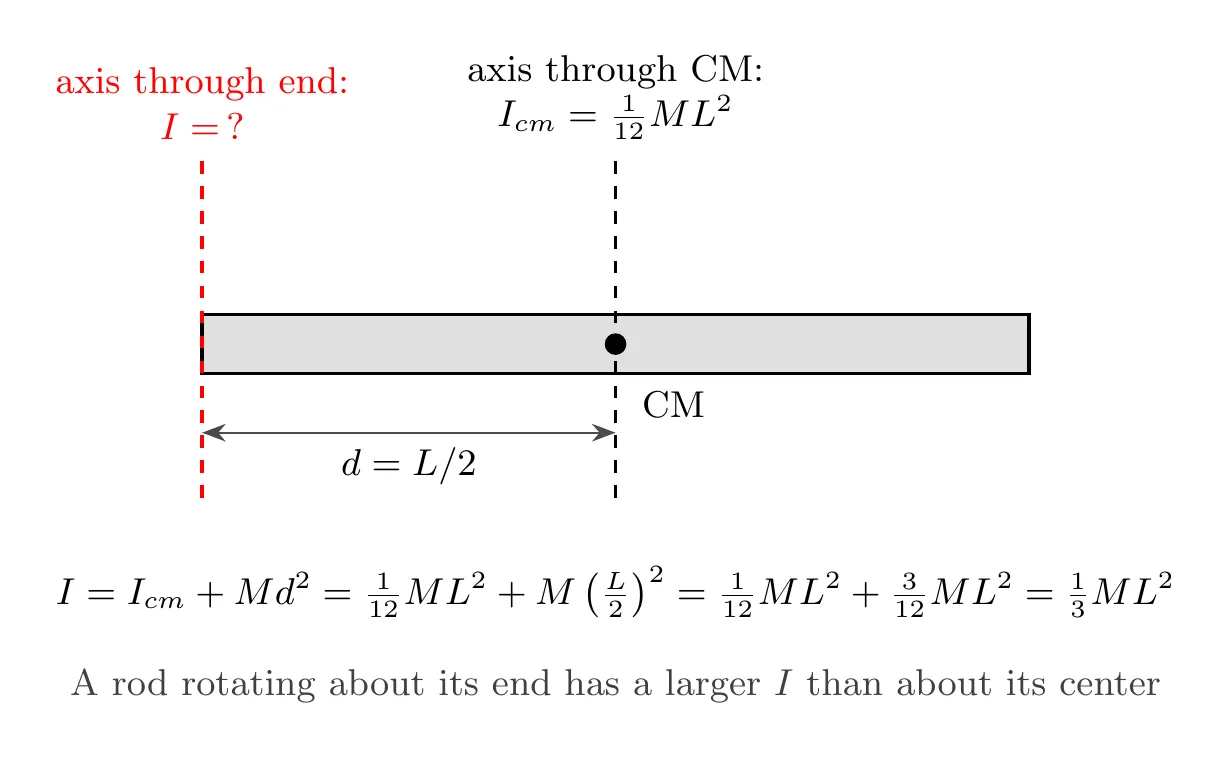
Use this theorem whenever the axis of rotation isn’t through the center of mass, you already know (from a table or calculation), and you can measure the distance between the two axes. A common scenario: standard formulas give you through the center, but the problem specifies a different axis (an edge, an end, etc.), so you adjust using the theorem.
Worked Example: Rod Rotating About One End
Use the parallel axis theorem to show that a thin rod of length and mass , rotating about one end, has rotational inertia , given .
Identifying the axes: the original axis passes through the center of mass, the new axis passes through one end. Since the center of mass sits at from each end, .
Applying the theorem:
Factoring out :
Finding a common denominator: , so:
Comparing the two: through the center, , but through the end, , four times larger. That makes sense: rotating about the end puts the entire rod’s length at distances up to from the axis, while rotating about the center keeps the maximum distance to just .
Worked Example: Four Masses, Two Axes
Four small 0.50 kg balls sit at the corners of a square 0.40 m on a side, joined by light rods (treat the rods as massless and the balls as point masses). Find the rotational inertia of the system about (a) an axis through the center of the square and (b) an axis through ball A. Both axes are perpendicular to the square.
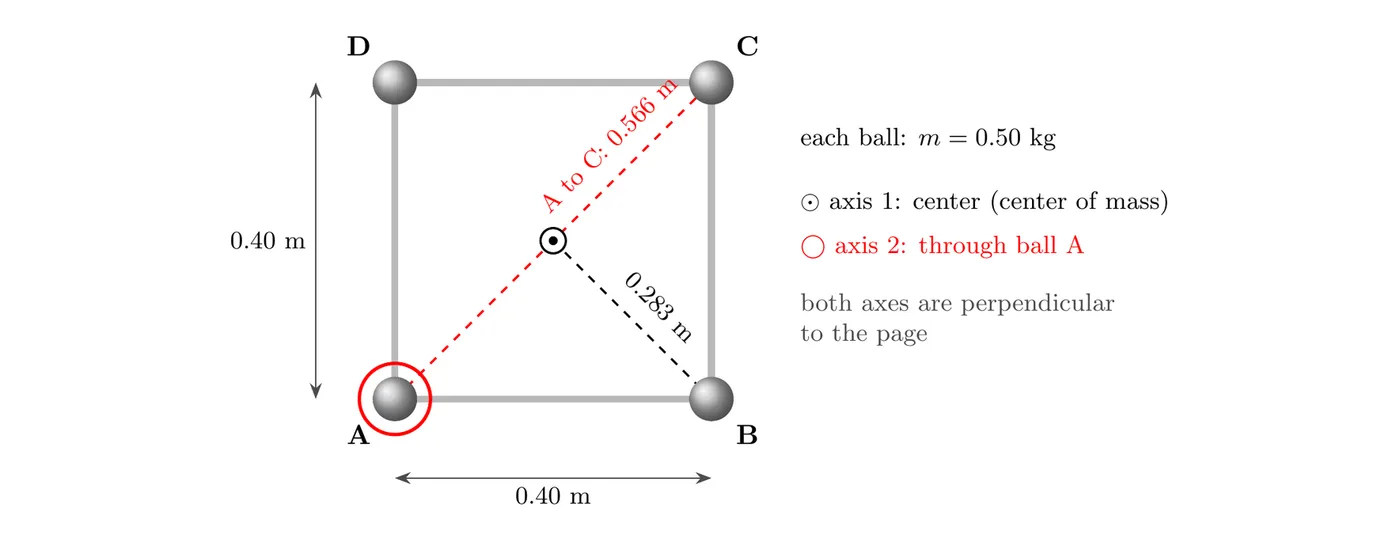
(a) Axis through the center: each ball is half a diagonal from the center. The diagonal is m, so every ball is m from the axis, and m².
(b) Axis through ball A: ball A sits on the axis (), balls B and D are each 0.40 m away, and ball C is a full diagonal, 0.566 m, away ( m²).
Check with the parallel axis theorem: the center of the square is the center of mass, the total mass is kg, and ball A is m from the center ( m²):
Same answer both ways. Moving the axis from the center of mass to a corner doubled the rotational inertia without changing the masses at all, because the masses now sit farther from the axis on average. Of all the parallel axes, the one through the center of mass gives the smallest .
Race Down a Ramp: Hollow vs. Solid
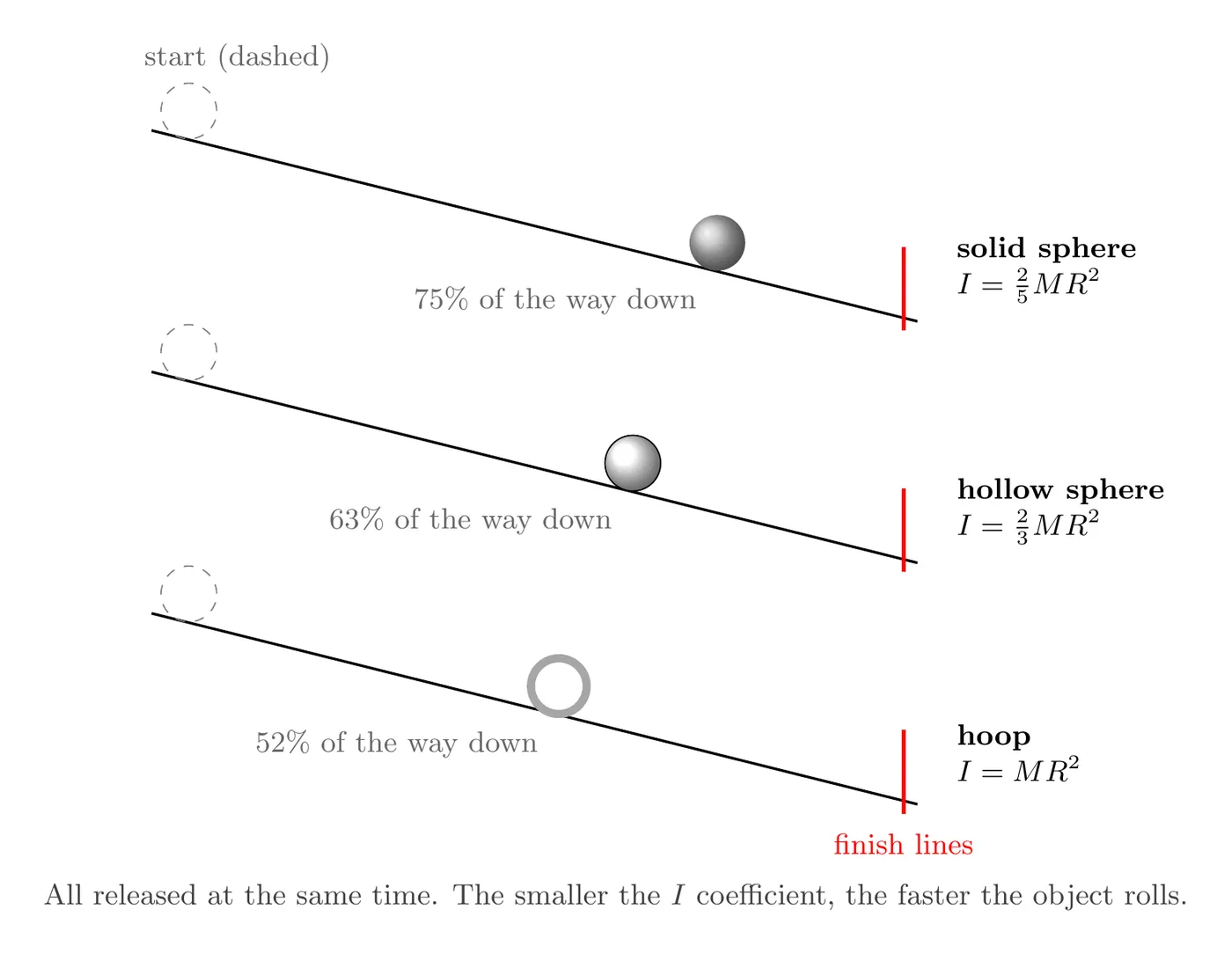
A classic problem: different-shaped objects roll down an incline, which reaches the bottom first? Objects with a smaller rotational inertia coefficient (relative to ) accelerate faster and win.
For objects with the same mass and radius , ranked fastest to slowest: the solid sphere (, ) is fastest, followed by the solid disk (, ), then the thin spherical shell (, ), with the thin hoop (, ) slowest. Smaller means less rotational inertia per unit mass, easier to rotate, and faster acceleration down the ramp.
Why? From an energy perspective, gravitational potential energy converts into both translational kinetic energy () and rotational kinetic energy () as an object rolls down. Objects with smaller put more of that energy into translation (moving forward) and less into rotation (spinning), so they move faster down the ramp.
A common misconception is thinking the hoop always wins because it’s “lightest,” but that’s not right, if all the objects share the same mass and radius, the solid sphere wins. Mass distribution matters more than total mass. If you actually race a solid marble, a hollow steel ball bearing of the same size, and a ring down a ramp, the solid marble reaches the bottom first and the ring comes in last.
Real-World Applications
Figure skating spins: a skater spins slowly with arms extended, then speeds up pulling their arms in. With arms extended, is large (mass far from the axis), giving a slower . Pulled in, is small (mass close to the axis), giving a faster . Since angular momentum is conserved, a smaller forces a larger .
Gyroscopes and flywheels: flywheels store rotational kinetic energy by putting as much mass as possible at the maximum radius (large ), which lets them resist changes in rotational speed, used for smoothing out engine power delivery or storing energy.
Gymnastics and diving: a tucked position (knees to chest) gives a small , spinning faster, while an extended position (body straight) gives a large , spinning slower. Athletes control their spin rate by adjusting their body position.
Pottery wheels: heavy flywheels resist speed changes thanks to their large , providing smooth, steady rotation that’s easier to work with.
Common Mistakes
Forgetting the square: don’t write (a linear dependence), it should be (quadratic).
Using diameter instead of radius: for a disk with diameter 0.6 m, don’t use m, the radius is half the diameter, m.
Confusing the formulas: don’t use for a hoop, that’s for a solid disk, a hoop is .
Wrong distance in the parallel axis theorem: don’t use the distance from the axis to the edge of the object, use the distance between the two parallel axes, which usually involves the center of mass location.
Assuming heavier means slower down a ramp: for rolling objects, shape (mass distribution) determines speed, not total mass. A heavy solid sphere beats a light hoop of the same size.