

2.1 - Electric Charge and Electric Force
Fundamental Properties of Charge
What Is Charge?
Charge is a fundamental property of all matter, a lot like mass. Some key facts:
- Charge comes in two types: positive (+) and negative (−).
- The elementary charge C is the smallest indivisible amount.
- An electron has a charge of .
- A proton has a charge of .
- A neutron has a charge of , so it’s neutral.
Charge is quantized, meaning every charge is a whole-number multiple of :
Charge is also conserved, so the total charge in an isolated system never changes.
The Point Charge Model
A point charge is a model where the physical size of a charged object is tiny compared to the distances involved. This lets us treat charged objects as single points, which makes the calculations simpler.
Coulomb’s Law
The Force Between Charges
Coulomb’s law gives the electrostatic force between two point charges:
where:
- = magnitude of the electric force (N)
- N·m²/C² (Coulomb’s constant)
- = charges (C)
- = distance between the charges (m)
- C²/(N·m²) (permittivity of free space)
Two relationships to notice:
- Force is proportional to the product of the charges, so doubling either charge doubles the force.
- Force is proportional to , which is the inverse square law, just like gravity.
Direction of the Electric Force
The force points along the line connecting the two charges. The rule is:
- Like charges repel (++ or −−), so the force pushes them apart.
- Unlike charges attract (+− or −+), so the force pulls them together.
Be careful with the vector nature of this. The equation only gives you the magnitude, so you figure out the direction separately from the charge signs.
On the AP exam you’ll only have to calculate the net electric force from four or fewer charges, unless the setup is very symmetric (like equal charges spaced evenly around a circle, where a lot of the forces cancel).
Electric Force vs. Gravitational Force
Comparison Table
Property | Electric Force | Gravitational Force |
Can be | Attractive or repulsive | Always attractive |
Relative strength | Strong | Weak |
Depends on | Charge | Mass |
Law |
Relative Magnitudes
For objects that have both mass and charge, the electric force usually dominates:
For two protons, . For an electron and a proton it’s about (see Practice Problem 3), and for two electrons it’s about . Either way, the electric force is enormously stronger.
So why does gravity win at large scales?
- Big objects like planets and stars are electrically neutral, with equal amounts of positive and negative charge.
- Their electric forces cancel out.
- Gravity is always attractive and never cancels.
- So only gravity is left at astronomical scales.
Electric Permittivity
Permittivity of Materials
Electric permittivity () measures how much a material gets polarized by an electric field.
For free space (a vacuum): C²/(N·m²).
Inside a material: , where is the dielectric constant, usually greater than 1.
Why do different materials have different permittivities? It comes down to what the material is made of and how its atoms and molecules are arranged. What matters most is how easily the electrons in the material can shift into a new arrangement when a field is applied:
- Electrons that shift easily mean the material polarizes a lot, so its permittivity is high.
- Electrons that are held tightly in place mean the material barely polarizes, so its permittivity is close to (air is almost exactly ).
Polarization
Electric polarization is the way charges rearrange inside a material when an external electric field is applied. The mechanism goes:
- An external field is applied.
- Electrons shift slightly toward the positive side.
- This creates a separation of positive and negative charges within the atoms or molecules.
- The material develops induced dipoles.
This affects the force. In a material with permittivity :
The force is smaller than in a vacuum by a factor of .
Conductors vs. Insulators
Conductors (metals, salt water):
- Their charge carriers, the electrons, move freely.
- They act as if their permittivity were extremely high.
- Electrons rearrange easily.
Insulators (rubber, glass, plastic):
- Their charge carriers can’t move easily.
- Electrons are bound to atoms.
- Polarization is limited.
Contact Forces Are Really Electric
Here’s a useful insight: everyday forces like the normal force, friction, and tension are all fundamentally electric forces between atoms.
- When you touch a table, the electron clouds repel each other.
- Friction is an interaction between the atoms on two surfaces.
- What we call “contact” is really electric repulsion at the atomic scale.
Because the number of particle interactions is so huge, we just use simplified “contact force” models instead of tracking every one.
Practice Problem 1: Basic Coulomb’s Law
Problem: Two point charges, C and C, are 0.20 m apart. Find the magnitude of the electric force between them.
Solution:
Direction: the signs are opposite, so the force is attractive and the charges pull toward each other.
Practice Problem 2: Multiple Charges
Problem: Three charges sit on a line: μC at , μC at cm, and μC at cm. Find the net force on .
Solution:
Force from on :
- Distance: m.
- Signs are +−, so it’s attractive and pulls left, toward .
Force from on :
- Distance: m.
- Signs are +−, so it’s attractive and pulls right, toward .
Net force, taking right as positive:
Answer: 40 N to the right.
Practice Problem 3: Comparing Forces
Problem: An electron and a proton are m apart, which is roughly the size of a hydrogen atom. Find:
(a) the electric force between them
(b) the gravitational force between them
(c) the ratio
Given: kg, kg, N·m²/kg².
Solution:
- Electric force:
- Gravitational force:
- Ratio:
Answer: the electric force is about times stronger. Gravity is completely negligible at atomic scales.
Practice Problem 4: Forces in Two Dimensions
Problem: Three point charges sit at the corners of a right triangle. μC is at the origin, μC is 0.30 m to its right on the x-axis, and μC is 0.40 m above it on the y-axis. Find the magnitude and direction of the net electric force on .
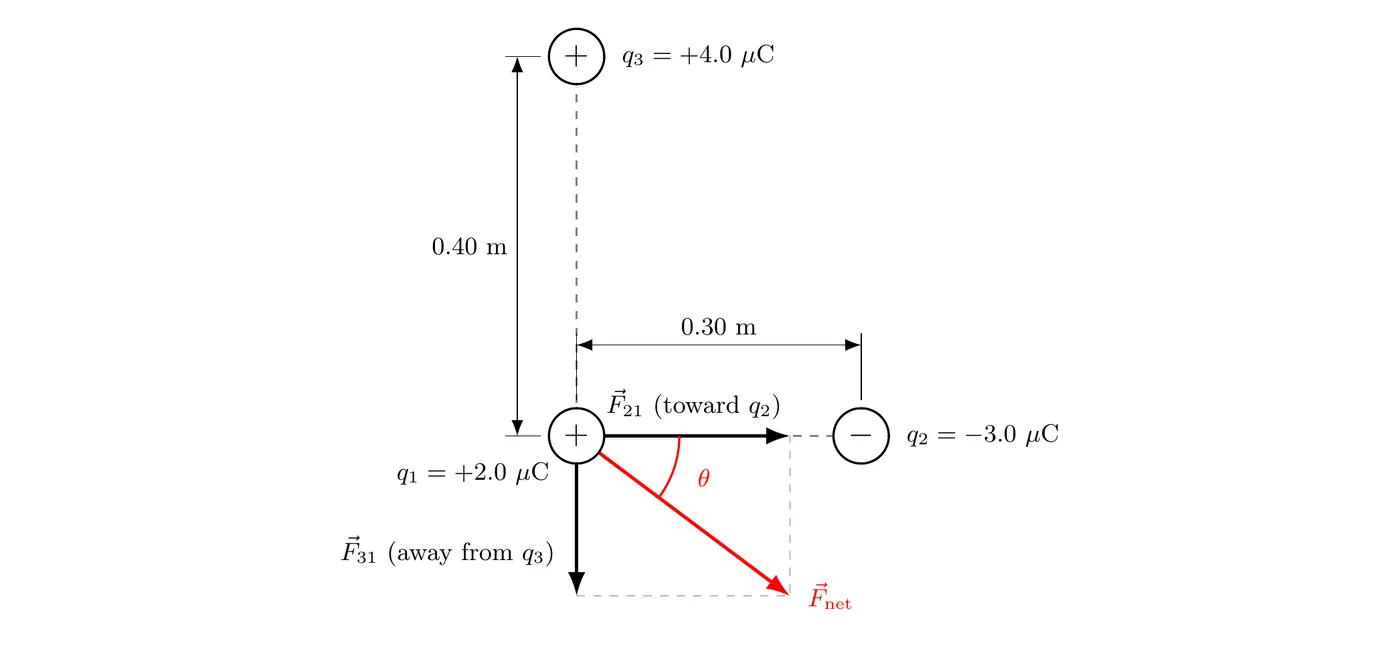
Solution:
Force from on :
- Distance: m.
- Signs are +−, so it’s attractive and pulls right, toward (+x).
Force from on :
- Distance: m.
- Signs are ++, so it’s repulsive and pushes down, away from ().
The two forces are perpendicular, so they’re already the x- and y-components of the net force: N and N. Combine them with the Pythagorean theorem:
Answer: 0.75 N, pointing 37° below the +x axis (down and to the right).
The thing to notice: you can’t just add 0.60 N and 0.45 N. Forces in different directions have to be added as vectors, using components.
Common Mistakes
- Sign errors. The Coulomb’s law formula uses absolute values to get the magnitude. Work out the direction separately from the charge signs, using attract versus repel.
- Unit confusion. Charges often come in μC or nC. Convert to coulombs: 1 μC = C.
- Distance mistakes. Use the center-to-center distance, and convert cm to m.
- Vector addition. With more than one charge, find each force on its own, then add them as vectors with their directions.
- Inverse square confusion. Doubling the distance makes the force 1/4 as big, not 1/2.