

2.6 - Capacitor
What a Capacitor Is
A capacitor is a device that stores electric charge and energy.
A parallel-plate capacitor is two parallel conducting plates separated by an insulator or a vacuum. Its key features:
- The plates hold equal and opposite charges, with +Q on one plate and −Q on the other.
- It creates a uniform electric field between the plates.
- It stores electrical energy.
Capacitance
Capacitance () measures how much charge a capacitor can store per unit voltage.
where:
- = capacitance (farads, F)
- = magnitude of charge on each plate (C)
- = potential difference between the plates (V)
The unit is the farad: 1 F = 1 coulomb/volt (C/V). You’ll usually see smaller units like μF ( F), nF ( F), and pF ( F).
What it means:
- A large stores more charge for a given voltage.
- A small stores less charge for a given voltage.
Importantly, capacitance depends only on the physical setup (the geometry and materials), not on the charge or the voltage.
Capacitance of a Parallel-Plate Capacitor
where:
- = capacitance (F)
- = dielectric constant (dimensionless, )
- C²/(N·m²) (permittivity of free space)
- = area of one plate (m²)
- = separation between the plates (m)
The dependencies are:
- : a larger plate area means more capacitance, since there’s more room for charge.
- : a bigger gap means less capacitance, since the interaction is weaker.
- : a higher dielectric constant means more capacitance.
For a vacuum or air, , so .
Testing this in a lab: change one variable at a time and measure with a capacitance meter (or charge the plates to a known , measure , and use ).
- To test the dependence, keep the plates and the material the same and measure at several gaps. A graph of vs. should be a straight line through the origin with slope .
- To test the dependence, keep the same and use plates of different sizes. A graph of vs. should be a straight line through the origin with slope .
- Graphing it this way (as a straight line) lets you find or from the slope.
Electric Field Between the Plates
The field between parallel plates is uniform, ignoring edge effects:
or, equivalently:
where:
- = field magnitude (N/C or V/m)
- = charge on each plate (C)
- = potential difference (V)
- = plate separation (m)
Its properties:
- It’s uniform, meaning constant magnitude and direction between the plates.
- It points from the positive plate to the negative plate, perpendicular to the plates.
- Edge effects are ignored. The field isn’t uniform near the edges, but that’s negligible when is much smaller than the plate dimensions.
Particle Motion Between the Plates
A charged particle in the uniform field between the plates feels:
This works just like projectile motion:
- The uniform field acts like uniform gravity.
- The acceleration is constant, like m/s² pointing down.
- The kinematics equations apply.
Using the horizontal-launch analogy:
- The direction parallel to the plates (“horizontal”) has uniform velocity.
- The direction perpendicular to the plates (“vertical”) has constant acceleration from the field.
- The path is parabolic.
For example, an electron that enters between the plates moving horizontally will deflect toward the positive plate along a parabolic path.
Energy Stored in a Capacitor
The stored electric potential energy is:
Using , you can rewrite it a couple of ways:
All three forms are equivalent, so use whichever fits what you’re given.
where:
- = energy stored (J)
- = charge on the capacitor (C)
- = voltage across the capacitor (V)
- = capacitance (F)
Physically, this is the work an external force does to separate the charges and store them on the plates.
Where the ½ comes from: as you charge a capacitor, grows in step with (since ). The first bit of charge gets moved across almost no voltage, and the last bit gets moved across the full . On average, the charge was moved across half the final voltage, so the work is .
On a graph of vs. , that work is the area under the line, a triangle. For example, a 2.0 μF capacitor charged to 12 V holds μC:
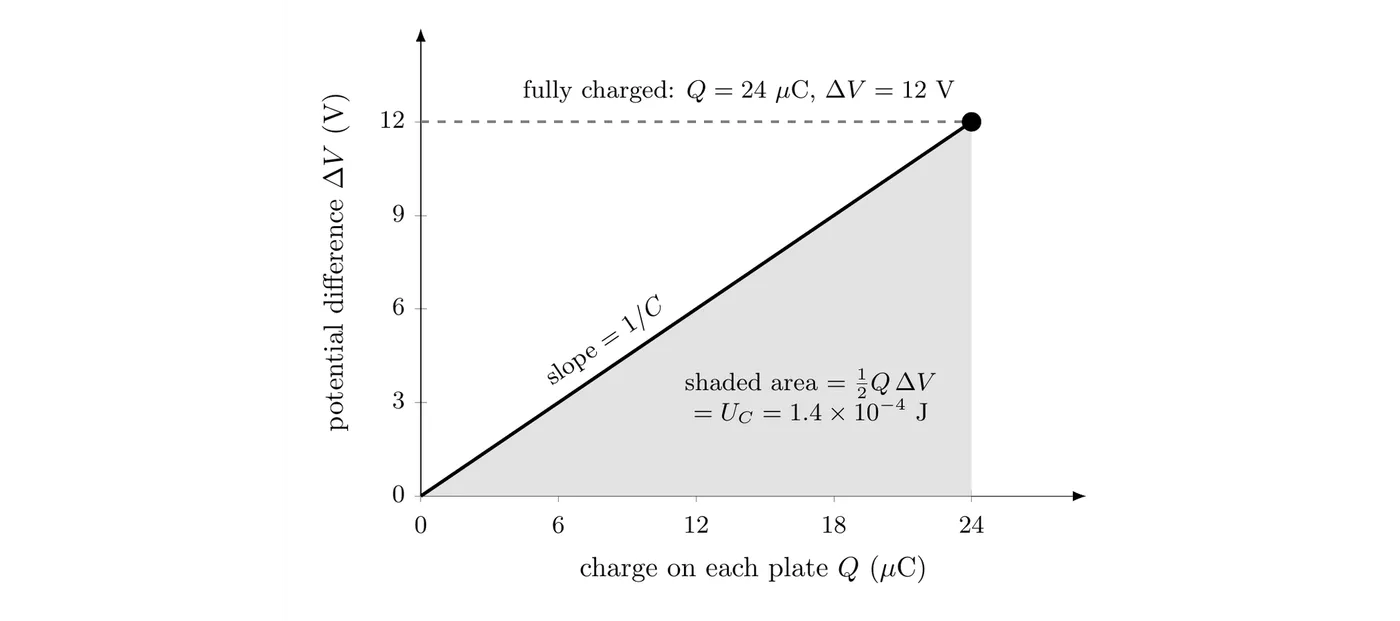
The slope of the line is . A bigger capacitor gives a flatter line, so it stores less energy for the same charge but more energy for the same voltage.
Dielectrics
A dielectric is an insulating material placed between the capacitor plates. Adding one does three things:
1. It increases the capacitance by a factor of , so .
2. If the charge on the plates stays the same (an isolated capacitor), it reduces the field by a factor of , so .
3. It sets up an opposing field inside the dielectric material.
Here’s how it works:
- The dielectric polarizes, meaning charges separate inside its molecules.
- This creates an internal field opposite to the external field.
- The net field drops.
- More charge can be stored for the same voltage, so the capacitance goes up.
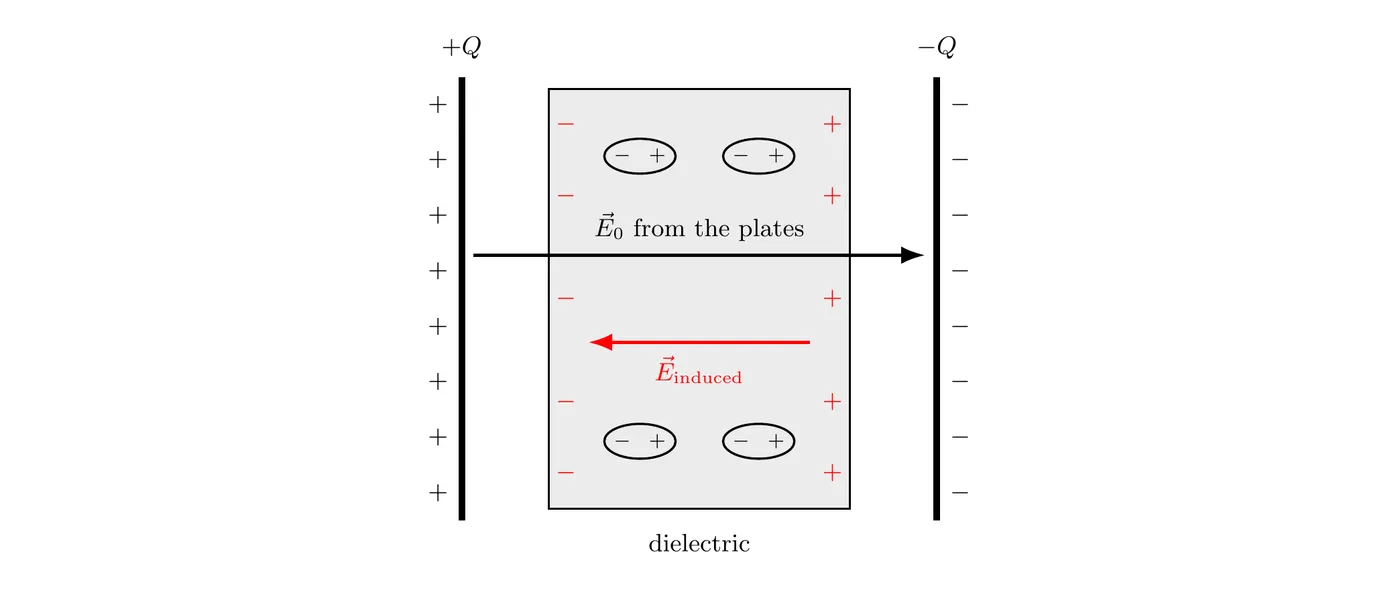
In the picture, the plates’ field points from to . In each molecule of the dielectric, the electrons shift slightly toward the positive plate. That leaves a layer of negative charge on the dielectric’s left face and positive charge on its right face. Those induced charges make a field that points the opposite way, so the net field inside the dielectric is weaker than alone.
Some common dielectric constants:
- Vacuum: (by definition)
- Air: , which is basically 1
- Paper:
- Glass: to
- Water:
With a dielectric added at constant voltage (still hooked to a battery):
- rises to .
- rises to , so more charge is stored.
- stays at , since and neither nor changes. The battery pushes extra charge onto the plates, which makes up for the dielectric’s opposing field.
- rises to , so more energy is stored.
With a dielectric added at constant charge (isolated, no battery):
- rises to .
- stays the same, since it’s isolated.
- falls to .
- falls to .
- falls to .
Practice Problem 1: Basic Capacitance
Problem: A parallel-plate capacitor has plates of area 0.050 m² separated by 2.0 mm of air. Find:
(a) the capacitance
(b) the charge stored when it’s connected to a 12 V battery
Solution:
- Using with for air:
- Using :
Answer: (a) 221 pF, (b) 2.65 nC.
Practice Problem 2: Electric Field and Force
Problem: A capacitor has plates 5.0 mm apart with a potential difference of 100 V. An electron is placed between the plates.
(a) What is the field magnitude?
(b) What force does the electron feel?
(c) What is its acceleration?
Solution:
- Field:
- Force on the electron: Direction: toward the positive plate, which is opposite to the field.
- Acceleration:
Answer: (a) N/C, (b) N toward the positive plate, (c) m/s².
Practice Problem 3: Energy Storage
Problem: A 10 μF capacitor is charged to 50 V. Find:
(a) the charge stored
(b) the energy stored
Solution:
- Charge:
- Energy:
Answer: (a) 0.50 mC, (b) 12.5 mJ.
Practice Problem 4: Dielectric Effect
Problem: A capacitor with air between its plates has pF and is charged to V. A dielectric with is inserted while the capacitor stays connected to the battery.
(a) What is the new capacitance?
(b) What is the new charge?
(c) What is the new energy stored?
Solution:
- New capacitance:
- The voltage stays at 100 V since it’s still on the battery: Compared to the original, nC, so the charge went up by a factor of 4. ✓
- New energy: Original: μJ, so the energy went up by a factor of 4. ✓
Answer: (a) 200 pF, (b) 20 nC, (c) 1.0 μJ.
Practice Problem 5: An Electron Between the Plates
Problem: An electron enters the space between two parallel plates moving horizontally at m/s, right along the midline. The plates are 4.0 cm long and 1.0 cm apart, with a potential difference of 50 V (top plate positive). Ignore edge effects. Find:
(a) the electron’s acceleration
(b) how far it gets pushed sideways () by the time it leaves the plates
(c) whether it hits a plate
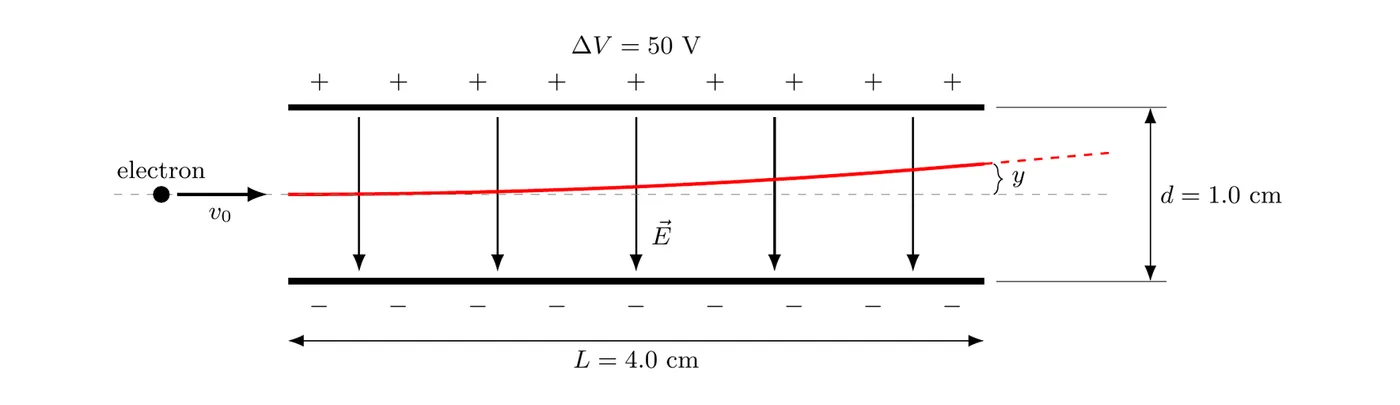
Solution:
- Acceleration:
The field points down (from + to −), so the force on the negative electron points up, toward the positive plate.
- Sideways push: treat it like a horizontal launch. There’s no horizontal force, so the time between the plates is just length over speed:
- It starts 5.0 mm from the top plate (half the gap) and only moves 1.8 mm toward it, so it gets out without hitting.
Answer: (a) m/s² toward the positive (top) plate, (b) 1.8 mm, (c) no, it clears the plate.
Why ignore gravity? The electric force on the electron is N, while its weight is N, about times smaller.
Common Mistakes
- Confusing Q and ΔV. Capacitance links charge to voltage through , so don’t mix them up.
- Forgetting the absolute value. The in is the magnitude on each plate. Both plates have the same magnitude, just opposite signs.
- Using the wrong area. Use the area of one plate, not the combined area of both.
- Unit slips. Capacitance often comes in μF, nF, or pF. Convert to farads: 1 μF = F.
- Energy formula confusion. There are three equivalent forms, so pick the one that matches what you know. Know and ? Use . Know and ? Use . Know and ? Use .
- Mixing up the dielectric scenarios. With a battery connected (constant ), , , and all rise by a factor of . Isolated (constant ), rises while and fall.
- Assuming a dielectric always weakens the field. It only does that when the charge is fixed (isolated). With the battery connected, can’t change, so the battery adds charge until the field is back to .
- Getting the field direction wrong. The field points from the + plate to the − plate, so high to low potential.
- Forgetting that edge effects are ignored. Assume a uniform field unless the problem says otherwise.
- Getting the acceleration direction wrong for a negative charge. Electrons accelerate toward the positive plate, opposite to the field.
- Using the wrong distance in the field formula. Use the separation , not or anything else.