

2.4 - Electric Potential Energy
What It Is
Electric potential energy () is the work an external force has to do to bring charges from infinity to their current positions, moving them at constant velocity. A few things about it:
- It’s stored energy that comes from how the charges are arranged.
- It can be positive or negative, unlike gravitational PE.
- It’s a scalar, not a vector.
The Formula
For two point charges separated by a distance :
where:
- = electric potential energy (J)
- N·m²/C²
- = charges (C), and you keep the signs here
- = separation distance (m)
The reference point is when the charges are infinitely far apart.
The Sign of Potential Energy
Unlike Coulomb’s law, do not use absolute values here. The signs matter.
- (positive) happens with like charges (++ or −−):
- The system has stored energy.
- The charges repel, so they’d fly apart on their own if released.
- (negative) happens with unlike charges (+− or −+):
- The system has negative energy, which is a bound state.
- The charges attract, so they’d come together on their own if released.
Physically:
- Positive means you have to do work to bring the charges together.
- Negative means the field does the work as the charges come together.
Force vs. Energy
Property | Coulomb’s Law | Potential Energy |
Quantity | Force (vector) | Energy (scalar) |
Equation | ||
Distance | ||
Signs | Use absolute value | Keep signs |
Systems with Multiple Charges
The total electric potential energy is the sum of the PE for each pair of charges. For charges, you find the PE of every unique pair:
The number of pairs for charges is . So:
- 3 charges give 3 pairs (1-2, 1-3, 2-3).
- 4 charges give 6 pairs (1-2, 1-3, 1-4, 2-3, 2-4, 3-4).
Count each pair once, and don’t double up.
Why it’s a sum over pairs: remember that is the work an outside force does to bring the charges in from infinitely far away. Build the system one charge at a time:
- Bring in : nothing else is there yet, so it takes no work.
- Bring in : you’re only working against , so .
- Bring in : now you’re working against both, so .
- Add it up: , exactly one term for each pair.
The order you bring them in doesn’t matter. You always end up with one term per pair. On the AP exam you’ll only have to do this for four or fewer point charges.
Work-Energy Relationship
The work an external force does to move charges is:
If there’s no external work, energy is conserved:
And with external work:
It’s a lot like mechanical energy conservation, just with electric PE instead of gravitational PE.
Practice Problem 1: Two Charges
Problem: Two point charges, C and C, are 0.40 m apart. Find the electric potential energy of the system.
Solution:
Answer: J, negative because opposite charges attract.
Practice Problem 2: Three Charges
Problem: Three charges form an equilateral triangle with sides of 0.10 m:
- μC at vertex A
- μC at vertex B
- μC at vertex C
Find the total electric potential energy.
Solution:
Work out the PE for each of the 3 pairs.
Pair 1-2 (both positive, 0.10 m apart):
Pair 1-3 (opposite signs, 0.10 m apart):
Pair 2-3 (opposite signs, 0.10 m apart):
Total:
Answer: J, negative overall because the attractive interactions win out.
Practice Problem 3: Work and Energy
Problem: An electron is released from rest 2.0 mm from a fixed proton. What is the electron’s speed when it’s 1.0 mm from the proton?
Given: kg.
Solution:
Energy conservation with no external forces:
Initial state (at rest, m):
Final state ( m):
Putting it together:
Answer: 502 m/s.
The physical read on this: the PE dropped (got more negative), so the KE went up. The electron accelerates toward the proton.
Practice Problem 4: Work to Bring In a Charge
Problem: Two μC charges are fixed 0.60 m apart. An outside force brings a third charge from very far away to the point halfway between them, moving it at constant speed. How much work does the outside force do if the third charge is:
(a) μC?
(b) μC?
Solution:
The charge moves at constant speed, so and the outside work equals the change in the system’s potential energy. Only the two new pairs are added ( doesn’t change), and the midpoint is 0.30 m from each fixed charge:
- For μC:
- For μC:
Answer: (a) J, (b) J.
The read on this: in (a) the fixed charges repel the incoming charge, so you have to push it in, and the system’s PE goes up from J to 0.18 J. In (b) they attract it, so you have to hold it back the whole way in (negative work), and the system’s PE goes down.
Energy Graphs
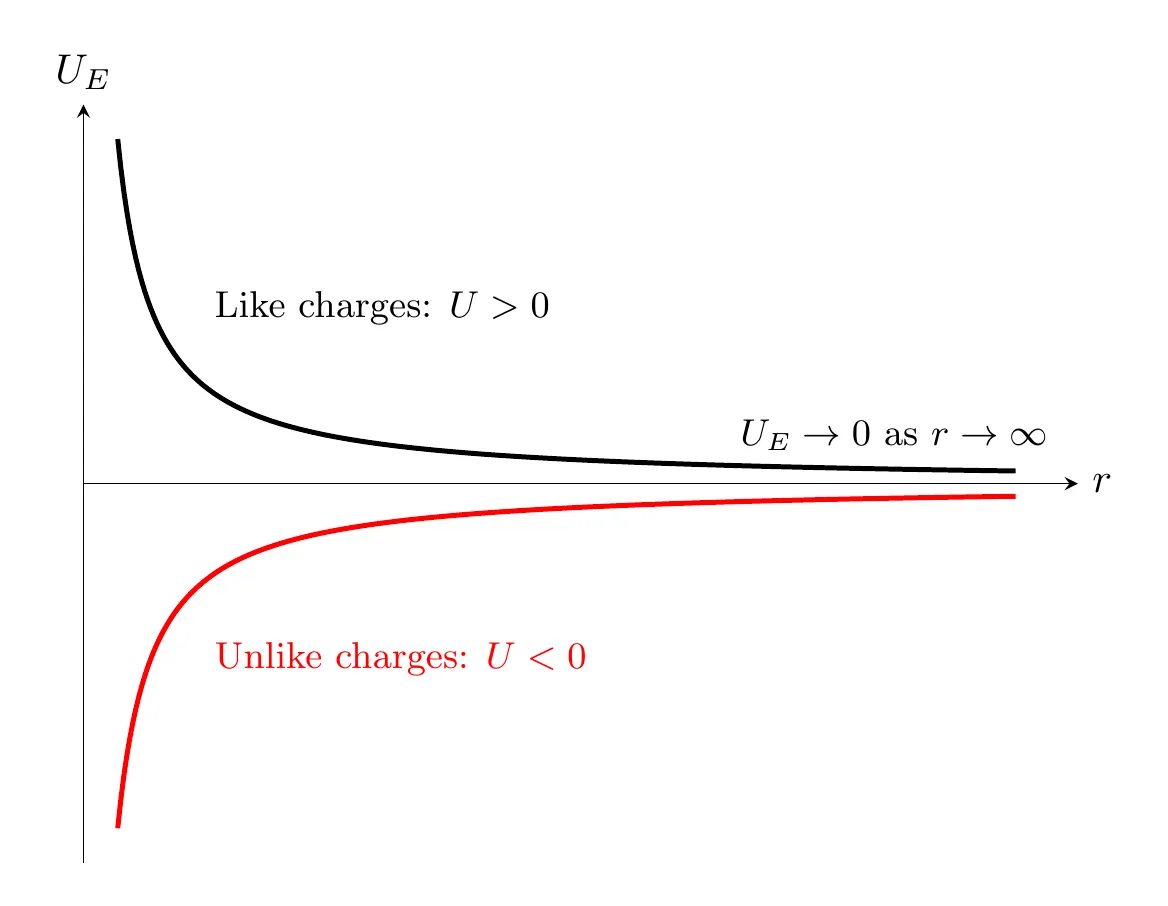
Key features to notice:
- Both curves head toward 0 as , which is the reference point.
- Like charges always have .
- Unlike charges always have .
- Both curves get steeper at small , where the interaction is stronger.
Common Mistakes
- Using absolute values. Unlike force, PE keeps its sign. Use with the real signs, not absolute values.
- Forgetting the reference point. Zero PE is at infinite separation, not at some finite distance.
- Double counting pairs. For 3 charges, there are 3 pairs, not 6. Count each pair once.
- Confusing PE and force. Force goes as (inverse square), while PE goes as (just inverse, not squared).
- Misreading the sign. Negative PE means the system has less energy than when the charges are infinitely far apart. To pull them apart, an outside force has to add energy (do positive work). That’s what makes it a bound, attractive state.
- Thinking negative PE is impossible. Negative values are perfectly normal and physical for attractive setups.
- Mixing up initial and final. , so check which is which.
- Not using energy conservation. When charges move freely with no external force, use .
- Forgetting that kinetic energy changes too. If a charge moves, both PE and KE change, so use energy conservation to link them.