

2.3 - Electric Fields
What an Electric Field Is
The electric field () is the electric force per unit charge at a point in space.
Rearranged, that gives:
where:
- = electric field (N/C or V/m)
- = electric force on a test charge (N)
- = test charge (C)
The units are N/C (newtons per coulomb) or V/m (volts per meter), and the two are equivalent.
The main idea is that the electric field exists at every point in space around a charge, whether or not there’s another charge sitting there to “feel” it.
Test Charge
A test charge is a small positive charge you use to probe the electric field without disturbing it much. It needs to be:
- Small in magnitude, so it doesn’t affect the field.
- Treated as positive by convention.
Electric Field from a Point Charge
For a point charge , the field at a distance is:
The direction depends on the sign:
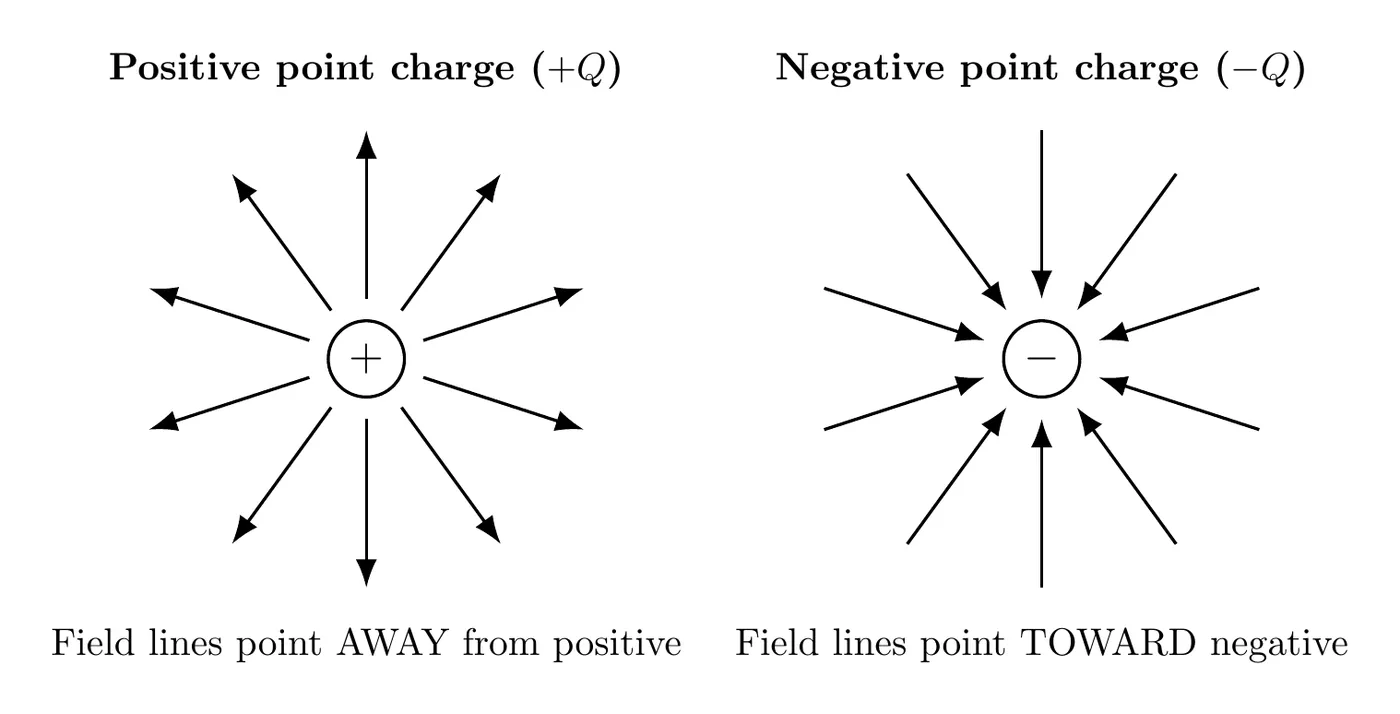
- For a positive charge (), the field points away, radially outward.
- For a negative charge (), the field points toward it, radially inward.
A quick way to remember it: positive pushes away, negative pulls in.
Force on a Charge in an Electric Field
For a charge sitting in a field :
Again, the direction depends on the sign:
- A positive charge () feels a force in the same direction as .
- A negative charge () feels a force in the opposite direction to .
Superposition of Electric Fields
The net electric field is the vector sum of all the individual fields:
The process is:
1. Find the field from each charge on its own.
2. Work out the direction of each field.
3. Add them as vectors, using either components or geometry.
The key point is that fields from different sources add independently.
On the AP exam you’ll only have to calculate the net field from four or fewer charges, unless the setup is very symmetric.
Ways to Represent Electric Fields
1. Vector Field Maps
An electric field map shows field vectors at many points in space:
- The arrow’s direction is the field direction.
- The arrow’s length is the field strength, so longer means stronger.
2. Electric Field Lines
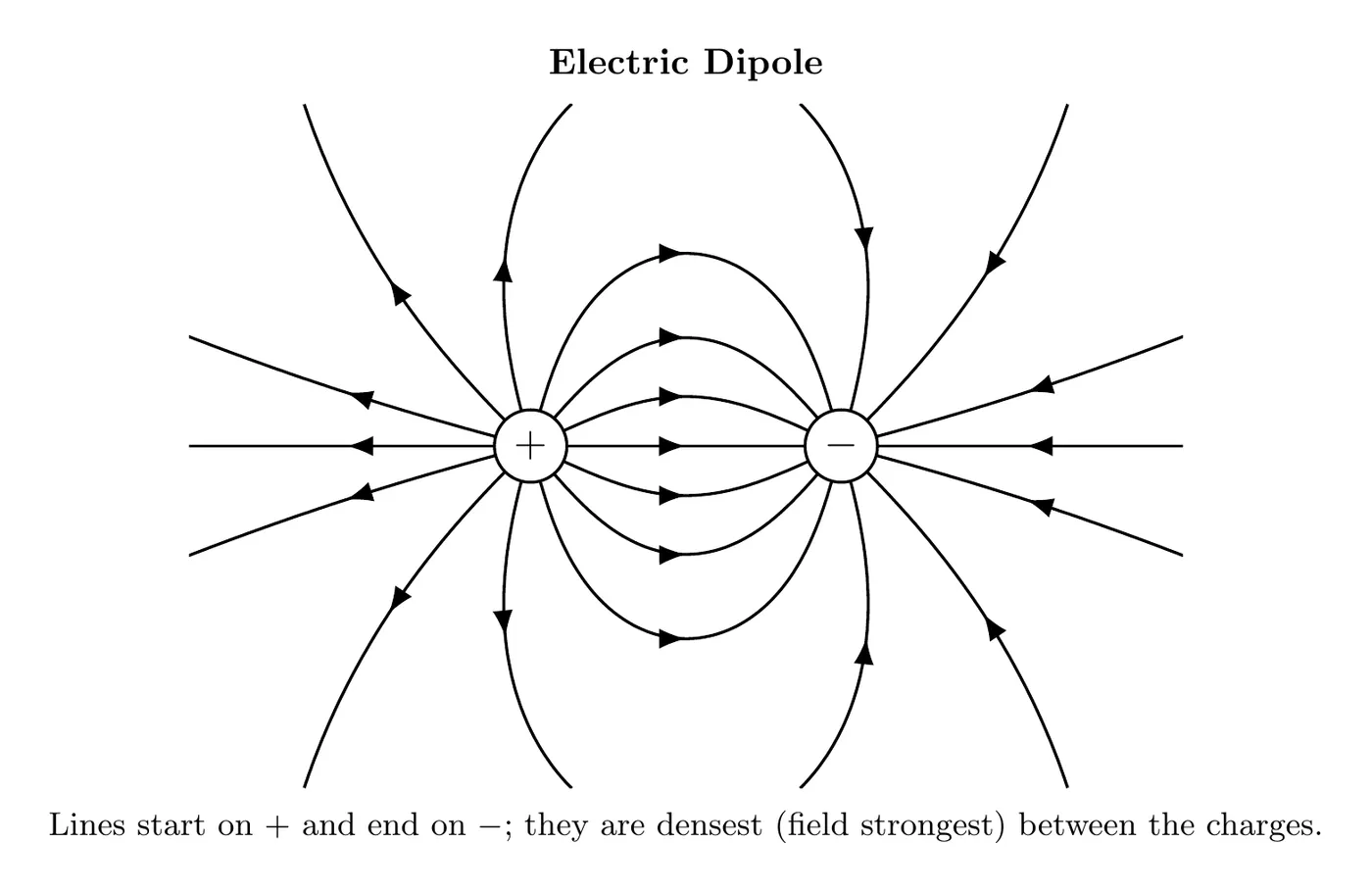
Field lines are a simplified model that shows field direction and relative strength. The rules for drawing them are:
1. Lines start on positive charges, or come in from infinity.
2. Lines end on negative charges, or go out to infinity.
3. Lines never cross.
4. Lines are tangent to the field direction at every point.
5. The density of lines is proportional to field strength, so closer lines mean a stronger field.
6. Lines meet conductor surfaces perpendicularly.
Common Configurations
Parallel plates (uniform field):
- The field lines are parallel and evenly spaced between the plates.
- The field is uniform, so between the plates.
- It points from the positive plate to the negative plate.
Two like charges (both + or both −):
- The lines push away from each other.
- There’s a weak field region between the charges.
Two opposite charges (a dipole):
- Lines run from + to −.
- The field is strong between the charges.
Conductors in Electrostatic Equilibrium
Electrostatic equilibrium means there’s no net motion of charges and the system is stable.
Conductors in equilibrium have four properties worth memorizing:
- The field is zero inside the conductor.
- The free charges rearrange until there’s no field left.
- Any field inside would push charges around, which wouldn’t be equilibrium.
- Excess charge sits on the surface.
- The charges repel each other out to the outer surface.
- The interior stays neutral.
- The field is perpendicular to the surface at the boundary.
- Any parallel component would drive surface charges to move.
- So it has to be perpendicular for equilibrium.
- Charge piles up where the surface is most curved.
- Sharp points get high surface charge density, which makes a strong field.
- Flat regions get low surface charge density and a weak field.
- This is exactly why lightning rods have sharp tips.
Spherical Conductor
Outside a spherical conductor (radius , charge ), for :
This is the same as a point charge with charge sitting at the center.
Inside a spherical conductor ():
Insulators (Dielectrics)
In insulators, charges can’t move around freely.
In electrostatic equilibrium:
- Excess charge spreads throughout the whole volume, not just the surface.
- The electric field can be nonzero inside.
- Polarization can happen, meaning charge separation at the molecular level.
For AP Physics 2, we only do qualitative analysis of fields inside insulators.
Practice Problem 1: Field from a Point Charge
Problem: A charge C creates an electric field. Find the field’s magnitude and direction at a point 0.30 m away.
Solution:
Direction: away from the positive charge, radially outward.
Answer: N/C, radially outward.
Practice Problem 2: Superposition
Problem: Two charges: μC at the origin, μC at m. Find the net electric field at m, the midpoint.
Solution:
Field from (0.30 m away, on the right):
Direction: away from , so it points right (+x).
Field from (0.30 m away, on the left):
Direction: toward , so it also points right (+x).
Net field, since both point right:
Answer: N/C to the right.
Practice Problem 3: Force in a Field
Problem: An electron is placed in a uniform electric field of magnitude N/C pointing downward. Find the force on the electron, both magnitude and direction.
Solution:
Direction: the electron is negative, so the force is opposite to the field. The field points down, so the force points up.
Answer: N upward.
Practice Problem 4: Field Off to the Side of a Dipole
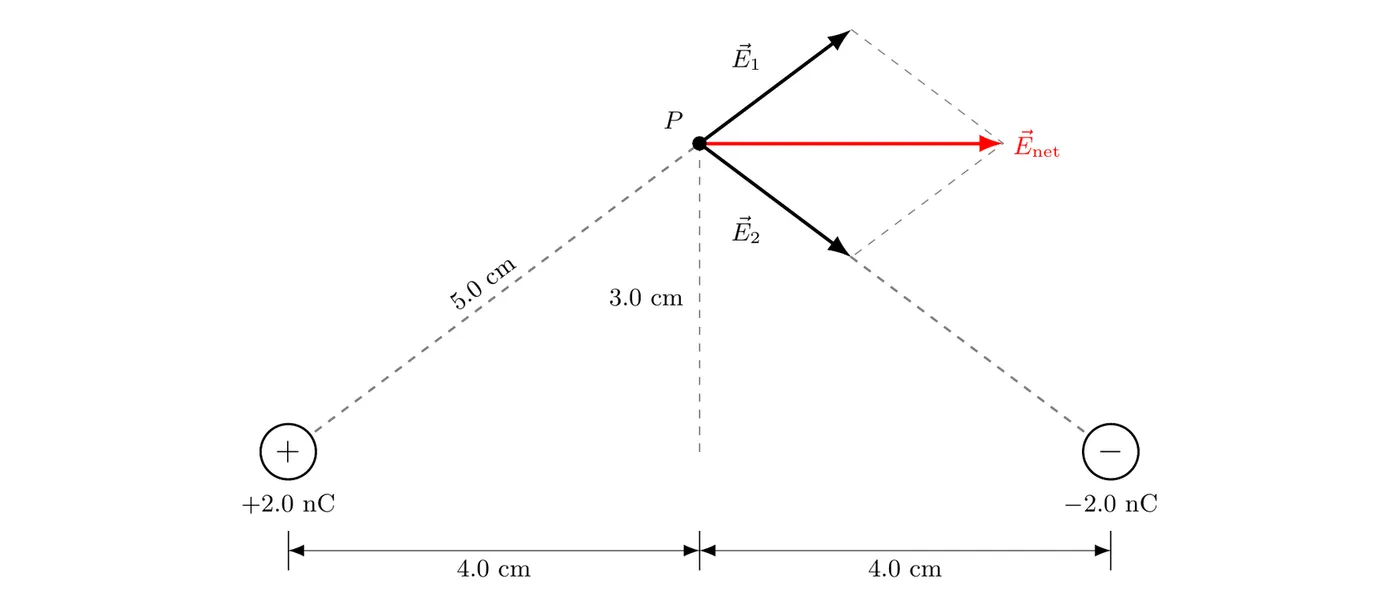
Problem: A nC charge and a nC charge are 8.0 cm apart. Point is 3.0 cm above the midpoint between them, so it’s 5.0 cm from each charge. Find the net electric field at .
Solution:
Both charges have the same magnitude and are the same distance from ( m), so their fields have the same magnitude:
Directions:
- points away from the positive charge, so up and to the right, along the line from through .
- points toward the negative charge, so down and to the right, along the line from to .
Break each one into components. Each line makes an angle with the horizontal, and the 3-4-5 triangle gives and :
Answer: N/C, pointing right (parallel to the line from the positive charge to the negative charge).
The y-components cancel by symmetry, but the x-components add. That’s why the field everywhere on this midline points the same way, from the + side toward the − side.
Practice Problem 5: Where Is the Field Zero?
Problem: A nC charge sits at and a nC charge sits at m. Where on the x-axis is the net electric field zero?
Solution:
First figure out which region it can be in:
- To the left of both charges, or to the right of both, the two fields point the same way, so they can’t cancel.
- Between the charges, the fields point in opposite directions (each one points away from its own positive charge), so they can cancel there.
- The zero point has to be closer to the smaller charge, since being closer is the only way its field can match the bigger charge’s field.
Call the zero point and set the two magnitudes equal:
Cancel and , then take the square root of both sides (both distances are positive):
Check: N/C to the right, and N/C to the left. ✓
Answer: m, between the charges and closer to the smaller one.
If the two charges had opposite signs, the zero point would be outside them instead, on the side of the smaller charge.
Common Mistakes
- Confusing field and force. The field exists everywhere, but you need a charge present to get a force.
- Getting the direction wrong for a negative charge. A negative charge feels a force opposite to the field direction.
- Adding magnitudes instead of vectors. You have to account for direction when finding the net field.
- Forgetting the in the denominator. Distance is squared in Coulomb-type equations.
- Thinking field lines are paths. Field lines show the direction of the force on a positive charge at each point, not the path a charge follows. A charge only moves along a field line in special cases, like a charge that starts from rest in a uniform field.
- Assuming the field inside a conductor is nonzero. In equilibrium, inside a conductor, always.
- Getting the perpendicular wrong. At a conductor’s surface, the field is perpendicular (90°), not tangent.
- Thinking excess charge spreads through the whole conductor. For a conductor in equilibrium, excess charge is only on the surface.