

2.2 - Conservation of Electric Charge and the Process of Charging
Conservation of Charge
The core principle is that charge can’t be created or destroyed, only moved around.
In an isolated system, . If one system gains charge, another system has to lose exactly the same amount.
Methods of Charging
1. Charging by Friction (Contact)
When two materials rub together, electrons move from one to the other.
Take rubbing a balloon on your hair:
- Electrons move from your hair to the balloon.
- The balloon becomes negative because it gained electrons.
- Your hair becomes positive because it lost electrons.
- The total charge is still 0, so it’s conserved.
Which material gains and which loses depends on the triboelectric series, which ranks materials by their tendency to gain or lose electrons.
2. Charging by Contact (Conduction)
Here a charged object touches a neutral conductor. The steps are:
1. The charged object touches the neutral object.
2. Electrons redistribute across both objects.
3. The charge gets shared.
4. Both objects end up with the same sign of charge.
For example, a charged rod touches a neutral metal sphere:
- If the rod is negative, electrons flow onto the sphere, so the sphere becomes negative.
- If the rod is positive, electrons flow from the sphere to the rod, so the sphere becomes positive.
The key point is that charge transfers through direct contact, and both objects come away charged.
3. Charging by Induction (No Contact)
Induced charge separation is when a nearby charged object rearranges the charge inside a neutral object without touching it. Importantly, the neutral object stays neutral overall, but its charges separate internally. The process is:
1. Bring a charged object close to a neutral conductor, but don’t touch it.
2. The charges in the conductor rearrange, with opposite charge pulled to the near side and like charge pushed to the far side.
3. The conductor is now polarized, meaning its charge is separated, but it’s still neutral overall.
4. Remove the charged object, and the charges spread back out evenly.
To make the charge permanent through induction:
1. Bring a charged object near a neutral conductor.
2. Ground the far side, which lets electrons flow to or from the Earth.
3. Remove the ground connection, which traps the charge imbalance.
4. Remove the charged object, and now the conductor is charged with the opposite sign.
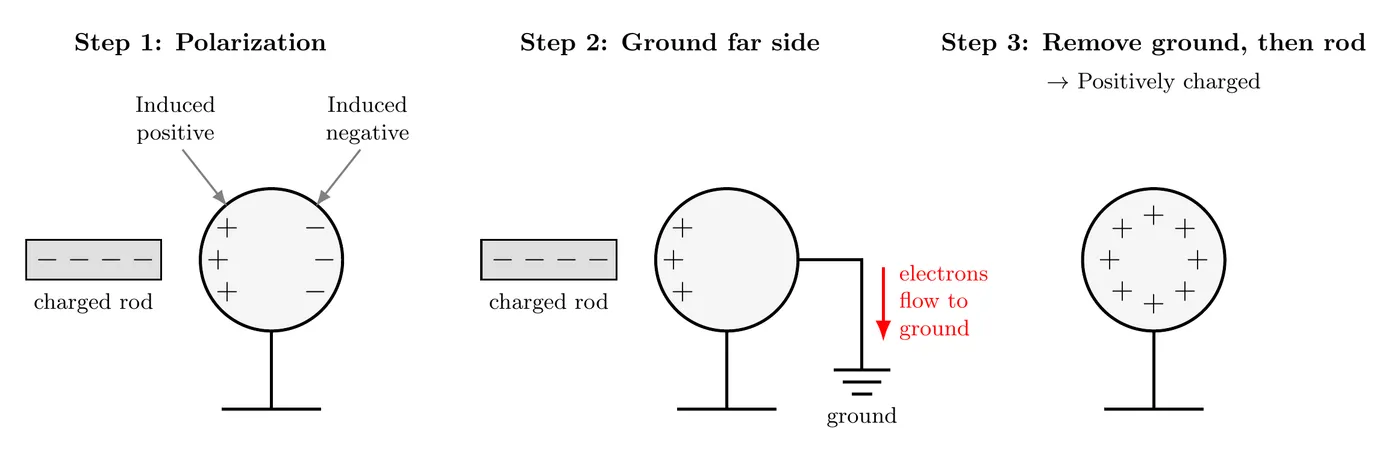
4. Polarization
Polarization is the separation of positive and negative charges inside a neutral object because of an external electric field.
The key fact is that induced charge separation can happen in neutral systems, so the system stays neutral but becomes polarized. There are two types:
a) Conductors (metals):
- Free electrons move easily.
- Charges separate to opposite sides.
- The polarization is strong.
b) Insulators (dielectrics):
- Electrons can’t move between atoms.
- Instead, the molecules or atoms rotate or distort.
- The polarization is weaker, but it’s still there.
For example, a charged balloon sticks to a neutral wall:
- The balloon is negative.
- It induces positive charge on the near surface of the wall, since the wall’s negative charge is pushed deeper in.
- The balloon and that induced positive charge attract each other.
- The net force is attractive, because the nearby charges have a stronger effect than the far ones.
Charge Transfer Details
What actually moves? In most materials, it’s the electrons that transfer, since protons are locked in the nuclei.
- Positive charge means a shortage of electrons.
- Negative charge means an excess of electrons.
Sign conventions:
- Gaining electrons makes something negative.
- Losing electrons makes something positive.
Conservation in action:
- Object A loses 100 electrons, so it becomes .
- Object B gains those 100 electrons, so it becomes .
- Total: . ✓
Grounding
Grounding means connecting a charged object to the Earth, or to some other very large neutral reservoir.
The purpose is to:
- Neutralize charged objects.
- Provide an effectively infinite source or sink of electrons.
- Rely on the fact that the Earth is so big it stays essentially neutral.
How it plays out:
- Ground a negative object, and its excess electrons flow to the Earth, so it becomes neutral.
- Ground a positive object, and electrons flow from the Earth to the object, so it becomes neutral.
The symbol for ground is ⏚, or a stack of horizontal lines.
Some real applications include lightning rods, the third prong on electrical outlets, and preventing static buildup in electronics.
Conservation of Charge Examples
Example 1: Electroscope
An electroscope has two metal leaves that repel each other when it’s charged. The process:
1. Touch the electroscope with a charged rod, say a negative one.
2. Electrons transfer onto the electroscope.
3. Both leaves become negative.
4. Like charges repel, so the leaves spread apart.
Conservation check: the charge on the rod goes down, and the charge on the electroscope goes up by the same amount.
Example 2: Charge Sharing
Two identical metal spheres, where sphere A has charge and sphere B is neutral.
When you bring them into contact:
- The total charge is .
- Since the spheres are identical, the charge splits evenly.
- Each sphere ends up with .
Conservation check: before equals after. ✓
Practice Problem 1: Charge Conservation
Problem: A glass rod is rubbed with silk. The rod ends up with a charge of C. What is the charge on the silk?
Solution:
At the start: rod = 0, silk = 0, total = 0.
At the end: rod = C.
By conservation:
Answer: the silk has C.
The reasoning: the rod became positive because it lost electrons, so the silk must have picked up those electrons and become negative.
Follow-up: how many electrons moved? Each electron carries a charge of magnitude C, so:
That’s about 190 billion electrons moving from the rod to the silk, and it only adds up to 30 nC. The silk gained exactly the charge the rod lost, just with the opposite sign.
Practice Problem 2: Charge Sharing
Problem: Three identical metal spheres have charges μC, μC, and μC.
(a) Spheres A and B are touched together, then separated. What are their final charges?
(b) Then sphere A is touched to sphere C and separated. What are the final charges of all three?
Solution:
- A and B touch:
- Total: μC.
- Split evenly, so each gets μC.
- μC, μC.
- A and C touch, where A now carries +3 μC from part (a):
- Total: μC.
- Split evenly, so each gets μC.
- μC, μC.
Final answer:
- μC
- μC
- μC
Practice Problem 3: Induction
Problem: A negatively charged rod is brought near a neutral metal sphere on an insulating stand, without touching it. Describe the charge distribution:
(a) while the rod is nearby
(b) if the sphere is grounded while the rod is nearby, then ungrounded
(c) after the rod is removed in part (b)
Solution:
- Polarization:
- Near side: positive, since it’s attracted.
- Far side: negative, since it’s repelled.
- Net charge: still zero, so neutral.
- Grounded:
- Electrons on the far side are pushed off to ground.
- Near side: still positive.
- Far side: now neutral, since the electrons left.
- Net charge: positive, because the sphere lost electrons.
- Rod removed:
- The positive charge spreads out evenly over the sphere.
- The sphere stays positively charged.
- The result: it ends up charged opposite to the rod, and it never got touched.
Common Mistakes
- Thinking polarization creates charge. Polarization just rearranges the charges that are already there. No charge is created, and the net charge stays zero.
- Confusing contact with induction. Contact means touching, and both objects end up the same sign. Induction means no touching, and you get opposite signs after the grounding step.
- Forgetting conservation. If one object gains charge, another has to lose it. The total is always conserved.
- Getting the sign wrong after induction. An object charged by induction ends up with the opposite sign to the object that induced it.
- Thinking only electrons ever move. Usually that’s true, but in solutions and plasmas, positive ions can move too.
- Forgetting the grounding step in induction. To permanently charge something by induction, you have to ground it while the inducing object is nearby, then remove the ground before removing the object.
- Not recognizing neutral attraction. Charged objects attract neutral objects through induced polarization, because the nearby charges get pulled in more than the far charges get pushed away.