

7.2 - The Bohr Model of Atomic Structure
Atomic Structure
Atoms have internal structure.
The Pieces
An atom is a small, positively charged nucleus surrounded by one or more negatively charged electrons.
Nucleus:
- Sits at the center of the atom.
- Holds essentially all the mass.
- Is positively charged.
- Is about m across (femtometers).
Electrons:
- Orbit the nucleus (in the classical picture).
- Are negatively charged.
- Have very little mass compared to the nucleus.
- Sit about m from the nucleus (angstroms).
What’s in the Nucleus
The nucleus is made of protons and neutrons.
Protons:
- Positive charge: C.
- Mass: kg u (atomic mass unit).
Neutrons:
- No charge: .
- Mass: kg u.
- A touch heavier than a proton.
Electrons:
- Negative charge: C.
- Mass: kg u.
- About 1/1836 the mass of a proton.
Nuclear Notation
You can show how many protons and neutrons an atom has with nuclear notation:
where:
- = the chemical symbol (the element).
- = the atomic number = the number of protons.
- = the mass number = the number of protons plus neutrons.
Examples:
- is carbon-12: 6 protons, 6 neutrons.
- is carbon-14: 6 protons, 8 neutrons.
- is uranium-238: 92 protons, 146 neutrons.
Number of neutrons: .
Ions
An ion is an atom with a nonzero net electric charge.
Positive ion (cation): an atom that’s lost one or more electrons.
- More protons than electrons.
- Net positive charge.
- Example: (a sodium ion that lost 1 electron).
Negative ion (anion): an atom that’s gained one or more electrons.
- More electrons than protons.
- Net negative charge.
- Example: (a chloride ion that gained 1 electron).
Elements and Identity
Every element has its own unique number of protons.
The atomic number () is what defines the element:
- Hydrogen: .
- Helium: .
- Carbon: .
- Gold: .
Change the number of protons and you change the element itself.
Electron Configuration
The number and arrangement of electrons shape how atoms interact.
- Chemical properties come from the electrons, especially the outermost (valence) ones.
- In a neutral atom, the number of electrons equals the number of protons.
- How the electrons are arranged determines bonding, reactivity, and so on.
Isotopes
The total number of protons and neutrons pins down the isotope of an element.
Isotopes are atoms of the same element (same ) with different numbers of neutrons (different ).
Examples:
- and are both carbon, but different isotopes.
- and are both uranium, but different isotopes.
Isotopes have almost identical chemical properties but different nuclear properties (stability, radioactivity, mass).
Atomic Mass
The mass of an atom is basically all in the protons and neutrons in the nucleus.
Electrons chip in less than 0.1% of the total.
The Bohr Model
The Bohr model of the atom is built on classical physics and was the historical picture that led to describing the hydrogen atom in terms of discrete energy states.
Some background:
- Niels Bohr came up with it in 1913.
- It blended classical and quantum ideas.
- It successfully explained the hydrogen spectrum.
- Full quantum mechanics later replaced it, but it’s still useful for grasping basic atomic structure.
Circular Orbits in the Bohr Model
In the Bohr model, electrons are pictured moving around the nucleus in circular orbits set by the electron’s charge and mass along with the electric force between the electron and the nucleus.
The Forces Inside the Atom
The electric force between the nucleus and the electron supplies the centripetal force for the circular motion:
For hydrogen (one proton, one electron):
where:
- N·m²/C² (Coulomb’s constant).
- C (the elementary charge).
- = the orbital radius.
This attractive electric force pulls the electron in toward the nucleus.
The Circular Motion
For a stable circular orbit, the net force provides the centripetal acceleration:
Setting the electric force equal to the centripetal force it needs to supply:
This ties together the orbital radius, the speed, and the energy of the electron.
Quantization: The Standing Wave Model
The standing wave model of electrons explains why an electron in an atom only has specific allowed energy states.
The Standing Wave Condition
The orbit’s circumference has to be a whole-number multiple of the electron’s de Broglie wavelength:
where:
- (positive integers, called the quantum number).
- = the orbital radius.
- = the de Broglie wavelength .
What this means physically: the electron wave has to “fit” perfectly around the orbit and form a standing wave. Only certain radii let that happen.
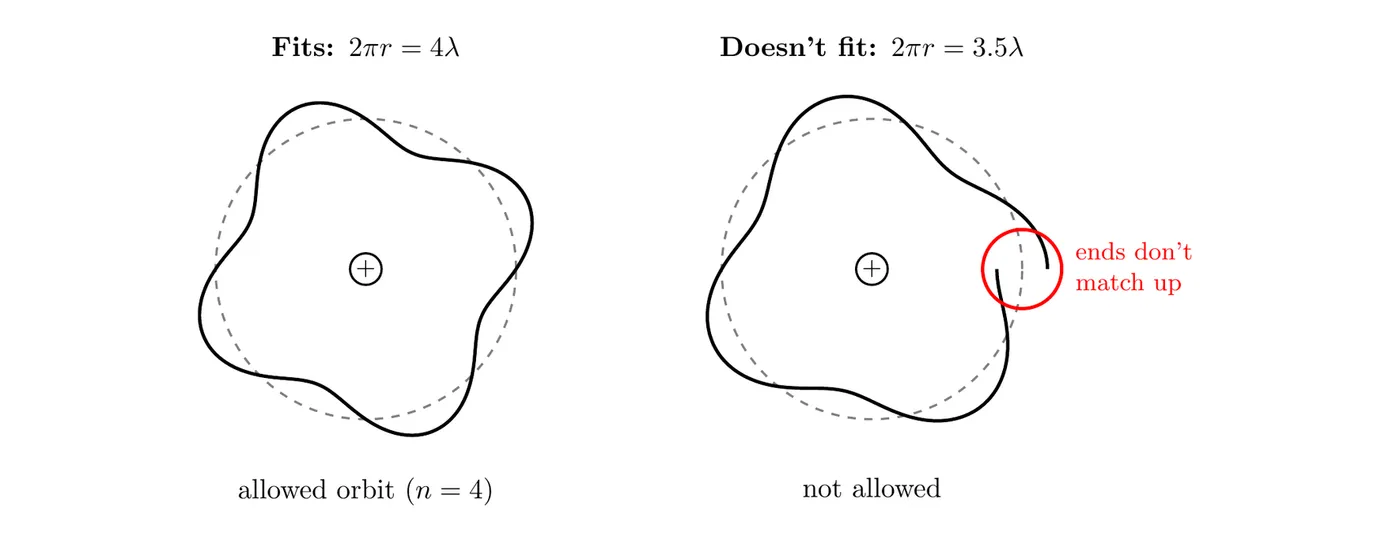
On the left, exactly four wavelengths fit around the orbit, so the wave joins up with itself smoothly and reinforces on every lap. On the right, 3.5 wavelengths don’t fit: the wave comes back around out of step with itself, and over many laps it cancels out. Only orbits like the one on the left are allowed.
The Payoff: Quantized Energy
This standing wave condition leads to:
- Discrete allowed orbital radii (not every radius is possible).
- Discrete allowed energies (energy levels).
- Discrete allowed angular momenta.
Only specific orbits are stable. Electrons can only live in those allowed energy states, never in between.
Example: in hydrogen’s ground state (), the Bohr model puts the electron at m moving at m/s (practice problems 5 and 6 below get this speed from ). Check that exactly one de Broglie wavelength fits around this orbit.
Answer: the circumference equals one de Broglie wavelength (to the two significant figures of the radius), so this is the standing wave. The orbit fits two wavelengths, fits three, and so on.
Energy Levels
Because only certain orbits are allowed, electrons in atoms have quantized energy levels:
- Ground state (): lowest energy, most stable.
- Excited states (): higher energy, less stable.
For hydrogen, the Bohr model gives the energy levels : eV for , eV for , eV for , and so on, getting closer to 0 as grows. The energies are negative because the electron is bound: 0 is the energy of an electron that’s just barely free. This formula isn’t on the equation sheet, so expect AP questions to give you the energy levels (usually as an energy level diagram, Topic 7.3).
Jumping between levels:
- An electron absorbs a photon and jumps to a higher level (absorption).
- An electron emits a photon and drops to a lower level (emission).
- The photon’s energy equals the gap between levels: .
This is what explains atomic spectra (those discrete emission and absorption lines).
Practice Problems
1. Write the nuclear notation for an atom with 17 protons and 18 neutrons. What element is it?
2. How many protons, neutrons, and electrons are in a neutral atom of ?
3. An oxygen atom () loses two electrons. What’s its charge? Is it a cation or an anion?
4. Two isotopes of chlorine are and . How do they differ?
5. In the Bohr model, an electron orbits a proton at radius m (the Bohr radius for hydrogen). Find the electric force between them.
6. For the electron in problem 5, find the speed it needs for a stable circular orbit. (Use kg.)
7. Explain how the standing wave condition leads to quantized energy levels in atoms.
8. An electron in hydrogen goes from to . Does it absorb or emit a photon?
Solutions
1.
- Protons: .
- Neutrons: .
- Mass number: .
Nuclear notation: .
The element with is chlorine.
Answer: (chlorine-35).
2. From :
- , so 26 protons.
- , so , which is 30 neutrons.
- It’s neutral, so electrons equal protons, which is 26 electrons.
Answer: 26 protons, 30 neutrons, 26 electrons.
3. Oxygen has , so 8 protons (positive charges).
It loses 2 electrons, so it’s down to 6 electrons (negative charges).
Net charge: .
Since the charge is positive, it’s a cation.
Answer: the charge is (or C), and it’s a cation (positive ion), written .
4. Both isotopes have (17 protons), so both are chlorine.
: neutrons.
: neutrons.
The difference: they have different numbers of neutrons (18 vs. 20). has 2 more neutrons, so it’s slightly heavier.
They have basically the same chemical properties (same number of electrons) but different nuclear properties (different stability and mass).
Answer: they differ in neutron count. has 18 neutrons and has 20.
5. Use the electric force equation:
Answer: the electric force is N, attractive, pointing toward the nucleus.
6. For a circular orbit, the electric force equals the centripetal force:
Solve for :
Answer: the orbital speed is m/s, about 0.7% the speed of light.
7. The electron’s de Broglie wavelength is . For the electron wave to form a stable standing wave around the circular orbit, the circumference has to equal a whole number of wavelengths:
This only works for specific values of the radius . And since the energy depends on the radius, only specific energy values are allowed.
Orbits that don’t satisfy this condition would have destructive interference, where the electron wave doesn’t line back up with itself after going around, so it cancels out. Only the quantized orbits survive.
The result: electrons can only sit at discrete energy levels, not any continuous value. That quantization is why atoms have specific emission and absorption spectra.
Answer: the standing wave condition (circumference equals an integer times the wavelength) only allows certain radii, which correspond to certain energies. Only those quantized energy levels are stable.
8. The electron goes from a higher level () to a lower level ().
Its energy drops: , so .
When an electron loses energy, it has to emit a photon that carries that energy away:
Answer: the electron emits a photon, which carries off the energy difference between the two levels.
Common Mistakes
- Mixing up protons, neutrons, and electrons. Protons are in the nucleus (positive). Neutrons are in the nucleus (neutral). Electrons orbit the nucleus (negative).
- Miscounting neutrons. The number of neutrons is (mass number minus atomic number), not .
- Thinking isotopes are different elements. Isotopes are different versions of the same element (same Z, different N).
- Forgetting that ions have a different electron count. Ions have gained or lost electrons, so the electron count isn’t equal to the proton count. Charge equals (protons) minus (electrons).
- Confusing mass number with atomic mass. The mass number is a whole number (a count of nucleons). Atomic mass is an average weighted by isotope abundance.
- Thinking the Bohr model works for every atom. It does a decent job for hydrogen but breaks down for multi-electron atoms. It’s a simplified historical model.
- Treating the forces in circular motion wrong. The electric force provides the centripetal force. Don’t treat them as two separate forces in balance.
- Forgetting the quantization condition. Not every orbit is allowed, only the ones that satisfy (the standing wave condition).
- Thinking electrons can have any energy. In bound atoms, energy is quantized. Only specific discrete values are allowed.
- Confusing emission and absorption. Electron goes up in energy means it absorbs a photon. Electron goes down means it emits one.
- Misreading the notation. In , the subscript is the atomic number (protons) and the superscript is the mass number (protons plus neutrons).
- Thinking electron mass matters for atomic mass. Electrons contribute less than 0.1% of the atomic mass. The nucleus dominates.
- Mixing up cation and anion. Cation is positive (lost electrons). Anion is negative (gained electrons).
- Forgetting the standing wave explanation. The quantization in the Bohr model comes from de Broglie waves forming standing waves, not from some arbitrary classical rule.
- Getting the electric force sign wrong. The proton-electron force is attractive (opposite charges). Use the magnitude in calculations and keep track of the direction separately.
- Units. Charge in coulombs, mass in kg, distance in meters, force in newtons. Watch the prefixes and scientific notation.