

7.4 - Blackbody Radiation
Thermal Radiation
Any object warmer than absolute zero gives off electromagnetic radiation just because of its temperature. Matter spontaneously turns some of its internal thermal energy into electromagnetic energy, and we call that thermal radiation.
A few things follow from this: hotter objects give off more radiation, the spectrum they emit depends on their temperature, and the whole process happens on its own with no outside energy needed. You see it when hot metal glows red and then white as it heats up, when infrared cameras pick up body heat, and when stars shine because they’re so hot.
What a Blackbody Is
A blackbody is an idealized object that soaks up every bit of radiation that hits it. An ideal one absorbs 100% of the incoming radiation with no reflection, does this at every wavelength, and looks completely black when it’s cold (which is where the name comes from).
If a blackbody is sitting at a steady temperature (in thermal equilibrium), it has to emit energy right back out, so that energy absorbed equals energy emitted. It’s an idealization, and real objects only come close to it, some better than others. Good approximations include a small opening in a cavity (radiation goes in but can’t get back out), dark rough surfaces, and stars.
The Blackbody Spectrum
A blackbody puts out a continuous spectrum that depends only on its temperature. Unlike atomic spectra, which show sharp separate lines, blackbody radiation gives a smooth continuous spread of wavelengths.
The key point is that the spectrum depends only on temperature, not on what the object is made of, its surface texture, its chemistry, or its size (though the total power does depend on area).
Intensity vs. wavelength. People usually picture blackbody radiation by plotting intensity per unit wavelength against wavelength.
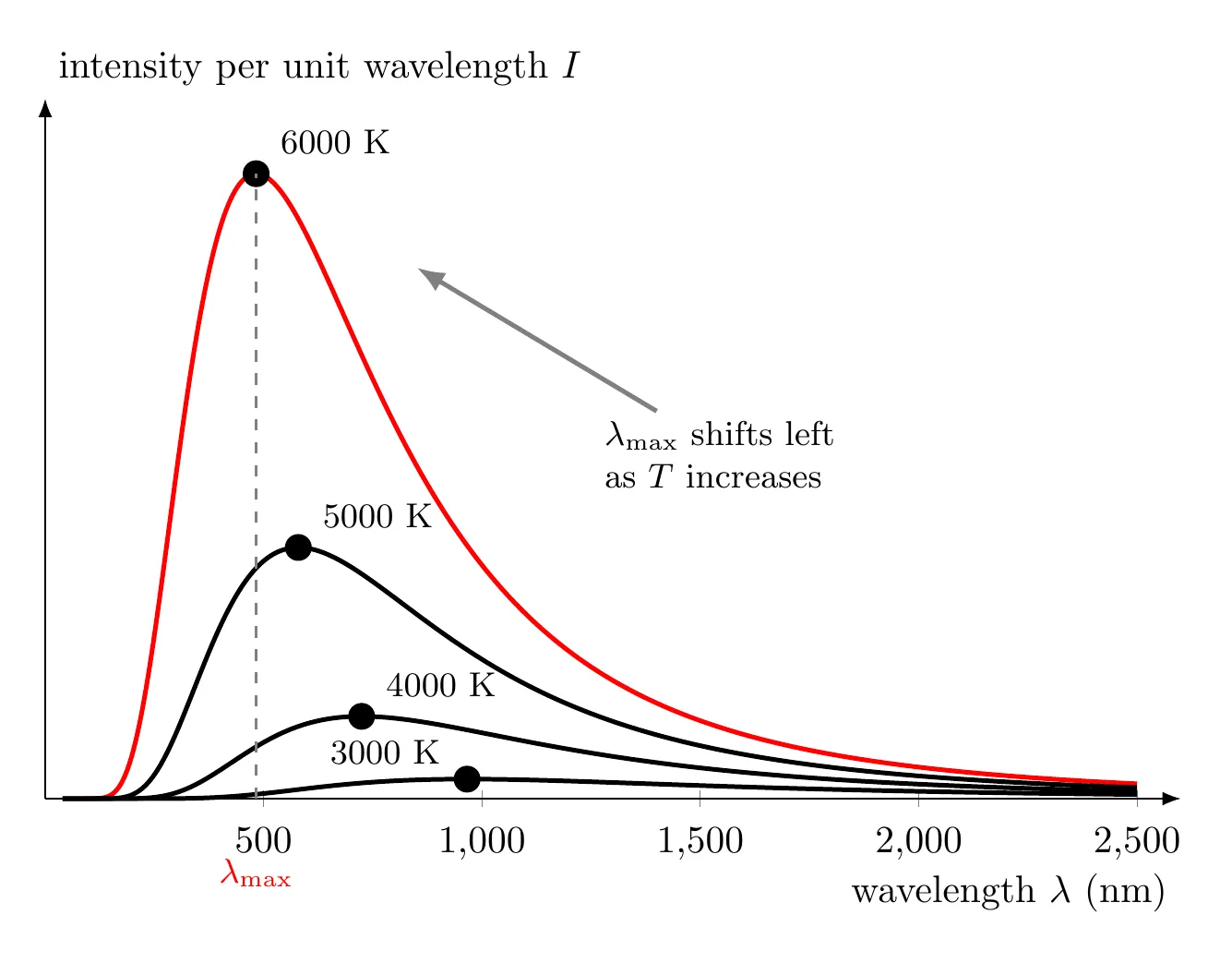
How to read (or sketch) these curves:
- Every curve starts near zero at very short wavelengths, rises to a peak at , then trails off slowly at long wavelengths.
- A hotter blackbody’s curve is higher at every wavelength, so curves for different temperatures never cross.
- The hotter curve’s peak is farther left (shorter ). That’s Wien’s law.
- The area under a curve is the total power given off per unit area of the surface, and it grows like . That’s the Stefan-Boltzmann law, and it’s why the 6000 K curve has times the area of the 3000 K curve.
Planck’s Law and Quantum Theory
You can’t get the shape of the blackbody spectrum from classical physics alone. Classical physics predicted the “ultraviolet catastrophe,” where infinitely much energy would pour out at short wavelengths, which flatly contradicted what experiments actually showed.
The real curve is described by Planck’s law, which assumes the energy of light is quantized. Planck’s big idea in 1900 was that electromagnetic energy comes in discrete packets (quanta), each with energy . That quantization is exactly what prevents the ultraviolet catastrophe, and it kicked off quantum mechanics. Blackbody radiation was one of the things classical physics simply couldn’t explain, which is what pushed physicists toward quantum theory in the first place.
Wien’s Displacement Law
The peak wavelength (the wavelength where a blackbody emits the most radiation per unit wavelength) gets shorter as the object gets hotter. That’s Wien’s law:
where:
- = peak wavelength (m)
- = Wien’s displacement constant = m·K
- = absolute temperature (K)
So higher temperature means a shorter peak wavelength (toward blue and UV), lower temperature means a longer one (toward red and IR), and the peak wavelength is inversely proportional to temperature. This is how you read a star’s temperature from its color, and it’s why hot metal glows red, then orange, then white as it heats up. Some quick examples: the Sun (about 5800 K) peaks in the visible range and looks yellow-white, a cool star (about 3000 K) peaks in the infrared and looks red, a hot star (about 10000 K) peaks in the UV and looks blue-white, and the human body (about 310 K) peaks in the mid-infrared, invisible to us.
Stefan-Boltzmann Law
The rate at which a blackbody radiates energy (its power) depends on its surface area and on its temperature raised to the fourth power. That’s the Stefan-Boltzmann law:
where:
- = power radiated (W)
- = surface area (m²)
- = Stefan-Boltzmann constant = W/(m²·K⁴)
- = absolute temperature (K)
Bigger objects radiate more (), and temperature has a huge effect (), so doubling the temperature boosts the power by a factor of 16. Temperature has to be in kelvin, and this gives the total power across all wavelengths, not just at the peak.
Example: a star has a radius 2.0 times the Sun’s and a surface temperature of 4500 K. The Sun’s surface is about 5800 K. Compare (a) the star’s peak wavelength and (b) the total power it radiates with the Sun’s.
(a) Wien’s law:
(b) The surface area of a sphere is , so doubling the radius makes the area times bigger. Take the ratio of for the two stars ( cancels):
Answer: the star peaks at about 640 nm (redder than the Sun’s 500 nm), and it radiates about 1.4 times as much total power as the Sun. Its cooler surface gives off much less power per square meter, but its bigger surface more than makes up for it.
Practice Problems
1. The Sun’s surface is about 5800 K. At what wavelength does it emit the most radiation?
2. An object peaks at 10 μm. What’s its temperature?
3. Star A is twice as hot at the surface as Star B. Compare (a) their peak wavelengths and (b) the power radiated per unit area.
4. A blackbody goes from 400 K to 800 K. By what factor does its total radiated power increase (same surface area)?
5. Human skin is about 33°C (306 K). At what wavelength does it emit the most radiation? Can you see it?
6. Why does heating metal make it glow red, then orange, then white?
7. A spherical blackbody of radius 0.50 m sits at 1000 K. How much total power does it radiate?
8. Two identical blackbodies are at 300 K and 600 K. What’s the ratio of their total radiated power?
Solutions
1. Wien’s law:
The Sun peaks at 500 nm (green, right in the middle of the visible range), which is why it looks yellow-white and emits strongly across all the visible colors.
2. Solve Wien’s law for temperature:
That’s 290 K (about 17°C or 63°F). A 10 μm peak sits in the mid-infrared, typical of things near room temperature.
3. (a) With :
Star A’s peak wavelength is half of Star B’s (shorter, shifted toward blue/UV).
(b) With :
Star A radiates 16 times more power per unit area.
4. Stefan-Boltzmann law:
The power goes up by a factor of 16. Doubling the temperature multiplies the power by .
5. Wien’s law:
That’s mid-infrared (visible light runs 400 to 700 nm), so you can’t see it, though infrared cameras can. That’s exactly how thermal imaging picks up body heat.
6. As the metal heats up, the peak wavelength shifts down according to Wien’s law (). Around 800 K the peak is far into the infrared (about 3.6 μm), but the tail of the curve reaches the red end of the visible range, so it glows dull red. Around 1200 K the whole curve is brighter and shifted shorter, so more orange and yellow show up and it glows orange-yellow. Above about 1500 K it gives off plenty of light at every visible wavelength, so it looks white, even though the peak is still in the infrared. The color marches from red (longest visible) toward white as the temperature rises and the peak wavelength shrinks. Blue-white takes about 10,000 K or more (like the hottest stars, which peak in the ultraviolet), and a solid metal melts long before that.
7. Surface area of the sphere first:
Then Stefan-Boltzmann:
The blackbody radiates 178 kW.
8. Stefan-Boltzmann with equal areas:
The 600 K body radiates 16 times more power. That fourth-power dependence makes temperature a really sensitive factor.
Common Mistakes
- Using Celsius instead of Kelvin. Both laws need absolute temperature. Convert with .
- Mixing up peak wavelength and total power. Wien’s law gives the peak wavelength, Stefan-Boltzmann gives the total power across all wavelengths. They’re different relationships.
- Getting Wien’s proportionality backward. , so higher temperature means shorter wavelength.
- Dropping the fourth power. Stefan-Boltzmann uses , so doubling the temperature multiplies power by 16, not 2 or 4.
- Thinking blackbodies are always black. “Blackbody” is about absorption (it absorbs everything), not emission color. Hot ones can glow white or blue.
- Treating real objects as perfect blackbodies. They only approximate it. Stars are close, shiny metal is not.
- Confusing atomic line spectra with continuous blackbody spectra. Atoms give discrete lines, blackbodies give continuous curves.
- Wrong units for . Wien’s constant is m·K, not just m or K.
- Forgetting area in Stefan-Boltzmann. Power depends on both temperature and surface area, so bigger objects radiate more even at the same temperature.
- Thinking classical physics handles blackbody radiation. It fails (ultraviolet catastrophe). You need quantum theory (Planck’s law).
- Missing the color-temperature link. Color tracks temperature through Wien’s law: red is cooler, blue is hotter.
- Confusing intensity and power. Intensity is power per unit area. Total power needs the area multiplied back in.
- Assuming every wavelength peaks at the same temperature. The peak shifts with temperature.
- Wrong Stefan-Boltzmann constant. It’s W/(m²·K⁴).
- Thinking emission is only at the peak. A blackbody emits a continuous spectrum. The peak is just where intensity is highest, but there’s radiation at every wavelength.
- Not seeing the applications. These laws are how we find stellar temperatures, study thermal emission, and design infrared devices.
- Forgetting temperature must be absolute. No negative kelvin values in these equations.
- Misreading the spectrum shape. It’s asymmetric, with a longer tail toward long wavelengths, not symmetric around the peak.