

7.3 - Emission and Absorption Spectra
Energy Transfer in Atoms
Energy gets transferred when an atom absorbs or emits photons, treating the atom as a system of a nucleus plus an electron.
The atom can:
- Absorb a photon (gain energy, electron moves to a higher level).
- Emit a photon (lose energy, electron moves to a lower level).
The energy moves in discrete packets (photons), not in a continuous stream.
Quantized Energy Transitions
An atom can only absorb or emit energy if that energy matches the gap between two of its energy states.
The photon’s energy has to exactly match the gap between levels. There’s no such thing as a partial transition.
Absorption
An atom in a given energy state can absorb a photon of just the right energy and jump up to a higher energy state.
How it goes:
1. The atom starts in a lower state (often the ground state).
2. A photon with energy reaches the atom.
3. The photon gets absorbed and vanishes.
4. The electron jumps to a higher level.
5. The atom is now in an excited state.
The condition: exactly. If the photon’s energy doesn’t match any transition, it passes right through without being absorbed. (The one exception is a photon with enough energy to ionize the atom, covered below.)
Emission
An atom in an excited state can emit a photon of the right energy and spontaneously drop to a lower energy state.
How it goes:
1. The atom starts in an excited (higher energy) state.
2. The electron spontaneously drops to a lower level.
3. A photon gets created with energy .
4. The photon carries the energy away.
5. The atom is now in the lower state.
Note: emission can be spontaneous (random timing) or stimulated (triggered by another photon).
Thinking of It as a System
Since we model the atom as a system of an electron and a nucleus, a change in the atom’s energy state is really a change in the interaction energy between the electron and the nucleus.
The energy levels stand for different electron-nucleus setups (different orbital radii in the Bohr model, different wave functions in full quantum mechanics).
One Frequency per Transition
A transition between two energy states corresponds to absorbing or emitting a photon of a single frequency and therefore a single wavelength.
One transition means one specific energy, which means one specific frequency, which means one specific wavelength.
Example for hydrogen:
- The to transition always makes a photon with nm (red).
- The to transition always makes a photon with nm (UV).
Atomic Spectra
Every element has its own unique set of allowed energy levels and therefore its own unique set of absorption and emission frequencies. That unique set of frequencies makes up the element’s spectrum.
Each element has its own “fingerprint” of spectral lines.
Why unique? Different elements have:
- Different nuclear charges.
- Different numbers of electrons.
- Different energy level structures.
- And therefore different possible transitions.
Emission Spectrum
You can use an emission spectrum to figure out which elements are in a light source.
What you do:
- Heat up or electrically excite a gas of atoms.
- The atoms emit light at specific wavelengths.
- Send that light through a prism or a diffraction grating.
- You see discrete bright lines on a dark background.
Each element makes its own pattern of bright lines, like a barcode.
Examples:
- Hydrogen: 4 visible lines (red, cyan, blue, violet) in the Balmer series.
- Sodium: a prominent yellow doublet.
- Mercury: several lines, including strong blue and green.
Uses: identifying elements in stars, gas discharge lamps, and unknown samples.
Absorption Spectrum
You can use an absorption spectrum to figure out what a substance is made of by looking at which light it absorbed.
What you do:
- Send white light (a continuous spectrum) through a cool gas.
- The atoms absorb specific wavelengths.
- Look at the transmitted light with a spectrometer.
- You see discrete dark lines on a bright continuous background.
Those dark lines land at exactly the same wavelengths as the bright emission lines for that element.
Uses:
- Identifying elements in stellar atmospheres (the Fraunhofer lines in the Sun’s spectrum).
- Analyzing the composition of distant objects.
- Studying atmospheric composition.
Energy Level Diagrams
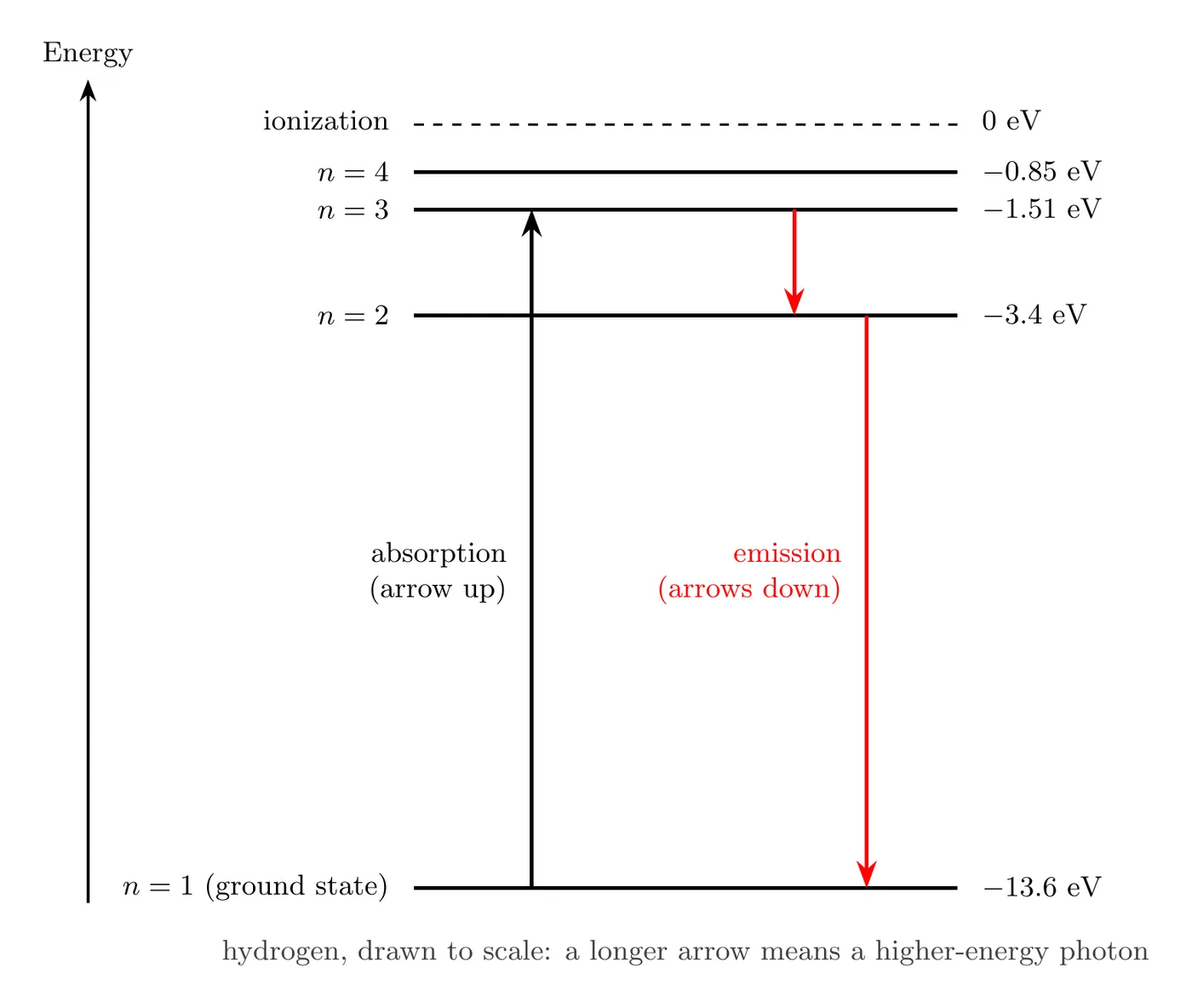
Energy level diagrams are a common way to picture an atom’s energy states.
What they look like:
- The vertical axis stands for energy.
- Horizontal lines mark the allowed energy levels.
- They’re labeled with quantum numbers ().
- The ground state (lowest) is at the bottom.
- Higher states sit above it.
- The ionization level is at the top ( or some reference).
- Arrows show the transitions:
- An upward arrow is absorption.
- A downward arrow is emission.
- The arrow’s length is proportional to the photon’s energy.
Binding Energy and Ionization
Binding energy is the energy it takes to pull an electron out of an atom, which leaves the atom ionized.
Ground State Binding Energy
An atom in the lowest energy level (the ground state) needs the most energy to have its electron removed.
- The ground state is the most tightly bound.
- It takes the most energy to ionize.
- Excited states are less tightly bound, since the electron already has some extra energy.
For hydrogen: the ground state binding energy is 13.6 eV.
Ionization energy is the energy needed to pull the electron out of the ground state, which equals the binding energy.
Photons with more than enough energy: to jump between two bound levels, a photon has to match the gap exactly. Ionizing is different. Any photon with more energy than the binding energy can free the electron, and the extra energy becomes the freed electron’s kinetic energy: .
Energy level convention:
- Often you set at ionization (the electron is free).
- Bound states then have (negative energy).
- The ground state is the most negative.
Example: Reading an Energy Level Diagram
A single-electron atom has the energy levels shown below. A gas of these atoms is studied two ways: heated until it glows (emission), and kept cool with white light shining through it (absorption).
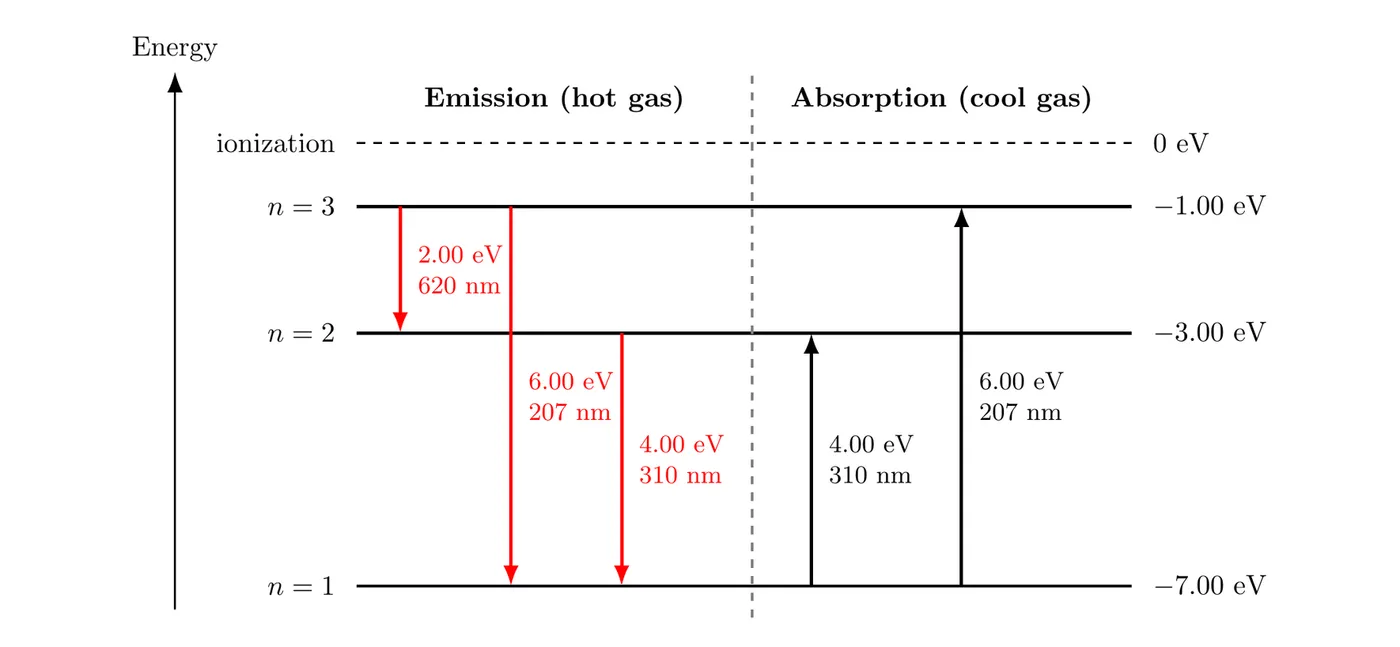
(a) Which photon energies can the hot gas emit? In a hot gas, collisions knock atoms into every level, so electrons can drop from any higher level to any lower one. That gives three possible jumps:
- to : eV
- to : eV
- to : eV
Each energy gives one wavelength. Using eV·nm:
So the emission spectrum has three bright lines: 620 nm (orange-red, visible), 310 nm (ultraviolet), and 207 nm (ultraviolet). The biggest energy gap gives the shortest wavelength.
(b) Which lines show up in the absorption spectrum? In a cool gas, almost every atom sits in the ground state, so absorption starts from . The atoms absorb 4.00 eV photons (310 nm, up to ) and 6.00 eV photons (207 nm, up to ). The 620 nm line is missing because almost no atoms are sitting in to absorb it. Every absorption line lines up with an emission line, but a cool gas can show fewer absorption lines than the hot gas shows emission lines.
(c) A 5.00 eV photon hits a ground-state atom. What happens? It would have to put the electron at eV, and there’s no level there. It’s also less than the 7.00 eV binding energy, so it can’t ionize the atom either. The photon passes right through.
(d) A 9.00 eV photon hits a ground-state atom. What happens? The binding energy from the ground state is eV. The photon has more than that, so it ionizes the atom, and the leftover energy becomes the electron’s kinetic energy:
Answer: the freed electron leaves with 2.00 eV of kinetic energy, which is J.
Practice Problems
1. An atom has energy levels at eV, eV, and eV. An electron drops from to . What are the energy and wavelength of the emitted photon?
2. A 400 nm photon hits an atom in its ground state ( eV). The atom has an excited state at eV. Will the photon be absorbed?
3. An atom emits photons at 500 nm and 600 nm. Can you tell whether they come from the same transition or different ones?
4. The ground state binding energy of hydrogen is 13.6 eV. How much energy does it take to ionize a hydrogen atom that’s already in the state (which has energy -3.4 eV)?
5. Explain why absorption spectra show dark lines at the same wavelengths where emission spectra show bright lines.
6. An astronomer sees absorption lines in a distant star’s spectrum matching hydrogen, helium, and iron. What does that tell you about the star?
7. One electron in hydrogen drops from to . Another drops from to . Which transition makes the higher-energy photon?
8. Why does each element have a unique spectrum?
Solutions
1. The electron drops from a higher level to a lower one, so it emits a photon.
Photon energy:
Convert to joules:
Find the wavelength:
Answer: the photon has energy 5 eV (or J) and wavelength 249 nm (ultraviolet).
2. First find the photon’s energy:
Convert to eV:
Energy gap between the states:
Since exactly, the photon energy matches the transition.
Answer: yes, it gets absorbed. The photon’s energy (3.1 eV) exactly matches the gap between the ground state and the excited state.
3. Each transition between two specific levels produces one specific wavelength.
Since you see two different wavelengths (500 nm and 600 nm), they have to come from two different transitions (two different pairs of levels).
If they came from the same transition, both photons would have the exact same wavelength and energy.
Answer: they come from different transitions. A single transition only makes one wavelength.
4. The state has energy eV.
The ionization level is at (the electron is free).
Energy needed to ionize from :
Answer: it takes 3.4 eV to ionize the atom from the state.
Note: that’s less than the ground-state ionization energy (13.6 eV) because the electron is already excited and sitting at a higher energy.
5. Both emission and absorption involve the same energy level transitions.
Emission spectrum: atoms in excited states emit photons as electrons drop down. Each transition makes a specific wavelength, which shows up as a bright line.
Absorption spectrum: white light (all wavelengths) passes through a cool gas. Atoms in the ground state absorb photons whose energies match their upward transitions. Those specific wavelengths get pulled out of the continuous spectrum, leaving dark lines.
Since the energy levels are the same, the transition energies are identical, so the wavelengths match up. The dark absorption lines sit at exactly the same wavelengths as the bright emission lines.
Answer: both spectra come from the same atomic transitions with the same energy gaps. Emission adds light at those wavelengths (bright lines), while absorption removes light at those same wavelengths (dark lines).
6. The absorption lines say the star’s atmosphere has hydrogen, helium, and iron in it.
Light from the hot interior (a continuous spectrum) passes through the cooler outer atmosphere. Atoms in that atmosphere absorb specific wavelengths that are characteristic of their elements, which leaves dark absorption lines.
Identifying those specific elements tells you:
- The chemical makeup of the star’s outer layers.
- That these three elements are present in the atmosphere.
- Rough relative abundances, from how strong the lines are.
- Clues about the star’s properties (temperature, composition, age, and so on).
Answer: the star’s atmosphere contains hydrogen, helium, and iron. Absorption spectroscopy lets astronomers work out the chemical composition of faraway objects.
7. You need to see which transition has the bigger energy gap.
For hydrogen-like atoms, the energy levels go as .
Higher means less negative energy (closer to ionization).
Transition 1:
to :
Transition 2:
to :
Compare: vs. .
.
Answer: the to transition makes the higher-energy photon, since it spans a bigger energy gap.
8. Each element has:
- A unique number of protons (its atomic number).
- A unique nuclear charge.
- A unique arrangement of electrons.
- And therefore a unique energy level structure.
The allowed energy levels depend on:
- The nuclear charge (which sets the electric force on the electrons).
- The number and arrangement of the electrons.
- The quantum mechanical details specific to that atom.
Since the energy levels are unique, the possible transitions are unique, which makes photons of unique frequencies. That gives each element a characteristic “fingerprint” spectrum.
Example: hydrogen (1 proton) has completely different energy levels than helium (2 protons), so their spectra look completely different.
Answer: each element has a unique nuclear charge and electron arrangement, which gives it unique energy levels and unique transitions, so it ends up with a unique spectrum, like a fingerprint that identifies it.
Common Mistakes
- Thinking any photon can be absorbed. Only photons whose energy exactly matches a transition can be absorbed. Everything else passes through untouched, unless it has enough energy to ionize the atom.
- Flipping emission and absorption. Emission: electron drops, photon goes out. Absorption: photon comes in, electron rises.
- Wrong energy calculation. Use , or take the absolute value. Keep the signs straight when the energies are negative.
- Thinking one transition makes several wavelengths. One transition means one energy gap, one frequency, one wavelength. Multiple wavelengths need multiple transitions.
- Confusing the two kinds of spectra. Emission: bright lines on a dark background. Absorption: dark lines on a bright (continuous) background.
- Forgetting to convert units. Energy often comes in eV, but you need joules for . 1 eV J.
- Getting ionization from excited states wrong. It takes less energy to ionize from an excited state than from the ground state, because the electron is already higher up.
- Thinking excited states are more tightly bound. The ground state is the most tightly bound (hardest to pull the electron out of). Excited states are less bound.
- Confusing binding energy with transition energy. Binding energy is the energy to remove the electron entirely (ionize). Transition energy is the gap between two bound states.
- Expecting a continuous spectrum from atoms. Isolated atoms make discrete line spectra, not continuous ones. Continuous spectra come from hot solids, dense gases, or thermal radiation.
- Getting the arrow direction wrong on diagrams. Upward arrow is absorption (photon in, electron up). Downward arrow is emission (electron down, photon out).
- Thinking spectra are intensity vs. wavelength. Emission and absorption spectra show the presence or absence of specific wavelengths, not necessarily an intensity curve (though intensity does carry extra information).
- Forgetting the wavelength-energy relationship. . Shorter wavelength means higher energy, not lower.
- Mixing up which lines are dark or bright. Emission spectrum: bright lines. Absorption spectrum: dark lines. For a given element, they land at the same wavelengths.
- Not appreciating that spectra are unique. Each element has a unique spectrum. No two elements have identical sets of lines (though a few lines might happen to overlap).
- Thinking energy levels are evenly spaced. They’re not. In hydrogen they bunch up closer together as increases (they go as ).