

7.6 - Compton Scattering
What Compton Scattering Is
In Compton scattering, a photon bounces off a free electron. The Compton effect is that the photon coming out has less energy and a longer wavelength than the one going in. A high-energy photon (usually an X-ray) collides with a free (or loosely bound) electron, hands over some energy and momentum, the electron recoils and picks up kinetic energy, and the photon scatters away with less energy and a longer wavelength. How much things change depends on the direction the photon goes after the collision (the scattering angle).
Why It Shows Light Is Made of Particles
Compton scattering is evidence that light comes in discrete, quantized packets called photons. The photoelectric effect showed light has quantized energy, and Compton scattering goes further, showing that photons also carry momentum and act like particles in collisions.
You can explain the whole thing by treating the photon as a particle and applying conservation of energy and conservation of momentum to the photon-electron collision. Classical wave theory got it wrong: it said light waves should just be absorbed and re-emitted at the same wavelength, with no angle-dependent energy transfer like this. The photon-as-particle picture gets it right: the photon behaves like a billiard ball, energy and momentum are conserved, and the quantitative predictions match experiments perfectly. Put together, the photoelectric effect (quantized energy) and Compton scattering (quantized momentum) firmly establish that light is particle-like.
Energy and Momentum Transfer
When the photon gives energy to the electron, the photon’s energy, momentum, frequency, and wavelength all change.
Photon energy:
Photon momentum:
where:
- = photon energy (J)
- = photon momentum (kg·m/s)
- = Planck’s constant = J·s
- = frequency (Hz)
- = wavelength (m)
- = speed of light = m/s
Photons have no mass, but they still carry momentum, . Since , never use for a photon.
Conservation laws. Energy is conserved:
and since the electron starts at rest, that simplifies to:
Momentum is conserved in two dimensions:
which you split into components, with the photon’s scattering angle and the electron’s recoil angle:
- x-component:
- y-component:
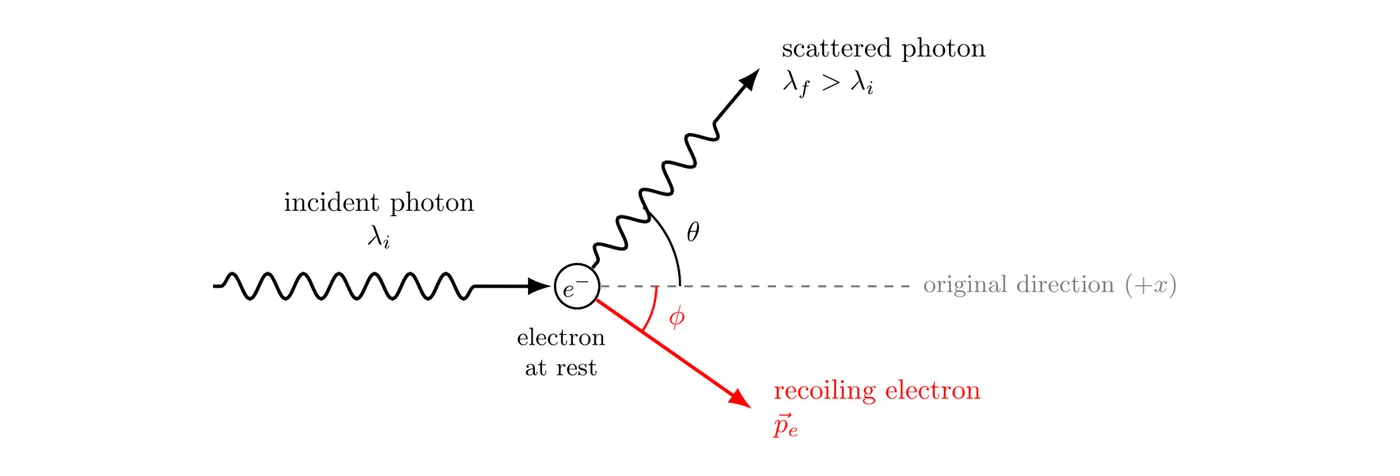
Set up axes so the incoming photon moves along . Before the collision, all the momentum belongs to the photon and points along , since the electron is at rest. Afterward, the photon goes off at angle above the axis and the electron recoils at angle below it. There was no -momentum to start with, so the -components of the two final momenta have to cancel. That’s why the photon and the electron always end up on opposite sides of the original direction.
Compton Wavelength Shift
How much the wavelength changes depends on how much the photon’s direction changes:
where:
- = change in wavelength (m)
- = Planck’s constant = J·s
- = electron mass = kg
- = speed of light = m/s
- = photon scattering angle (between the initial and final photon directions)
Compton wavelength. The quantity is called the Compton wavelength of the electron:
so the shift becomes:
How the Shift Depends on Angle
At (straight through, no deflection):
no wavelength change, since there was effectively no collision.
At (perpendicular scattering):
the wavelength grows by one Compton wavelength.
At (straight back, head-on):
the largest possible shift. The general rule: a bigger scattering angle means a bigger wavelength increase and more energy handed to the electron.
What’s Physically Going On
The wavelength increases because the photon loses energy in the collision, and lower energy means lower frequency (), which means longer wavelength (). It depends on angle because a larger scattering angle is a more direct hit, so more energy goes to the electron and more is lost by the photon. The electron mass shows up because heavier particles are harder to get moving, so the electron’s mass sets how much momentum the photon can transfer, and a smaller mass gives a bigger wavelength shift for the same angle.
Example: Energy and Momentum in Two Dimensions
Example: an X-ray photon with a wavelength of 50.0 pm hits an electron at rest and scatters at . Find (a) the scattered photon’s wavelength, (b) the electron’s momentum (size and direction), and (c) the electron’s kinetic energy.
(a) Compton shift at 90.0°:
(b) Photon momenta from (keeping an extra digit until the end):
The incoming photon moves along and the scattered photon moves along . Conserve momentum one component at a time:
- : , so kg·m/s
- : , so kg·m/s
(c) Energy conservation: the electron’s kinetic energy is the energy the photon lost.
That’s eV, or 1.15 keV. Check: the electron’s speed is m/s (about 7% of ), and J. Momentum conservation and energy conservation give the same answer, which is exactly what the particle model of light predicts.
Answer: pm. The electron moves off with momentum kg·m/s at 43.6° below the original direction, and its kinetic energy is J (1.15 keV).
Practice Problems
1. An X-ray photon of wavelength 0.050 nm scatters at 90° off a free electron. What’s the scattered photon’s wavelength?
2. A photon’s wavelength grows from 2.0 pm to 4.5 pm in Compton scattering. What was the scattering angle?
3. In Compton scattering, which gives a bigger wavelength shift: 60° or 120°?
4. A 100 keV photon scatters at 180° off an electron. What’s the change in wavelength?
5. Why is Compton scattering a bigger deal for X-rays than for visible light?
6. An incoming photon has a wavelength of 1.0 pm. After scattering at 45°, what’s its final wavelength and how much energy did it give the electron?
7. Why is Compton scattering strong evidence for the particle nature of light?
8. Compare the wavelength shift for a photon scattering off an electron versus a proton at the same angle. Which is bigger?
Solutions
1. Compton equation at :
Final wavelength:
The scattered photon is at 0.0524 nm, about a 4.9% increase.
2. Using with pm:
The scattering angle was about 92°, just past perpendicular.
3. Using :
At 60°:
At 120°:
120° gives the bigger shift (3.65 pm vs. 1.22 pm). A larger scattering angle means more energy transfer and a bigger wavelength increase.
4. Backscattering at :
The wavelength grows by 4.86 pm, which is the maximum possible Compton shift. Notice the initial 100 keV sets the initial wavelength, but the shift depends only on the angle, not on the starting energy.
5. The shift is on the order of the Compton wavelength, 2.43 pm. X-rays have wavelengths around 0.01 to 10 nm (10 to 10,000 pm), so a 2 to 5 pm shift is a real, measurable fraction of the wavelength (a 1 nm X-ray shifting 2.4 pm is a 0.24% change you can detect). Visible light runs 400 to 700 nm (400,000 to 700,000 pm), so the same 2 to 5 pm shift is a tiny fraction and basically undetectable (500 nm light shifting 0.0024 nm is only a 0.0005% change). The effect only matters when the photon’s wavelength is comparable to the Compton wavelength, which is why X-rays show it clearly and visible light doesn’t.
6. Shift at :
Final wavelength:
For the energy transferred, compare initial and final photon energies (using eV·m):
The final wavelength is 1.71 pm, and the photon gave the electron about 520 keV.
7. Compton scattering points to particles in several ways. The wavelength shifts at all, which classical wave theory can’t produce (it predicts absorption and re-emission at the same wavelength). The collision can be worked out exactly like a particle-particle collision using conservation of energy and momentum, which only makes sense if the photon has definite energy and momentum. The Compton equation , derived from particle collision mechanics, matches experimental data perfectly. The shift depends on scattering angle exactly as particle collisions predict, which wave theory can’t reproduce. And the recoiling electron’s momentum is exactly what you’d expect from a particle of momentum hitting it. So photons carry both energy () and momentum () and collide like particles, while classical wave theory fails and the particle picture gives perfect agreement.
8. The shift is , where is the target’s mass. For an electron ( kg):
For a proton ( kg, about 1836 times heavier):
The ratio is:
Electron scattering gives a shift about 1836 times larger than proton scattering at the same angle. Heavier targets give much smaller shifts because they’re harder to accelerate, so the photon transfers less momentum.
Common Mistakes
- Confusing Compton with the photoelectric effect. Photoelectric: the photon is absorbed and an electron is ejected. Compton: the photon scatters (not absorbed) and both photon and electron come out.
- Thinking the wavelength decreases. The photon loses energy, so the wavelength gets longer, not shorter.
- Ignoring the scattering angle. The shift depends heavily on . Don’t assume the maximum shift, check the angle.
- Using the wrong angle. is between the initial and final photon directions, not relative to some other reference.
- Giving photons mass. Photons are massless but still carry momentum: . Don’t use for them.
- Mixing up electron and photon mass. The in the equation is the target electron’s mass.
- Wrong units for the Compton wavelength. It’s m = 2.43 pm. Keep wavelengths consistent.
- Thinking classical physics explains it. Wave theory fails. This is a quantum/relativistic effect.
- Not seeing why it’s “scattering.” Unlike absorption, the photon bounces off and continues with less energy.
- Forgetting that both energy and momentum are conserved. You need both conservation laws (momentum in 2D) to fully analyze the collision.
- Expecting big effects for visible light. A 2 to 5 pm shift only matters for X-rays and gamma rays, not visible light.
- Swapping initial and final. . The scattered photon has the longer wavelength.
- Wrong maximum shift. The max is at and equals pm, not .
- Thinking the shift depends on initial energy. depends only on the angle, though the fractional change does depend on the initial wavelength.
- Missing the particle evidence. Compton scattering is one of the clearest demonstrations that light has particle properties.
- Forgetting the free-electron assumption. The equation assumes an unbound electron. Tightly bound electrons behave differently.
- Confusing the photon’s energy loss with the electron’s gain. They’re equal: the energy the photon loses is the kinetic energy the electron gains.
- Unit slips. Wavelength in meters (often pm for X-rays), energy in joules or eV, momentum in kg·m/s. Convert carefully.