

7.5 - The Photoelectric Effect
What the Photoelectric Effect Is
The photoelectric effect is when electrons get knocked out of a photoactive material because electromagnetic radiation hits it. Light (photons) strikes a metal surface, the photons hand their energy to electrons in the metal, and if a photon carries enough energy, an electron gets ejected. Those ejected electrons are called photoelectrons. One important detail: the electrons come out almost the instant the light hits, with no time delay.
Threshold Frequency
You need the light to be at or above a certain minimum frequency, the threshold frequency (), to knock any electrons loose.
Once the light is at the threshold frequency or higher, it will free electrons no matter how many photons are hitting. So if you get electrons even from dim light, and if you get nothing even from blindingly bright light. Classical physics got this wrong: it predicted any frequency should work if you just made the light bright enough, since the energy would supposedly pile up. The quantum picture is right: each photon acts on its own, and a single photon has to carry enough energy to free one electron.
Energy doesn’t depend on brightness. The energy of the ejected electrons doesn’t depend on how many photons hit the surface. That’s strong evidence that light comes in discrete, quantized packets called photons. In experiments, brighter light (more photons) ejects more electrons but each one comes out with the same maximum energy, while higher-frequency light ejects fewer electrons but each with more energy. Intensity sets the rate of emission, not the energy per electron. This is exactly why it proved the photon idea: wave theory said brighter light should mean faster electrons, but experiments showed brighter light just means more electrons at the same maximum speed. The photon picture explains it cleanly, since each photon dumps its energy () into one electron on its own.
Work Function
The maximum kinetic energy of an ejected electron depends on the frequency of the light and on the material’s work function ().
The work function is the minimum energy needed to free an electron from the material. It’s the energy required to overcome the pull holding the electron in the metal, it’s different for every material (it depends on atomic structure), and it’s measured in joules or electron volts. Some examples: cesium is about 2.1 eV (low, so it gives up electrons easily), sodium about 2.3 eV, zinc about 4.3 eV, and platinum about 5.6 eV (high, so it holds onto electrons).
Link to threshold frequency. Right at the threshold frequency, the photon’s energy exactly equals the work function:
Maximum Kinetic Energy Equation
The maximum kinetic energy of an ejected electron is:
where:
- = maximum kinetic energy of the ejected electron (J)
- = Planck’s constant = J·s
- = frequency of the incident light (Hz)
- = work function of the material (J)
It’s just energy conservation: the photon’s energy splits between freeing the electron and giving it kinetic energy.
A few things to keep in mind: this is the maximum kinetic energy, since some electrons lose energy escaping from deeper in the material, and only surface electrons that don’t collide on the way out reach . Also, if , nothing gets emitted (a negative isn’t physically possible).
Other forms. Using wavelength:
Using threshold frequency:
Graph of Maximum Kinetic Energy vs. Frequency
has the same form as , so a graph of against frequency is a straight line:
- Slope , Planck’s constant. It’s the same for every metal, so the lines for different metals are parallel.
- Horizontal intercept , the threshold frequency.
- Vertical intercept . Below no electrons come out at all, so this part of the line (dashed) is only an extension you draw to read off the work function.
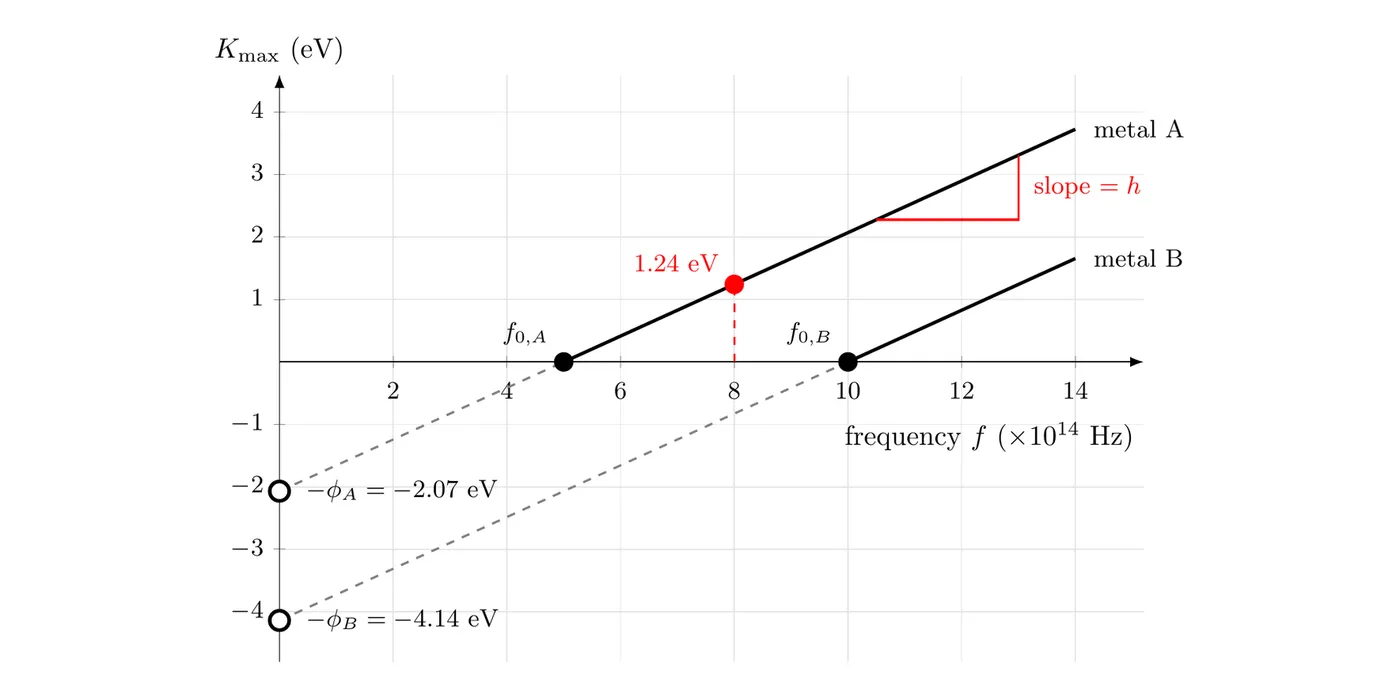
Example: the graph shows the results for two metals, A and B. (a) Find Planck’s constant from metal A’s line. (b) Find each metal’s work function. (c) Light with a frequency of Hz shines on both metals. Find and the stopping potential for each.
(a) Metal A’s line passes through 0 eV at Hz and through 2.07 eV at Hz:
That matches the equation sheet value of in eV·s.
(b) Use (or extend each line back to ):
- Metal A: eV
- Metal B: eV
(c) Metal A: Hz is above its threshold, so
In joules, that’s J. Since , an electron with 1.24 eV of kinetic energy is stopped by 1.24 V, so V. Metal B: Hz is below its threshold of Hz, so no electrons come out, no matter how bright the light is.
Answer: eV·s, eV, and eV. Metal A ejects electrons with eV ( V), and metal B ejects none.
Experimental Setup
A standard setup to show the effect and measure a metal’s work function looks like this: two metal plates in a vacuum chamber, connected to an adjustable voltage source, with one plate lit by monochromatic (single-frequency) light. The light ejects electrons from that plate, and you tune the voltage between the plates until no current flows in the circuit.
Stopping potential. The stopping potential () is the smallest reverse voltage that keeps every photoelectron from reaching the other plate. At that voltage:
Combining with the photoelectric equation:
That’s a straight line if you plot against : the slope is (so you can pull out Planck’s constant), the y-intercept is (so you get the work function), and the x-intercept is (the threshold frequency).
What you measure in the lab: with no opposing voltage, the current depends on how many electrons are ejected each second, so brighter light gives more current. As you raise the opposing voltage, the slower electrons get turned back and the current drops, until it reaches zero at . Brighter light of the same frequency gives more current but the same , because each photon still has the same energy. Higher-frequency light gives a bigger , because the fastest electrons have more kinetic energy.
Practice Problems
1. Light of frequency Hz hits a metal with a 2.0 eV work function. Find the maximum kinetic energy of the ejected electrons in both joules and electron volts.
2. Sodium’s work function is 2.28 eV. What’s its threshold frequency?
3. A metal has a threshold wavelength of 400 nm. What’s its work function?
4. In an experiment, 300 nm light produces electrons with a maximum kinetic energy of 1.5 eV. What’s the metal’s work function?
5. Why doesn’t bright red light (low frequency) eject electrons from zinc (work function 4.3 eV), while dim ultraviolet light (high frequency) does?
6. The stopping potential is measured at different frequencies. At Hz, V. At Hz, V. Find Planck’s constant and the work function.
7. Explain how the photoelectric effect shows that light is made of particles.
8. Light of wavelength 250 nm hits cesium (work function 2.1 eV). What’s the maximum speed of the ejected electrons? Use kg.
Solutions
1. Photon energy first:
In eV:
Work function in joules:
Maximum kinetic energy:
In eV, that’s eV. So J, or 0.49 eV.
2. At threshold, . Work function in joules:
The threshold frequency is Hz (green-yellow region).
3. At threshold wavelength, :
In eV:
The work function is J, or 3.11 eV.
4. Photon energy:
Then:
The work function is 2.64 eV.
5. Red light is low frequency, so even though it’s bright (lots of photons), each photon carries only about
which is well below zinc’s 4.3 eV work function. No single photon has enough energy, and brightness doesn’t help, since means no emission. UV light is high frequency. At 250 nm each photon carries about
which is above 4.3 eV, so each photon can eject an electron even though the light is dim. Photon energy depends on frequency (), not brightness, which is exactly the quantized, particle behavior of light.
6. The stopping potential relates to frequency by , so the slope of vs. is :
So , which gives:
Close to the accepted J·s. For the work function, use one data point:
So Planck’s constant is about J·s and the work function is 2.0 eV.
7. The photoelectric effect points to particles in a few ways. First, there’s a threshold frequency: emission depends on frequency, not brightness. Wave theory says any frequency should work at high enough intensity (wrong), while photon theory says each photon needs (right). Second, emission is instant: electrons come out immediately even in very dim light, whereas wave theory predicts a delay while energy builds up (wrong) and photon theory has a single photon-electron interaction (right). Third, electron energy is independent of brightness: brighter light gives more electrons but not more energetic ones, which wave theory can’t explain but photon theory nails, since more photons means more electrons each still carrying . Fourth, the -vs- graph is a straight line with slope , confirming quantitatively. Classical wave theory fails on threshold frequency, instant emission, and the intensity independence, while the photon model explains all of it.
8. Photon energy:
Work function in joules:
Maximum kinetic energy:
Then from :
The maximum speed is m/s, about 0.3% of the speed of light.
Common Mistakes
- Thinking brighter light means faster electrons. Brightness raises the number of photoelectrons, not their maximum energy. Energy comes from frequency: .
- Treating any frequency as good enough. Below threshold (), no electrons come out no matter how bright the light.
- Mixing up work function units. It can be joules or eV. Convert with 1 eV J.
- Forgetting to subtract the work function. Max KE isn’t , it’s . The work function energy goes into freeing the electron.
- Assuming every ejected electron has the same KE. Only surface electrons with no collisions reach . Others come out with less.
- Confusing stopping potential with kinetic energy. links them, but is in volts and is in joules or eV.
- Thinking wave theory explains it. Wave theory fails here. The photoelectric effect was key evidence for the photon nature of light.
- Misreading intensity. Intensity is power per unit area, not the energy of each photon. At the same frequency, more intensity means more photons per second, not more energetic ones.
- Thinking electrons soak up several photons. Each photoelectron is freed by one photon. It’s a one-photon, one-electron deal.
- Muddling wavelength and frequency effects. Shorter wavelength means higher frequency, higher photon energy, and higher-energy electrons (once above threshold).
- Losing the sign of the stopping potential. It’s applied in reverse to oppose the electrons. Use its magnitude for .
- Forgetting the threshold condition. If , the equation gives a negative KE, which just means no emission.
- Swapping slope and intercept. On the -vs- graph: slope is , x-intercept is , y-intercept is .
- Thinking classical physics predicts instant emission. Wave theory predicts a delay while energy accumulates. Instant emission supports the photon model.
- Flipping the threshold formula. It’s , not the other way around.
- Forgetting energy conservation. Photon energy = escape energy + electron kinetic energy. Too little photon energy and the electron can’t escape at all.
- Assuming every material has the same work function. It varies by atomic structure, which is why some materials give up electrons more easily.