

7.7 - Fission, Fusion, and Nuclear Decay
The Strong Nuclear Force
The strong force acts at nuclear scales and runs the show for nucleons (protons and neutrons). A nucleon is just a proton or neutron, one of the particles in the nucleus.
A few key properties: it’s very strong (about 100 times stronger than the electromagnetic force at nuclear distances), it’s short-range (it only reaches about m, roughly the size of a nucleus), it’s attractive (it binds nucleons together despite the electromagnetic repulsion between protons), and it’s charge-independent (it pulls equally on protons and neutrons). Without it, the electromagnetic repulsion between protons would blow apart every nucleus except hydrogen-1. The strong force overpowers that repulsion and keeps nuclei together.
Conservation Laws in Nuclear Reactions
Conservation of nucleon number. Every nuclear reaction has to conserve the total number of nucleons. The nucleon number (mass number, ) is the total protons plus neutrons, and:
The nucleons might rearrange or even switch type, but the total count stays fixed. For example:
Check it: . Note that the proton and neutron counts can each change (a proton can turn into a neutron or vice versa), but the total nucleon number holds.
Other conservation laws. Nuclear reactions also obey conservation of energy, mass-energy equivalence, and conservation of momentum. All told, the quantities conserved are energy (including rest-mass energy), momentum, electric charge, and nucleon number.
Mass-Energy Equivalence
In every nuclear reaction, mass and energy can trade places through mass-energy equivalence:
where:
- = energy equivalent (J)
- = mass (kg)
- = speed of light = m/s
Mass can turn into energy and energy can turn into mass. In a reaction, if the final mass is less than the initial mass, that lost mass came out as energy (kinetic energy or photons). If the final mass is more, energy went into making mass, which takes an energy input.
The mass defect () is the difference between the initial and final masses, and the energy released or absorbed is:
A positive means energy is released (exothermic), and a negative means energy is required (endothermic). A handy conversion: 1 atomic mass unit (u) kg MeV/.
Momentum in a decay. A nucleus sitting at rest has zero momentum, so after it splits into two pieces, their momenta must add to zero. The two pieces fly apart in opposite directions with momenta of equal size. Since , equal momenta mean the lighter piece gets most of the kinetic energy: .
Example: a radium-226 nucleus at rest alpha decays into radon-222. The atomic masses are 226.025410 u (Ra-226), 222.017578 u (Rn-222), and 4.002603 u (He-4). Find the energy released and how it’s shared.
First find the mass lost, then use with (the AP equation sheet rounds 931.5 to 931):
That’s J. The alpha particle and the radon nucleus share it: MeV and , so
Answer: the decay releases 4.87 MeV. The alpha particle carries 4.78 MeV of it, and the heavy radon nucleus recoils the opposite way with only 0.0862 MeV (86.2 keV), even though both have the same size momentum.
Energy Release
Nuclear processes can release energy as kinetic energy of the products or as photons. More specifically, it can show up as kinetic energy of the product nuclei and particles, gamma rays (high-energy photons), beta particles (electrons or positrons with kinetic energy), alpha particles (helium nuclei with kinetic energy), and neutrinos (nearly massless particles carrying energy). All of that energy ultimately comes from the mass defect converted through .
Binding Energy
The binding energy of a nucleus is the energy it takes to pull it completely apart into separate protons and neutrons. It’s also the energy released when those nucleons come together. Because of , a nucleus has less mass than the protons and neutrons that make it up, and the missing mass times is the binding energy.
Example: a helium-4 nucleus has a mass of 4.00151 u. A proton is 1.00728 u and a neutron is 1.00866 u. Find the binding energy.
Answer: the binding energy is 28.3 MeV. Spread over its 4 nucleons, that’s MeV per nucleon.
Binding energy per nucleon tells you how tightly each nucleon is held. The bigger it is, the more stable the nucleus. It rises steeply for light nuclei, peaks near iron-56 (about 8.8 MeV per nucleon), and slowly falls off for heavy nuclei:
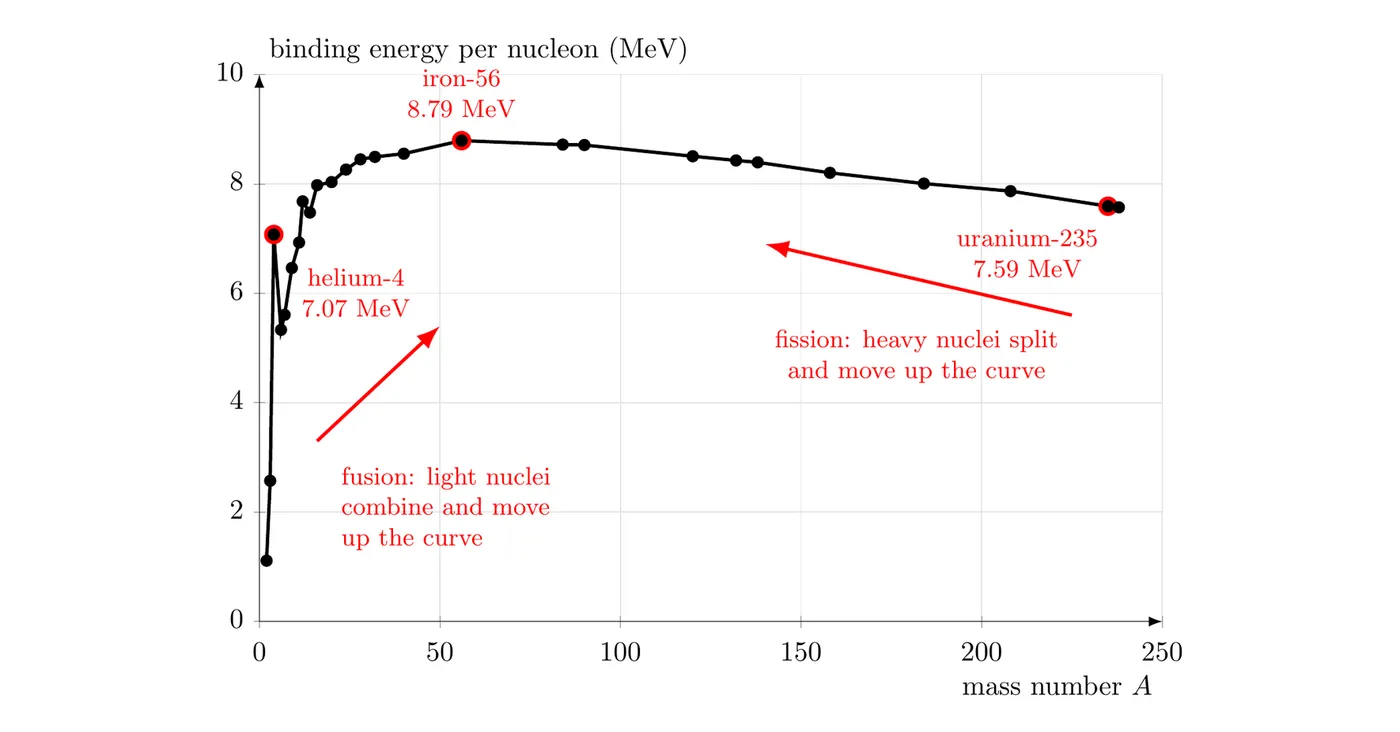
Any reaction that moves nuclei up this curve releases energy, because the products are more tightly bound than what you started with:
- Fusion: joining light nuclei (left side) makes a nucleus higher on the curve.
- Fission: splitting a heavy nucleus like uranium-235 (about 7.6 MeV per nucleon) makes middle-sized fragments like barium and krypton (about 8.3 to 8.5 MeV per nucleon).
- Iron sits at the top, so it can’t release energy by fusing or by splitting. That’s why fusion in a star’s core stops releasing energy once it reaches iron.
Nuclear Fusion
Nuclear fusion is when two or more smaller nuclei merge into a larger nucleus, along with some subatomic particles. In general:
A classic example is deuterium-tritium fusion, used in fusion reactors:
Fusion needs very high temperatures (millions of kelvin) to overcome the electromagnetic repulsion between nuclei, and it releases a lot of energy for light elements (up to iron). It powers stars, including the Sun, and it’s clean (no long-lived radioactive waste), but controlled fusion is hard to pull off on Earth. The energy comes from the fact that binding energy per nucleon goes up when light elements fuse.
Nuclear Fission
Nuclear fission is when a nucleus splits into two or more smaller nuclei, plus some subatomic particles. In general:
A common example is uranium-235 fission:
and many other fragment combinations are possible. Fission releases a lot of energy for heavy elements, produces radioactive waste, and can start chain reactions (the released neutrons trigger more fissions). It’s used in nuclear power plants and weapons, and its energy also comes from the mass defect.
The 173 MeV comes from the mass lost in this particular split, about 0.186 u. Different splits release slightly different amounts. Averaged over all of them, and counting the energy given off later as the radioactive fragments decay, one U-235 fission releases about 200 MeV.
Spontaneous vs. induced fission. Depending on a nucleus’s binding energy, fission can happen on its own or need an energy input. Spontaneous fission happens naturally with no trigger and is very rare for most nuclei (for example, Cf undergoes spontaneous fission). Induced fission needs the nucleus to absorb a neutron (or take in energy some other way) and is more common (for example, U fissions after absorbing a neutron, which supplies the activation energy). Fission favors heavy elements (past iron) because binding energy per nucleon drops off for very heavy nuclei.
Why fission can need an energy input. Splitting a heavy nucleus releases energy overall, but the nucleus has to stretch out before it can split, and stretching it takes energy first, like pushing a ball over a hill before it rolls down the other side. For some very heavy nuclei, like californium-252, that hill is low enough that every so often a nucleus splits on its own. For uranium-235 the hill is higher, so it almost never splits on its own, and the energy it gains by absorbing a neutron is what gets it over.
Radioactive Decay
Radioactive decay is the spontaneous transformation of a nucleus into one or more different nuclei. Unstable nuclei change on their own to reach a more stable state, releasing energy along the way.
Radioactive decay also includes a nucleus that stays the same element and just drops from an excited state to a lower energy level of the same nucleus, giving off the extra energy as a gamma-ray photon (gamma decay, Topic 7.8).
Randomness and probability. You can’t predict when any single nucleus will decay, but you can describe decay rates with probability. There’s a genuine quantum indeterminacy here: you can’t say when a specific nucleus will go, only the probability of decay per unit time, and for a large sample the statistics come out very accurate. The decay constant () is the probability of decay per nucleus per unit time.
Half-Life
The half-life () is the time for half of the radioactive nuclei in a sample to decay. After one half-life, ; after two, ; after three, ; and after half-lives:
Link to the decay constant:
where is the decay constant (s⁻¹), is the half-life (s), and .
Exponential Decay
Once you know the decay constant, you can predict how many nuclei are left after some time, or figure out a material’s age if you know how much you started with.
Exponential form:
Logarithmic form:
where is the number of radioactive nuclei at time , is the initial number, is the decay constant (s⁻¹), and is the elapsed time (s). The same equations work for activity (the decay rate), , and for mass, .
Reading decay graphs. A graph of against is a curve that drops by half every half-life, no matter where you start. Graphing against instead turns it into a straight line through the origin with slope , since . That’s how you get (and the half-life) from lab data: graph the natural log, draw a best-fit line, and use its slope.
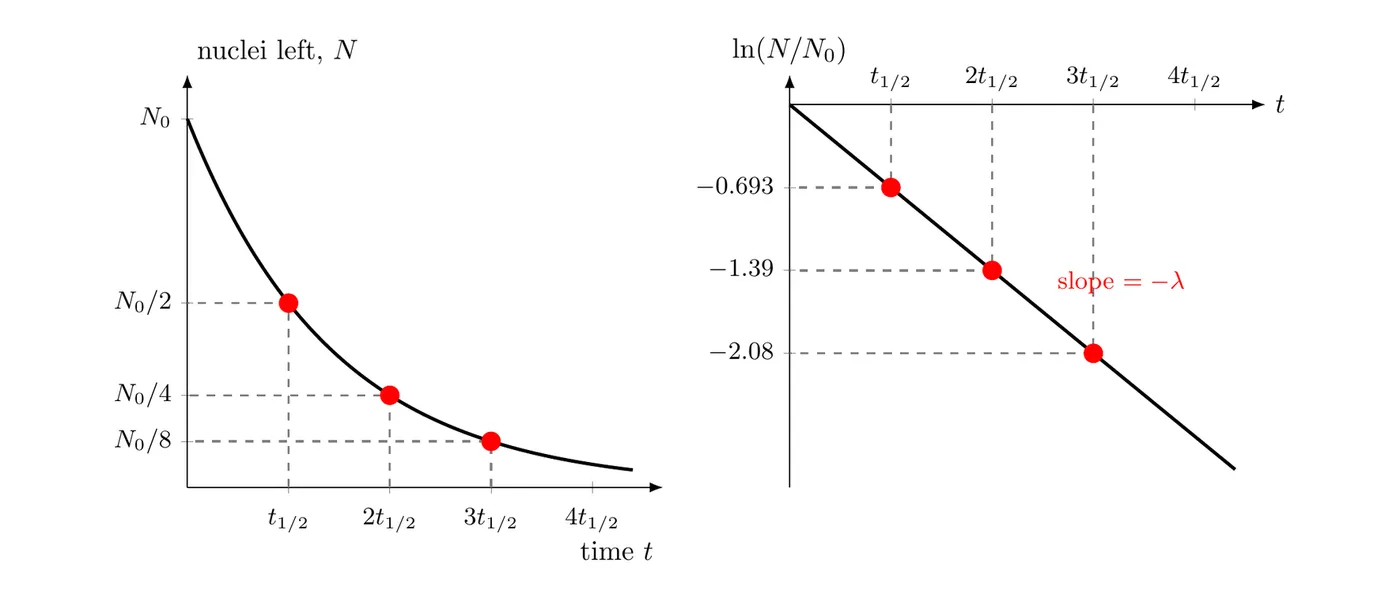
Each half-life lowers by , which is why the points on the right graph sit at , , and .
Example 1 (how many are left): iodine-131 has a half-life of 8.02 days. A sample starts with I-131 nuclei. How many are left after 30.0 days?
30.0 days isn’t a whole number of half-lives, so use the exponential form. Keep time in days so the units cancel (and keep an extra digit in ):
Answer: about nuclei are left, 7.48% of the original. Quick check: 30.0 days is about 3.74 half-lives, a bit less than 4, so a bit more than should be left.
Example 2 (how old): a wooden tool from an ancient site has 30.0% as much carbon-14 per gram of carbon as a living tree. Carbon-14’s half-life is 5730 years. How old is the tool?
Use the derived equation with :
Answer: the tool is about 9950 years old. Check: 30.0% is between 50% (one half-life) and 25% (two half-lives), so the age should be between 5730 and 11,460 years, and it is.
Range of Half-Lives
Different unstable isotopes have wildly different half-lives, anywhere from fractions of a second to billions of years. Polonium-214 has a half-life of 164 microseconds, iodine-131 about 8 days (used in medicine), carbon-14 about 5,730 years (used for dating), and uranium-238 about 4.5 billion years (the age of the Earth). That huge range reflects how differently stable various nuclei are.
Practice Problems
1. In the fusion reaction , the mass drops by 0.019 u. How much energy is released?
2. Carbon-14 has a half-life of 5,730 years. How long does it take for 75% of a sample to decay?
3. A sample starts with nuclei. After 10 days, remain. What’s the half-life?
4. An isotope has a decay constant of s⁻¹. What’s its half-life?
5. Why do fusion reactions need extreme temperatures while fission reactions don’t?
6. A sample starts with radioactive nuclei and has a half-life of 12 hours. How many remain after 36 hours?
7. In nuclear reactions, mass turns into energy. Does that break the law of conservation of mass?
8. Uranium-235 has a half-life of 700 million years. What fraction of the original amount is left after 2.1 billion years?
Solutions
1. Use with 1 u MeV:
17.7 MeV is released.
2. If 75% has decayed, then 25% remains, so . That’s two half-lives:
3. The number left is:
so three half-lives have passed:
4.
In minutes, that’s minutes. So the half-life is 277 s, or 4.6 minutes.
5. Fusion needs high temperatures because two positively charged nuclei have to get extremely close, and the electromagnetic repulsion between them is strong. It takes a lot of kinetic energy (high temperature) to punch through that Coulomb barrier and get the nuclei close enough for the attractive strong force to take over, so you’re looking at 10 to 100 million K. Fission doesn’t need high temperatures because a neutral neutron kicks it off, and a neutron has no charge to overcome. It slips right up to a heavy nucleus and gets absorbed, the compound nucleus becomes unstable, and it splits, all of which can happen at room temperature. So fusion has to beat electromagnetic repulsion between charged nuclei (needs heat) while fission is triggered by neutral neutrons (no Coulomb barrier).
6. 36 hours is 3 half-lives (since ). After half-lives, :
7. In nuclear reactions mass isn’t conserved in the old classical sense, since it can convert to energy via . But mass-energy together is conserved. The missing mass didn’t vanish, it turned into kinetic energy of the products or into photons (gamma rays). This is the relativistic law of conservation of mass-energy, which replaces the separate classical laws of conservation of mass and conservation of energy. So classical conservation of mass is broken, but the deeper mass-energy conservation law holds: mass converts to energy, and the total mass-energy stays constant.
8. The number of half-lives is:
so:
12.5% (or 1/8) of the original amount remains.
Common Mistakes
- Confusing fusion and fission. Fusion is light nuclei combining, fission is a heavy nucleus splitting. Fusion fuses things together, fission makes a fissure.
- Doing half-life the wrong way. After half-lives, , not . It’s exponential, not linear.
- Dropping the in . It’s , not . The is what turns a tiny mass into enormous energy.
- Wrong units for the decay constant. If the half-life is in years, either convert to seconds for or keep the units consistent throughout.
- Confusing nucleon number and mass number. They’re the same thing, = total protons plus neutrons.
- Thinking individual decays are predictable. You can’t say when one nucleus decays, only give probabilities and statistics for large samples.
- Getting the conservation laws wrong. Proton and neutron counts can each change (as in beta decay), but the total nucleon number is conserved.
- Ignoring the mass-energy trade. In nuclear reactions the mass changes are significant and must be accounted for, unlike chemical reactions where mass is roughly conserved.
- Using the wrong decay equation. It’s , not . Exponential, not linear.
- Mixing up ln and log. Natural log (ln) uses base . Common log (log) uses base 10. Nuclear decay uses ln: .
- Misreading binding energy. Higher binding energy per nucleon means more stable. Fusing light elements and splitting heavy ones both head toward the maximum binding energy per nucleon, around iron.
- Thinking all radioactive materials decay fast. Half-lives range from microseconds to billions of years.
- Forgetting the strong force is short-range. It only acts at nuclear distances (about m). Beyond that, electromagnetic repulsion wins.
- Wrong energy units. Nuclear energies are usually in MeV, not joules. 1 MeV J.
- Assuming fusion is easy. It releases energy but needs enormous temperature and pressure to start, which is why controlled fusion power is still tough.
- Confusing activity and number of nuclei. Activity (decays per second) decays exponentially just like , but they’re different quantities related by .
- Skipping the conservation checks. Always verify nucleon number, charge, energy (including mass), and momentum.
- Misreading the Q-value. . Positive Q is exothermic (energy released), negative Q is endothermic (energy required).