

6.3 - Induced Currents and Magnetic Forces
Magnetic Force on a Current-Carrying Loop
When an induced current runs through a conducting loop that’s sitting in a magnetic field, the loop feels a magnetic force.
Force on a Current in a Magnetic Field
For a straight segment of wire:
where:
- = magnetic force on the wire (N).
- = current through the wire (A).
- = length of the wire segment that’s in the field (m).
- = magnetic field strength (T).
- = angle between the wire and the field.
The key principle: the magnetic force only acts on the parts of the loop that are actually inside the external magnetic field.
These forces can speed the loop up or slow it down (translational acceleration). If they act along different lines, they can also make a torque and change how fast the loop spins (rotational acceleration). For example, the coil in a generator carries induced current, and the forces on its two long sides point in opposite directions. That makes a torque that opposes the spin, which is why a generator gets harder to turn when it’s delivering more current.
A Conducting Loop Moving Through a Field
A classic setup is dragging a rectangular conducting loop through a region of magnetic field.
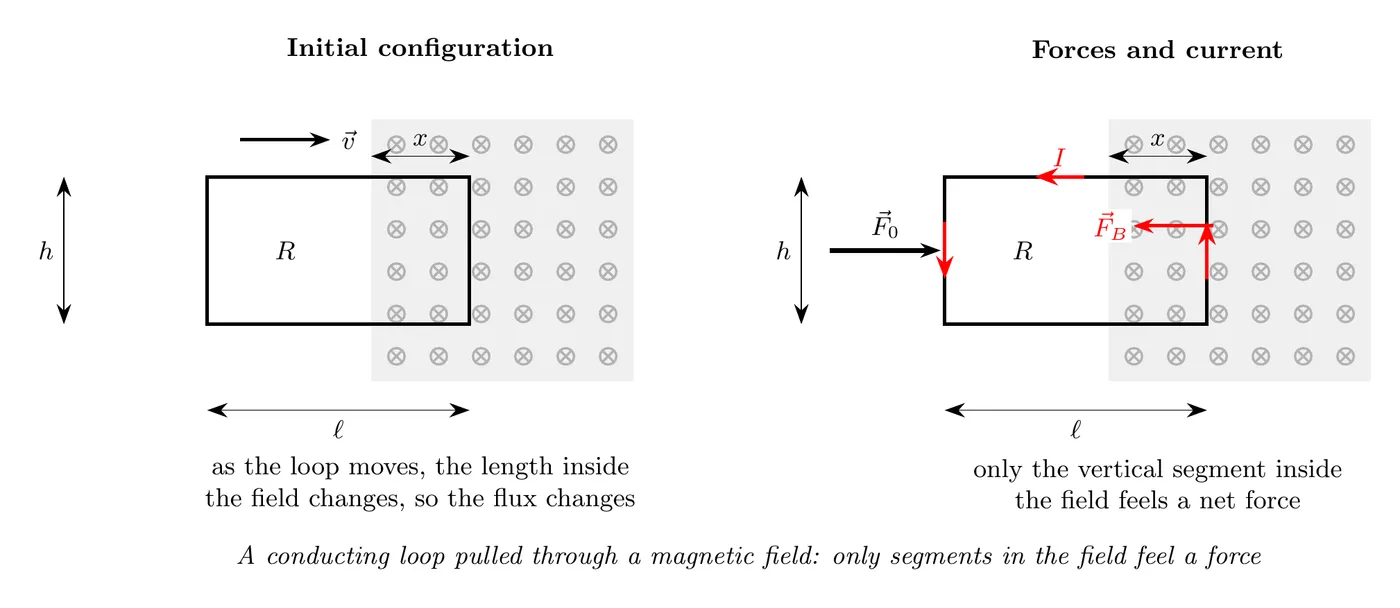
What’s happening as the loop moves:
- The amount of loop sitting inside the field keeps changing.
- That changes the magnetic flux through the loop.
- The changing flux induces an EMF and a current.
- The current-carrying segment inside the field then feels a force.
In the integral :
- Only the segment of length (the vertical edge in the field) contributes anything.
- So it collapses down to .
Motional EMF
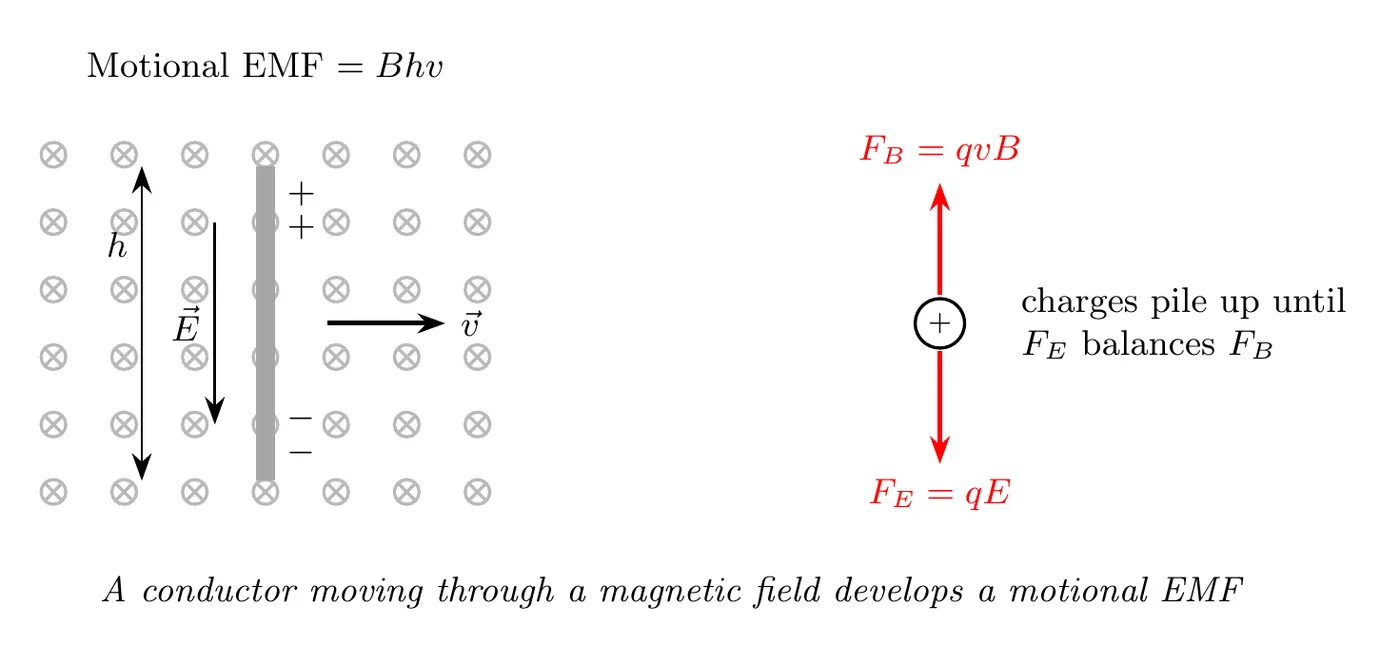
When a conductor moves through a magnetic field, you get an induced EMF even though the field itself never changes. That’s motional EMF.
The Formula
where:
- = motional EMF (V).
- = magnetic field strength (T).
- = length of conductor perpendicular to both and (m).
- = velocity of the conductor (m/s).
Where it comes from:
- As the conductor moves, the charge carriers inside it feel a magnetic force.
- That force shoves charges to one end, setting up a potential difference.
- The result is an EMF across the conductor.
For our rectangular loop:
where is the height of the loop, perpendicular to both the motion and the field.
Applying Newton’s Second Law
Newton’s Second Law works on conducting loops in magnetic fields just like anything else:
For motion at constant velocity:
so the applied force just matches the magnetic force:
That’s the hook you use to solve for velocity, force, or current.
Example Problem: Loop Pulled at Constant Velocity
Problem:
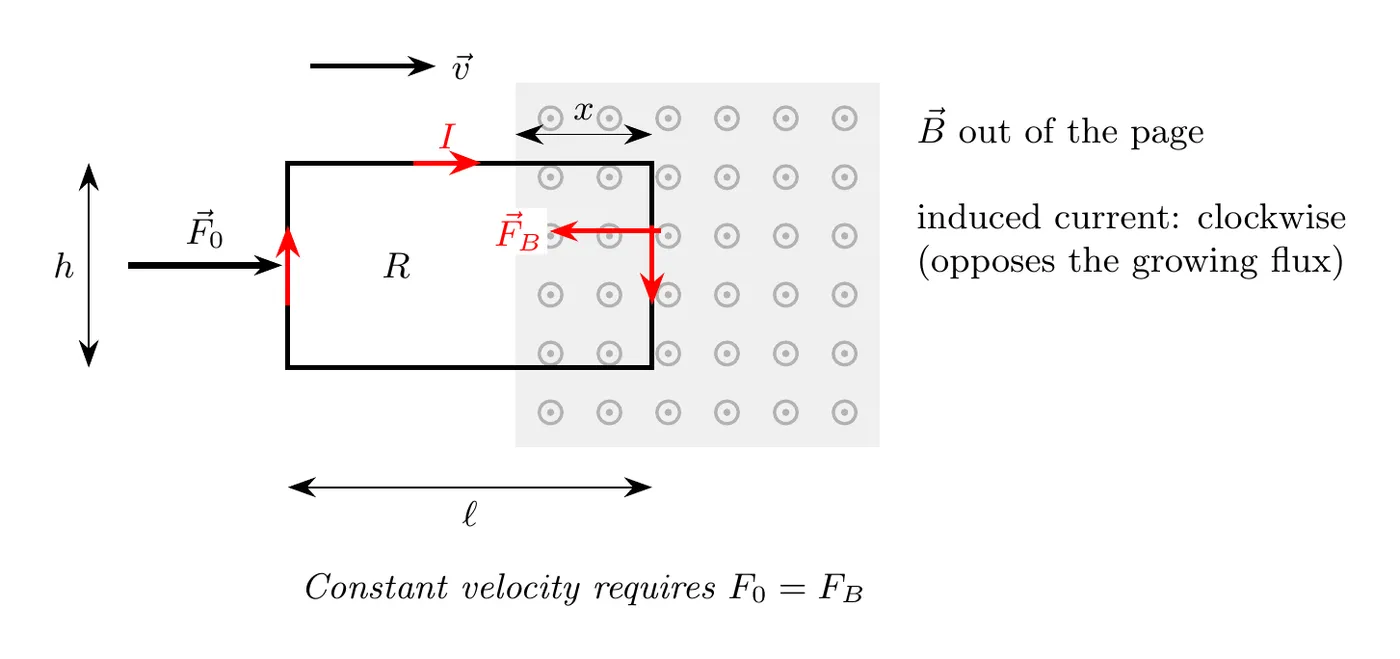
A rectangular loop of resistance sits partly inside a region of uniform magnetic field pointing out of the page. The loop’s height is and its length is . A constant force pulls it to the right, and it moves at a constant speed .
Derive an expression for in terms of the given quantities.
Solution
Step 1: force balance, since the velocity is constant
Constant velocity means zero acceleration, so:
Step 2: write the magnetic force
The force on the current-carrying segment of height inside the field:
Step 3: find the induced current with Faraday’s Law and Ohm’s Law
The induced EMF:
The flux through the loop:
where and is however much of the loop is inside the field.
As the loop slides along:
Take the time derivative:
But , the loop’s velocity, so:
which is exactly the motional EMF.
Step 4: get the current from Ohm’s Law
Step 5: substitute back into the force equation
Step 6: solve for the velocity
Answer:
What it tells you:
- A bigger applied force gives you more speed, which is what you’d expect.
- More resistance also gives more speed, since there’s less induced current fighting the motion.
- A stronger field means less speed, since the opposing force is stronger.
- A taller loop also means less speed, since you get more flux change and a stronger opposing force.
Energy Considerations
The applied force is doing work on the loop:
That power goes into two places:
1. Joule heating in the resistance: .
2. Kinetic energy, if the loop is speeding up.
For steady motion, every bit of the applied power ends up as heat:
We can double-check that with our result:
And:
They match. ✓ Energy is conserved.
When the Speed Isn’t Constant
The magnetic force on the loop is proportional to the induced current, and that current depends on how fast the flux changes and on the resistance. For the loop above:
So the force grows with speed, the way a drag force does, and a bigger resistance makes it weaker. Since depends on , the acceleration changes as the loop speeds up or slows down. That calls for Newton’s Second Law as a differential equation.
Starting from rest: suppose starts pulling the loop from rest, and the loop is long enough that its back edge stays outside the field. Taking right as positive:
Separate the variables and integrate from at :
The speed climbs toward , the constant speed from the example above. That’s the terminal speed: the loop speeds up until the magnetic force grows to match .
Example Problem: A Bar Coasting on Rails
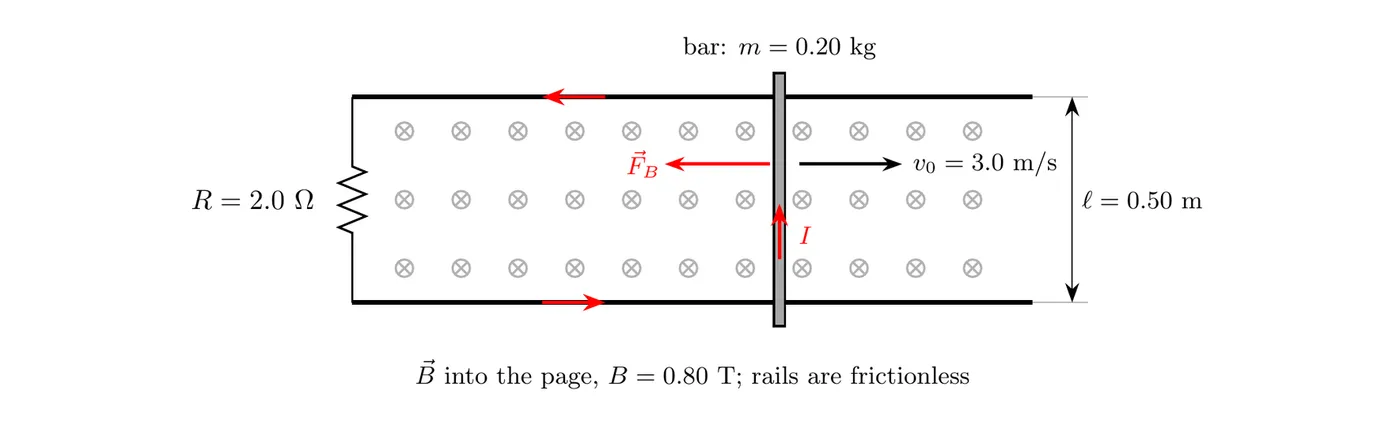
Problem: A metal bar ( kg) slides without friction on two parallel rails 0.50 m apart. A 2.0 Ω resistor connects the rails at one end, and the rails and bar have negligible resistance. A uniform 0.80 T field points into the page. The bar is moving away from the resistor at m/s when nothing is pushing it anymore.
- Find the induced current and the magnetic force on the bar at that moment.
- Find the bar’s speed as a function of time.
- How far does the bar slide before it stops, and how much thermal energy does the resistor produce?
Solution
(a) Current and force at the start
Direction: the loop made by the bar, the rails, and the resistor is getting bigger, so the flux into the page is increasing. The induced current runs counterclockwise, which is up through the bar in the figure. The force on that current, , points back toward the resistor, opposite to the motion. The bar starts out slowing down at .
(b) Speed as a function of time
The only horizontal force is the magnetic force, and it points opposite to :
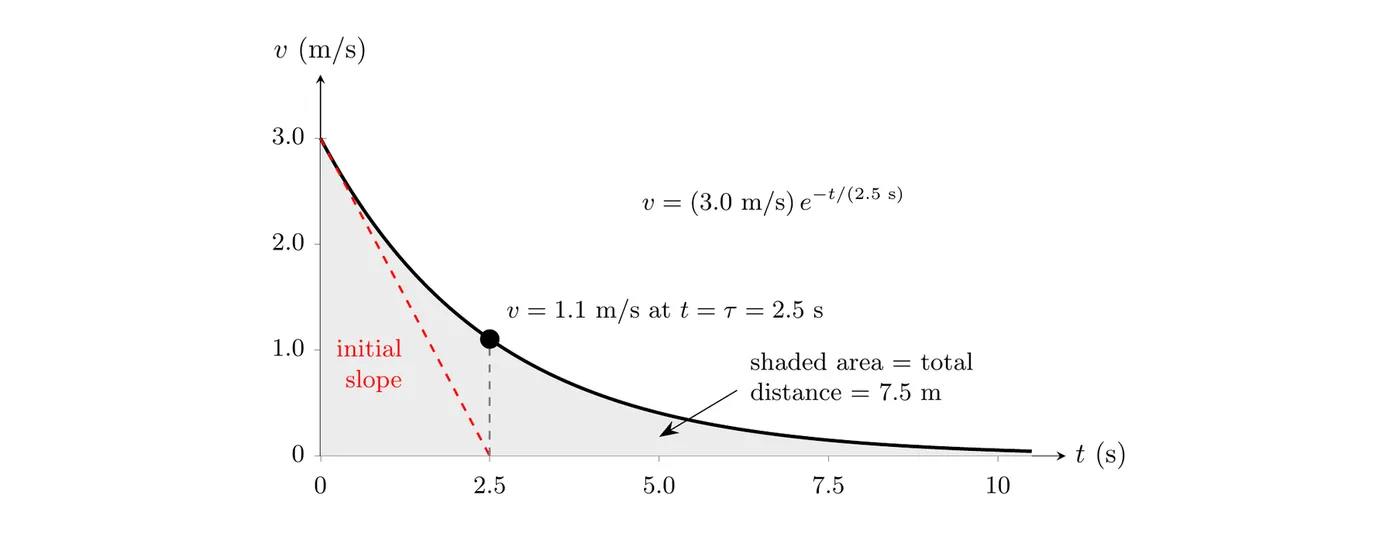
So . After one time constant (2.5 s), the bar is down to m/s.
(c) Distance and thermal energy
The distance is the area under the vs. graph:
All of the bar’s kinetic energy ends up as thermal energy in the resistor:
What it tells you: in theory the bar never quite stops, but it gets as close as you like to 7.5 m. It slows fastest at the start, when it’s moving fastest and the opposing force is biggest. That’s the same exponential math as an RC or LR circuit, with as the time constant.
Variations on This Problem
This problem shows up in a few different costumes on the AP exam.
1. Loop on a Cart
- A conducting loop mounted on a rolling cart.
- The cart rolls through a magnetic field region.
- You analyze the forces, acceleration, and velocity.
2. Sliding Bar on Rails
- A conducting bar slides along parallel conducting rails.
- The magnetic field is perpendicular to the plane.
- The bar completes the circuit, which makes a loop.
- Same analysis applies.
3. Rotating Loop in a Field
- The loop spins in a magnetic field.
- The flux changes because the angle changes: .
- This is exactly how AC generators work.
4. Expanding or Contracting Loop
- The loop’s area changes while it sits in a uniform field.
- The flux changes because the area changes.
- Same kind of EMF and force calculations.
The common thread: in every version, changing flux induces an EMF, which drives a current, which then feels a force in the magnetic field.
Graphs for a Loop Passing Through a Field
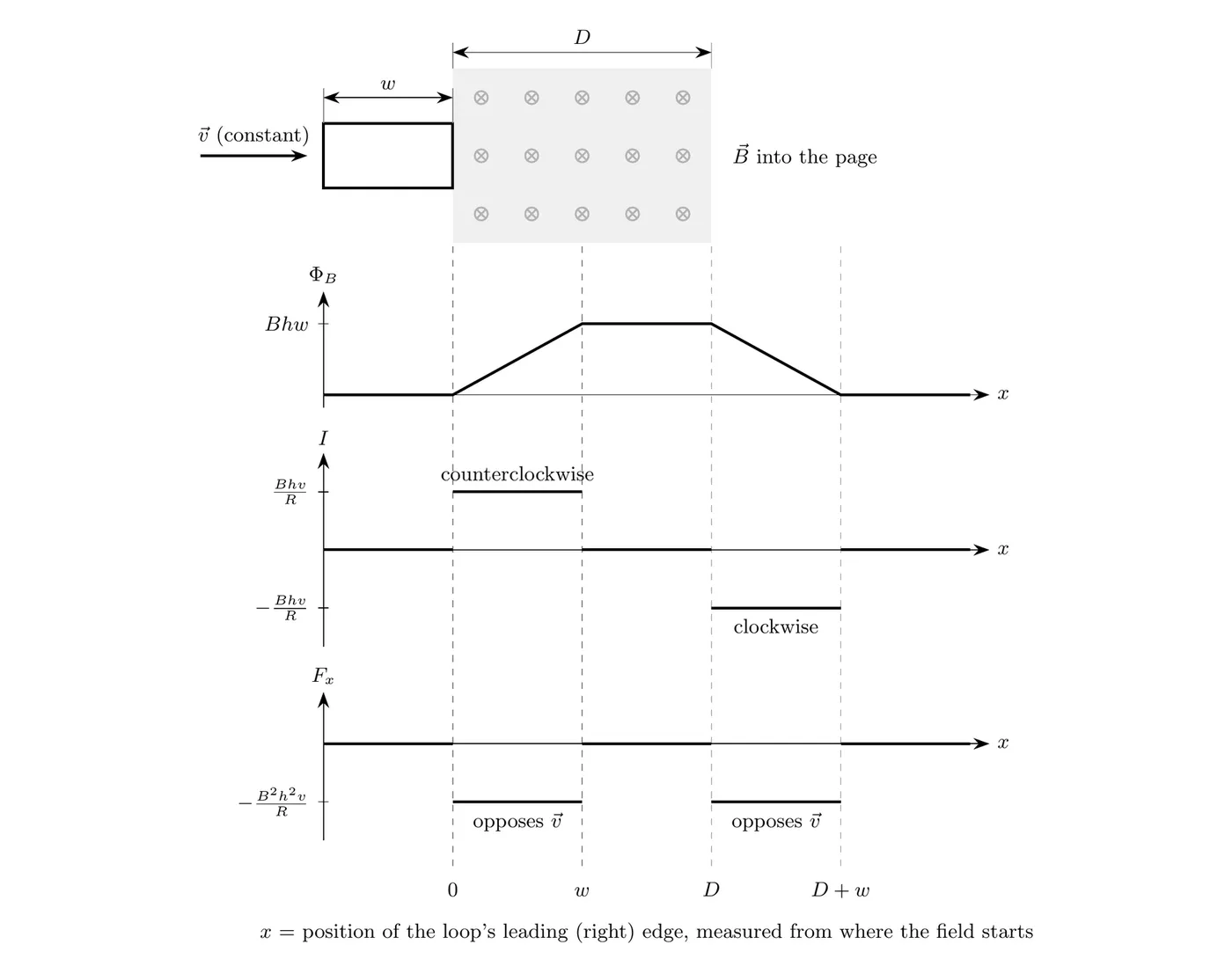
A common AP question: a loop of width and height moves at constant speed all the way through a field region of width (wider than the loop). Sketch the flux, the current, and the force as the loop moves.
Breaking it down:
- Entering (): the flux into the page grows steadily, so there’s a steady counterclockwise current . Only the leading edge is in the field, and the force on it points opposite to .
- All the way in (): the flux is constant, so there’s no current and no force, even though the loop is sitting in a strong field.
- Leaving (): the flux shrinks, so the current reverses (clockwise). Now only the trailing edge is in the field, and the force on it still points opposite to .
- Out (): no field, no flux, no current.
The force opposes the motion both on the way in and on the way out. To keep the speed constant, something has to push the loop during those two stretches.
Summary of Key Formulas
Magnetic Force on a Current
For a segment perpendicular to the field:
Motional EMF
Induced Current
Force Balance (Constant Velocity)
Velocity from the Force Balance
Problem-Solving Strategy
Step 1: find what’s changing the flux.
- What’s moving? What’s changing?
- How does change?
Step 2: apply Faraday’s Law.
Step 3: get the induced current.
Step 4: get the magnetic force on that current.
(Only on the segments that are actually in the field.)
Step 5: apply Newton’s Second Law.
For constant velocity, that’s just .
Step 6: solve for whatever you’re after.
Common Mistakes
- Using the whole loop length instead of just the segment in the field. Only the part of the conductor that’s actually inside the field region feels a magnetic force. Don’t plug in the total loop length when only a piece of it is in the field.
- Forgetting that dℓ changes as the loop moves. In the integral , the length of wire inside the field is changing with time. At any given instant, though, you use the current length for the force calculation.
- Getting the Lenz’s Law direction wrong. The induced current makes a magnetic force that fights the motion causing the flux change. If you’re dragging the loop to the right, the magnetic force should point left.
- Treating motional EMF as something separate. Motional EMF () is just a special case of Faraday’s Law where the flux changes because something’s moving rather than because the field is changing. Same physics underneath.
- Not spotting that dx/dt = v in flux calculations. When the loop moves at velocity and the flux depends on position , remember . That’s what connects the spatial change to the time change.