

6.1 - Magnetic Flux
Introduction to Magnetic Flux
Magnetic flux measures how much magnetic field passes through a given area. It’s analogous to electric flux, just with magnetic fields instead of electric ones.
Its purpose: to quantify how much magnetic field “flows through” or penetrates a surface.
Definition of Magnetic Flux
For a uniform magnetic field passing through a flat surface:
That’s a dot product (a scalar product), so it gives a scalar result.
Expanded Form
where:
- = magnetic flux (Wb, webers)
- = magnitude of the magnetic field (T, tesla)
- = area of the surface (m²)
- = angle between and , the area vector
Important: the area vector is perpendicular to the surface, pointing in the outward normal direction.
For a closed surface (a box, a sphere, a closed cylinder), always points outward. A flat loop isn’t closed, so it has two possible normals, one on each side, and you pick one. That choice decides which sign of flux counts as positive. The usual way to pick: curl the fingers of your right hand in the direction you’ll call positive around the loop, and your thumb points along . Topic 6.2 uses this same choice to get the direction of the induced EMF from its sign.
Units:
Understanding the Angle θ
The angle is measured between the magnetic field vector and the area vector (which is perpendicular to the surface), NOT between the field and the surface itself.
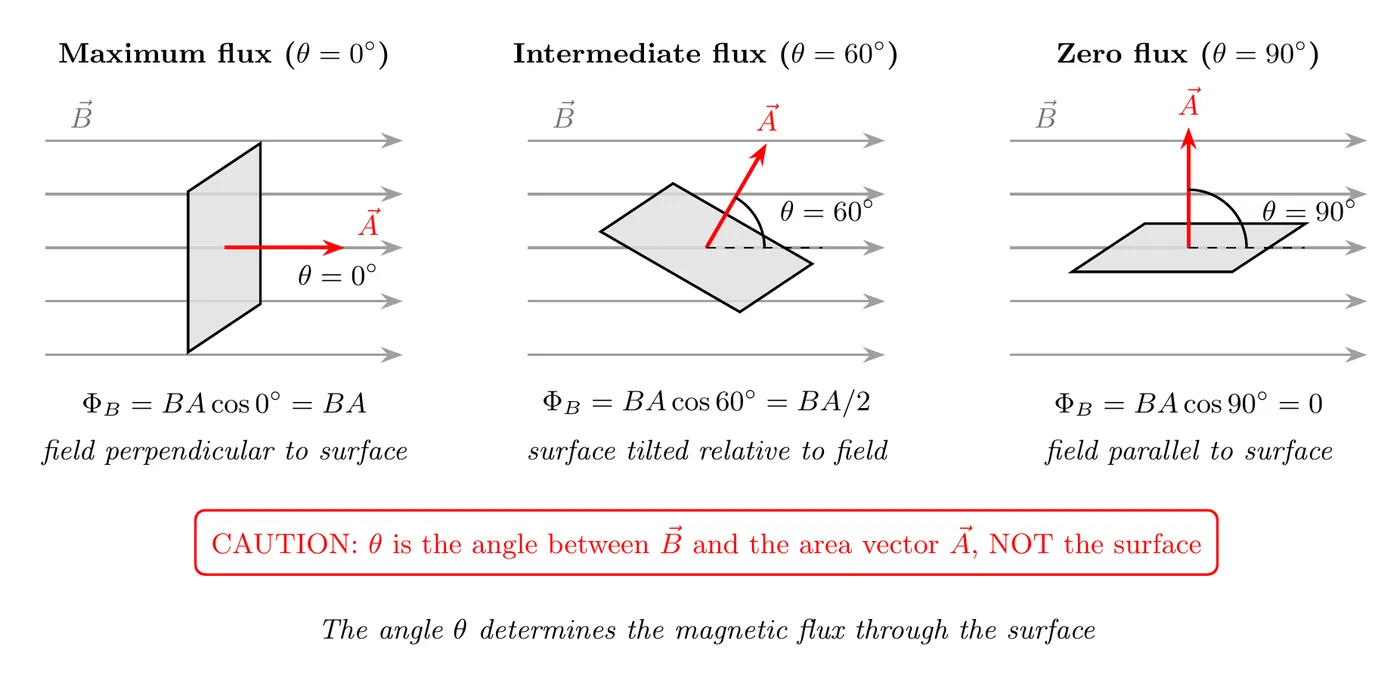
A critical distinction:
- If the problem gives you the angle between the field and the surface plane, you have to convert:
-
- If it gives you the angle between the field and the area vector, use that angle directly.
Special Cases
Maximum flux ():
The field is perpendicular to the surface, so parallel to the area vector.
No flux ():
The field is parallel to the surface, so perpendicular to the area vector.
The General Definition: A Surface Integral
For non-uniform fields or curved surfaces, magnetic flux requires integration:
This integral sums the flux contributions through infinitesimal area elements across the whole surface.
Simplification for AP Physics C
For most problems at this level, the field is uniform and the surface is flat, so:
When you actually need integration:
- The field strength varies across the surface.
- The surface is curved.
- There are multiple surfaces at different angles.
Example: Flux from a Long Straight Wire
Problem: A long straight wire carries a steady current of 20 A. A rectangular loop sits in the same plane as the wire, with its long sides parallel to the wire. Each long side is m long, the near side is 0.050 m from the wire, and the far side is 0.15 m from the wire. Find the magnetic flux through the loop.
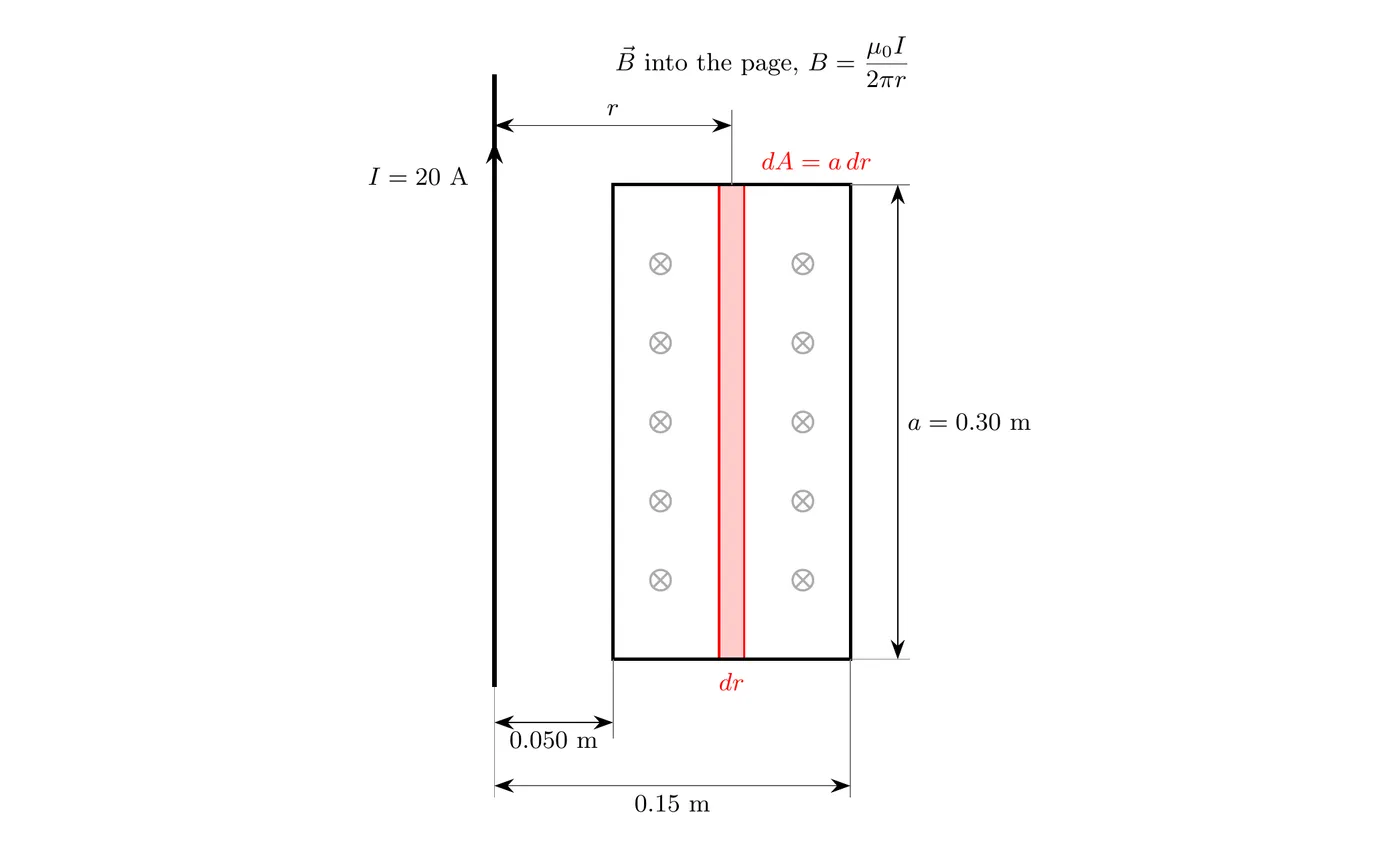
Step 1: the field isn’t uniform
The wire’s field is (topic 5.4), so it’s 3 times stronger at the near side (0.050 m) than at the far side (0.15 m). One value of won’t work for the whole loop, so set up the integral.
Step 2: slice the loop into thin strips
Take a strip at distance from the wire, with width and length . Its area is , and the field is the same everywhere along the strip. To the right of a wire with current going up, points into the page, perpendicular to the loop. Choose into the page too, so and:
Step 3: add up the strips
Step 4: plug in the numbers
Answer: Wb. If you had used the field at the middle of the loop (0.10 m from the wire) times the area, you’d get Wb, about 9% too low. The field rises steeply near the wire, so the near half of the loop holds more flux than the middle value suggests.
The Sign of Magnetic Flux
The dot product hands you the sign automatically.
Positive flux ():
- The field and area vector point in generally the same direction ().
- The field has a component pointing “outward” through the surface.
Negative flux ():
- The field and area vector point in generally opposite directions ().
- The field has a component pointing “inward” through the surface.
Zero flux ():
- The field is parallel to the surface ().
- No field component passes through the surface.
Area Calculations
Magnetic flux depends on the geometry of the surface:
Shape | Area Formula |
Rectangle | |
Square | |
Circle | |
Triangle | |
Cylinder (curved surface) | |
Sphere (surface) |
Important: use the correct area for the surface the field is actually passing through.
Example Problem: Magnetic Flux Through a Tilted Loop
Problem: A magnetic field of magnitude 4.0 T is directed at an angle of 30° to the plane of a rectangular loop with area 5.0 m². Calculate the magnetic flux through the loop.
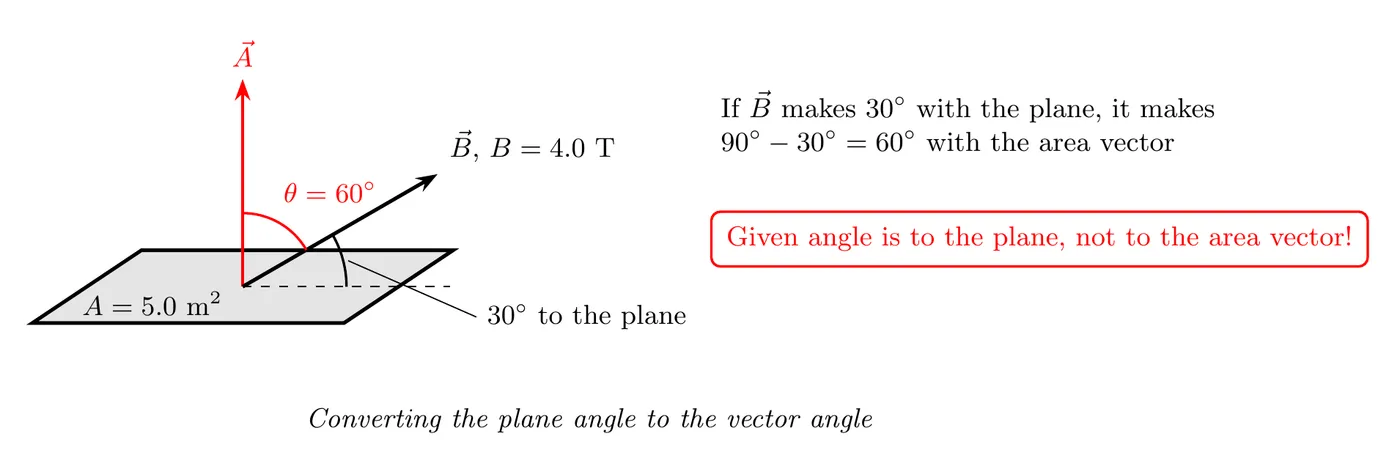
Solution
Step 1: Identify the correct angle
The problem says the field is at 30° to the plane of the loop.
The area vector is perpendicular to the plane.
So the angle between and is:
Alternatively, use instead of , since they’re equal:
Step 2: Apply the magnetic flux formula
Answer: the magnetic flux through the loop is 10 Wb (webers).
The key insight: always check whether the given angle is
- between the field and the area vector (use it directly in ), or
- between the field and the surface plane (convert with ).
Comparison: Electric Flux vs. Magnetic Flux
Both types of flux follow the same mathematical structure.
Property | Electric Flux | Magnetic Flux |
Symbol | ||
Formula | ||
Magnitude | ||
Units | N·m²/C or V·m | T·m² or Wb |
Gauss’s Law |
The key difference in Gauss’s Law:
- Electric flux through a closed surface depends on the enclosed charge.
- Magnetic flux through a closed surface is always zero, because there are no magnetic monopoles.
Example: Flux Through a Closed Surface
Problem: A closed cylinder (radius 0.10 m) sits in a uniform field T that points along the cylinder’s axis. Find the flux through each end, through the curved side, and in total.
Solution: for a closed surface, every area vector points outward.
- End where the field enters: points outward, opposite to , so and Wb.
- End where the field leaves: points outward, along , so Wb.
- Curved side: runs parallel to the surface, so and .
Answer: the total is , just like Gauss’s Law for magnetism says. Every field line that goes in comes back out.
Physical Interpretation
What does magnetic flux actually represent? Think of it as measuring:
- How many magnetic field lines pass through the surface.
- The “amount” of magnetic field penetrating the area.
- How effectively the field interacts with the surface.
Factors that increase flux:
- A stronger magnetic field (larger ).
- A larger area (larger ).
- Better alignment (a smaller , closer to perpendicular).
Factors that decrease flux:
- A weaker field.
- A smaller area.
- Worse alignment (a larger , closer to parallel).
Connection to Electromagnetic Induction
Magnetic flux is the foundation of Faraday’s Law of Induction, which says that a changing magnetic flux induces an electromotive force (a voltage):
That’s the basis for:
- Electric generators.
- Transformers.
- Inductors.
- Wireless charging.
- Electromagnetic braking.
A preview: when the magnetic flux through a wire loop changes (by changing , , or ), it induces a current in the loop. That’s electromagnetic induction, and it’s the next topic.
Summary of Key Formulas
Magnetic flux:
Units:
Maximum flux:
Zero flux:
Problem-Solving Strategy
Step 1: Identify the given quantities
- Magnetic field strength .
- Area , which you may need to calculate from the dimensions.
- Angle , and be careful about which angle it is.
Step 2: Determine the correct angle
- Is it the angle between the field and the area vector? Use it directly.
- Is it the angle between the field and the surface plane? Convert with .
Step 3: Apply the formula
Step 4: Check your units
- in tesla (T).
- in square meters (m²).
- Result in webers (Wb).
Common Mistakes
- Using the wrong angle. This is the most common error. If the problem gives you the angle between the field and the plane (30° in the example), you have to convert to get the angle between the field and the area vector (60° in the example). Always ask: is this angle between B and A, or between B and the surface?
- Forgetting cos θ when it isn’t perpendicular. A lot of students write even when the field isn’t perpendicular to the surface. Only use when .
- Confusing electric flux with magnetic flux. The formulas look similar, but the symbols are different ( versus ) and they involve different fields ( versus ). Don’t mix them up in equations.
- Using the wrong area formula. Make sure the area formula matches the geometry. A circular loop uses , not (the circumference) or (a sphere’s surface).
- Unit conversion errors. If the area comes in cm², convert to m² before calculating. If the field comes in gauss, convert to tesla (1 T = 10,000 G). Mixing units gives you the wrong number.