

2.1 - Systems and Center of Mass
Defining Systems
A system is defined by the interactions between the objects inside it. Those internal interactions determine the system’s properties.
If the internal properties or interactions don’t matter for modeling how the system behaves, then you can treat the system as a single object.
For example, a car driving on a road gets treated as a single object. You don’t break it down into tires, seats, engine parts, and so on. The car itself is the system.
What’s Inside a System Matters
Properties come from the inside. A system’s properties, like its total mass, where its center of mass sits, and how it responds to an outside push, are set by the objects inside it and the forces between them. A train of three cars linked by couplings speeds up as one unit because the couplings (internal interactions) pull each car along with the others.
Parts can move differently from the whole. The objects inside a system don’t have to move the same way as each other, or the same way as the system as a whole. When a firework shell bursts in midair, the pieces fly off in every direction, but (ignoring air resistance) the center of mass of all the pieces keeps following the same parabola the shell was on.
Internal structure changes the analysis. Two carts with the same total mass roll into a wall. One carries a heavy block bolted to its deck, the other an open tub of water. When the carts stop suddenly, the block stops with its cart, so that cart can be treated as one object. The water sloshes forward and splashes over the side, so its mass moves relative to its cart, and that cart can’t be treated as one rigid object anymore. Same mass, different insides, different analysis.
Outside changes can change the inside. As something outside a system changes, the system’s substructure can change too. A block of ice slides across a table as one rigid object. Warm the room (an outside variable) and the ice melts into a puddle: the same molecules, but now the system flows and spreads instead of moving as one piece.
Types of Systems
Systems are classified by what can cross their boundaries:
System Type | Energy Transfer | Mass Transfer |
Open | Yes | Yes |
Closed | Yes | No |
Isolated | No | No |
- Open systems let both energy and mass transfer freely with the environment.
- Closed systems let energy transfer but not mass.
- Isolated systems have no transfer of energy or mass with the environment.
Where you draw the boundary decides what counts as a transfer. Interactions between a system and its environment (everything outside the boundary) can move energy or mass across the boundary. A rocket is an open system: it loses mass every second as exhaust leaves the nozzle. When you push a cart across the floor, your hand is outside the cart system, so your push transfers energy into it. Draw the boundary around you and the cart together, and that same push becomes an internal interaction that just moves energy around inside the system. This idea comes back a lot in Unit 3.
Center of Mass: Discrete Objects
For objects or systems with a discrete mass distribution, you find the center of mass with:
where:
- = mass of individual object
- = position of object (positive or negative relative to the origin)
- = total mass of the system =
The same formula works for the y and z directions:
The AP equation sheet writes this in vector form, . The arrow is shorthand: do the , , and directions one at a time, each with its own signed positions.
Shortcut: Lines of Symmetry
If an object’s mass is spread out symmetrically, its center of mass lies on every line of symmetry. When there are two or more lines of symmetry, the center of mass is where they cross, so you can often find it with no math at all:
- Uniform rod: at its midpoint.
- Uniform rectangle, disk, or sphere: at its geometric center.
- Uniform ring (like a hula hoop): at the center of the ring, where there’s no mass at all. The center of mass doesn’t have to be on the object.
For a shape made of simple pieces (like an L-shaped bracket), find each piece’s center of mass by symmetry, treat each piece as a point mass sitting there, then use the discrete formula.
Example: Three Masses in a Plane
Problem: three small balls sit on a flat sheet: 2.0 kg at , 3.0 kg at , and 5.0 kg at . Find the center of mass.
Total mass: kg.
Answer: the center of mass is at . That’s closer to the 5.0 kg ball than the triangle’s geometric center, , because that ball carries half the system’s mass.
Center of Mass: Continuous Objects
For non-uniform continuous objects, you need calculus. The center of mass is:
where:
- = an infinitesimal mass element
- = total mass of the object
- The integral runs over the whole object.
The AP equation sheet writes this as
The bottom, , adds up every mass element, so it’s just the total mass . The means you do each direction separately: , , and so on.
The idea: break the continuous object into infinitely small pieces, each with mass at position from a reference point, add up all the contributions, and divide by the total mass.
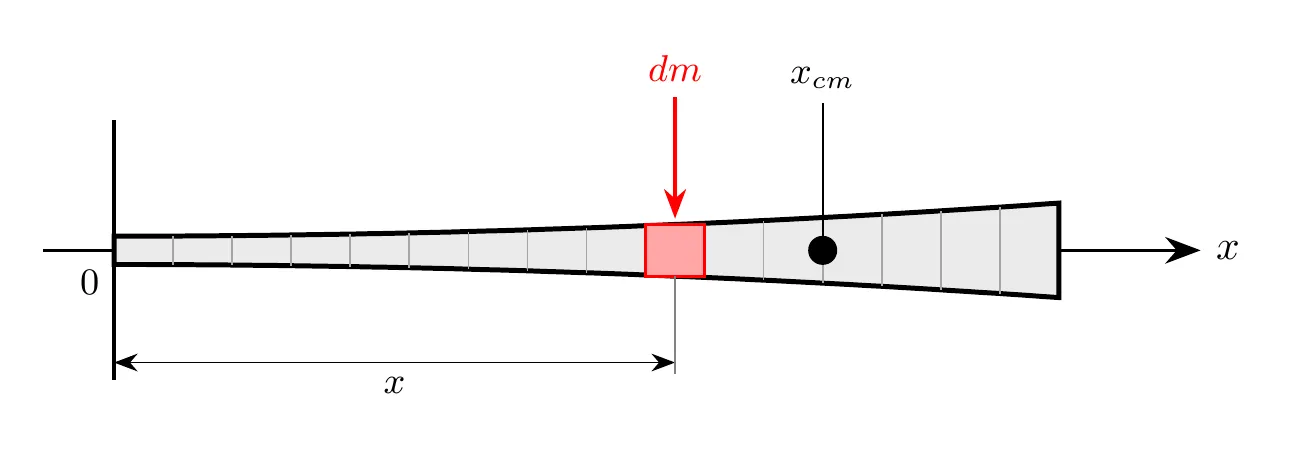
Modeling a System
You can model a system as a single object sitting at the system’s center of mass. This simplification is really useful for analyzing the motion of complex systems.
Important Property: Center of Mass Stays Put
A system’s center of mass keeps the same velocity unless a net external force acts on it. So if the center of mass starts at rest, it stays put. The objects inside the system can still move, redistributing mass internally, but the center of mass holds its position.
A classic example is a person walking on a boat.
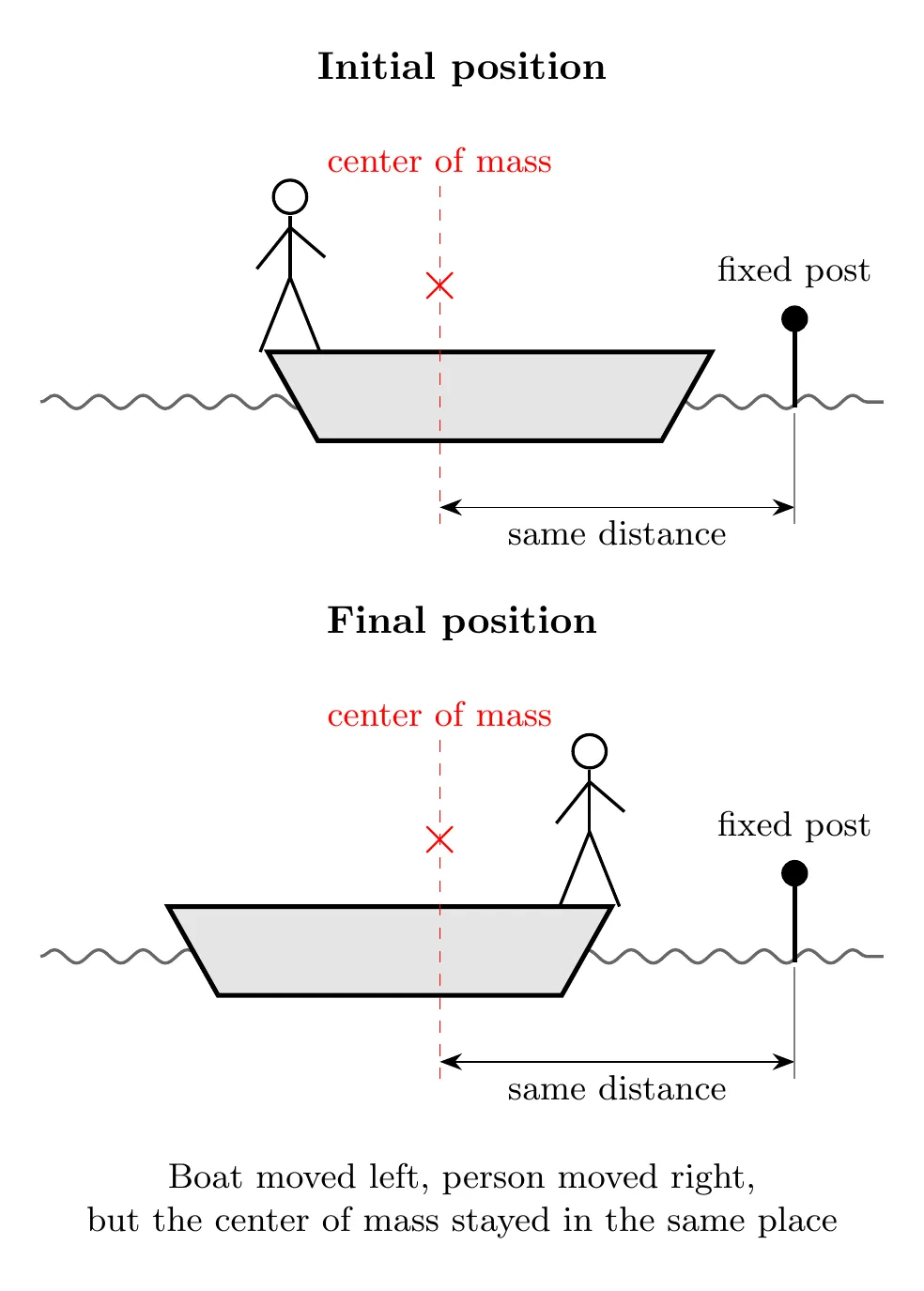
When the person walks to the right on the boat, the boat slides to the left, but the center of mass of the person-and-boat system stays in the same place (assuming no external horizontal forces).
Center of Mass of Physical Objects
For non-uniform objects like a baseball bat, the center of mass sits closer to the region with more mass.
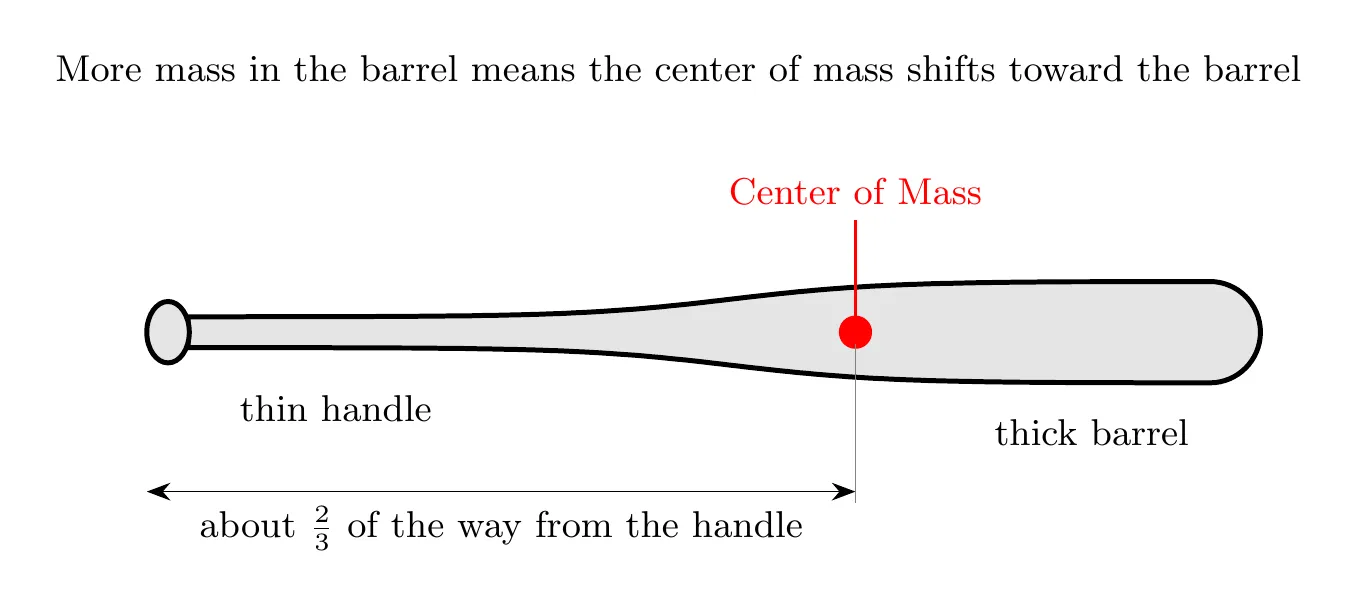
The handle is thin (less mass per unit length) while the barrel is thick (more mass per unit length), so the center of mass sits closer to the barrel.
Example Problem: Non-Uniform Rod
Problem:
A rod of length has a non-uniform linear mass density given by:
where:
- is the linear mass density (mass per unit length)
- is a constant with units of mass
- is the distance from the left end of the rod
- The left end of the rod is at
Find the horizontal location of the center of mass of the rod. Express your answer in terms of .
Solution
Step 1: Understand linear mass density
Linear mass density is:
Rearranging gives the infinitesimal mass element:
Step 2: Write the center of mass integral
The center of mass formula for a continuous object:
Substitute :
Step 3: Substitute the given function
With :
Step 4: Set the integration limits
The rod runs from to :
Step 5: Pull out the constants
Step 6: Integrate with the power rule
Step 7: Express in terms of L only
You need in terms of and . The total mass is:
Step 8: Substitute back
Answer: the center of mass is at .
The read: since the mass density grows as , there’s more mass toward the right end of the rod. So the center of mass sits to the right of the geometric center (), specifically at three-quarters of the length.
Key Relationships for Linear Mass Density
For objects with linear mass density :
The equation sheet’s version of the density definition is : if you know , the mass of the first meters of the rod, its derivative gives the linear mass density.
Example: Density From a Mass Function
Problem: for a rod 1.5 m long, the mass between the left end and a point meters from it is . Find the rod’s linear mass density, its total mass, and its center of mass.
Answer: kg/m, kg, and m from the left end. That’s two-thirds of the way along, past the middle, because the density grows toward the right end.
Area and Volume Densities
The same idea works in two and three dimensions. If a flat plate has an area density (mass per area, kg/m²) or a solid has a volume density (mass per volume, kg/m³), you get the total mass by integrating the density over the whole area or volume:
For a sphere whose density depends only on the distance from the center, slice it into thin spherical shells. A shell of radius and thickness has volume .
Example: a solid ball of radius m has density , with kg/m³, so it’s densest at the surface. Find its mass.
By symmetry, this ball’s center of mass is still at its center, even though the density changes, because the mass is spread the same way in every direction out from the center.
Common Mistakes
- Forgetting the signs on positions. In , positions can be negative if they’re on the other side of the origin. Don’t use absolute values.
- Confusing with . The mass element is not the same as the length element . They’re linked by the mass density: .
- Not finding the total mass correctly. For continuous objects, you have to integrate the mass density over the whole object to get : .
- Forgetting the integration limits. Always identify your limits. For a rod from to , the limits are 0 and .
- Assuming the center of mass is at the geometric center. For non-uniform objects, it isn’t. It shifts toward the region with more mass.
- Thinking internal motion moves the center of mass. In an isolated system, internal rearrangements (like a person walking on a boat) don’t change the center of mass. Only external forces can move it.
- Not pulling constants out of integrals. Constants like should be factored out of the integral to make the calculation simpler.
- Not evaluating the limits properly. With a lower limit of 0, terms like . Don’t forget to subtract the lower-limit value, even when it’s zero.