

6.1 - Rotational Kinetic Energy
Introduction: Energy of Rotating Systems
Moving objects have translational kinetic energy, and spinning objects have rotational kinetic energy.
The key parallel: the equation has the same shape. You just swap the linear quantities for the rotational ones.
Translational Kinetic Energy (Review)
For an object moving in a straight line:
where:
- = translational kinetic energy (J).
- = mass (kg).
- = linear speed (m/s).
Rotational Kinetic Energy
For a rigid object spinning about a fixed axis:
where:
- = rotational kinetic energy (J).
- = rotational inertia (kg·m²).
- = angular speed (rad/s).
Where the Formula Comes From
A spinning object is a lot of tiny pieces of mass, each moving in a circle. A piece of mass at distance from the axis moves at (on the equation sheet), so it has ordinary kinetic energy . Add up (integrate) over the whole object. Every piece has the same , so comes out of the integral, and what’s left is the rotational inertia (also on the equation sheet):
So rotational kinetic energy isn’t a new kind of energy. It’s the ordinary translational kinetic energy of every piece, added up. That’s why, for an object turning about a fixed axis, with measured about that axis is the object’s total kinetic energy. Don’t add a separate term on top of it.
Rotational kinetic energy is a scalar. It has a size but no direction. Since gets squared, spinning clockwise or counterclockwise at the same rate gives the same , and can never be negative. Compare that with angular momentum (Topic 6.3), which is a vector that flips sign when the spin reverses.
Lined up against the translational version:
Translational | Rotational | Meaning |
(mass) | (rotational inertia) | Resistance to acceleration |
(linear speed) | (angular speed) | Rate of motion |
Kinetic energy |
The pattern: swap and and you’ve got the rotational form.
Total Kinetic Energy for Rolling Objects
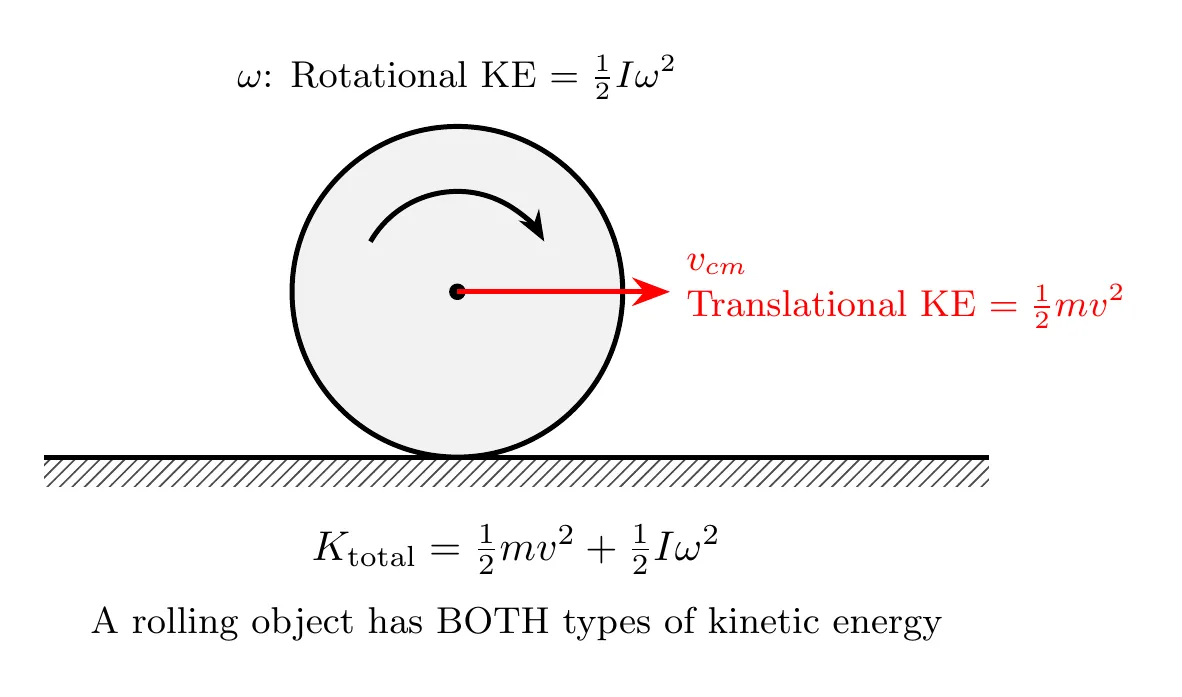
When something is translating and rotating at the same time (a ball rolling down a ramp, say), it has both kinds of kinetic energy.
Total Kinetic Energy Formula
where:
- = linear speed of the center of mass (m/s).
- = angular speed about the center of mass (rad/s).
Where it applies: rolling wheels, rolling balls, rolling cylinders, and so on.
Two Ways to Count the Same Energy
The total kinetic energy of any rigid object can be split into two pieces: rotation about its center of mass plus translation of its center of mass:
When an object turns about a fixed axis that isn’t through its center of mass (a rod swinging on a pivot at one end, a door on its hinges), you get the same total either way: use with about the pivot, or use the two-piece formula above. Pick one. Using both counts the energy twice.
Example Problem: A Rod Swinging About One End
Problem: a uniform rod of mass 1.2 kg and length 1.0 m rotates about a fixed pivot at one end at 4.0 rad/s. Find its kinetic energy two ways.
Step 1: Rotational inertia about the pivot. Put the pivot at . The rod’s mass per length is , so :
Step 2: Method 1, pure rotation about the pivot.
Step 3: Method 2, rotation about the center plus motion of the center. About its center, kg·m² (check with the parallel axis theorem: kg·m², matching Step 1). The center is 0.50 m from the pivot, so it moves at m/s.
Answer: J both ways. Method 1 counts everything as rotation about the pivot. Method 2 splits the same 3.2 J into 0.80 J of spinning about the center and 2.4 J of moving the center.
Connecting Rotational and Translational Quantities
For rolling without slipping, remember:
You can use that to rewrite the rotational kinetic energy in terms of linear speed.
The Alternative Form Using Linear Speed
Start with:
Since (where is the shape factor) and :
So the total kinetic energy becomes:
And depends on the shape:
- Solid sphere:
- Solid cylinder or disk:
- Hollow sphere:
- Hollow cylinder or hoop:
Notice: the terms cancel out. For a given mass and speed, the kinetic energy doesn’t care about the radius.
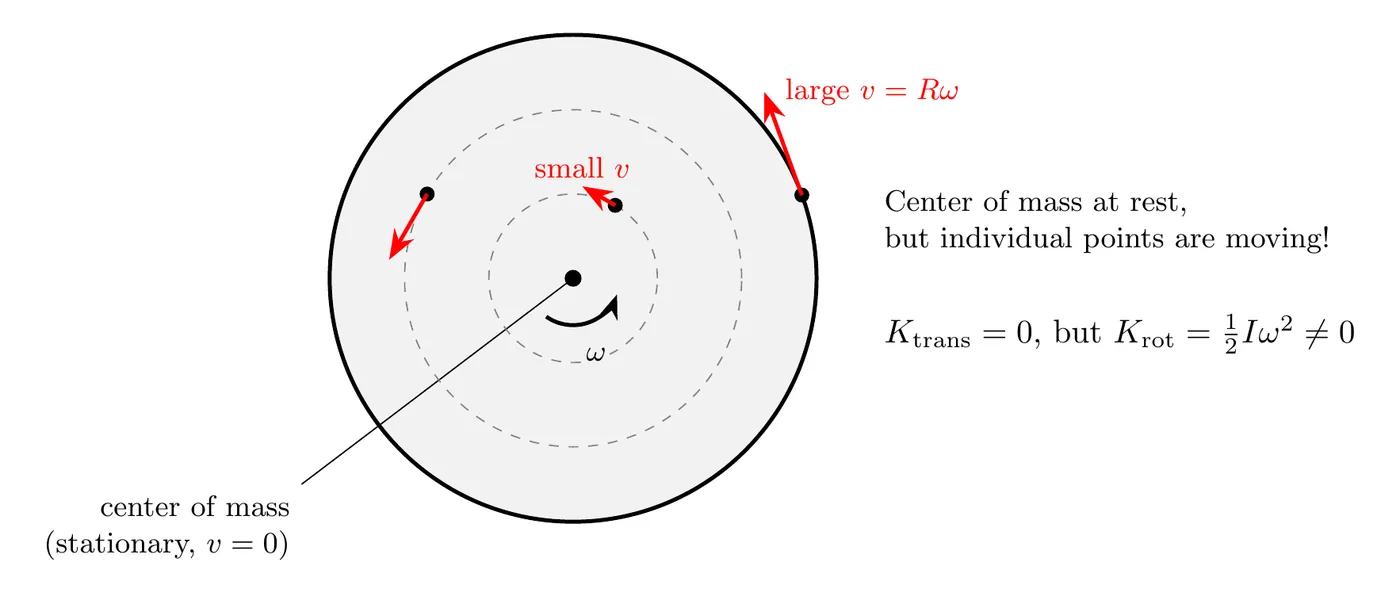
A Rotating Object with Its Center of Mass at Rest
Here’s a subtle one: a rigid object can have rotational kinetic energy even when its center of mass isn’t moving at all.
How? Because individual points inside the object are moving and carry kinetic energy, even though the average (the center of mass) stays put.
Example: a spinning top on a table.
- Center of mass: not moving ().
- Individual points on the top: whipping around in circles at speed .
- Total kinetic energy: , purely rotational.
Example Problem: A Flywheel with Its Center of Mass at Rest
Problem: a flywheel is a uniform solid disk with mass 4.0 kg and radius 0.25 m. It spins at 120 rad/s on a fixed axle through its center. Find (a) its kinetic energy, (b) its total linear momentum, and (c) its kinetic energy if it spins the other way at the same rate.
(a) kg·m², so:
(b) Zero. The center of mass isn’t moving, so . Every piece on one side of the axle moves opposite to a matching piece on the other side, so their momentum vectors cancel. Their kinetic energies don’t cancel, because kinetic energy is a scalar and is never negative. That’s how a system with can still store 900 J.
(c) Still J. is the same for and rad/s, so the direction of spin doesn’t matter.
Does it make sense? The rim moves at m/s. If all 4.0 kg moved at 30 m/s, the energy would be J. The flywheel has half that, because most of its mass is closer to the axle and moves slower than the rim.
Power and Rotational Kinetic Energy
From Unit 3, power is the rate at which energy changes:
For rotating systems where the kinetic energy is changing:
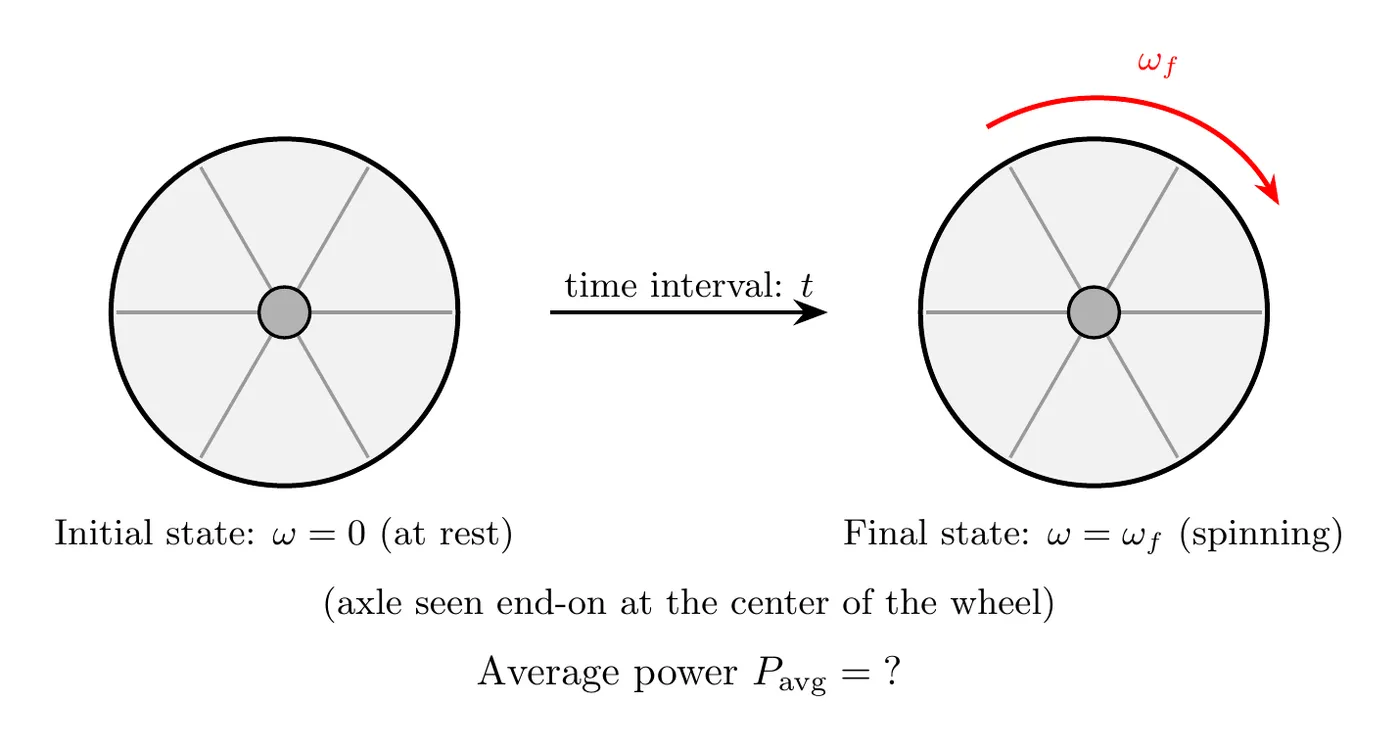
Example Problem: Average Power Input to a Wheel
Problem: a wheel with rotational inertia sits on a fixed frictionless axle. Its angular speed goes from up to over a time interval . What’s the average power input to the wheel over that interval?
Solution
Step 1: Recall what average power means
For rotational kinetic energy:
Step 2: Find the change in rotational kinetic energy
Starting kinetic energy:
Final kinetic energy:
The change:
Step 3: Compute the average power
Answer: the average power input is:
What it tells you:
- You need more power if the rotational inertia is bigger, since it’s harder to spin up.
- You need more power to hit a higher final angular speed .
- You need less power if you’ve got more time , since you can take it slow.
Application: Rolling Objects on Inclines
A classic setup is objects (spheres, cylinders, hoops) rolling down a ramp.
Use energy conservation:
At the top:
- (gravitational PE).
- (it starts from rest).
At the bottom:
- (that’s our reference point).
- (both kinds of KE).
The conservation equation:
For rolling without slipping ( and ):
Solving for the final speed:
The key insight: objects with a smaller (less rotational inertia) end up with a bigger final speed and hit the bottom first.
Race results, fastest to slowest:
1. Solid sphere ():
2. Solid cylinder ():
3. Hollow sphere ():
4. Hollow cylinder ():
The pattern: more mass packed near the axis means smaller , which means faster.
Rotational Inertia Values (Common Shapes)
For reference (the AP exam gives these to you when you need them):
Shape | Speed down a ramp | ||
Solid sphere | Fastest | ||
Solid cylinder/disk | Fast | ||
Hollow sphere | Slow | ||
Hollow cylinder/hoop | Slowest |
Memory aid: hollow objects are always slower than solid ones of the same shape, because their mass sits farther from the axis.
Summary of Key Formulas
Concept | Formula | Notes |
Rotational KE | Energy of rotation | |
Translational KE | Energy of translation | |
Total KE (rolling) | Both types together | |
Alternative form | Using and | |
Average power | Rate of energy change | |
Rolling constraint | For rolling without slipping |
Common Mistakes
- Leaving out rotational kinetic energy for rolling objects. A rolling object has BOTH translational and rotational KE. Don’t just use and call it a day.
- Using the wrong rotational inertia. Solid sphere: . Hollow sphere: . Solid cylinder: . Keep them straight.
- Not squaring the angular velocity. It’s , not . Just like linear velocity, it gets squared.
- Thinking bigger objects roll faster. Size and mass don’t matter. From the same starting height, the object with the smaller (solid sphere, ) beats the one with the bigger (hollow sphere, ).
- Wrong relationship between v and ω. Rolling without slipping means , not or . The radius is in there.
- Adding the energies wrong. Total KE is a plain sum: . Don’t multiply them or do anything fancier.
- Unit confusion. Rotational KE is in joules (J), same as translational KE, even though and have different units from and .
- Thinking radius changes the final speed for the same shape. For objects of the same shape and mass rolling down a ramp, the radius cancels. A big solid sphere and a small one hit the same speed (which is still different from a cylinder’s).
- Not spotting when an object has only rotational KE. If the center of mass is parked (like a spinning top), then and all you’ve got is .
- Using the wrong power equation. Average power is , not . You need the change in energy, not the final energy.
- Dropping the factor of 1/2. Both and carry the . Don’t lose it.
- Setting up energy conservation wrong. For rolling down a ramp it’s . Don’t forget the gravitational PE at the top or either type of KE at the bottom.
- Thinking hollow objects are faster. It’s the other way around. Hollow objects have more rotational inertia for their mass, so they’re slower down a ramp.
- Not using the rolling constraint. When something rolls without slipping, you MUST use to tie the two motions together.
- Algebra errors solving for v. From , you get , not . Don’t lose the square root.