

6.2 - Torque and Work
Introduction: The Rotational Version of Work
Forces do work when they cause a linear displacement, and in the same way torques do work when they cause an angular displacement.
The key parallel: torque is the rotational version of force, so work done by torque follows the same pattern as work done by force.
Linear Work (Review)
For translational motion:
For a constant force:
Rotational Work
For rotational motion, the work done by a torque is:
where:
- = work (J).
- = torque (N·m).
- = angular displacement (rad).
- You integrate over the angular displacement.
What it means: energy moves into or out of a rotating system whenever a torque acts over some angular displacement.
Into or out of the system: the sign of the work tells you which way the energy goes. If the torque points the same way the object turns ( and have the same sign), and the torque transfers energy into the object (a motor spinning up a fan). If the torque opposes the rotation (a brake, friction in a bearing), and the torque transfers energy out. A torque on an object that doesn’t turn () does no work at all.
A collection of torques: when several torques act, each does its own work, . The net work is the sum, which equals the work done by the net torque, and that’s what changes the rotational kinetic energy ( on the equation sheet):
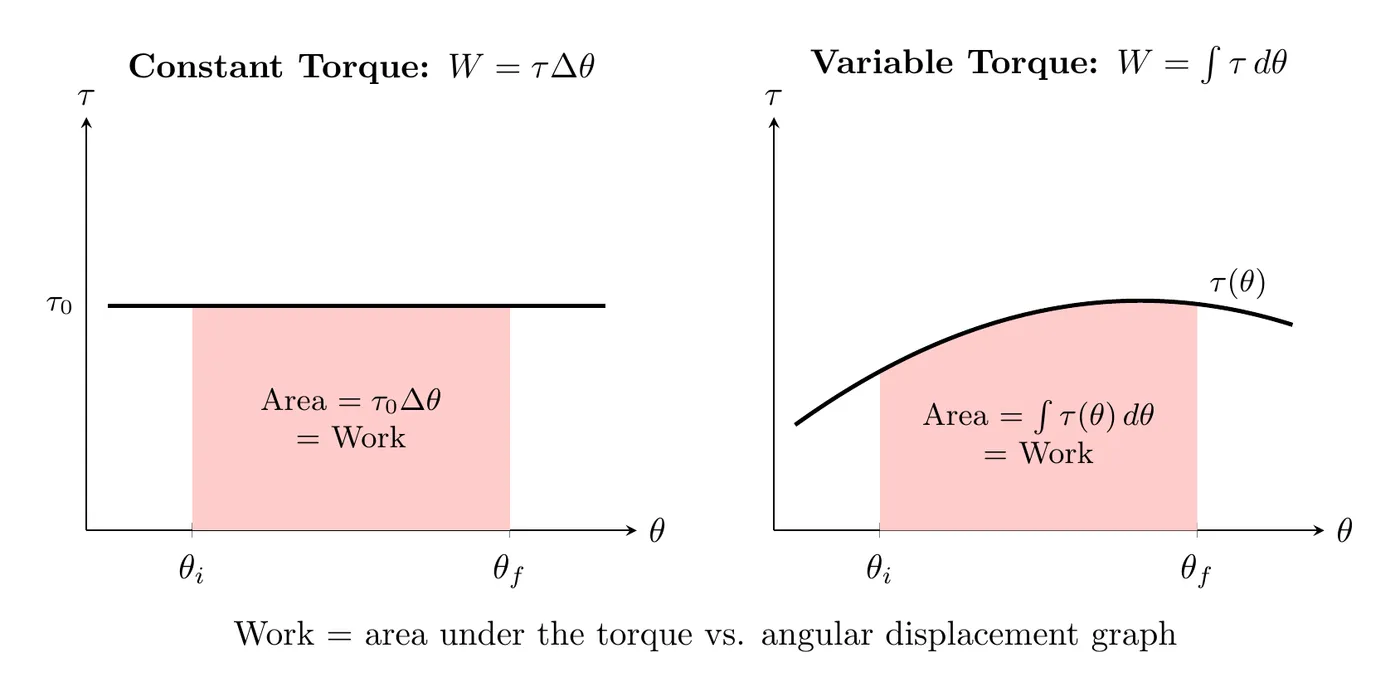
Constant vs. Variable Torque
Constant Torque
When the torque holds steady:
where:
- = the constant torque (N·m).
- = angular displacement (rad).
This is the twin of for a constant force.
Variable Torque
When the torque changes with angle:
Now you need calculus to evaluate it.
Connection to the Linear Work Formula
Start from the definitions.
Linear quantities:
- Force: .
- Displacement: .
- Work: .
Rotational quantities:
- Torque: .
- Angular displacement: , where .
Put them together:
So for a constant torque.
Work-Energy Theorem for Rotation
Just like in linear motion, work equals the change in kinetic energy.
Work-Energy Theorem (rotational):
This is what links the work done by a torque to the change in rotational kinetic energy.
Example Problem: A Motor and Friction on a Grinding Wheel
Problem: a grinding wheel with kg·m² starts from rest. A motor exerts a constant 2.4 N·m torque on it, and friction in the bearings exerts a constant 0.40 N·m torque the opposite way. (a) Find the work done by each torque, and the net work, during the first 25 rad of rotation. (b) Find the wheel’s angular speed after 25 rad. (c) The motor then shuts off. Through what angle does the wheel turn before friction stops it?
(a) Take the direction of rotation as positive. Both torques are constant, so :
The net work is J. The motor transfers 60 J into the wheel, and friction transfers 10 J out (it ends up as thermal energy in the bearings).
(b) Work-energy theorem, starting from rest:
(c) Now only friction acts, and it has to remove all 50 J:
That’s about 20 turns ().
Getting a Rotational Kinematics Equation from the Work-Energy Theorem
The work-energy theorem can hand you a rotational kinematics equation.
Start with:
and
Set them equal:
For constant torque ( from Newton’s second law):
Divide by :
Multiply by 2:
That’s the rotational twin of .
Rearranged:
And that’s one of the CAKE equations from Unit 5.
Example Problem: Torsion Spring
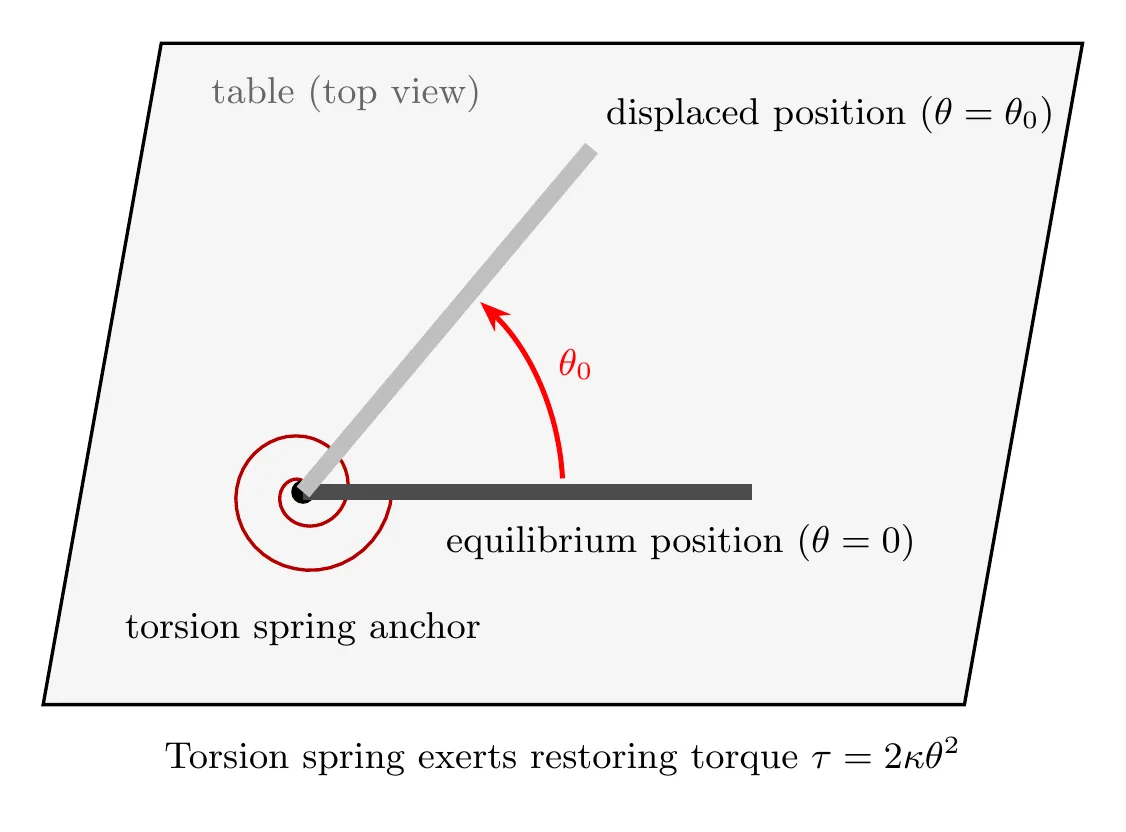
Problem: a torsion spring is attached to the end of a rod with rotational inertia . The torsion spring is anchored to a horizontal table with negligible friction, as shown in the top view. When the rod gets displaced by an angle from equilibrium, the torsion spring pushes back with a restoring torque of magnitude:
where is a positive constant with the right units. After being displaced by an angle , the rod is released and swings through its equilibrium position with angular speed .
- How much work went into moving the rod out to the displaced position ?
Part (a): Finding the Work Done
Step 1: Set up the work integral
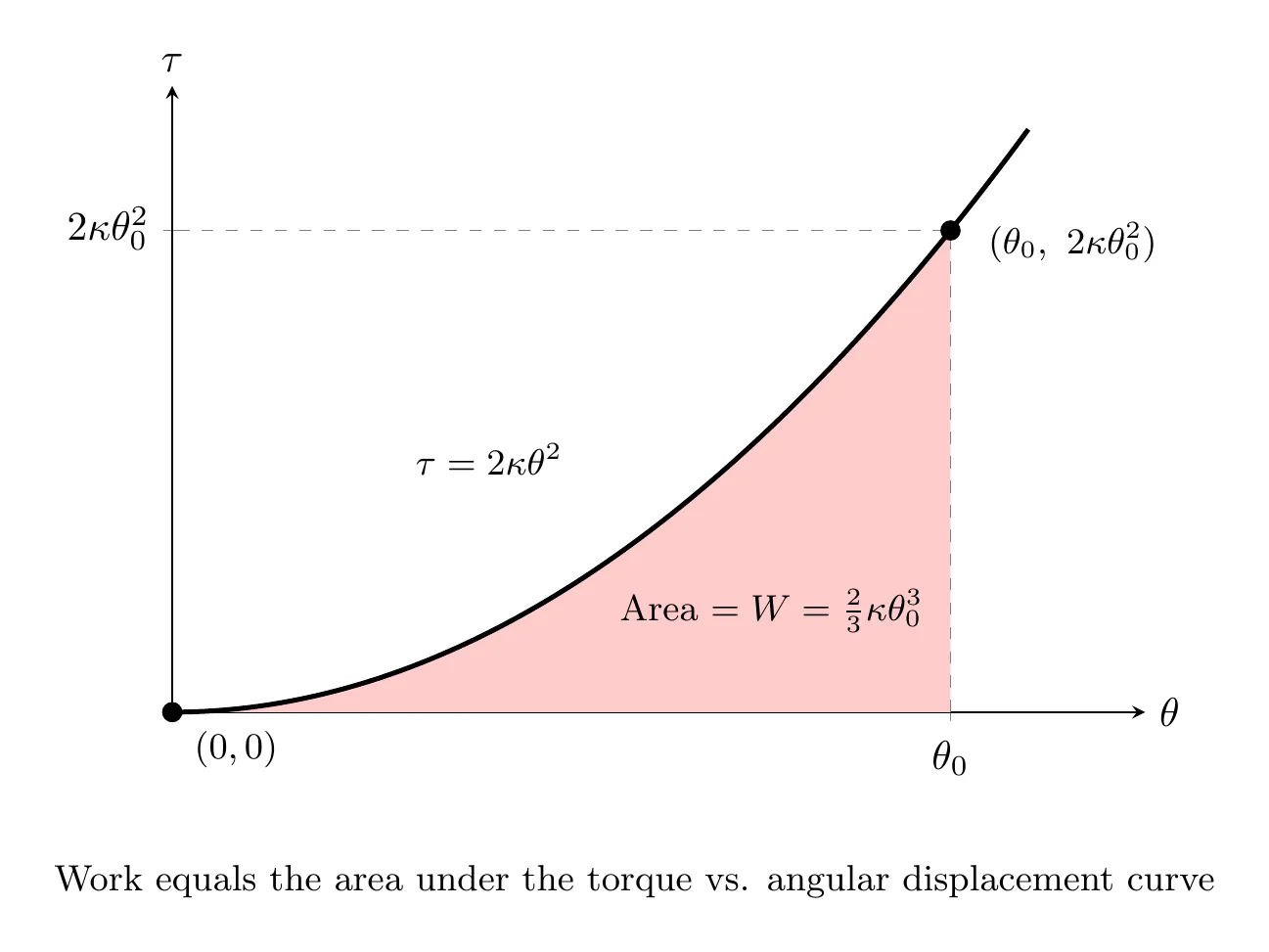
This is the work an outside agent does against the restoring torque to twist the rod:
We’re going from equilibrium () out to the displaced position ():
Step 2: Plug in the torque function
We’re given :
Step 3: Pull the constant out
Step 4: Integrate with the power rule
Step 5: Evaluate the definite integral
Answer: the work done is:
What it means: that work gets stored as potential energy in the twisted torsion spring, the same way a regular spring stores elastic potential energy.
Extension: Finding the Final Angular Speed
Follow-up: use the work-energy theorem to find the angular speed as the rod swings back through equilibrium.
Solution:
Step 1: Apply the work-energy theorem
The energy stored in the spring comes back out as rotational kinetic energy:
(The initial kinetic energy is zero since it’s released from rest.)
Step 2: Solve for
Multiply both sides by 2:
Or, written another way:
What it tells you:
- A bigger displacement stores more energy, so you get a higher angular speed.
- A bigger rotational inertia is harder to accelerate, so you get a lower angular speed.
- A bigger spring constant means a stiffer spring, so you get a higher angular speed.
Try It with Numbers
Say N·m/rad², the rod is twisted to rad, and kg·m².
Keep the unrounded 0.6912 J in the second step and round only at the end. Units check: is in N·m and is in rad², so is in N·m/rad², and comes out in N·m = J (radians are dimensionless).
Summary of Relationships
Linear Quantity | Rotational Quantity | Relationship |
Force: | Torque: | |
Displacement: | Angular displacement: | |
Work: | Work: | Same form |
Work (variable): | Work (variable): | Same form |
KE: | KE: | Same form |
Work-Energy: | Work-Energy: | Same principle |
The pattern: swap the linear quantities for the rotational ones and the math stays exactly parallel.
Area Under the Curve Interpretation
Graphically, the work done is the area under a torque vs. angular displacement graph.
Which mirrors:
- Work = area under an vs. graph (linear motion).
- Impulse = area under an vs. graph.
Example Problem: Work from a Torque vs. Angle Graph
Problem: a flywheel with kg·m² starts from rest. The graph shows the net torque on it as a function of its angular position. Find (a) the work done from to 5.0 rad, (b) the angular speed at 5.0 rad, and (c) the angular speed at 6.0 rad.
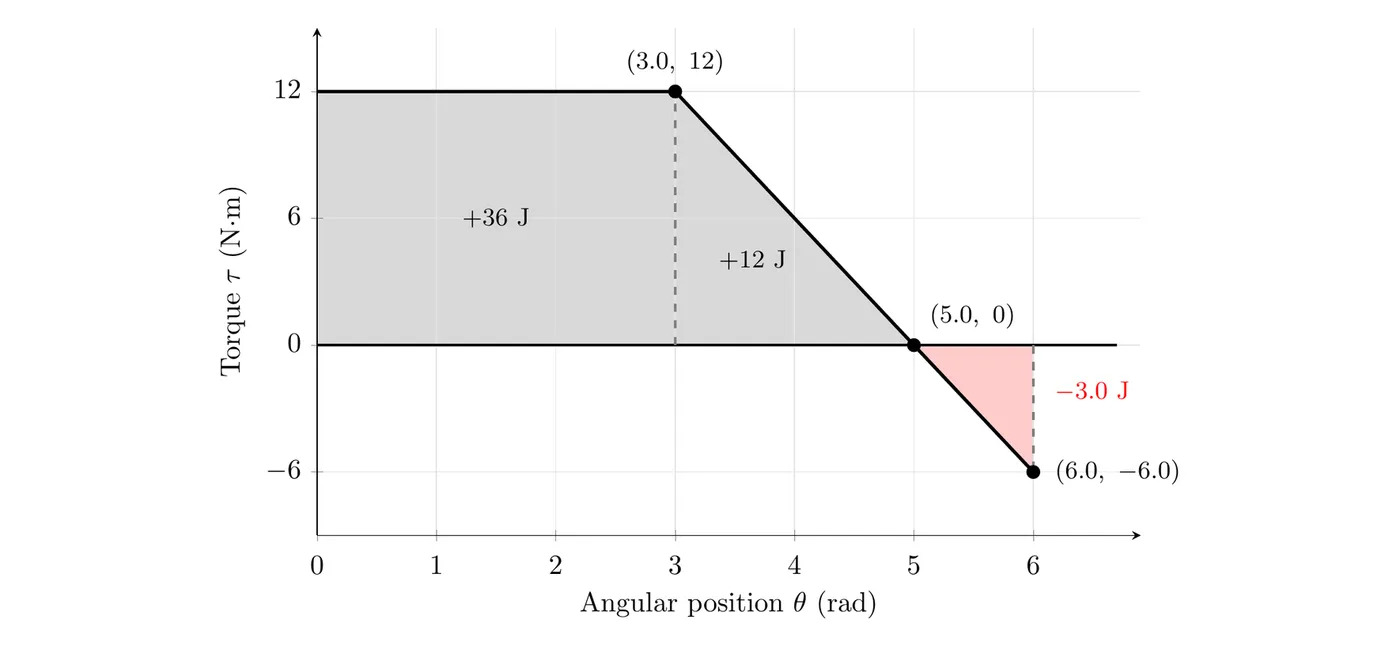
(a) Split the area into shapes. From 0 to 3.0 rad it’s a rectangle. From 3.0 to 5.0 rad it’s a triangle above the axis:
(b) It starts from rest, so all 48 J becomes rotational kinetic energy:
(c) From 5.0 to 6.0 rad the torque is negative, so the area below the axis counts as negative work: J. The net work from 0 to 6.0 rad is J:
What it tells you: the flywheel spins fastest at rad, right where the torque crosses zero. Before that, the torque adds energy. After that, it takes energy back out. The negative torque doesn’t reverse the spin here; it just slows the flywheel down.
Units Check
Always make sure the dimensions line up.
Work from torque:
And since radians are dimensionless:
✓
So torque times angular displacement really does give you energy, and the units back that up.
Common Mistakes
- Using the wrong angle for work. Work uses the angular displacement in radians, not degrees, and not the absolute angle unless you happen to start at zero.
- Not integrating for variable torque. If depends on , you MUST use . Only use when the torque is actually constant.
- Confusing work and torque. Work is in joules (J), and torque is in N·m. Numerically 1 J = 1 N·m, but they’re different physical things. Work is torque times angular displacement.
- Not squaring the angular velocity in the kinetic energy. It’s , not . Always square it.
- Wrong limits of integration. Integrate from the initial angle to the final angle: . In the example that’s 0 (equilibrium) to (the displaced spot).
- Missing that the lower limit vanishes. When you evaluate , the lower limit gives 0, which cleans things up.
- Fraction slip-ups. equals , not or .
- Mixing up positive and negative work. If the torque fights the motion, the work done by that torque is negative. If you’re computing the work done against a restoring torque, that work is positive (it’s getting stored).
- Not spotting when the work-energy theorem applies. When a problem says “find the work done” and then “find the angular speed,” that’s your cue to connect them with .
- Botching the power rule. . For that’s , not .
- Forgetting the initial kinetic energy. The theorem is . If it’s released from rest, and things simplify, but always check the initial conditions.
- Failing dimensional analysis. Work should come out in joules. If it doesn’t, something went sideways.
- Not pulling constants out of the integral. In , pull the out first: . Much cleaner.
- Mistaking the torque function for the work. The given is the torque at angle , not the total work. You have to integrate to get work.
- Sign confusion with restoring torques. A restoring torque opposes the displacement (so the torque itself does negative work), but the work an external agent does to create that displacement is positive and gets stored as potential energy.
Summary of Key Formulas
Concept | Formula | When to Use |
Work (constant torque) | Torque is constant | |
Work (variable torque) | Torque changes with angle | |
Work-Energy Theorem | Linking work to energy | |
Rotational kinetic energy | Energy of rotation | |
Kinematics (from W-E) | The no-time equation |