

6.3 - Angular Momentum and Angular Impulse
Introduction: Momentum in Rotational Motion
Linear momentum describes translational motion, and angular momentum does the same job for rotational motion.
The pattern keeps going: take the linear quantities, swap in the angular ones, and the math structure stays the same.
Angular Momentum
Angular momentum is the rotational counterpart of linear momentum.
The Formula
where:
- = angular momentum (kg·m²/s).
- = rotational inertia (kg·m²).
- = angular velocity (rad/s).
Where it comes from: each small piece of mass at distance from the axis moves at , perpendicular to , so its angular momentum is . Every piece has the same , so adding them up gives:
That’s the on the equation sheet. Its direction comes from the right-hand rule (below): points along the axis.
Example: a potter’s wheel head is a uniform 5.0 kg disk of radius 0.20 m, spinning counterclockwise (seen from above) at 8.0 rad/s. Its rotational inertia is kg·m², so kg·m²/s, pointing straight up along the axle.
Side by side with linear momentum:
Linear Momentum | Angular Momentum |
Mass | Rotational inertia |
Velocity | Angular velocity |
Units: kg·m/s | Units: kg·m²/s |
The pattern: swap and .
Angular Momentum as a Cross Product
You can also write angular momentum as the cross product of the position and linear momentum vectors:
where:
- = the position vector from the axis to the particle.
- = the linear momentum vector ().
Magnitude Form
where:
- = distance from the axis to the particle (m).
- = mass (kg).
- = speed (m/s).
- = angle between and .
When do you use this? This is the angular momentum of a particle moving in a straight line, taken about some specific axis or point. It matters a lot for problems where linear motion joins a rotating system.
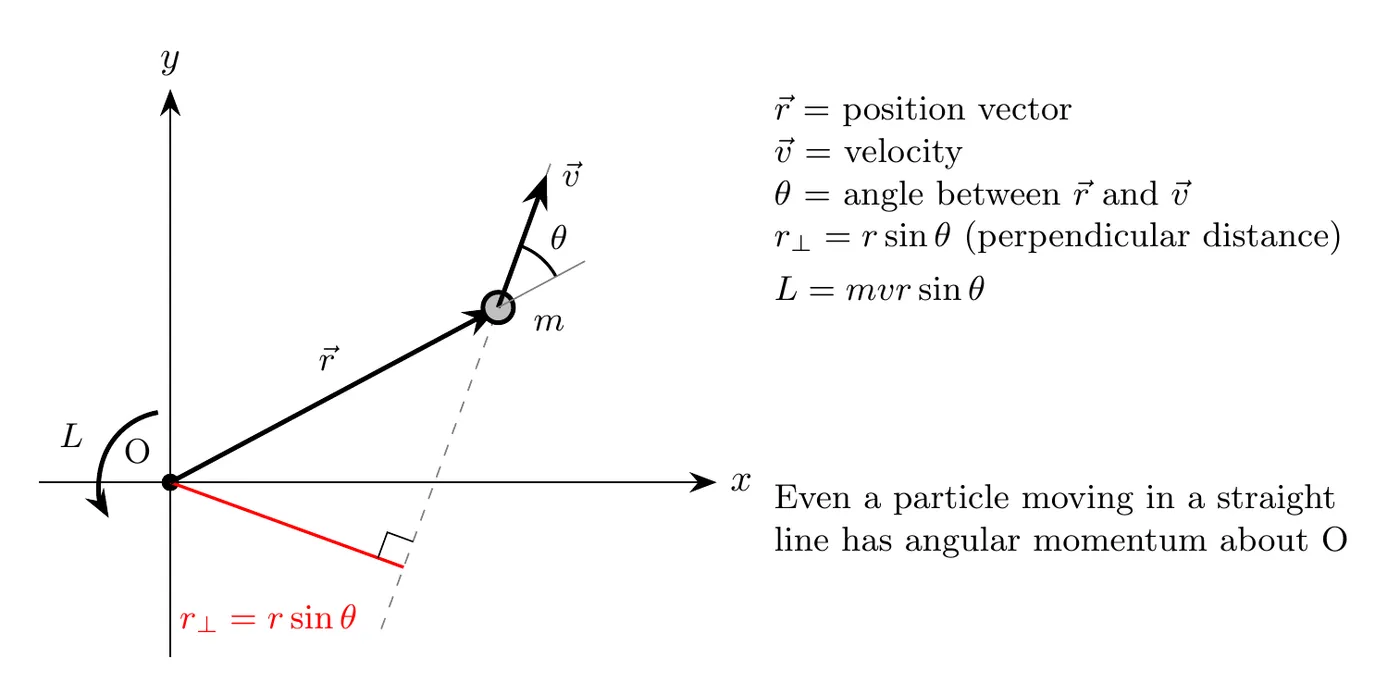
The key insight: even something moving in a perfectly straight line has angular momentum about an axis, as long as its path doesn’t run right through that axis.
Angular Impulse
Angular impulse is the torque exerted on an object multiplied by the time interval during which that torque is exerted (for a torque that changes, the integral of torque over time). It’s what changes an object’s angular momentum, the same way linear impulse changes linear momentum.
Symbol: (sometimes it’s just written out as “angular impulse” with no special symbol).
Variable Torque
When the torque changes with time:
where:
- = angular impulse (N·m·s, or kg·m²/s).
- = torque as a function of time (N·m).
That’s the area under a torque vs. time graph.
Constant Torque
When the torque holds steady:
where:
- = the constant torque (N·m).
- = the time interval (s).
Next to linear impulse:
Linear Impulse | Angular Impulse |
(constant) | (constant) |
Units: N·s = kg·m/s | Units: N·m·s = kg·m²/s |
Direction: angular impulse points the same way as the torque that delivers it. With counterclockwise as positive, a counterclockwise torque gives a positive angular impulse and a clockwise torque gives a negative one. If the torque points the same way the object is spinning, the spin speeds up. If it points the opposite way, the spin slows down (and can even reverse).
Angular Impulse-Momentum Theorem
The angular impulse-momentum theorem ties angular impulse to the change in angular momentum.
Variable Torque Form
Constant Torque Form
In words: the change in angular momentum equals the angular impulse you applied.
Which is exactly parallel to the linear version:
Newton’s Second Law (Rotational Form)
Newton’s Second Law for rotation can be written in terms of angular momentum:
In words: the net torque equals the rate of change of angular momentum.
Which parallels:
When the rotational inertia is constant (so doesn’t change):
And that hands us back .
Run it the other way: start from Newton’s second law with constant , . Multiply by and integrate:
So the angular impulse-momentum theorem ( on the equation sheet) comes straight out of Newton’s second law for rotation.
Graphical Interpretations
Angular Momentum vs. Time Graph
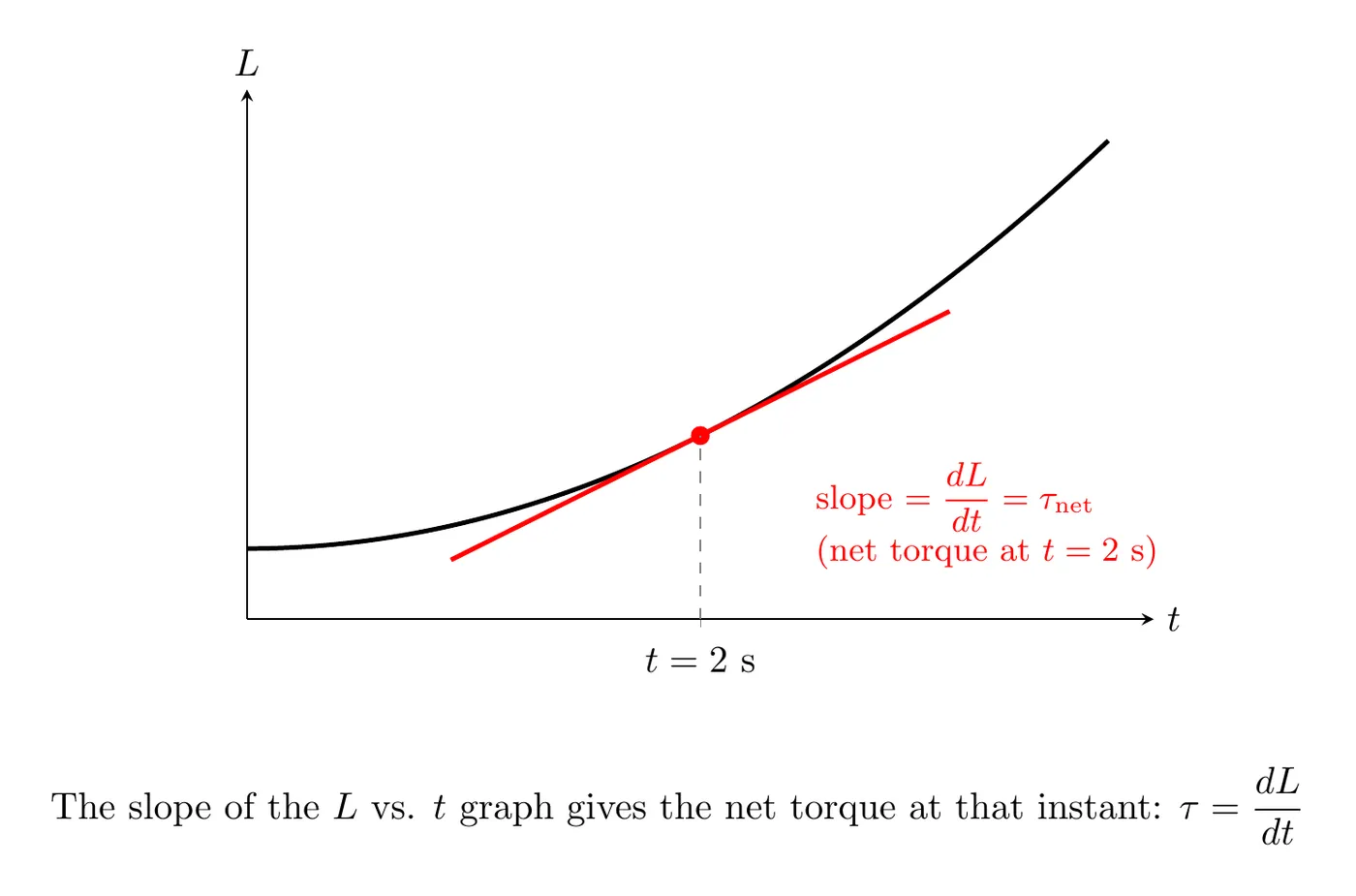
How to read it: the slope of an angular momentum vs. time graph is the net torque at that instant.
To find the net torque at a specific time:
1. Take the derivative of .
2. Evaluate it at the time you want.
3. That’s your .
Torque vs. Time Graph
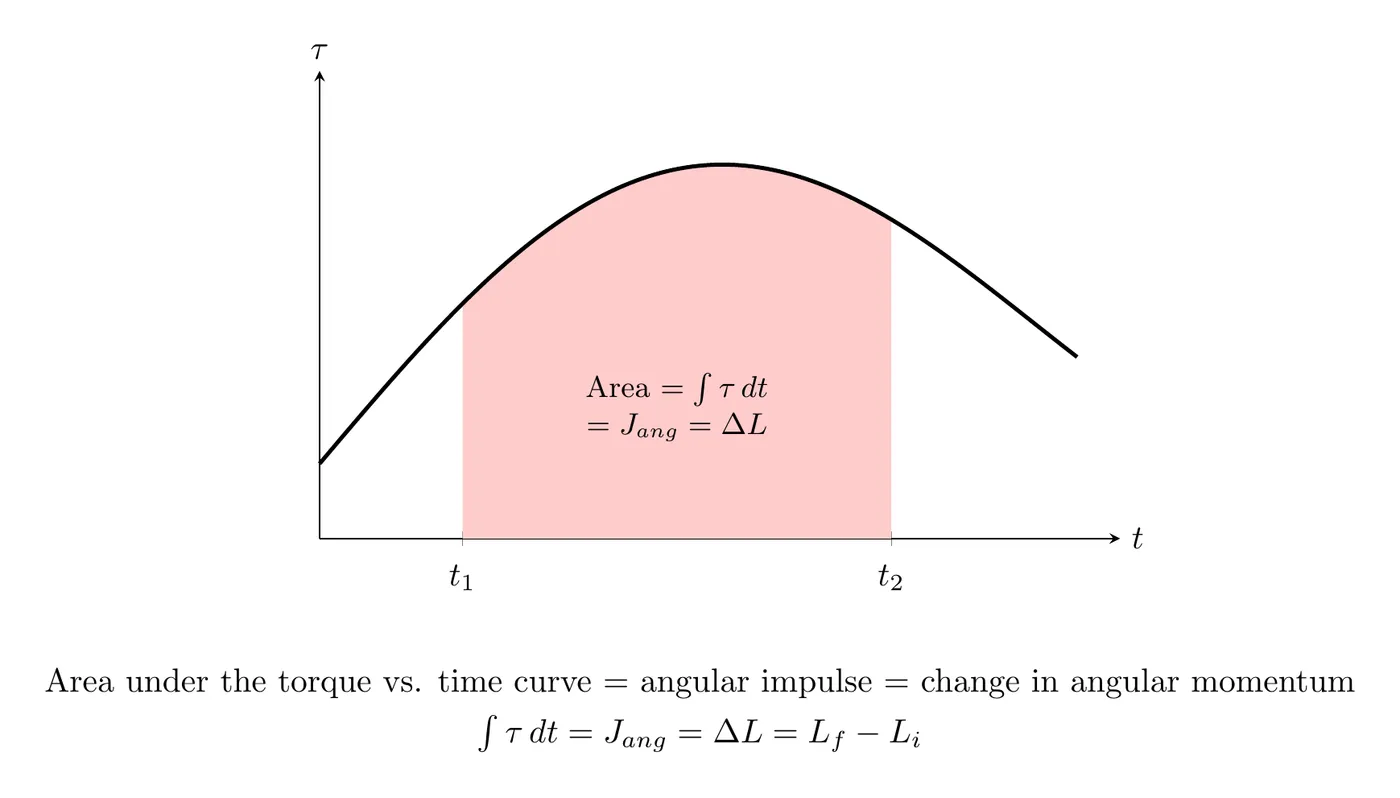
How to read it: the area under a torque vs. time graph is the angular impulse, which is the change in angular momentum.
Example Problem: A Torque That Changes with Time
Problem: a wheel with kg·m² spins counterclockwise at 10 rad/s. Starting at , a motor exerts a counterclockwise net torque (in N·m, with in s) until s, when the torque is back to zero. (a) Find the angular impulse. (b) Find the angular momentum and angular velocity at s. (c) Show that the slope of vs. at s equals the torque then. (d) Then the motor reverses and exerts a constant clockwise torque of 2.0 N·m. How long until the wheel stops?
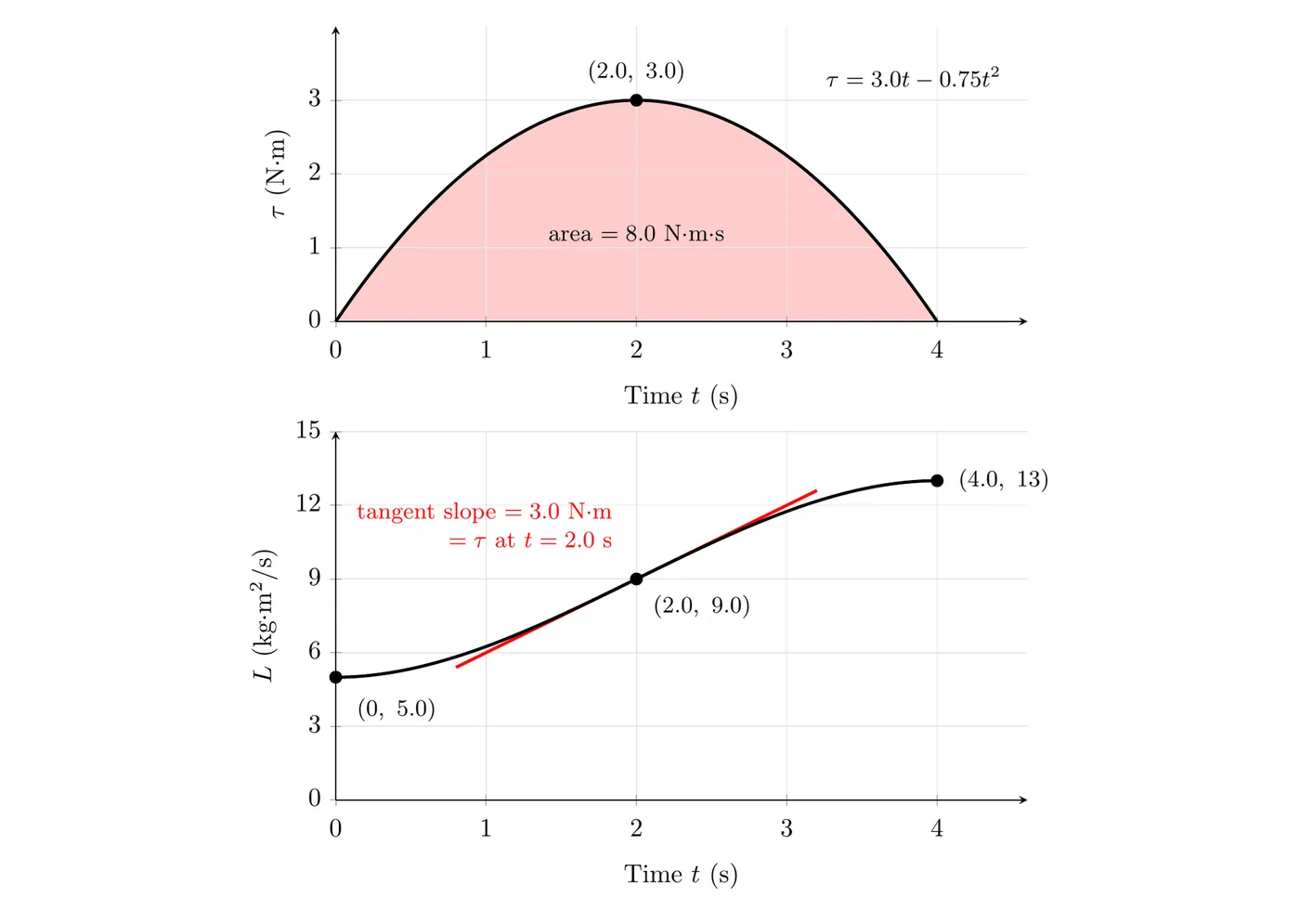
(a) Angular impulse is the area under the torque vs. time curve. Counterclockwise is positive:
(b) Add it to the starting angular momentum. kg·m²/s, so:
(c) Slope check. Integrating from 0 to any time gives . Its derivative is , which is exactly . At s, N·m, the peak torque. That’s why the graph is steepest at s, where kg·m²/s.
(d) A torque in the opposite direction. The clockwise torque is N·m, so its angular impulse is negative, the same direction as the torque. To stop the wheel, it has to cancel all 13 kg·m²/s:
Watch the signs if the spin reverses. If that motor kept pushing for 8.0 s instead, kg·m²/s, so kg·m²/s: the wheel ends up spinning clockwise at rad/s. The size of went from 13 to 3.0, but the change was , not . Comparing magnitudes only works when the direction doesn’t change. Otherwise, keep the signs.
Summary of the Parallels
Linear Quantity | Angular Quantity | Relationship |
Momentum: | Angular momentum: | Swap , |
Impulse: | Angular impulse: | Swap |
Impulse (const): | Angular impulse (const): | Same structure |
Impulse-momentum: | Angular I-M: | Same principle |
Newton’s 2nd: | Newton’s 2nd: | Same form |
The math is completely parallel. Just swap linear for angular.
Example Problem: A Particle Moving in a Straight Line
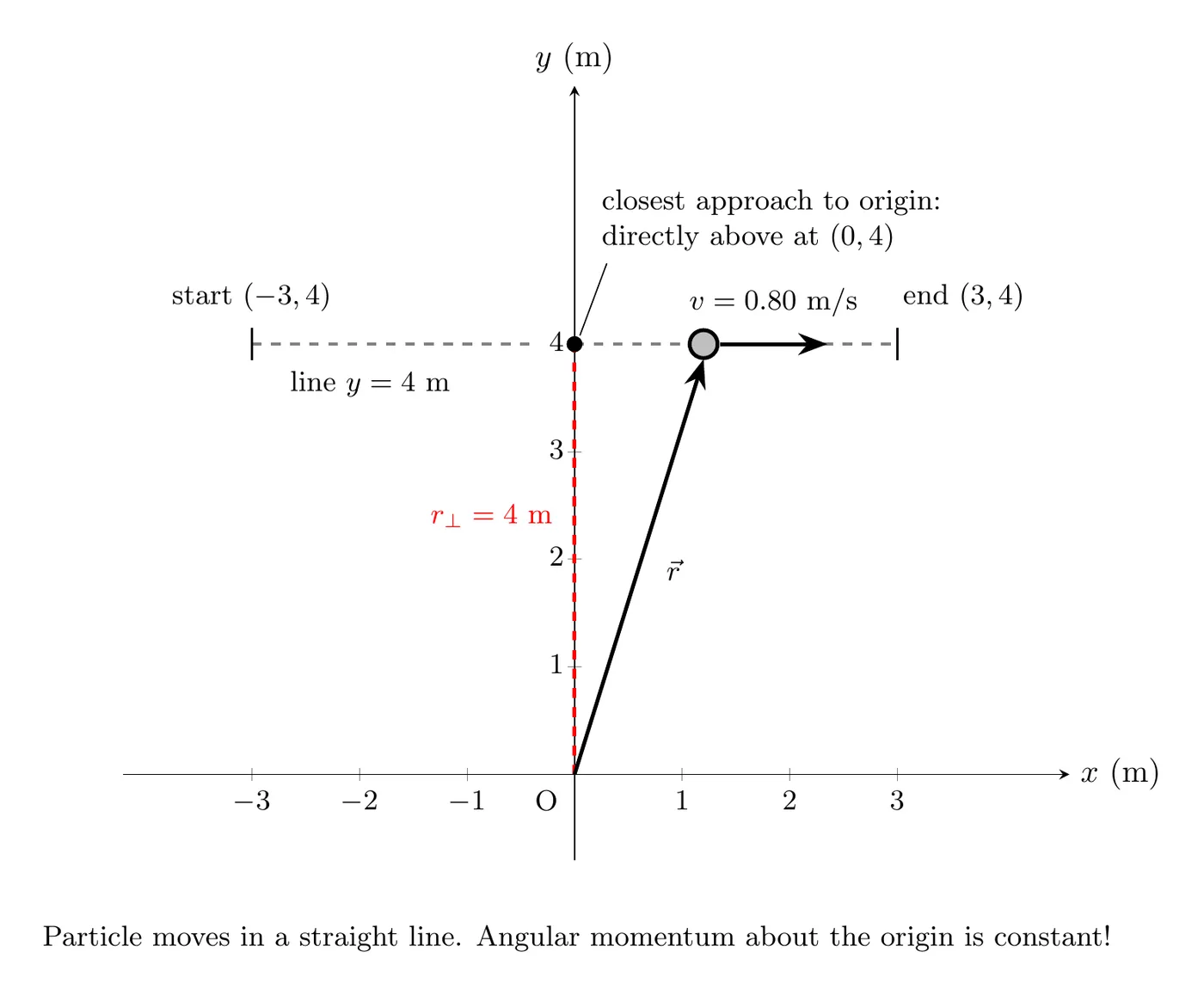
Problem: a 2.0 kg particle moves in the xy-plane at a constant speed of 0.80 m/s in the positive x-direction, along the line m. As it travels from m to m, what’s the magnitude of its angular momentum about the origin?
Solution
The key idea: even though the particle travels in a straight line, it still has angular momentum about the origin, because its path doesn’t go through the origin.
Step 1: Grab the right formula
or, using the perpendicular distance:
where is the perpendicular distance from the axis (the origin) to the line of motion.
Step 2: Find the perpendicular distance
The particle rides along the line m, which is horizontal.
The perpendicular distance from the origin to that line is:
Step 3: Calculate the angular momentum
We’ve got:
- kg
- m/s
- m
Answer: the magnitude of the angular momentum is 6.4 kg·m²/s.
Worth noticing: the angular momentum stays constant the whole way, because:
- The speed doesn’t change.
- The perpendicular distance doesn’t change (the particle is always 4 m from the x-axis).
- No torque acts about the origin, since the motion is uniform.
Why the Angular Momentum Stays Constant
There’s no net torque.
The particle cruises at constant velocity in a straight line, so there’s no net force on it. No net force means no torque about any point at all.
A way to picture it: think of the origin as a pivot. The particle “swings” past it at a fixed perpendicular distance of 4 m at a steady speed. Its rotational effect about the origin never changes.
Check with the angle form: at m, the particle’s position vector from the origin is m, so m, and the angle between and has :
Same answer. As the particle moves, and both change, but stays at 4 m. The direction comes from : the particle passes above the origin moving right, which is clockwise about the origin, so points into the page ( kg·m²/s with counterclockwise positive).
Changing the Reference Point
Now measure from a different point. Angular momentum depends on the point you measure it about. For the same particle:
- About , a point on its path: , so .
- About , above its path: m, so kg·m²/s, and now it’s counterclockwise (out of the page), because the particle passes below that point.
- About : m, so kg·m²/s, clockwise.
Same particle, same motion, different answers. Always say which point or axis you’re using, and use the same one for every object in a problem.
Units of Angular Momentum
SI unit: kg·m²/s.
From the formula:
(Radians are dimensionless.)
Another route:
And one more:
All three agree.
Direction of Angular Momentum (Right-Hand Rule)
Angular momentum is a vector, and it points along the axis of rotation.
Right-hand rule:
1. Curl your fingers the way the thing is rotating.
2. Your thumb points along .
For the cross product :
1. Point your fingers along .
2. Curl them toward .
3. Your thumb points along .
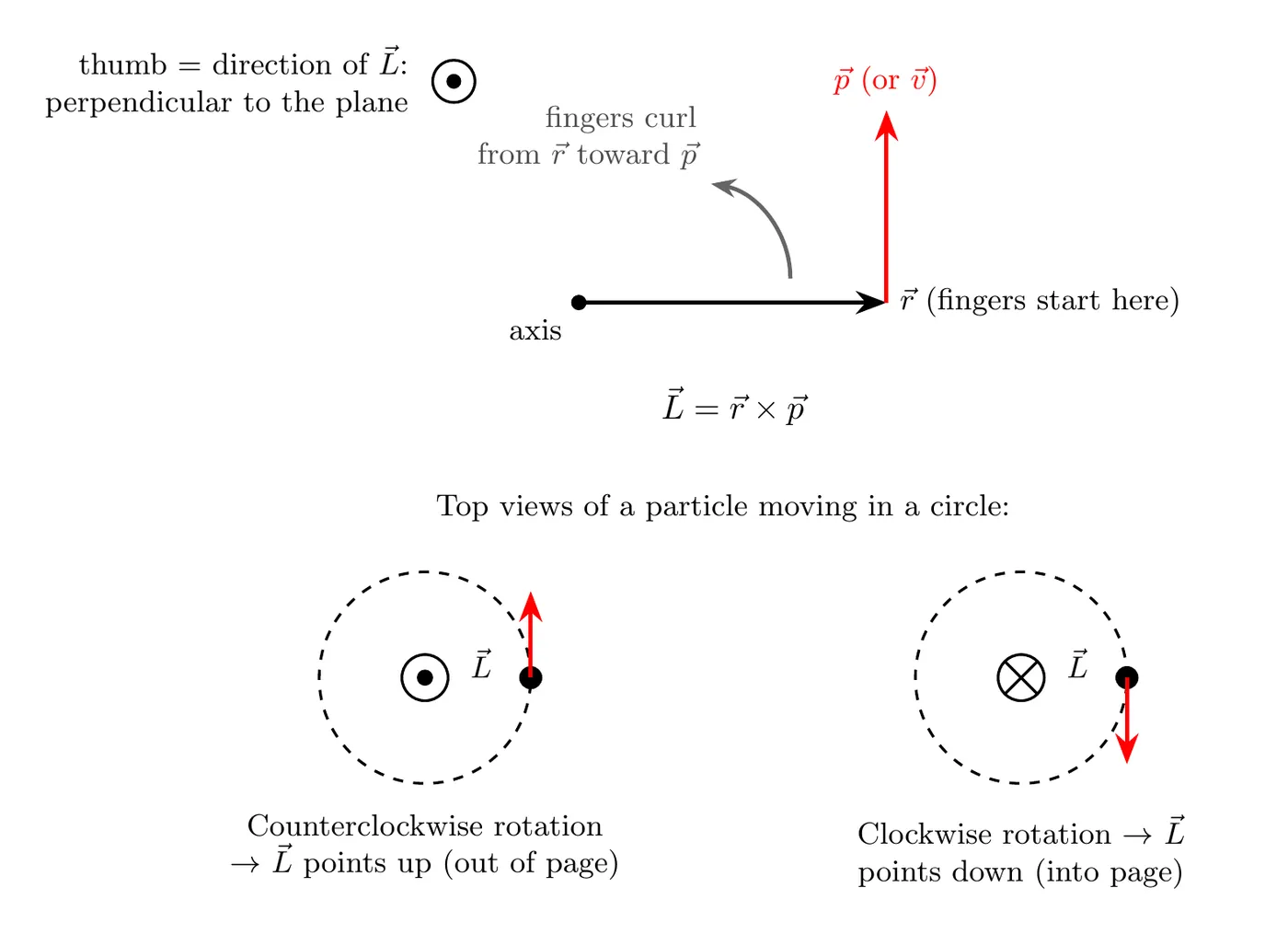
Sign convention in 2D:
- Counterclockwise rotation: is positive (out of the page).
- Clockwise rotation: is negative (into the page).
Common Mistakes
- Confusing angular momentum with linear momentum. Angular momentum is in kg·m²/s, not kg·m/s. They’re related but they’re not the same thing.
- Forgetting that straight-line motion can carry angular momentum. A particle moving in a straight line has angular momentum about any point that isn’t on its line of motion. Use or .
- Using the wrong distance in the formula. In , is the distance from the axis to the particle and you multiply by . Or just use (the perpendicular distance) directly: .
- Not spotting when L is constant. If the net torque is zero, angular momentum holds steady (). That’s exactly what happens for particles moving at constant velocity.
- Mixing up slope and area on graphs. Slope of vs. gives torque. Area under vs. gives the change in angular momentum. Don’t swap them.
- Squaring the angular velocity by accident. It’s , not . Unlike kinetic energy, angular momentum is linear in .
- Wrong units for angular impulse. Angular impulse is in N·m·s = kg·m²/s (same as angular momentum), not N·s.
- Assuming angular momentum is always about the center of mass. It depends on which axis you pick. The same object has different angular momenta about different axes.
- Getting the cross product backwards. It’s , not . Order matters, since cross products anticommute.
- Confusing the torque-time integral with the torque-angle integral. Angular impulse is . Work is . Don’t mix up and .
- Thinking the perpendicular distance changes in the example. For a particle riding along m, the perpendicular distance to the origin is always 4 m, no matter where it is in x.
- Not leaning on the linear-angular analogies. Nearly every formula and concept from linear motion has a direct rotational twin. Spotting those patterns saves you a ton of work.
- Wrong direction for the angular momentum vector. Use the right-hand rule the same way every time. Curl your fingers with the motion, and your thumb gives .
- Forgetting that is the general form. This version of Newton’s second law still works when changes, unlike , which assumes constant .
- Cross product slip-ups. For 2D problems, . At (perpendicular), . If they’re parallel ( or ), .
Summary of Key Formulas
Concept | Formula | Notes |
Angular momentum (rotating object) | About the axis of rotation | |
Angular momentum (moving particle) | About a point or axis | |
Angular momentum (vector) | Cross product form | |
Angular impulse (variable torque) | Area under vs. | |
Angular impulse (constant torque) | Constant torque only | |
Angular impulse-momentum theorem | Change equals impulse | |
Newton’s 2nd (rotational) | The most general form | |
Newton’s 2nd (constant I) | Only when is constant |