

6.5 - Rolling
Combined Translation and Rotation
Rolling without slipping is a special kind of motion where an object translates (moves along) and rotates at the same time, with a specific rule tying the two together. That rule lets you use the linear-to-angular relationships from Unit 5.
Total Kinetic Energy of a Rolling Object
When an object both translates and rotates, its total kinetic energy is the sum of the two pieces:
where:
- = speed of the center of mass (m/s)
- = rotational inertia about the center of mass (kg·m²)
- = angular speed (rad/s)
This formula showed up in Topic 6.1, and now you apply it to rolling.
The Rolling Without Slipping Constraint
For rolling without slipping, the translational motion of the center of mass is locked to the rotation:
where:
- = displacement of the center of mass (m)
- = angular displacement (rad)
- = speed of the center of mass (m/s)
- = angular speed (rad/s)
- = acceleration of the center of mass (m/s²)
- = angular acceleration (rad/s²)
- = radius of the rolling object (m)
These came from Unit 5, and they only hold when the object rolls without slipping.
Why they hold: a wheel rolling without slipping lays its rim down on the ground like tape peeling off a roll, with no sliding. In one full turn ( rad), every point on the rim touches the ground once, so the center moves forward exactly one circumference, . That’s (on the equation sheet). Take time derivatives to get the other two:
Example: a bike wheel of radius 0.33 m rolls 50 m along a road without slipping. It turns through rad, about 24 turns.
The Role of Friction
Static friction makes rolling without slipping possible. It supplies the torque needed to spin the object, but it does no work, because the contact point is instantaneously at rest. That means it dissipates no energy. Even though friction is acting, no mechanical energy is lost, since there’s no relative sliding at the contact point.
Rolling with slipping brings in kinetic friction. If the object is slipping as it rolls, kinetic friction takes over, energy does get dissipated as heat, and the relationship no longer holds. Eventually kinetic friction brings the object into pure rolling. A bowling ball is the classic example: when you release it, it slips along the lane at first and then gradually settles into pure rolling as kinetic friction does its work.
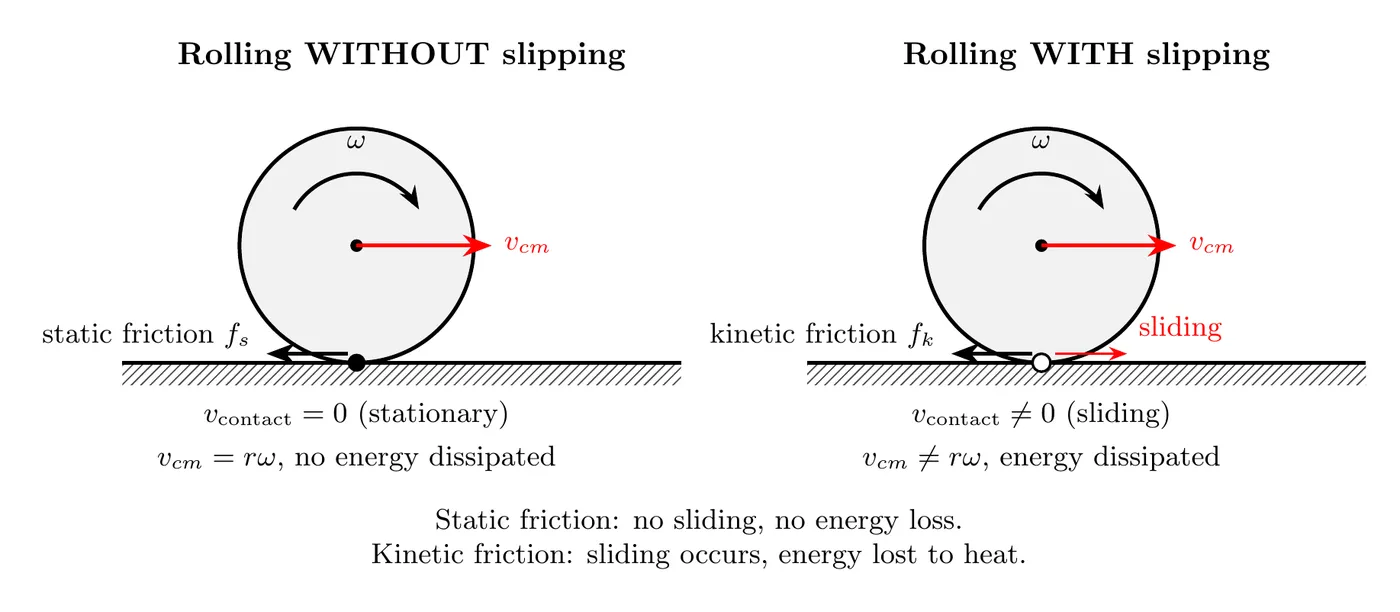
Rolling While Slipping
When an object slips, and aren’t tied together anymore: . Treat them as two separate unknowns. Use Newton’s second law for and the rotational form of Newton’s second law for .
Why energy is lost: when the object slips, the contact point slides, so the point where kinetic friction acts moves relative to the surface. Kinetic friction then turns kinetic energy into thermal energy, and the amount equals the friction force times the distance the contact point slides.
Friction isn’t always needed: a ball rolling without slipping on level ground at constant speed needs no friction at all, since nothing has to change or . Friction only shows up when something tries to change one of them without the other (a ramp, a push, a brake, or slipping).
Example Problem: A Bowling Ball Skids, Then Rolls
Problem: a 6.00 kg bowling ball (a uniform solid sphere, ) is released on a level lane sliding at 7.00 m/s with no spin. The coefficient of kinetic friction is 0.200. Use m/s². Find (a) when it starts rolling without slipping and how fast it’s going then, and (b) how much kinetic energy friction dissipates.
Step 1: Forces and torques while it slips. The bottom of the ball slides forward, so kinetic friction on the ball points backward, with size N. That one force slows the center of mass, and because it acts at the bottom of the ball, it also exerts a torque about the center that spins the ball up:
Step 2: Speeds as functions of time. The ball starts with no spin, so:
Step 3: Slipping stops when they match. gives s, and then m/s. From then on the ball rolls without slipping at 5.00 m/s. The radius cancels, so any solid sphere that starts with no spin ends up at of its starting speed.
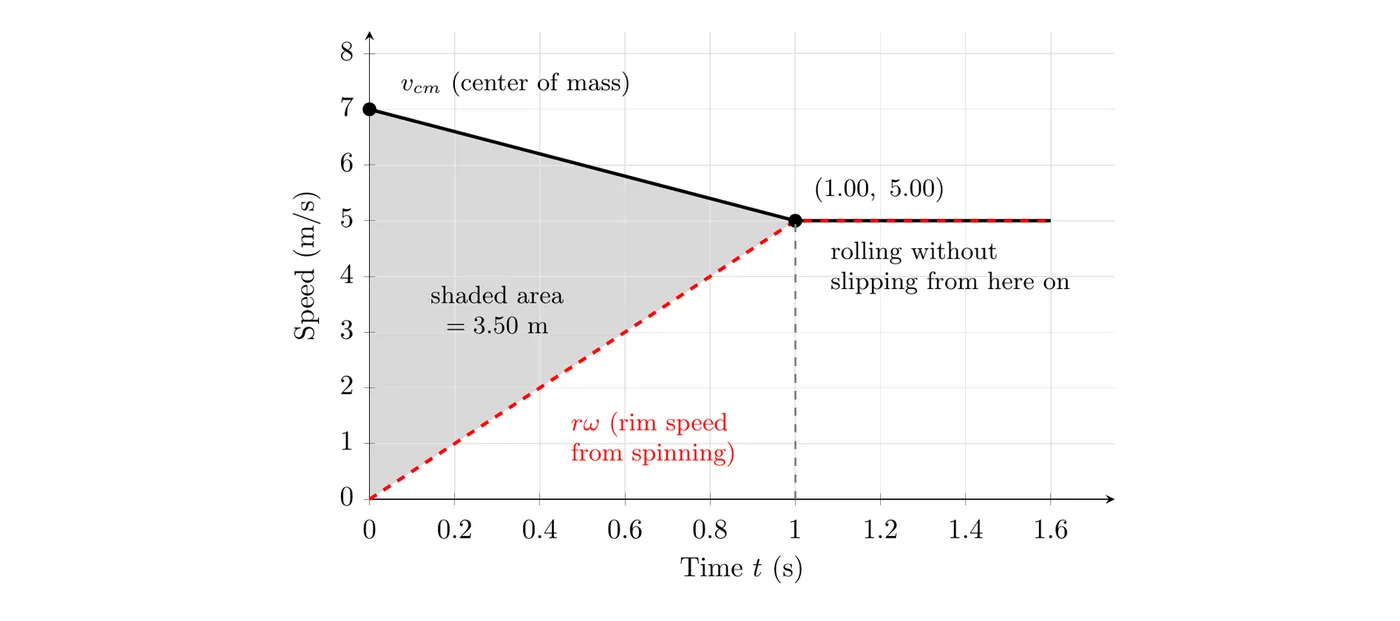
Step 4: How far the contact point slides. The bottom of the ball slides along the lane at . Integrate that sliding speed over the slipping time (the shaded area between the two lines):
Step 5: Energy dissipated.
Check with kinetic energies: before, J, all translational. After, J and J, for a total of 105 J. The loss is J, which matches. Notice that the center of mass traveled m, but the energy lost depends on the 3.50 m the contact point actually slid, not the 6.00 m.
Velocity Distribution on a Rolling Object
When an object rolls without slipping, different points on it move at different speeds.
At the point of contact (the bottom):
so the point touching the ground is instantaneously at rest.
At the center of mass:
so the center just moves at the translational velocity.
At the top:
so the top moves at twice the center-of-mass speed.
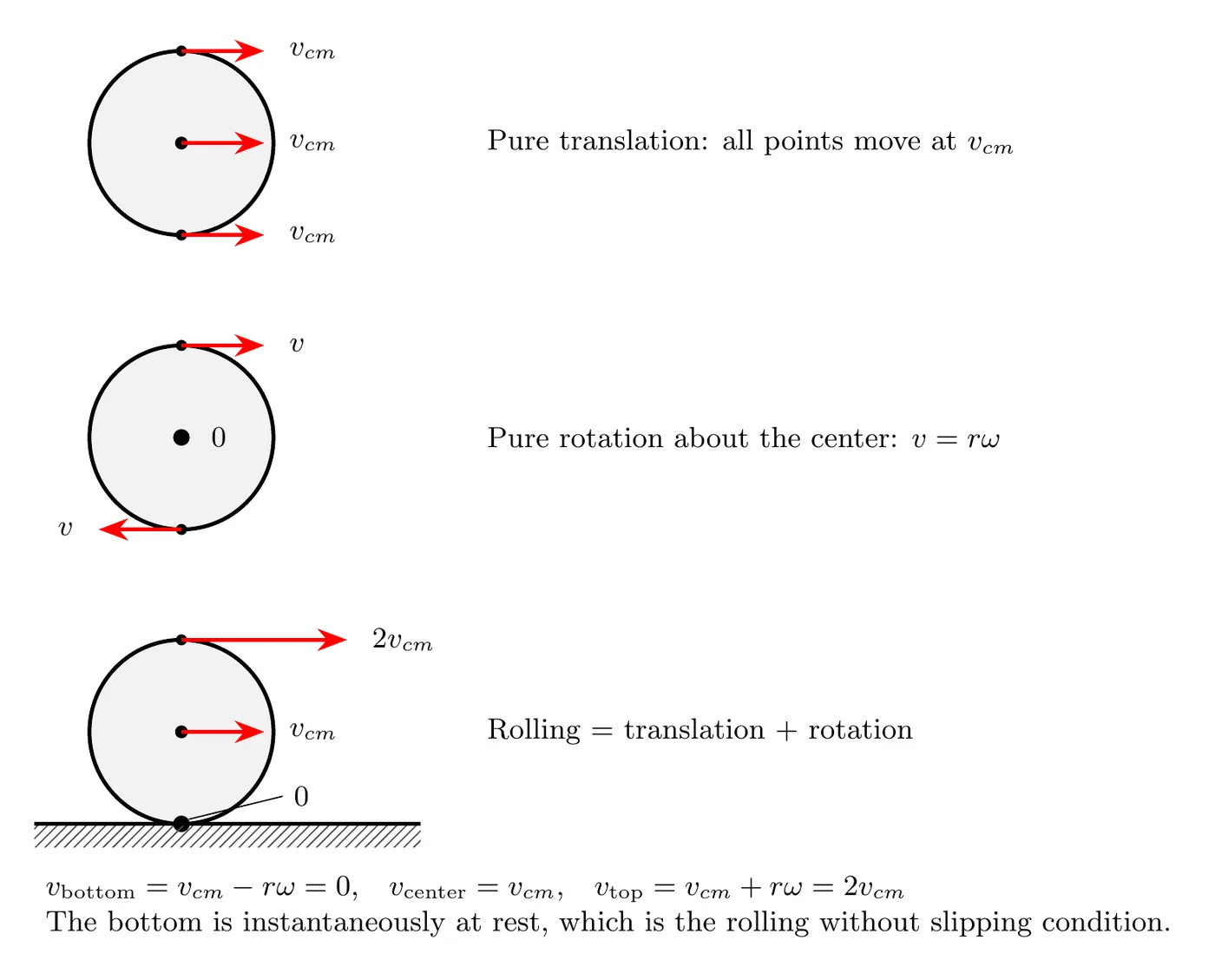
This velocity picture is exactly why static friction doesn’t drain energy: the contact point has zero velocity, so nothing slides.
Example Problem: Sphere Rolling Down an Incline
A sphere of mass , radius , and rotational inertia is released from rest at the top of an incline of height . The incline has enough friction that the sphere rolls without slipping. What is the speed of the center of mass at the bottom?
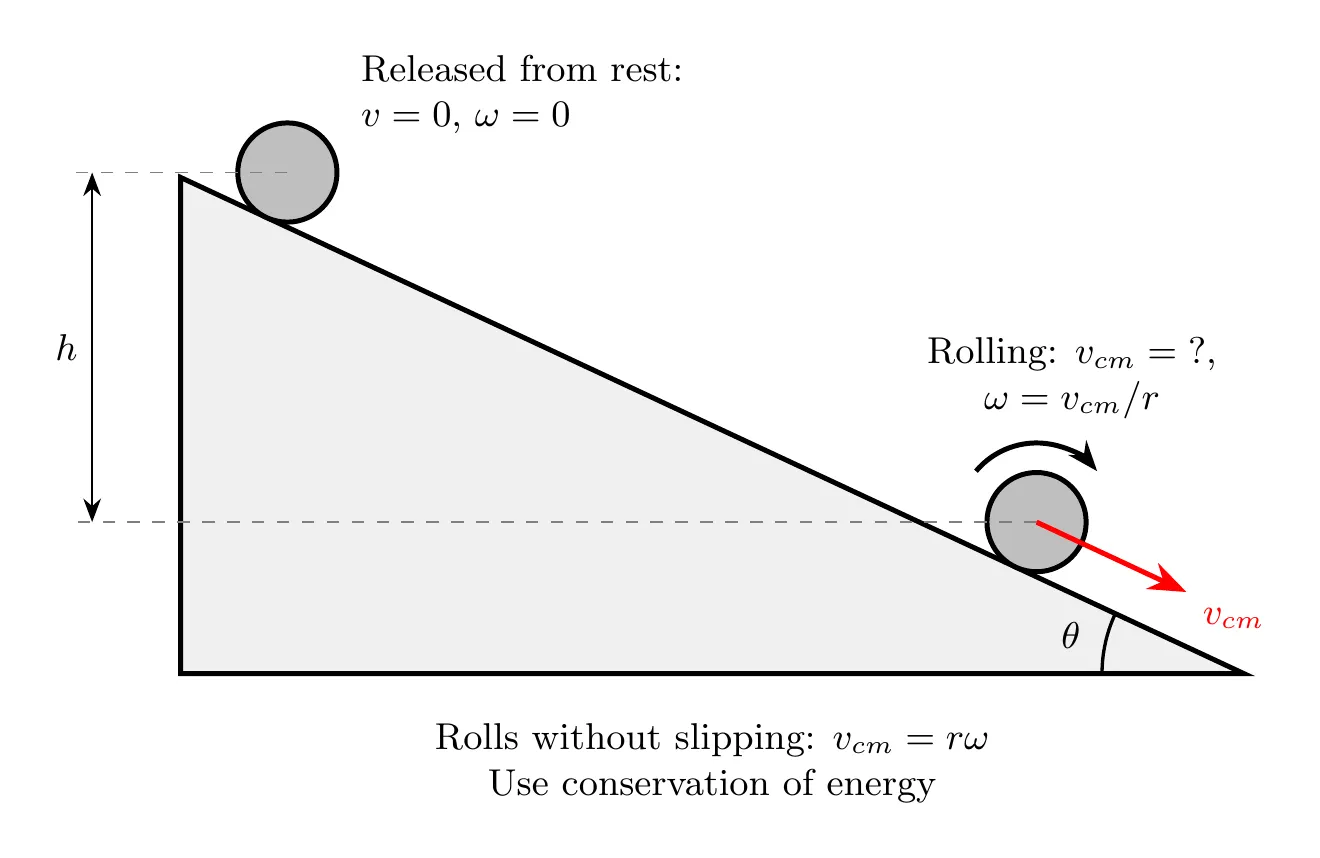
Solution
Step 1: Spot that it’s a conservation of energy problem. Rolling without slipping means friction dissipates nothing, so the mechanical energy of the sphere-Earth system is constant:
Step 2: Initial energy (at the top). It starts from rest and isn’t rotating, so both kinetic terms are zero and only the gravitational PE survives:
Step 3: Final energy (at the bottom). Taking the bottom as the reference so :
Step 4: Apply the rolling constraint.
Step 5: Substitute into the energy equation.
Step 6: Plug in the rotational inertia for a solid sphere:
Step 7: Simplify. Cancel the and combine the fractions:
Step 8: Solve for the speed.
So the speed at the bottom is .
Generalizing
For any rolling object:
Object | |||
Solid sphere | |||
Solid cylinder | |||
Hollow sphere | |||
Hollow cylinder |
The pattern: objects with a smaller (mass packed closer to the center) end up faster, no matter their mass or radius.
Compare that to sliding down frictionlessly, where . The rolling sphere gets , which is less than . It’s slower because some of the energy goes into rotation instead of translation.
Alternative Form Using
Recall that , where is a shape factor. Substituting into energy conservation:
That’s the compact form that works for any shape once you know .
Energy Distribution
At the bottom of the ramp, how much energy is translational versus rotational?
So the ratio is:
For a solid sphere (), the rotational KE is of the translational KE, which works out to of the total.
Example Problem: Energy of a Rolling Ball, with Numbers
Problem: a 1.40 kg solid ball of radius 0.110 m is released from rest and rolls without slipping down a ramp, dropping a height of 0.500 m. Use m/s². Find (a) its speed and angular speed at the bottom, (b) how its kinetic energy splits between translation and rotation, and (c) how many turns it makes if the ramp is 1.50 m long.
(a) Static friction does no work, so the mechanical energy of the ball-Earth system stays constant. At the top, J. Using the solid-sphere result from above:
(b)
So J, all of the starting , split 5 to 2 (the ratio from above). The energy bar charts show it:
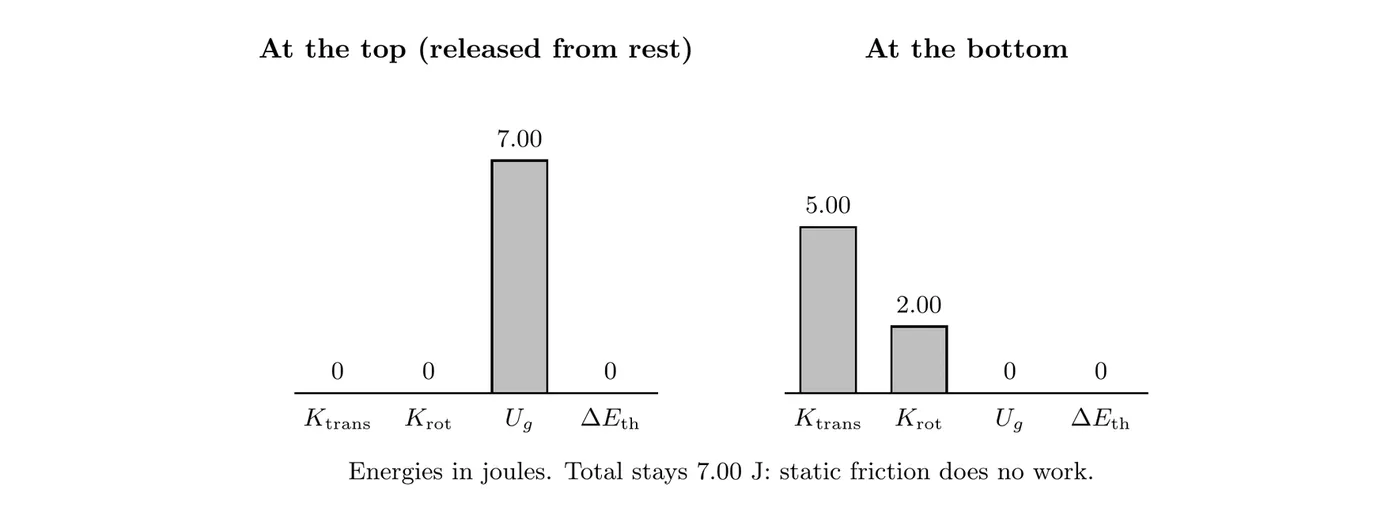
(c) Rolling without slipping, rad, which is turns.
For comparison, a block sliding down a frictionless ramp from the same height reaches m/s. The ball is slower because 2.00 J of its energy went into spinning.
Summary of Key Principles
Concept | Formula | Condition |
Rolling constraint | Rolling without slipping | |
Total KE | Rolling object | |
Compact form | Using | |
Speed down a ramp | Rolling down from height | |
Point velocities | , | At any instant |
Static friction’s role | Does no work | Contact point at rest |
Common Mistakes
- Forgetting rotational kinetic energy. A rolling object has both translational and rotational KE. Don’t just use .
- Wrong rotational inertia. A solid sphere is , not (that’s a cylinder). Check the shape.
- Skipping the rolling constraint. For rolling without slipping you have to use to link the linear and angular quantities.
- Thinking friction dissipates energy in rolling. Static friction enables rolling without slipping but does no work, since the contact point is instantaneously at rest.
- Assuming all rolling objects hit the same speed. Different shapes (sphere, cylinder, hoop) reach different speeds down the same ramp because their rotational inertias differ.
- Confusing rolling with sliding. Sliding down a frictionless ramp gives . Rolling is slower: .
- Adding fractions wrong. needs a common denominator: , not or .
- Forgetting the square root. From , you still need .
- Thinking kinetic friction drives rolling. It’s static friction that enables rolling without slipping. Kinetic friction means slipping is happening.
- Missing when slipping occurs. If the problem says something “initially slips then rolls” (like a bowling ball), there’s a kinetic-friction phase before pure rolling starts.
- Mixing up the point velocities. At any instant, the bottom has , the center has , and the top has .
- Losing track of radius factors. With and , the terms cancel: .
- Thinking solid vs. hollow doesn’t matter. It matters a lot. Hollow objects have larger for their mass, so they roll down slower.
- Not checking energy conservation. At the bottom, . Both sides should be in joules and should match.
- Thinking the object must start from rest. The example starts from rest to keep things simple, but rolling without slipping can happen at any speed as long as holds.