

6.4 - Conservation of Angular Momentum
Introduction: The Parallel Keeps Going
We covered conservation of linear momentum back in Unit 4, and now we do the same for conservation of angular momentum in rotating systems.
The pattern: the principles and the math are completely parallel. Just swap the linear quantities for the angular ones.
Total Angular Momentum of a System
The total angular momentum of a system about some axis is the sum of the angular momenta of all its pieces.
For rotating objects:
For particles moving in straight lines:
For mixed systems:
Which parallels for linear momentum.
Conservation of Angular Momentum
The principle: any change in a system’s angular momentum has to come from an interaction between the system and its surroundings, meaning an external torque.
When Angular Momentum Is Constant
If the net external torque on the system is zero, the total angular momentum stays constant.
Which parallels conservation of linear momentum when .
When It’s NOT Constant
If there is a net external torque, angular momentum gets traded between the system and its environment.
Why Internal Torques Cancel
When two parts of a system push or pull on each other, Newton’s third law says the forces are equal in size, opposite in direction, and act along the same line. So about any axis they exert equal and opposite torques, and they act for exactly the same time. That makes their angular impulses equal and opposite:
Whatever angular momentum one part gains, the other part loses. Inside a system these changes always cancel, so only external torques can change the system’s total.
Conserved vs. Constant: Choosing the System
Angular momentum is conserved in every interaction: it’s never created or destroyed, only transferred from one object to another. Whether a particular system’s angular momentum is constant depends on how you draw the system:
- Net external torque is zero: the system’s total angular momentum is constant. Pick the system to include every object that exerts a torque during the interaction (the person and the merry-go-round, or both discs), so those torques are internal and cancel in pairs.
- Net external torque is not zero: the system’s angular momentum is not constant. Angular momentum is transferred between the system and its surroundings, and the change equals the angular impulse from outside, .
Example: a disc is dropped onto a spinning disc (Scenario 2 below). If the system is just the bottom disc, the top disc exerts an external friction torque on it, so the bottom disc’s angular momentum is not constant: some of it is transferred to the top disc. If the system is both discs, that torque is internal, and the total stays constant (as long as the axle is frictionless).
Common Conservation Scenarios
1. Figure Skater (Changing Rotational Inertia)
The classic: a figure skater spinning with arms out pulls them in.
The physics:
- Arms out: big , small , so a slow spin.
- Arms in: small , big , so a fast spin.
Why? There’s no external torque (friction is negligible), so stays constant:
Solving for the final angular velocity:
Since , you get , so the skater speeds up.
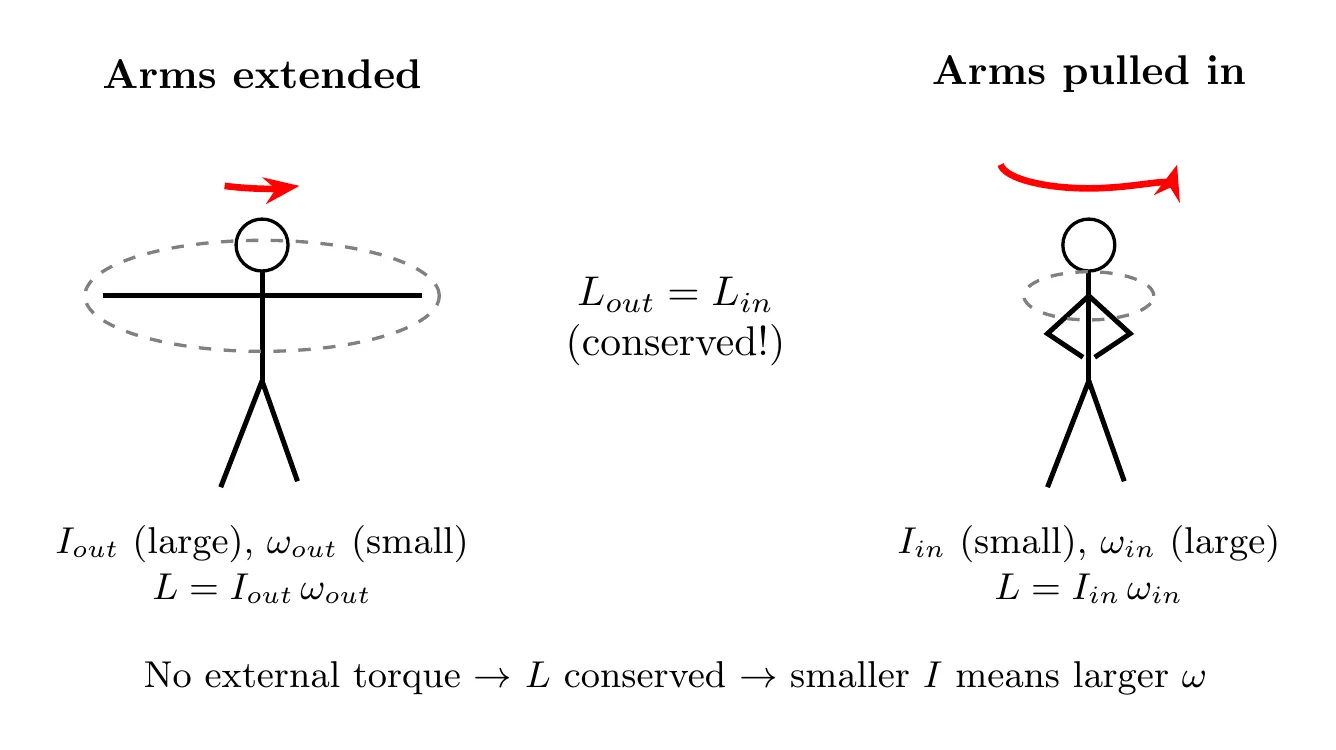
What about energy? The kinetic energy goes UP. Since , shrinking raises . That extra energy comes from the skater doing work to pull their arms in.
With numbers: a skater spins at 2.0 rad/s with her arms out ( kg·m²) and pulls them in to kg·m². No external torque acts, so kg·m²/s stays constant:
Her kinetic energy goes from J to J. The extra 14 J is work her muscles do pulling her arms inward. She’s a nonrigid system: her shape changed, so changed with no change in .
2. Dropping a Disc onto a Rotating Disc
The setup: a disc spins at angular velocity . A second disc, not spinning at all, gets dropped onto it from above.
The physics:
- Before: only disc 1 is spinning, so .
- After: both discs spin together, so .
Conservation:
Result: , so it slows down, because the total went up.
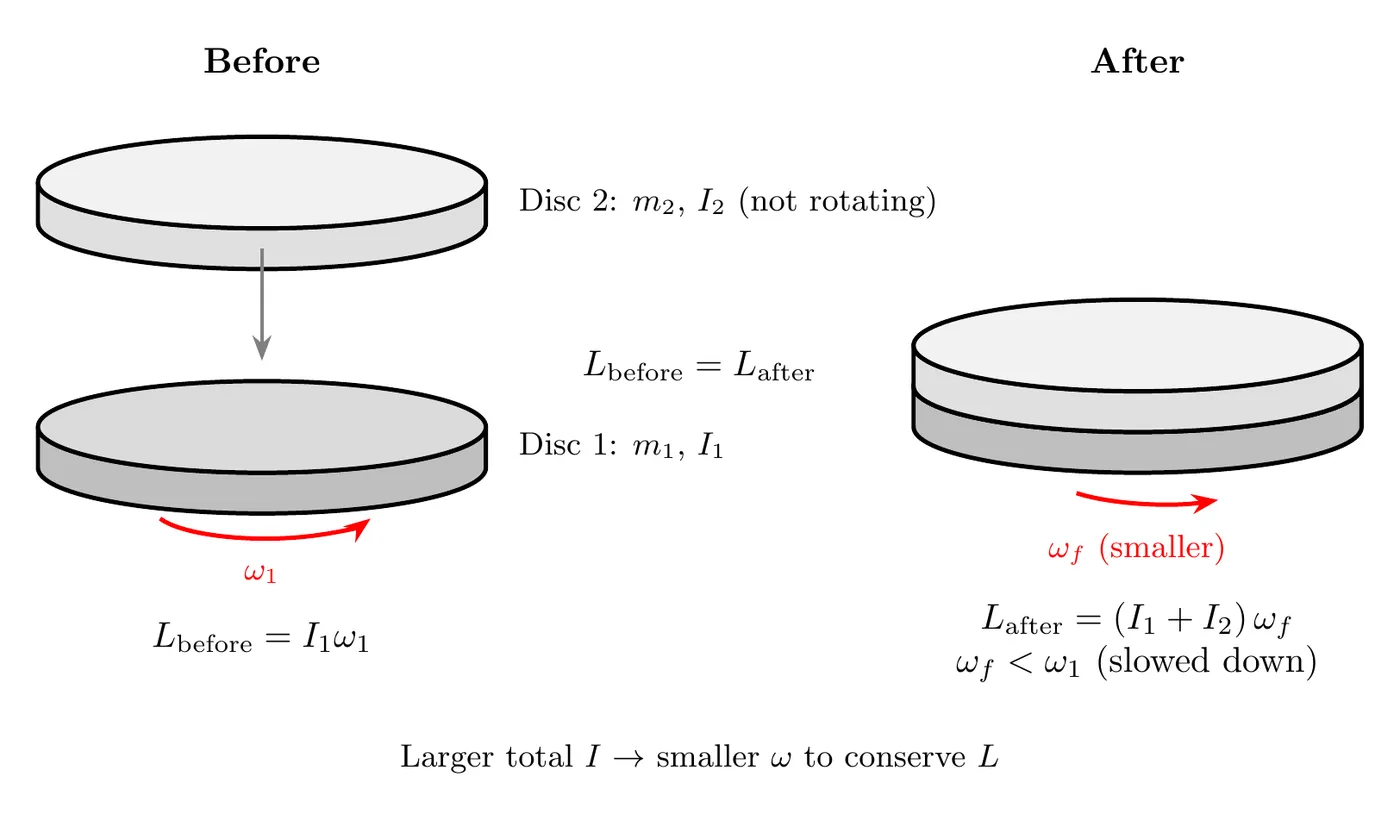
What about energy? The kinetic energy drops. The “lost” energy goes into sound, heat, and deformation during the collision.
3. Person Jumping onto a Merry-Go-Round
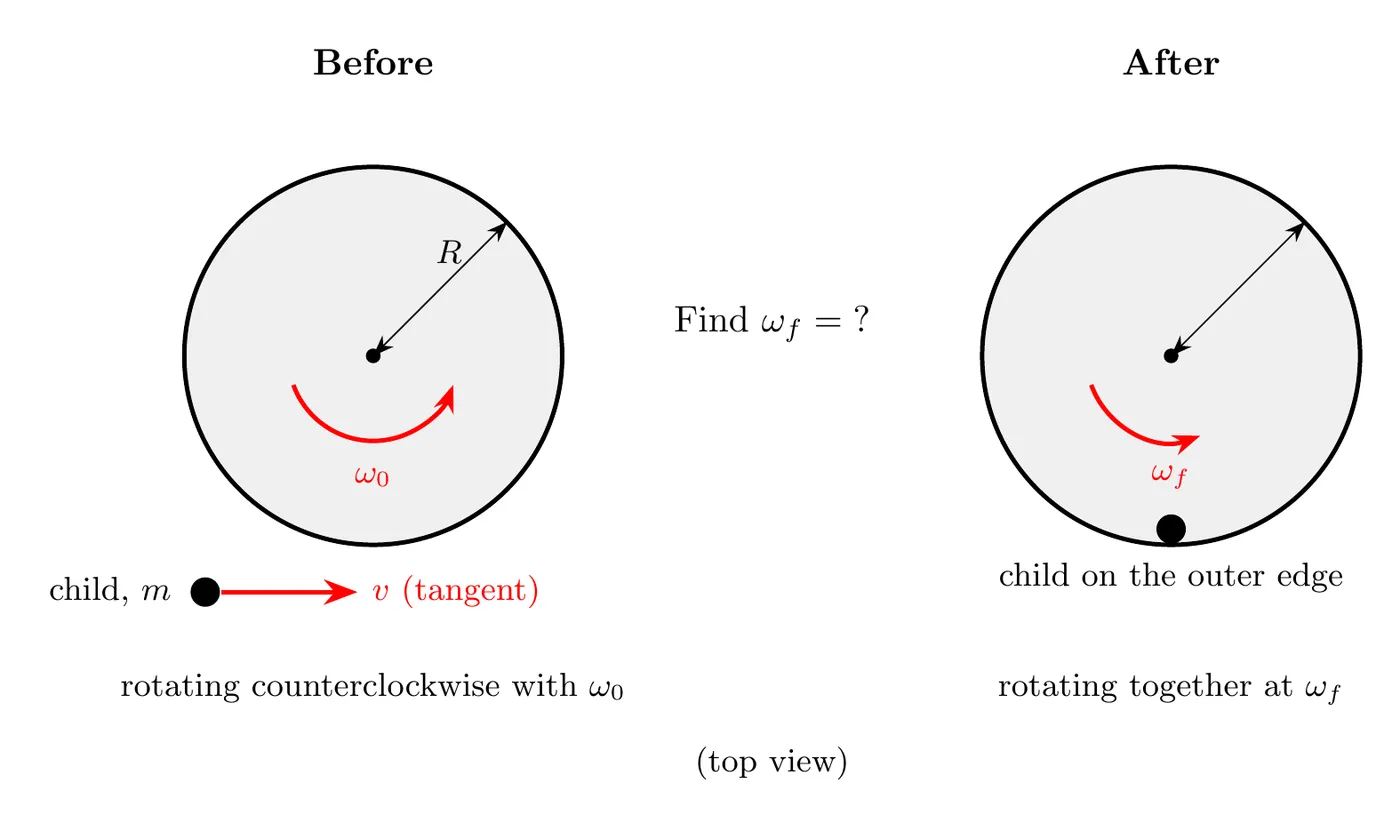
The setup: a person running tangentially hops onto the edge of a spinning merry-go-round.
The physics:
- The person has linear motion, which gives angular momentum about the center: .
- The platform has rotational motion, giving angular momentum .
Conservation:
where is the person’s rotational inertia once they’re standing on the platform.
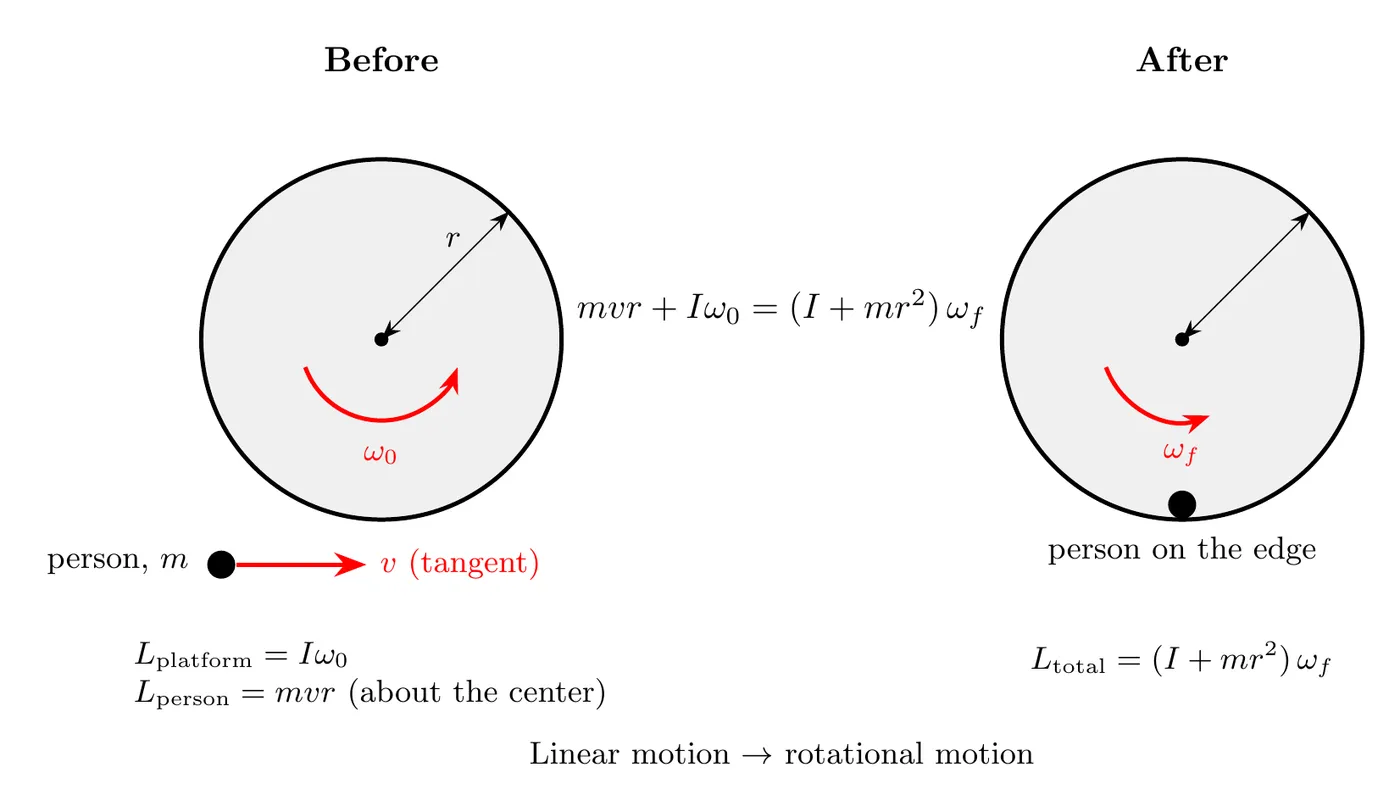
This is the example we’ll work through in detail below.
4. Planets in Orbit
Circular orbit:
- The radius stays constant.
- The speed stays constant.
- Angular momentum: .
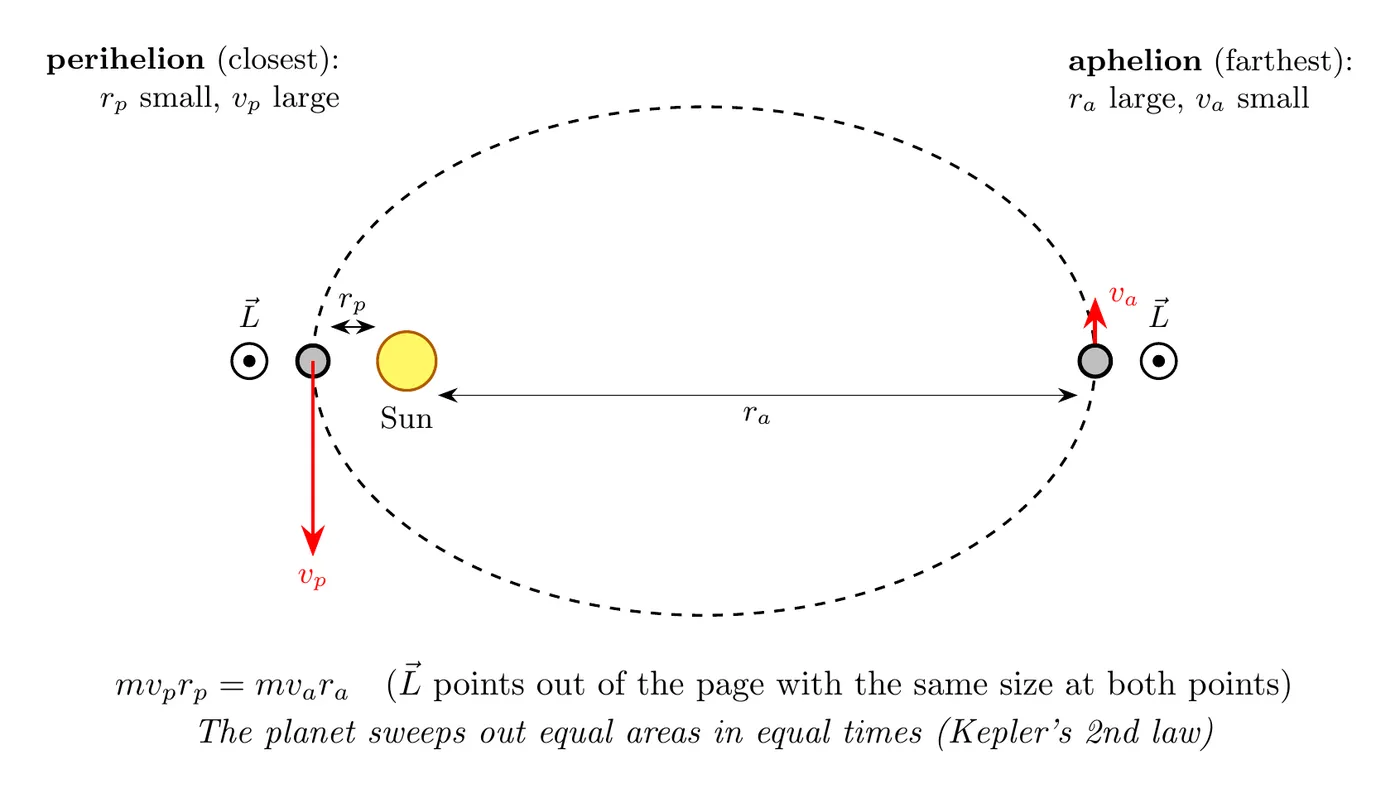
Elliptical orbit:
- The radius changes (perihelion is closest, aphelion is farthest).
- The speed changes too (faster when close, slower when far).
- But angular momentum still stays constant. At perihelion and aphelion, the velocity is perpendicular to (), so there it’s just .
At perihelion (closest):
- Small , big .
- .
At aphelion (farthest):
- Big , small .
- .
Conservation:
That’s Kepler’s second law: a line from the Sun to a planet sweeps out equal areas in equal times, so the planet moves fastest when it’s closest.
Example Problem: Child Jumping onto a Rotating Platform
Problem: a circular platform of radius has rotational inertia . It spins around a fixed pivot at its center with negligible friction and initial angular velocity . A child of mass runs tangentially at speed and jumps onto the outer edge. What’s the system’s new angular velocity?
Solution
Step 1: Write down conservation of angular momentum
Step 2: Find the angular momenta before the collision
The child (moving in a straight line):
(Using with , the distance from the axis.)
The platform (rotating):
Total initial angular momentum:
Step 3: Find the angular momentum after
Once the child lands, everything spins together as one system:
The child’s rotational inertia
(a point mass at distance ):
Total final angular momentum:
Step 4: Apply conservation
Step 5: Solve for the final angular velocity
Answer: the system’s new angular velocity is:
Digging into the Result
Special case: platform starts at rest ()
That’s the version you usually see in algebra-based physics.
Reading the pieces:
- The numerator () is the total initial angular momentum.
- The denominator () is the total final rotational inertia.
- The child’s linear momentum effectively gets converted into rotational motion.
What about energy?
The collision is inelastic, so kinetic energy gets lost.
Before:
After:
Generally , with the difference going into heat, sound, and deformation.
Example Problem: The Same Landing with Numbers
Problem: the platform has kg·m² and radius 2.0 m and spins counterclockwise at 0.50 rad/s. A 30 kg child runs at 3.0 m/s tangent to the edge, in the same direction the edge is moving, and jumps on. (a) Find the final angular velocity. (b) How much angular momentum does each part gain or lose? (c) How much kinetic energy is lost? (d) Later, friction at the pivot exerts a constant 4.0 N·m torque. How long does it take to stop the platform and child?
(a) Plug into the result above:
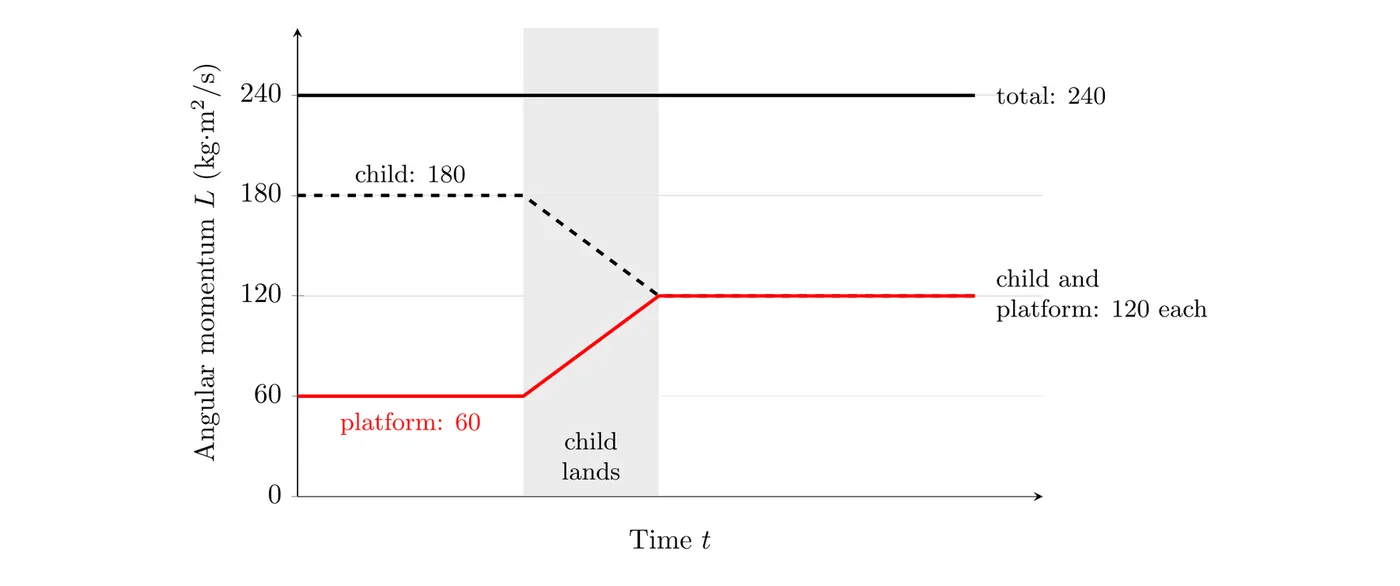
(b) The platform goes from 60 to kg·m²/s, a gain of 60 kg·m²/s. The child goes from 180 to kg·m²/s, a loss of 60 kg·m²/s. Friction between the child’s feet and the platform gives them equal and opposite angular impulses, so the total stays at 240 kg·m²/s:
(c) Before: J. After: J. So 30 J (20%) becomes thermal energy and sound as the child’s feet skid to a stop on the platform.
(d) Now there’s an external torque, so the system’s angular momentum isn’t constant: the pivot transfers it to the Earth. The angular impulse from friction has to remove all 240 kg·m²/s:
Problem-Solving Strategy
Step 1: Define the system
- What objects are in play?
- Are there any external torques?
Step 2: Check whether the system’s angular momentum is constant
- Is the net external torque zero?
- If it is, use .
Step 3: Write the initial angular momentum
- For each rotating object: .
- For each object moving in a straight line: .
- Add up all the contributions.
Step 4: Write the final angular momentum
- Think about how changed (things combining, spreading out, and so on).
- Use the same formulas for each piece.
- Often everything ends up moving together at one .
Step 5: Set them equal and solve
Step 6: Check your answer
- Right units?
- Physically reasonable?
- Do the limiting cases work?
Units Check
Angular momentum is in kg·m²/s.
From :
From :
Both agree. ✓
Summary of Key Principles
Concept | Equation | When It Applies |
Conservation | Net external torque is zero | |
Total L (system) | Add up all the components | |
Rotating object | Object spinning about an axis | |
Moving particle | Linear motion about a point | |
Not constant (transferred) | External torque present |
Common Mistakes
- Forgetting the platform’s initial angular momentum. In Physics C, the platform might already be spinning. Include in your initial angular momentum, not just the from the person.
- Wrong formula for the person’s rotational inertia. Once they’re on the platform, they’re a point mass at distance : , not .
- Adding velocities instead of angular momenta. Don’t just add and together. Convert to angular momentum first: .
- Assuming kinetic energy is conserved. Angular momentum is conserved in these collisions, but kinetic energy usually drops. Don’t set unless the problem explicitly says it’s elastic.
- Not noticing external torques. Friction at the pivot, air resistance, or other external forces can supply an external torque, which transfers angular momentum into or out of the system. Only set when you’re told friction is negligible.
- Wrong sign for angular momentum. Pick a sign convention and stick with it. If the person runs counterclockwise and the platform spins counterclockwise, both contributions are positive.
- Confusing the platform’s radius with an orbital distance. In planetary motion, changes as you move around the orbit. In platform problems, is usually a fixed value, the platform’s radius.
- Thinking the figure skater breaks energy conservation. The energy goes up when they pull their arms in because they’re doing work. Nothing is violated, energy is just being added.
- Skipping the limiting cases. Check yourself: if (platform at rest), does your answer collapse to ? If not, something’s off.
- Adding rotational inertias wrong. Total is just the plain sum: . Don’t multiply or do anything else to them.
- Mixing up the before and after states. Label “before” (initial) and “after” (final) clearly so you don’t lose track of which is which.
- Forgetting that L is constant in elliptical orbits. Even though and both change, stays constant, as long as there’s no external torque. At the closest and farthest points, , so .
- Using the wrong distance for the linear angular momentum. In , the distance runs from the axis or point to the particle, perpendicular to its velocity.
- Assuming everything ends up at the same final ω. That’s only true if the objects stick together or get connected. If they stay separate, they can end up with different angular velocities.
- Skipping the units check. Always verify: angular momentum should come out in kg·m²/s. If you get kg·m/s, something went wrong (N·m·s is fine, since it equals kg·m²/s).