

1.3 - Comparative Advantage and Gains from Trade
The Benefits of Trade and Specialization
Trade is basically why people today are richer than almost anyone throughout human history. Without it, people would spend all their time and energy just surviving, feeding, and clothing themselves. Trade lets people specialize in what they’re good at, or even enjoy doing, then trade their labor (or the money from it) for goods made by others. The overall benefit from specializing and trading is called gains from trade.
Absolute Advantage vs. Comparative Advantage
- Absolute Advantage (AA): producing more of a good using the same resources than anyone else, basically being the best or fastest producer.
- Comparative Advantage (CA): producing something at a lower opportunity cost than someone else.
Here’s the key idea: even if one country has the absolute advantage in both goods, both sides can still gain from specializing and trading based on comparative advantage.
Calculating Advantage for Output Questions
Output questions tell you how much of a good can be produced.
- Absolute advantage: whoever produces more has the AA.
- Comparative advantage (opportunity cost): set up a ratio using the acronym “Other Over” (O/O). To find the cost of Good A, divide the max amount of Good B by the max amount of Good A. Whoever has the lower opportunity cost has the comparative advantage.
- Reciprocity: for each country, the opportunity cost of making one good is just the reciprocal of the opportunity cost of making the other.
- Uniqueness: each country will have the comparative advantage in only one of the two goods, unless the opportunity costs happen to be identical, which is rare.
- Reading PPCs instead of a table: the two ends of a country’s PPC show the most of each good it can make, so treat those numbers just like an output table. For a straight-line PPC, the slope (ignoring the minus sign) is the opportunity cost of the good on the horizontal axis, measured in the good on the vertical axis.
Specialization and Terms of Trade
Each country should specialize in whatever good gives it the comparative advantage. For trade to actually be mutually beneficial, the terms of trade need to be set so each side gives up less than they would if they made the other good themselves. That means the terms of trade have to fall somewhere between the two countries’ opportunity costs.
When both countries specialize and trade at terms like these, each one ends up consuming a combination beyond its own PPC, something it could never reach on its own. A country’s PPC limits what it can produce, but trade lets it consume more than that. That’s what gains from trade really means.
Worked Example: Output Question
Country A and Country B can each make corn or shirts. The table shows the most each country can make of each good if it uses all of its resources on that good.
Country | Corn | Shirts |
Country A | 60 | 30 |
Country B | 25 | 25 |
- Absolute advantage: Country A can make more of both goods (60 vs. 25 corn, 30 vs. 25 shirts), so A has the absolute advantage in both.
- Opportunity costs (Other Over): for Country A, 1 corn costs shirts, and 1 shirt costs corn. For Country B, 1 corn costs shirt, and 1 shirt costs 1 corn.
- Comparative advantage: A gives up less to make corn (0.5 shirts vs. 1 shirt), so A has the comparative advantage in corn. B gives up less to make shirts (1 corn vs. 2 corn), so B has the comparative advantage in shirts, even though A is better at making both.
- Specialize: A makes only corn (60), and B makes only shirts (25).
- Terms of trade: the price of 1 shirt has to land between the two opportunity costs, 1 corn and 2 corn. Say they agree on 1 shirt for 1.5 corn. B gets 1.5 corn for each shirt, more than the 1 corn it gives up to make one. A pays 1.5 corn per shirt, less than the 2 corn it would give up to make one itself. Both come out ahead.
- Trade: B sends 20 shirts to A, and A sends back corn.
Country | Before trade (each makes both goods) | After specializing and trading |
Country A | 20 corn and 20 shirts | 30 corn and 20 shirts |
Country B | 20 corn and 5 shirts | 30 corn and 5 shirts |
Each country keeps the same number of shirts and ends up with 10 more corn. Neither new combination was possible alone: making 20 shirts leaves Country A only enough resources for 20 corn, and making 5 shirts leaves Country B only enough for 20 corn. Trade puts both countries beyond their PPCs.
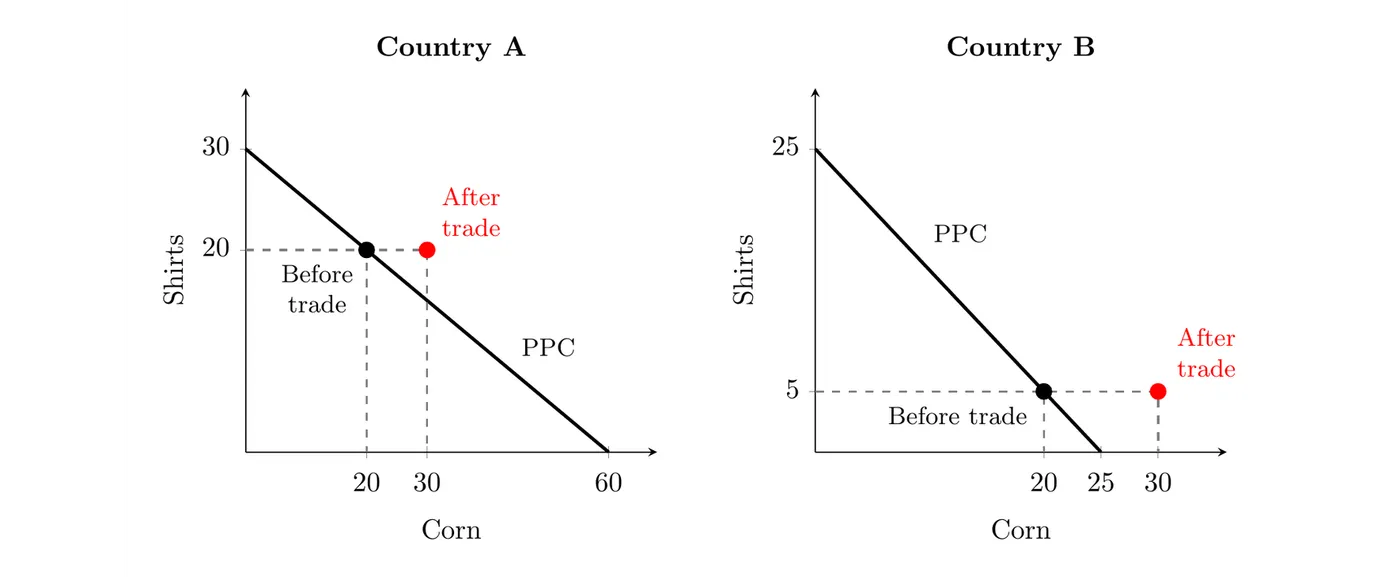
Testing terms of trade: a deal only works if it lands between the two opportunity costs. At 1 shirt for 3 corn, A would say no, since it can make a shirt itself for just 2 corn. At 1 shirt for 0.8 corn, B would say no, since making a shirt already costs it 1 corn.
Input Questions
Input questions measure resources used, often how long something takes to make.
- Absolute advantage: whoever uses fewer resources has the AA.
- Comparative advantage: use the acronym “Other Under” (I/O/U) to set up the ratio.
- How Other Under works: to find the opportunity cost of a good, put that good’s time on top and the other good’s time underneath. If a worker needs 4 hours to make a bike and 2 hours to make a radio, the 4 hours spent on one bike could have made 2 radios instead, so one bike costs radios.
Once you’ve calculated the opportunity costs, figuring out comparative advantage, specialization, and trade terms works exactly like it does for output questions.
Example: the table shows how many hours a worker in each country needs to make one bike or one radio.
Hours to make one | Bike | Radio |
Country C | 4 | 2 |
Country D | 6 | 6 |
- Absolute advantage: Country C needs fewer hours for both goods, so C has the absolute advantage in both. With input data, the smaller number wins.
- Opportunity costs (Other Under): for C, 1 bike costs radios, and 1 radio costs bikes. For D, 1 bike costs radio, and 1 radio costs 1 bike.
- Comparative advantage: D has it in bikes (1 radio vs. 2 radios), and C has it in radios (0.5 bikes vs. 1 bike).
- Specialization and terms of trade: D makes bikes, C makes radios, and 1 bike has to trade for somewhere between 1 and 2 radios (for example, 1 bike for 1.5 radios).
Takeaway
Trade, powered by specialization, is the foundation of modern wealth. What determines what to specialize in isn’t who’s the best (absolute advantage), it’s who has the lower opportunity cost (comparative advantage). Calculating that opportunity cost depends on whether you’re given output data (“Other Over”) or input data (“Other Under”). Specializing by comparative advantage guarantees both sides can find mutually beneficial trade terms somewhere between their two opportunity costs.