

1.4 - Demand
Markets and Incentives
Supply and demand are often called the two-headed monster of economics. A market brings buyers and sellers together, and it can be physical or digital. A solid system of property rights is essential for markets to work, since people need confidence that what they make or buy is actually theirs. People respond to incentives, which can be monetary or non-monetary, like laws, regulations, and prices. If prices jump dramatically, people are pushed to find a substitute or just buy less.
Defining Demand and the Law of Demand
Demand is the willingness and ability to buy a good or service, meaning you need both the desire for it and the money to actually buy it. The Law of Demand says price and quantity demanded move in opposite directions: as price rises, quantity demanded falls, and as price falls, quantity demanded rises. This makes intuitive sense since people generally like lower prices.
Three things explain why quantity demanded falls when the price rises:
- Substitution effect: a higher price makes the good more expensive compared to other goods, so people switch to substitutes.
- Income effect: a higher price means the same income buys less (purchasing power falls), so people can’t afford as much of the good.
- Diminishing marginal utility: each extra unit gives a little less satisfaction than the one before, so people will only buy more if the price drops.
Illustrating Demand
Demand can be shown two ways:
- Demand schedule: a table showing quantity demanded at different prices. An individual schedule shows quantity demanded rising as price falls. A market demand schedule adds up everyone’s preferences, and the Law of Demand still holds.
- Demand curve: a graph with price on the vertical axis and quantity on the horizontal axis. It slopes downward.
Change in Quantity Demanded vs. Change in Demand
A change in quantity demanded only happens because of a change in the price of the good itself. This causes movement along the existing demand curve: moving up when price rises and quantity demanded falls, moving down when price falls and quantity demanded rises. A price change never changes demand itself, only the quantity demanded.
Determinants of Demand (TRIBE)
A change in demand means the whole curve shifts, because something besides the good’s own price changed. Remember the five reasons with the mnemonic TRIBE:
- Tastes and preferences: if something becomes more popular, demand increases.
- Related goods (price of): covers substitutes and complements.
- Substitutes are goods people see as similar (like Sprite and 7up). If the price of one rises, demand for its substitute increases.
- Complements are goods used together (like a console and its games). If the price of one falls, demand for the other rises.
- Income: depends on the type of good.
- Normal goods: demand rises when income rises (true for most goods).
- Inferior goods: demand falls when income rises (like generic brands).
- Buyers (number of): more buyers means more demand, fewer buyers means less.
- Expectations (future prices): if people expect a price to rise later, demand today goes up. If they expect it to drop soon, demand today goes down.
Graphing a Change in Demand
An increase in demand shifts the curve right. A decrease shifts it left. Just remember: increase right, decrease left.
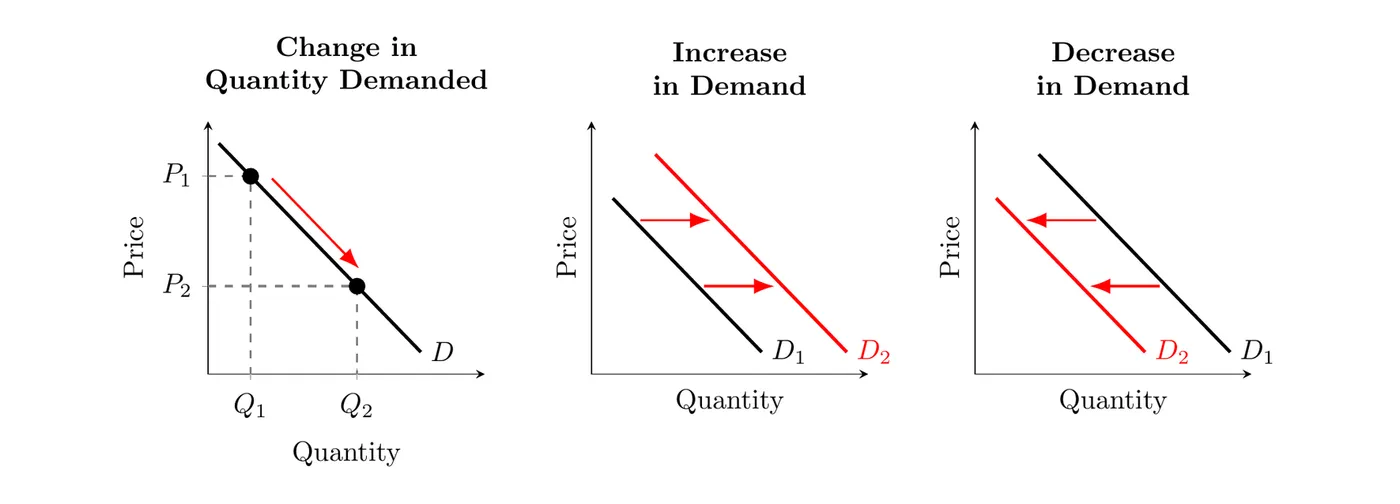
For example, if the price of pizza falls, people buy more pizza: that’s a movement down along the pizza demand curve (a change in quantity demanded). If the price of tacos (a substitute) falls, people buy fewer pizzas at every price: the whole pizza demand curve shifts left (a decrease in demand).
Takeaway
Demand is a consumer’s willingness and ability to buy something, and the Law of Demand says price and quantity demanded move inversely. Only a change in the good’s own price causes movement along the curve (a change in quantity demanded). But the five TRIBE factors (tastes, related goods, income, buyers, expectations) shift the entire curve, representing a true increase or decrease in demand even when the price stays the same.