

1.5 - Supply
Defining Supply and the Law of Supply
Supply can feel less intuitive than demand since most of us have more experience buying than selling. To understand it, think like a seller. Supply is the ability and willingness to sell a good or service, and sellers generally prefer high prices. The Law of Supply says there’s a positive relationship between price and quantity supplied: as price rises, quantity supplied rises too, and as price falls, quantity supplied falls. The supply curve’s whole job is to show what sellers are willing and able to sell.
Why does the supply curve slope upward? A higher price makes each unit more profitable, so sellers want to make and sell more. Each extra unit also costs more to make than the last one (paying overtime, running machines harder, using resources that aren’t as well suited to the job), so sellers will only produce those extra units if the price is high enough to cover the extra cost.
Illustrating Supply
A supply schedule is a table showing quantity supplied at each price, and it shows that positive relationship. The resulting supply curve slopes upward.
Change in Quantity Supplied vs. Change in Supply
A change in quantity supplied happens only because of a price change, and it causes movement along the existing curve. A change in supply means the entire curve shifts because of some factor other than the good’s own price.
Determinants of Supply (TIGERS)
Remember the six shifters with the acronym TIGERS:
- Technology: better technology increases supply (shifts right); destroyed technology, like from war, decreases it.
- Inputs (costs): includes resources and wages. Higher input costs decrease supply; lower costs increase it.
- Government policies: taxes and subsidies.
- Taxes raise production costs and decrease supply (shift left).
- Subsidies lower the effective cost and increase supply.
- Expectations (future prices): if sellers expect prices to rise later, they hold back today, decreasing supply. If they expect prices to fall soon, they sell now, increasing supply.
- Related goods (price of): viewed from the seller’s side.
- Substitutes in production are goods made with the same inputs (like leather belts and purses). If the price of one rises, producers shift resources toward it, decreasing supply of the other.
- Complements in production, or byproducts, means making more of one good increases supply of the other (like beef and leather). More beef production means more leather as a side effect.
- Sellers (number of): more sellers entering a market increases supply; sellers leaving decreases it.
Graphing a Change in Supply
An increase in supply shifts the curve right, a decrease shifts it left. Same rule as demand: increase right, decrease left. It’s best to think in terms of right or left rather than up or down, to avoid confusion.
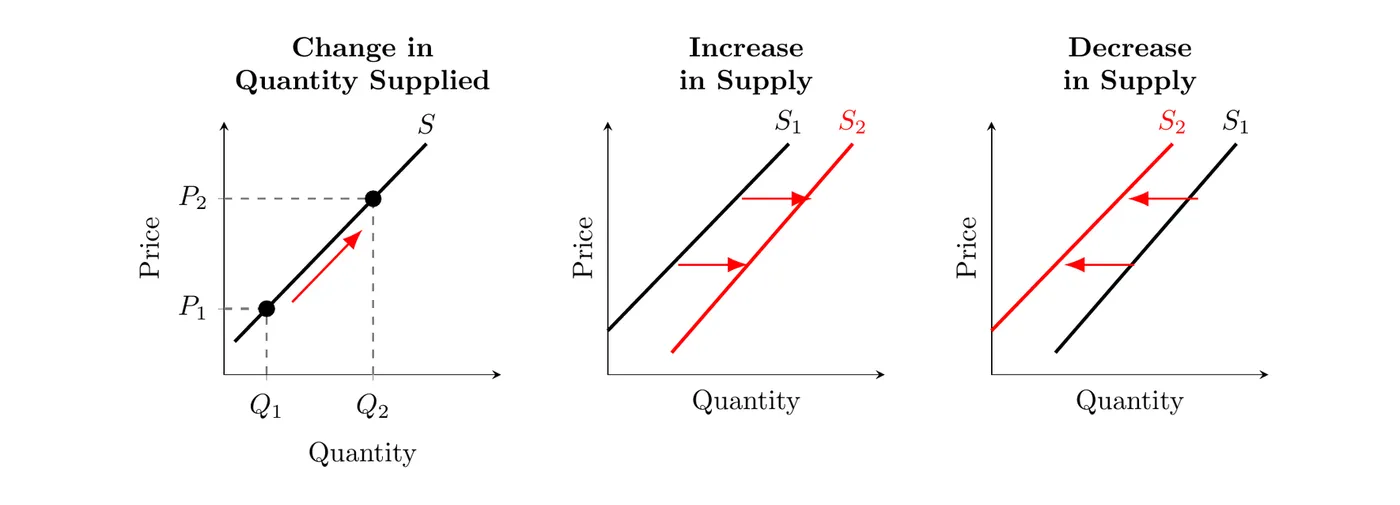
For example, if the price of lattes rises, coffee shops sell more lattes: that’s a movement up along the latte supply curve (a change in quantity supplied). If the price of coffee beans (an input) rises, coffee shops supply fewer lattes at every price: the whole latte supply curve shifts left (a decrease in supply).
Takeaway
Supply reflects a seller’s willingness and ability to sell, and the Law of Supply describes a positive relationship between price and quantity supplied, giving an upward-sloping curve. A price change moves you along the curve (changing only quantity supplied), while the six TIGERS factors (technology, input costs, government policy, expectations, related goods, and number of sellers) shift the whole curve right or left.