

5.2 - The Phillips Curve
Setup
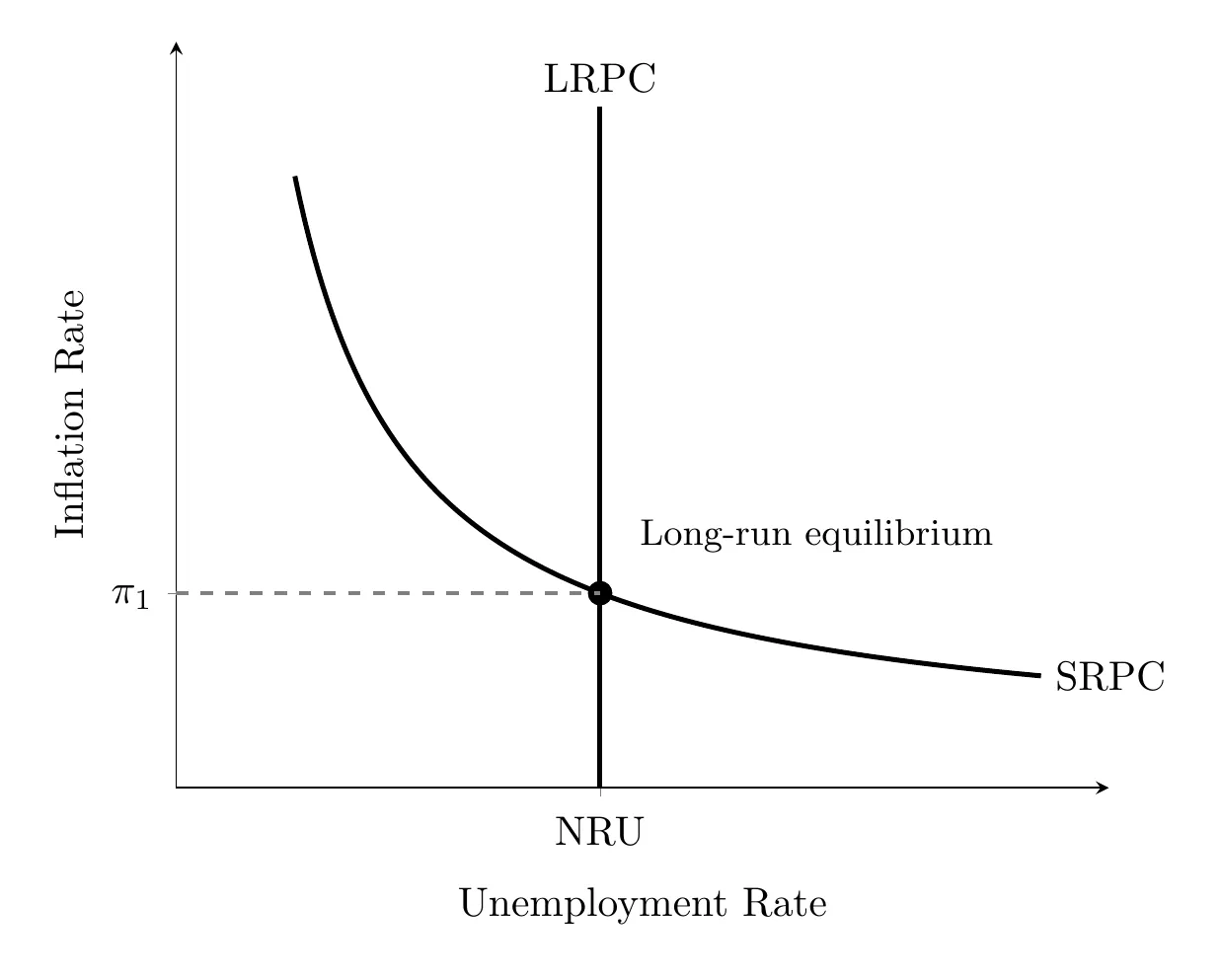
The Phillips curve tells the same story as AD-AS, just with different axes: inflation rate on the vertical axis (matching the price level), and unemployment rate on the horizontal axis (inversely related to real GDP).
Short-Run Phillips Curve (SRPC)
The SRPC slopes downward, showing a short-run trade-off between inflation and unemployment. A movement along the SRPC is the same thing as a shift of the AD curve:
- Expansionary policy (AD right) moves you up the SRPC: higher inflation, lower unemployment.
- Contractionary policy (AD left) moves you down the SRPC.
The economy is always operating somewhere on its current SRPC. Policy isn’t the only thing that moves it there: any demand shock (a change in consumer or business confidence, government spending, net exports, or the money supply) moves the economy along the SRPC, trading higher inflation for lower unemployment or the reverse.
Long-Run Phillips Curve (LRPC)
The LRPC is vertical, meaning there’s no trade-off in the long run. It sits at the natural rate of unemployment (NRU), where the economy has no cyclical unemployment.
Long-run equilibrium happens where SRPC crosses LRPC, and at that point actual inflation equals expected inflation.
- Inflationary gap: equilibrium sits left of the LRPC (unemployment below NRU); actual inflation exceeds expected inflation.
- Recessionary gap: equilibrium sits right of the LRPC; actual inflation is below expected inflation.
The LRPC only shifts if the natural rate of unemployment itself changes, say from an aging population or policy changes around minimum wage or unemployment benefits.
- LRPC shifts right (NRU rises): more frictional or structural unemployment, like more generous unemployment benefits that let people search longer, or workers’ skills no longer matching the jobs available.
- LRPC shifts left (NRU falls): less frictional or structural unemployment, like better job-search websites that match workers to jobs faster, or job training programs.
Nothing else moves the LRPC. Changes in AD, supply shocks, and inflation expectations only affect the SRPC.
How the SRPC Shifts (Long-Run Self-Correction)
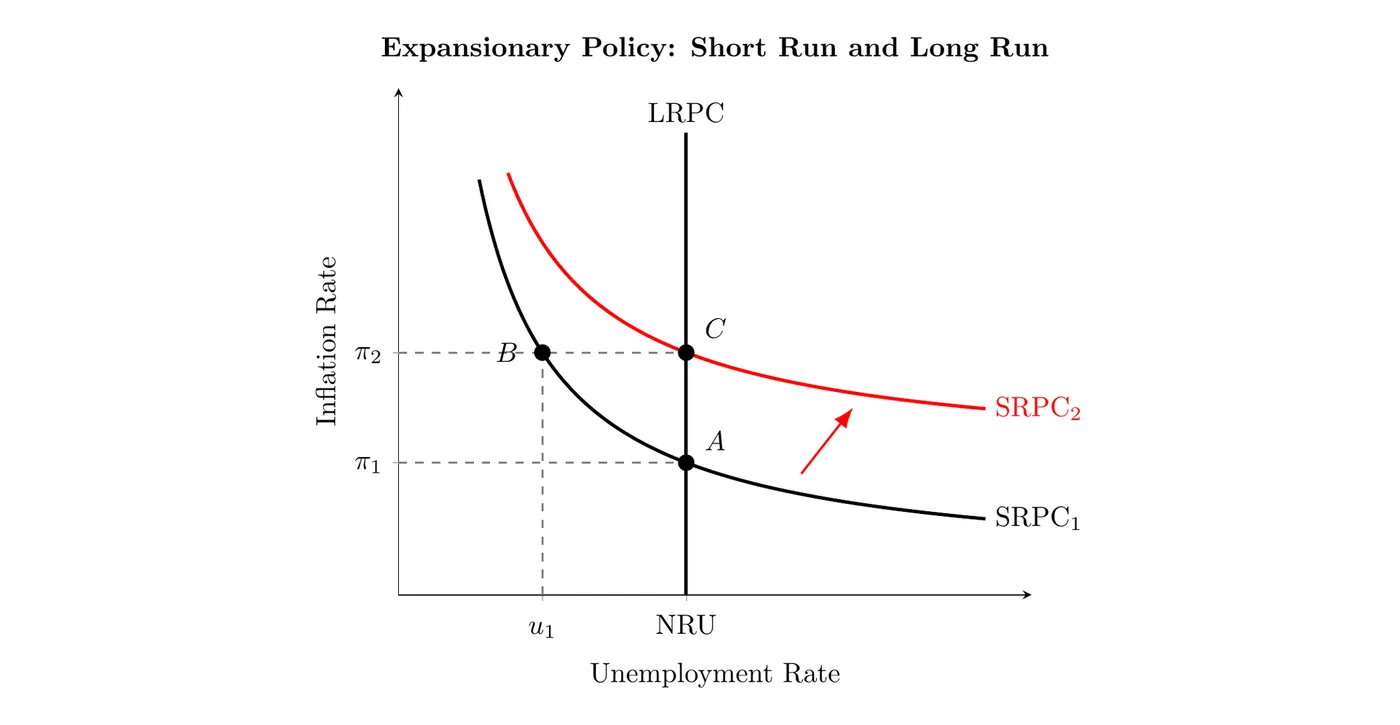
- Expansionary policy pushes the economy into an inflationary gap.
- People notice actual inflation is running higher than they expected.
- Workers demand higher wages to keep up.
- This raises expected inflation, shifting the whole SRPC right.
- The economy settles back at the natural rate of unemployment, but now at a permanently higher inflation rate.
On the graph: the economy starts in long-run equilibrium at A. Expansionary policy moves it up along to B, where inflation rises from to and unemployment falls below the NRU to . Once people expect inflation of , the curve shifts to , and the economy ends up at C: back at the NRU, but with inflation stuck at .
NAIRU
The natural rate of unemployment is also known as the Non-Accelerating Inflation Rate of Unemployment (NAIRU): the unemployment rate at which inflation holds steady instead of speeding up. If policymakers keep trying to push unemployment below the natural rate, all they get is accelerating inflation. Repeated expansionary policy makes people’s expectations adjust faster and faster, until the policy stops working in the short run at all and just fuels ever-faster inflation.
SRAS and SRPC Connection
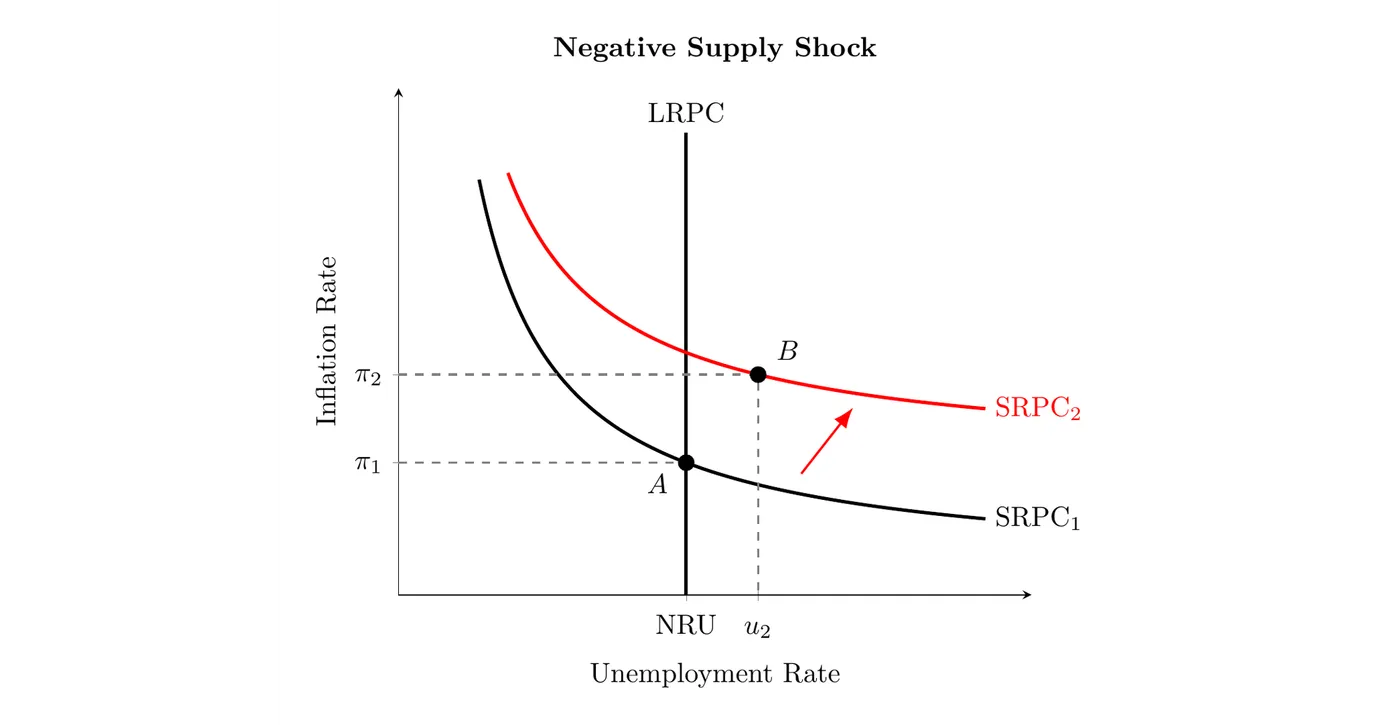
The same things that shift SRAS also shift the SRPC, just in opposite directions. If SRAS shifts left (like during a negative supply shock or stagflation), that’s the same as the SRPC shifting right, meaning it now takes higher inflation to hold any given unemployment rate.
On the graph, a negative supply shock (like a sudden jump in oil prices) shifts the curve from to . The economy moves from A to B: inflation rises from to and unemployment rises above the NRU to , both at once. That’s stagflation. The LRPC doesn’t move, since the natural rate itself hasn’t changed.
It works the other way too. A positive supply shock (like a drop in oil prices or a jump in productivity) shifts SRAS right and the SRPC left, so the economy can get lower inflation and lower unemployment at the same time.
Quick rule: demand shocks move the economy along the SRPC, supply shocks shift the SRPC, and only a change in the natural rate of unemployment shifts the LRPC.