

5.7 - Public Policy and Economic Growth
Public Policy and the Labor Force
Public policy, regulations, tax policy, trade policy, and more, affects productivity, labor force participation, and ultimately growth.
The labor force participation rate (LFPR) is the share of the working-age population that’s either employed or actively looking for work. Discriminatory policies that make it harder for certain groups to legally work reduce participation. Ironically, an overly generous social safety net can also discourage work if it makes getting by without a job too easy, an unintended consequence worth noting.
Here’s how productivity and participation both feed into growth:
Real GDP per capita is output per worker (productivity) times the share of the population that has a job. Policies that raise productivity, like funding education or research, raise the first part. Policies that raise labor force participation, like childcare support that lets parents take jobs or laws against hiring discrimination, get more people working and raise the second part. Either way, real GDP per capita grows.
The Government’s Role in Growth
The government’s biggest contribution to growth probably comes from building human capital, education, skills, and training. Public education and subsidized college aim to raise human capital, making workers more productive.
Other roles include:
- Infrastructure: roads, bridges, electric grids, dams, ports, airports.
- Stability: political stability and protecting property rights lay the groundwork for growth.
- Trade: policies favoring free trade and limited government intervention also tend to help.
Infrastructure is public capital. Good roads, ports, power grids, and internet networks cut the time and cost of moving goods, workers, and information, so private businesses get more output from the same workers and machines. The government also invests in technology: it funds basic research (through agencies like the National Science Foundation and the National Institutes of Health), gives tax credits for research and development, and grants patents so inventors can profit from new ideas. New technology raises productivity, which shifts LRAS right.
Supply-Side Fiscal Policy
Supply-side fiscal policies are tax and spending policies meant to grow aggregate supply (not just aggregate demand) by changing the incentives to work, save, and invest.
These policies, cutting business taxes, offering investment tax credits, work by changing incentives for households and businesses so they invest more, which is the first domino in the growth process.
They also change household incentives:
- Lower income tax rates: workers keep more of each extra dollar they earn, so more people choose to work and people work more hours.
- Lower taxes on saving (like taxes on interest income or capital gains): saving pays off more, so households save more. More saving increases the supply of loanable funds, which lowers the real interest rate and encourages even more investment.
Effect on AD-AS:
- Short run: more investment spending raises AD (since ), shifting AD right.
- Long run: that investment builds new capital and technology, raising productivity and shifting AS right, which raises potential output.
On the graph, the economy starts in long-run equilibrium at A, and the government offers an investment tax credit. In the short run (left), the new investment spending shifts AD right: the economy moves to B, with real output rising from to and the price level rising from to . In the long run (right), the new capital raises potential output, so LRAS (and SRAS) shift right and the economy reaches a new long-run equilibrium at C, at the higher potential output . Here the price level ends back at , but it can end up higher or lower depending on how big each shift is.
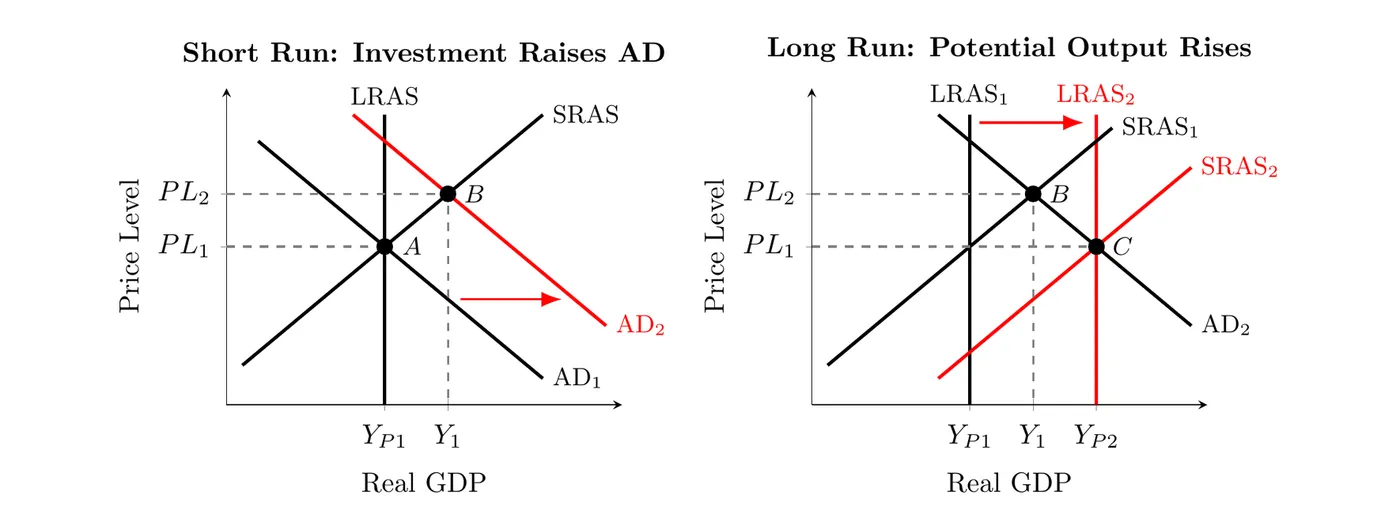
Bottom line: public policy drives long-run growth by building human capital (education) and physical capital (infrastructure, investment credits). Policies that boost investment spending have a double effect: raising AD in the short run and raising potential output (LRAS shifts right) in the long run.