

5.5 - Crowding Out
The Mechanism
Crowding out happens because the government has to borrow to cover its deficit, often through Treasury bonds (the 2021 deficit, for example, was about $3 trillion).
The supply curve in the loanable funds market represents national savings, which includes public savings (the budget balance). When the government runs a deficit, public savings turn negative, shifting the supply of loanable funds left, and that pushes the real interest rate up.
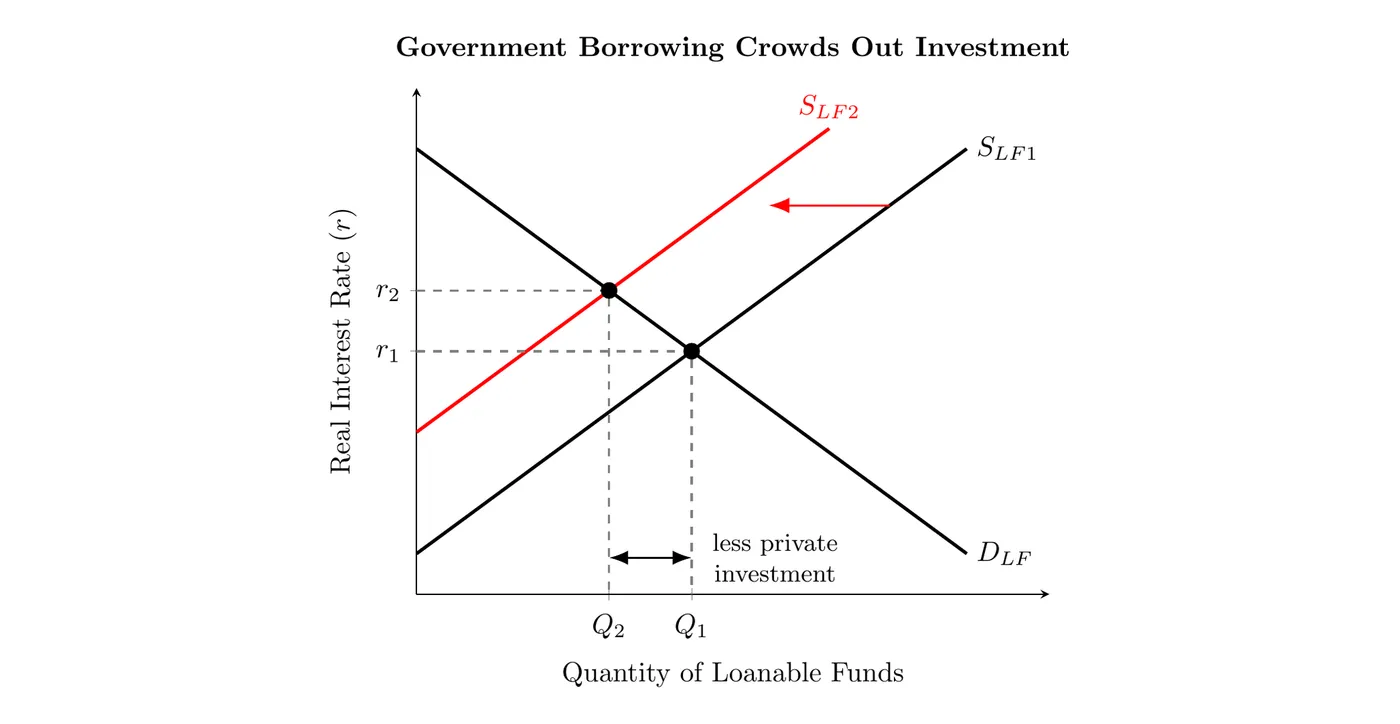
On the graph, the deficit shifts supply from to . The real interest rate rises from to , and the amount of loanable funds going to private investment falls from to .
The AP exam also accepts drawing this as the government adding to the demand for loanable funds, so demand shifts right instead (see 4.7). The total amount borrowed then goes up, but more of it goes to the government and less to private borrowers. Either way, the real interest rate rises and private investment falls.
Crowding out, then, is when increased government borrowing drives up the real interest rate, which in turn crowds out private investment spending. Businesses borrow more readily when rates are low, so when rates get pushed higher by government borrowing, some investment that would have happened simply doesn’t.
It isn’t only business investment. In the short run, crowding out hits any interest-sensitive private spending, like new homes (higher mortgage rates) and big purchases people pay for with loans, such as cars.
Consequences
- Weaker fiscal policy: expansionary fiscal policy aims to shift AD right, but since crowding out reduces investment spending, the actual AD shift ends up smaller than intended. Depending on how sensitive investment is to rates, it’s even possible the investment drop cancels out the entire intended AD increase. Monetarists like Milton Friedman argued that fiscal policy needs the Fed to expand the money supply alongside it, or its impact will be much weaker.
- Slower long-run growth: investment spending (new machines, technology, tools, construction) is the primary engine of economic growth. If crowding out reduces investment, capital accumulation slows, and long-run growth suffers as a result.
Bottom line: government deficits force borrowing, which shifts loanable funds supply left and raises real interest rates. This crowding out effect reduces private investment, weakening fiscal policy and slowing long-run economic growth.