

5.3 - Money Growth and Inflation
Monetary Neutrality
Milton Friedman famously argued that inflation is always and everywhere a monetary phenomenon, caused by the money supply growing faster than output.
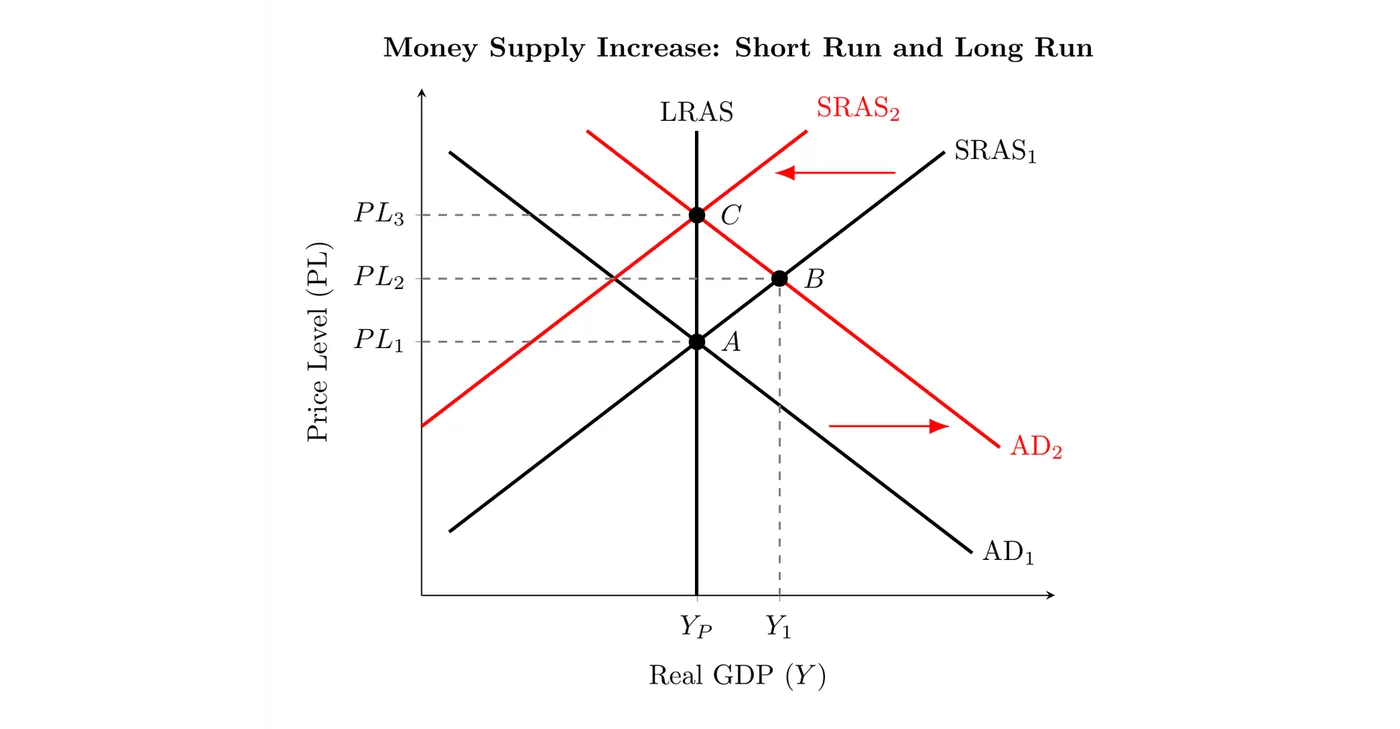
- Short run: expansionary monetary policy shifts money supply right, lowers the nominal rate, boosts investment and spending, and shifts AD right, which can raise real output in the short run.
- Keynesians vs. classical/monetarist economists: Keynesians focus on that short-run boost (“in the long run we are all dead”), while classical and monetarist thinkers emphasize the long run.
- Long-run adjustment: eventually sticky wages become flexible and rise, shifting SRAS left and bringing the economy back to long-run equilibrium.
- Monetary neutrality: once you’re back at full employment, changes in the money supply don’t affect real output anymore, they only affect nominal variables.
On the AD-AS graph, the economy starts in long-run equilibrium at A. The money supply increases, so AD shifts right and the economy moves to B: real output rises above potential () and the price level rises to . Over time, nominal wages rise, SRAS shifts left, and the economy ends at C: back at , with an even higher price level, . In the long run the extra money changed nothing real. It only raised prices.
The Quantity Theory of Money
This theory highlights the positive relationship between the money supply and the price level, especially over the long run. It’s captured by the velocity equation:
- = money supply
- = velocity of money (how many times the average dollar gets spent per year)
- = price level
- = real GDP
The right side () equals nominal GDP, so the left side () does too, representing total spending.
If velocity () stays stable, and since money supply changes don’t affect real GDP in the long run, an increase in the money supply translates directly into a proportional increase in the price level. A 10% rise in leads to a 10% rise in . Since and move together, the real quantity of money () stays unchanged in the long run.
Using the equation: rearrange to solve for whatever is missing.
- Velocity: , nominal GDP divided by the money supply. If nominal GDP is $20 trillion and the money supply is $4 trillion, , so the average dollar is spent 5 times a year.
- Price level: . With = $4 trillion, , and real GDP of $10 trillion, .
- Real output: . With = $4 trillion, , and , , so real GDP is $10 trillion.
- Money supply: . With , real GDP of $10 trillion, and , , so the money supply is $4 trillion.
Now say the money supply rises 10%, to $4.4 trillion. In the long run stays at 5 and real GDP stays at $10 trillion (potential output), so : a 10% rise in the price level, matching the 10% rise in .
Deflation and Disinflation
Inflation happens when the central bank grows the money supply faster than output grows. If and grow at the same rate (with stable ), there’s no inflation at all.
A one-time increase in raises the price level once. Inflation that keeps going year after year comes from the money supply growing too fast year after year. In growth rates, the quantity theory becomes (approximately):
With stable velocity (), the inflation rate () is about the growth rate of the money supply minus the growth rate of real GDP. If the money supply grows 7% a year and real GDP grows 3% a year, inflation runs about 4% a year. That’s why, in the long run, the growth rate of the money supply sets the inflation rate.
Deflation results from shrinking the money supply too aggressively for too long, and it can be genuinely harmful. During the Great Depression, the U.S. money supply fell by about a third and consumer prices fell about 25% from 1929 to 1933.
Disinflation is the process of bringing inflation back down. It works through the Phillips curve:
- Contractionary policy moves you down the SRPC to lower inflation and higher unemployment.
- People eventually adjust their inflation expectations downward.
- This shifts the SRPC left, achieving disinflation.
The biggest hurdle is convincing people the central bank will actually stick with its contractionary stance. If people believe it, disinflation can happen fast.
Bottom line: in the long run, the money supply determines the price level, this is the Quantity Theory of Money. Since monetary policy can’t permanently move real variables like output or employment, any short-run boost eventually gets erased by inflation.