

1.1 - Scarcity
1.1 Scarcity
The big idea here is scarcity: the fundamental problem in economics. It’s essential to know the four factors of production that go into making goods and services, and to understand how limited resources force us into trade-offs.
What scarcity actually means
Scarcity is simply the inability of limited resources to satisfy unlimited human wants. Something counts as scarce if there’s less of it available than people actually want. You can usually spot scarce items because they carry a positive price and involve an opportunity cost, meaning you have to give something up to get them.
Not everything is scarce though. Things like trash have a negative price (someone pays you to take it away), things like air are available in amounts that exceed what people need, and things like non-rival knowledge don’t run out when one person uses them.
The four factors of production
Every good or service needs these four ingredients:
- Land: natural resources, basically gifts from nature like minerals, soil, rain, and sunlight
- Labor: the mental or physical work people put in
- Physical capital: human-made tools used to produce other things, anything from scissors to industrial robots
- Entrepreneurship: the people who take on risk to combine land, labor, and capital into a product, chasing profit
Economists also call these four resources or inputs. Most of them are scarce: there’s only so much land, labor, and capital to go around. The big exception is established knowledge, like a recipe or the Pythagorean theorem. Knowledge is non-rival, meaning one person using it doesn’t leave any less for anyone else. Millions of people can use the same formula at the same time and it never runs out, so it may not be scarce the way land, labor, and capital are.
One common trap: money is not capital in economics. Cash, stocks, and bonds are financial assets. They can buy capital, but capital itself means the real tools, machines, and buildings used to make other goods.
Trade-offs
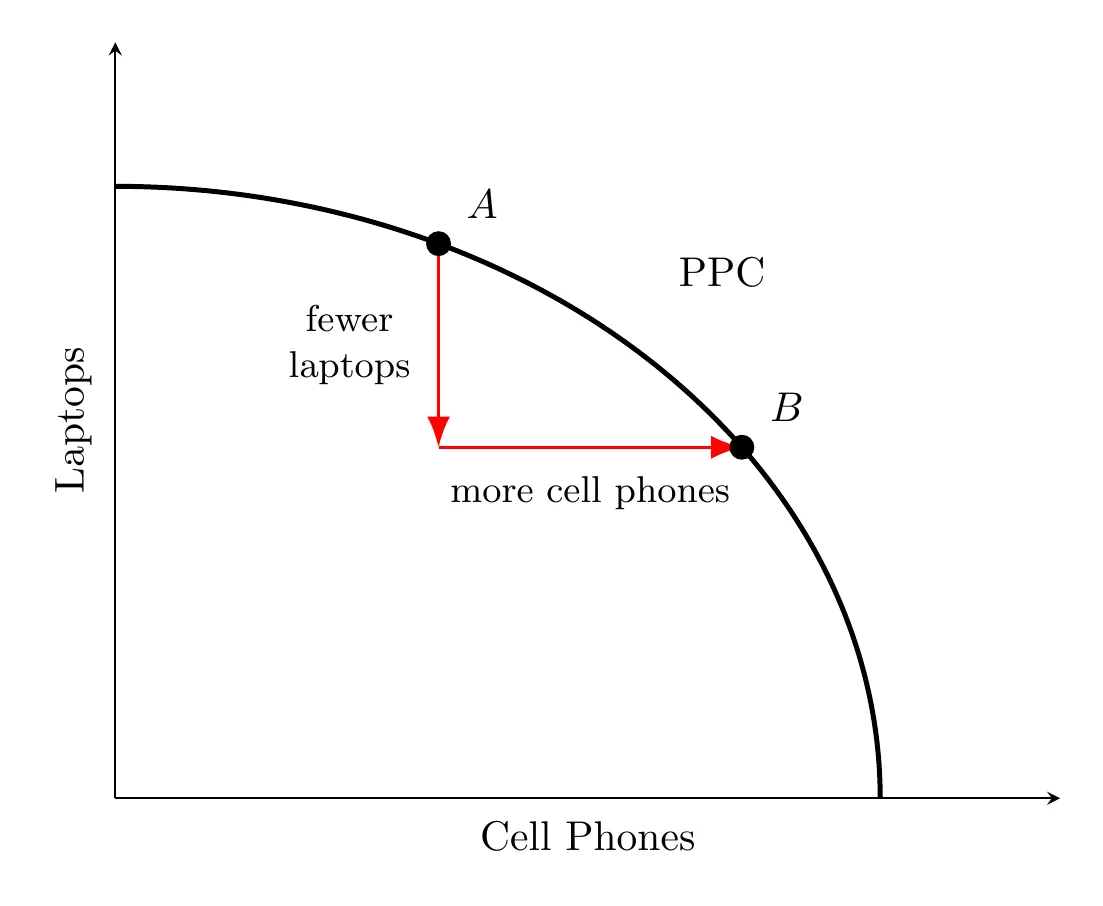
Because resources are scarce, every choice comes with a trade-off. If you play video games instead of doing yard work, you’re trading time for time. If Apple puts more resources into laptops, it has fewer resources left for phones.
Scarcity vs. shortage
People mix these up a lot, but they’re different things:
- Scarcity is permanent: there just aren’t enough resources to satisfy everyone’s wants.
- Shortage is a market condition where quantity supplied falls short of quantity demanded at the current price. This usually pushes the price up or the item disappears from shelves.
Takeaway
Economics is really the study of how society deals with limited resources against unlimited wants. Since land, labor, capital, and entrepreneurship are all finite, everything we produce has a cost attached. Scarcity is the permanent condition that forces hard choices. A shortage, by contrast, is temporary and can be fixed by adjusting prices.
Analogy: Scarcity is like only having 24 hours in a day. No matter how you plan, you can’t do everything. A shortage is more like your phone dying right now because you forgot to charge it. You can fix it by charging up later, but you’ll still only ever have 24 hours in a day.