

1.5 - Cost-Benefit Analysis
Here we define opportunity cost as the value of the next best alternative you gave up, split costs into explicit (out-of-pocket) and implicit (lost opportunities), and learn to combine them into total opportunity cost. We also cover cost-benefit analysis and when a choice actually makes sense.
Opportunity cost, the core idea
In economics, “cost” basically always means opportunity cost. Every choice involves giving something up because time and money are finite.
TINSTAAFL is a fun acronym worth knowing: “There Is No Such Thing As A Free Lunch.” Nothing is truly free, because every action uses up time or resources that could’ve gone somewhere else.
Explicit vs. implicit costs
- Explicit costs: direct payments, like $100 for a certification course or $50 for a concert ticket.
- Implicit costs: non-monetary costs like time or lost earnings. If you spend four hours at a concert instead of working a side job that pays $20 an hour, your implicit cost is $80.
- Total opportunity cost: explicit plus implicit. In the concert example, that’s $130 ($50 ticket plus $80 in lost wages).
What doesn’t count as opportunity cost
- Sunk costs: money (or time) already spent that you can’t get back. You’ve paid it no matter what you choose next, so it isn’t part of the opportunity cost. If you already paid $10 for a daily train pass, that fare isn’t part of the opportunity cost of picking the museum over work, because it’s gone either way.
- Third-best alternatives: only your next best option counts. If you’re choosing between A, B, and C, and you pick A, your opportunity cost is just the value of B, not C.
Opportunity cost on the PPC
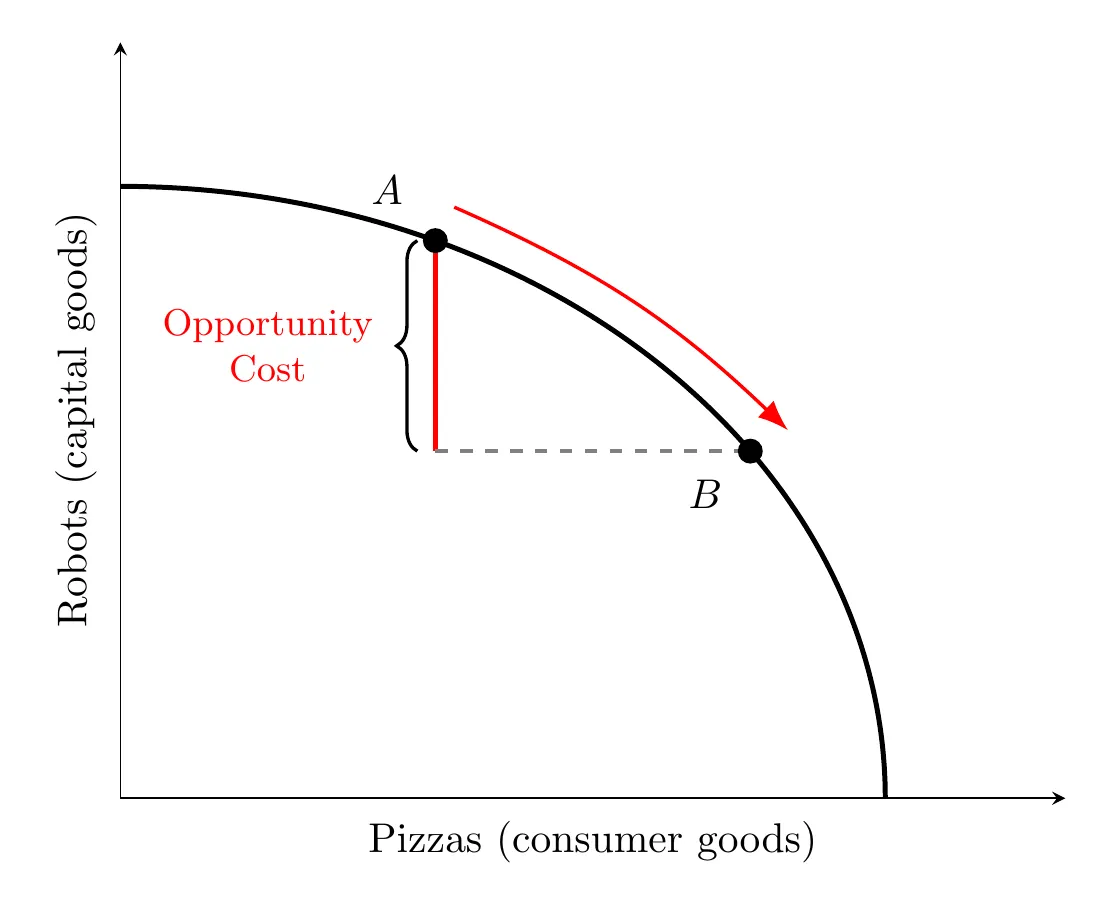
Moving from one point on the PPC to another means gaining one good while sacrificing the other. If shifting production gains you 50 units of consumer goods but costs 20 units of capital goods, those 20 units are your opportunity cost.
Cost-benefit analysis
Economists assume people are rational: they weigh the benefits of each option against all of its costs, explicit and implicit, and pick the one that leaves them best off.
Total net benefit is total benefit minus total cost (explicit plus implicit). A rational choice only happens when total benefits exceed total costs.
If a city builds a library for $2 million but it delivers $3 million in social value, that’s rational: a $1 million net gain. But buying a $15 lunch you only value at $10 is irrational: a $5 net loss.
What counts as a benefit
Benefits get measured differently depending on who’s deciding. For consumers, total benefit is utility, the satisfaction they get from what they buy. For firms, total benefit is total revenue, the money they take in from sales (price times quantity, ).
Finding the best choice with totals
When a choice comes in amounts (how many hours, how many units), the best amount is the one where total net benefit is the biggest. Say a food truck owner is deciding how many hours to stay open. Total benefit is the truck’s total revenue, and total cost includes both explicit costs (gas, food, a helper’s wages) and implicit costs (the owner’s time):
Hours open | Total benefit | Total cost | Total net benefit |
1 | $200 | $50 | $150 |
2 | $360 | $120 | $240 |
3 | $480 | $210 | $270 |
4 | $560 | $320 | $240 |
5 | $600 | $450 | $150 |
Net benefit peaks at 3 hours ($270), so that’s the optimal choice. Staying open 4 or 5 hours still brings in more total benefit, but costs climb faster, so net benefit falls. You’d get the same answer by comparing marginal benefit and marginal cost hour by hour (see 1.6): the 3rd hour adds $120 of benefit for $90 of cost, but the 4th adds only $80 for $110.
Total vs. marginal decisions
Some decisions can be broken into small steps, like how many hours to stay open or how many slices of pizza to eat. For those, you can just compare the marginal benefit and marginal cost of each extra unit (1.6). Other decisions are all or nothing, like whether to build a bridge, go to college, or take a job offer. You can’t build half a bridge, so you have to compare total benefits with total costs, like the library example above.
Takeaway
Every decision is a balance scale weighing what you gain against the “ghost” of what you gave up. The true price of a college degree isn’t just tuition (explicit), it’s also the years of salary you didn’t earn while studying (implicit). Cost-benefit analysis just makes sure the scale tips in your favor before you commit.